PUBLISHER: Mordor Intelligence | PRODUCT CODE: 2120319

PUBLISHER: Mordor Intelligence | PRODUCT CODE: 2120319
Cloud-based Contact Center - Market Share Analysis, Industry Trends & Statistics, Growth Forecasts (2026 - 2031)
According to Mordor Intelligence, the cloud-based contact center market size is expected to grow from USD 32.65 billion in 2025 to USD 40.35 billion in 2026 and is forecast to reach USD 116.33 billion by 2031 at 23.6% CAGR over 2026-2031.
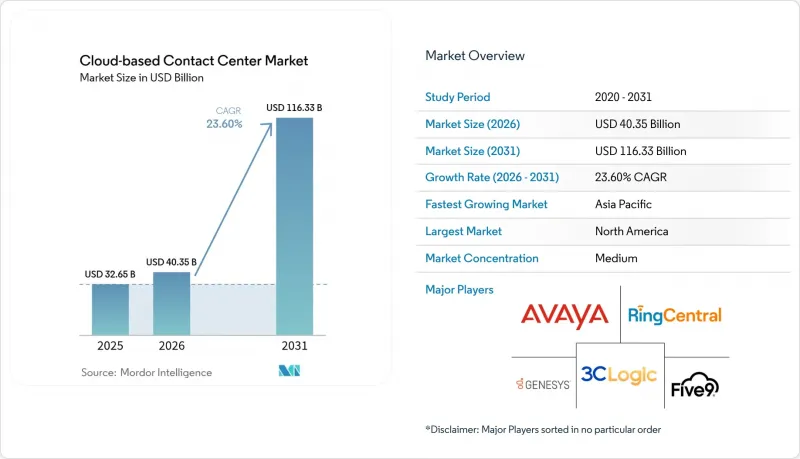
This report is Segmented by Solution Type (Automatic Call Distribution, and More), Deployment Model (Public Cloud, and More), Service (Professional Services, and More), Organisation Size (Small & Medium Enterprises, and More), End-User Industry (BFSI, IT and Telecommunications, and More), and Geography (North America, and More). The Market Forecasts are Provided in Terms of Value (USD).
Global Cloud-based Contact Center Market Trends and Insights
Rapid Shift to Omnichannel Customer Engagement
Contact volumes now begin on social channels, pivot to chat, and conclude over voice, demanding a unified agent desktop that legacy equipment cannot deliver economically. Cloud platforms integrate new channels in weeks, not quarters: Genesys Cloud added WhatsApp voice notes so agents can exchange audio messages without leaving workflow screens. Omnichannel alignment also collapses data silos, letting analytics reveal lifetime value signals in real time. Five9's Deepgram-powered speech recognition improves alphanumeric transcription accuracy two-fold, raising self-service containment and cutting transfers. Enterprises that harmonize channels convert contact centers into proactive insight engines, boosting revenue as every interaction informs personalized outreach. The trend gains urgency in APAC, where mobile-first consumers expect fluid channel hopping, spurring double-digit regional adoption.
AI-Driven Agent-Assist Use-Cases Requiring Cloud Scale
Generative AI workloads need GPUs and elastic compute that exceed on-premise budgets. AWS Connect's real-time summarization and Five9's Genius AI Suite show how cloud economics democratize deep-learning models that guide agents mid-conversation . McKinsey reports 72% of CX leaders believe AI will materially reshape operations, yet human call volumes decline slowly, pushing blended models that elevate rather than replace agents. Continuous cloud updates refresh models weekly, keeping intent detection current with slang and product launches. Financial upside is clear: automated self-service averages USD 0.10 per contact versus USD 8 for live support, freeing spend for strategic CX investments.
Cyber-security & Data-privacy Concerns
Enterprise security apprehensions regarding cloud-based contact centers stem from legitimate concerns about data exposure and regulatory compliance, particularly as customer interaction data represents high-value targets for cybercriminals and regulatory scrutiny. The implementation of zero trust architecture becomes mandatory for cloud contact center deployments, with organizations requiring comprehensive security frameworks that exceed traditional perimeter-based protection models. GDPR, TCPA, HIPAA, and PCI-DSS compliance requirements create complex security obligations that some organizations perceive as easier to manage with on-premise infrastructure, despite cloud providers' typically superior security capabilities.
Other drivers and restraints analyzed in the detailed report include:
- Lower Cap-Ex and Faster Deployment Than On-Premise
- Cyber-Security and Data-Privacy Concerns
- Complex Migration of Legacy IVR & CRM Integrations
For complete list of drivers and restraints, kindly check the Table Of Contents.
Segment Analysis
Analytics and Reporting applications are forecast to grow at an 18.1% CAGR, reflecting demand for actionable insights that elevate customer lifetime value. In 2025 Automatic Call Distribution still held a 23.80% cloud-based contact center market share, anchoring routing logic that funnels queries to the right expertise. The convergence of speech analytics, sentiment scoring, and KPI dashboards turns every interaction into a dataset that steers marketing, product, and service decisions. Five9 offers 140 pre-built reports alongside AI-generated recommendations, making enterprise-grade analytics accessible to firms with limited data staffs.
Workforce Engagement Management (WEM) adoption is accelerating as planners connect agent well-being to CX outcomes. NICE's Employee Engagement Manager automates shift bidding and performance nudges, improving retention and boosting sales by 20% among engaged teams. Integrating WEM with analytics lets supervisors predict staffing around promotional spikes or outages. Dialer tools, while still relevant for campaigns, see tempered growth as compliance caps outbound volumes. Overall, providers that unify routing, analytics, and WEM into one pane gain stickier deployments and upsell paths.
Public cloud offerings captured 51.20% of the cloud-based contact center market size in 2025 as enterprises targeted quick wins and global reach. Yet hybrid architecture, projected to expand at 21.1% CAGR, is the strategic sweet spot for regulated industries balancing sovereignty with innovation. Cisco notes 82% of enterprises now run hybrid estates, segmenting workloads by sensitivity and latency . Hybrid lets banks keep core call recording on private nodes while leveraging public regions for burst analytics, satisfying auditors without sacrificing agility.
Multi-cloud permutations add another control layer: if one provider suffers an outage, traffic reroutes seamlessly. Huawei Cloud's 106% hybrid-cloud growth in APAC illustrates regional appetite for sovereign nodes paired with global feature catalogs. Private cloud lingers for defense and critical infrastructure, but lifecycle economics increasingly favor managed hybrid stacks where vendors shoulder patching, scaling, and compliance paperwork. Decision frameworks thus pivot from blanket prohibitions to workload-by-workload placement.
Complete Report Scope:
- By Solution Type
- Automatic Call Distribution (ACD)
- Interactive Voice Response (IVR)
- Predictive / Progressive Dialers
- Computer Telephony Integration (CTI)
- Analytics and Reporting
- Workforce Engagement Management
- By Deployment Model
- Public Cloud
- Private Cloud
- Hybrid Cloud
- Multi-Cloud
- By Service
- Professional Services
- Managed Services
- Training and Support Services
- By Organization Size
- Small and Medium Enterprises ( less than 1,000 seats )
- Large Enterprises ( Greater than or equal to 1,000 seats )
- By End-User Industry
- Banking, Financial Services and Insurance
- IT and Telecommunications
- Retail and e-Commerce
- Healthcare and Life Sciences
- Logistics and Transportation
- Media and Entertainment
- Government and Public Sector
- By Geography
- North America
- United States
- Canada
- Mexico
- South America
- Brazil
- Argentina
- Rest of South America
- Europe
- United Kingdom
- Germany
- France
- Italy
- Russia
- Rest of Europe
- Asia-Pacific
- China
- Japan
- India
- South Korea
- Rest of Asia-Pacific
- Middle East and Africa
- Middle East
- Israel
- Saudi Arabia
- United Arab Emirates
- Turkey
- Rest of Middle East
- Africa
- South Africa
- Egypt
- Rest of Africa
- Middle East
- North America
Geography Analysis
North America contributed 37.80% of 2025 revenue, buoyed by mature broadband, early cloud buy-in, and proactive customer-experience budgeting. Hyperscalers operate dense regional data-center footprints, delivering sub-50 ms latency that powers real-time transcription and sentiment analytics. Market maturity means net-new logo growth slows, so providers focus on AI upsells and outcome-based renewals. Consolidation is underway as private-equity firms acquire niche CCaaS vendors to build end-to-end CX suites.
Asia-Pacific is on track for a 15.2% CAGR through 2031, propelled by smartphone ubiquity, government cloud-first edicts, and expanding fiber coverage. Five9's dual Indian data centers exemplify investments that respect data-localization rules while assuring performance. Developed markets like Japan demand advanced AI orchestration, whereas Southeast Asian SMEs prioritize cost and multilingual bots. Regional telcos partner with CCaaS providers, bundling SIP trunks, 5G slices, and CPaaS APIs to accelerate uptake among emerging digital merchants.
Europe balances opportunity with regulatory rigor. GDPR plus emerging AI-governance laws drive hybrid deployments anchored in local zones. Providers that certify ISO 27001 and offer in-region disaster recovery gain advantage. Economic headwinds push enterprises toward opex models that stretch budgets without new datacenter builds. Growth pockets exist in Central and Eastern Europe where legacy estates persist, and in public-sector digitization funds earmarked for post-pandemic citizen-service modernization. Elsewhere, Latin America, Middle East, and Africa record high double-digit adoption albeit from lower bases, paced by telecom infrastructure rollouts and fintech booms.
- Amazon Web Services (Amazon Connect)
- NICE Ltd.
- Genesys Telecommunications Laboratories Inc.
- Five9 Inc.
- Cisco Systems Inc.
- RingCentral Inc.
- 8x8 Inc.
- Avaya LLC
- Talkdesk Inc.
- Vonage Holdings Corp.
- Twilio Inc.
- Dialpad Inc.
- Content Guru Limited
- Mitel Networks Corporation
- Odigo SAS
- Aspect Software Group Ltd.
- Alvaria, Inc.
- Sprinklr Inc.
- SAP SE
- Zoom Video Communications Inc.
Additional Benefits:
- The market estimate (ME) sheet in Excel format
- 3 months of analyst support
TABLE OF CONTENTS
1 INTRODUCTION
- 1.1 Study Assumptions and Market Definition
- 1.2 Scope of the Study
2 RESEARCH METHODOLOGY
3 EXECUTIVE SUMMARY
4 MARKET LANDSCAPE
- 4.1 Market Overview
- 4.2 Market Drivers
- 4.2.1 Surge in remote and hybrid work adoption
- 4.2.2 Rapid shift to omnichannel customer engagement
- 4.2.3 Lower cap-ex and faster deployment than on-premise
- 4.2.4 AI-driven agent-assist use-cases requiring cloud scale
- 4.2.5 5G network slicing enabling ultra-low-latency CX
- 4.2.6 Industry-specific compliant CCaaS platforms emerging
- 4.3 Market Restraints
- 4.3.1 Cyber-security and data-privacy concerns
- 4.3.2 Cloud-service downtime and vendor lock-in risk
- 4.3.3 Complex migration of legacy IVR and CRM integrations
- 4.3.4 Cross-border data-sovereignty compliance burdens
- 4.4 Value Chain Analysis
- 4.5 Regulatory Landscape
- 4.6 Technological Outlook
- 4.7 Porter's Five Forces
- 4.7.1 Threat of New Entrants
- 4.7.2 Bargaining Power of Suppliers
- 4.7.3 Bargaining Power of Buyers
- 4.7.4 Threat of Substitutes
- 4.7.5 Competitive Rivalry Intensity
- 4.8 Impact of Macroeconomic Factors
- 4.9 Investment Analysis
5 MARKET SIZE AND GROWTH FORECASTS (VALUE)
- 5.1 By Solution Type
- 5.1.1 Automatic Call Distribution (ACD)
- 5.1.2 Interactive Voice Response (IVR)
- 5.1.3 Predictive / Progressive Dialers
- 5.1.4 Computer Telephony Integration (CTI)
- 5.1.5 Analytics and Reporting
- 5.1.6 Workforce Engagement Management
- 5.2 By Deployment Model
- 5.2.1 Public Cloud
- 5.2.2 Private Cloud
- 5.2.3 Hybrid Cloud
- 5.2.4 Multi-Cloud
- 5.3 By Service
- 5.3.1 Professional Services
- 5.3.2 Managed Services
- 5.3.3 Training and Support Services
- 5.4 By Organization Size
- 5.4.1 Small and Medium Enterprises ( less than 1,000 seats )
- 5.4.2 Large Enterprises ( Greater than or equal to 1,000 seats )
- 5.5 By End-User Industry
- 5.5.1 Banking, Financial Services and Insurance
- 5.5.2 IT and Telecommunications
- 5.5.3 Retail and e-Commerce
- 5.5.4 Healthcare and Life Sciences
- 5.5.5 Logistics and Transportation
- 5.5.6 Media and Entertainment
- 5.5.7 Government and Public Sector
- 5.6 By Geography
- 5.6.1 North America
- 5.6.1.1 United States
- 5.6.1.2 Canada
- 5.6.1.3 Mexico
- 5.6.2 South America
- 5.6.2.1 Brazil
- 5.6.2.2 Argentina
- 5.6.2.3 Rest of South America
- 5.6.3 Europe
- 5.6.3.1 United Kingdom
- 5.6.3.2 Germany
- 5.6.3.3 France
- 5.6.3.4 Italy
- 5.6.3.5 Russia
- 5.6.3.6 Rest of Europe
- 5.6.4 Asia-Pacific
- 5.6.4.1 China
- 5.6.4.2 Japan
- 5.6.4.3 India
- 5.6.4.4 South Korea
- 5.6.4.5 Rest of Asia-Pacific
- 5.6.5 Middle East and Africa
- 5.6.5.1 Middle East
- 5.6.5.1.1 Israel
- 5.6.5.1.2 Saudi Arabia
- 5.6.5.1.3 United Arab Emirates
- 5.6.5.1.4 Turkey
- 5.6.5.1.5 Rest of Middle East
- 5.6.5.2 Africa
- 5.6.5.2.1 South Africa
- 5.6.5.2.2 Egypt
- 5.6.5.2.3 Rest of Africa
- 5.6.5.1 Middle East
- 5.6.1 North America
6 COMPETITIVE LANDSCAPE
- 6.1 Market Concentration
- 6.2 Strategic Moves
- 6.3 Market Share Analysis
- 6.4 Company Profiles (includes Global level overview, market level overview, core segments, financials as available, strategic information, market rank/share, products and services, recent developments)
- 6.4.1 Amazon Web Services (Amazon Connect)
- 6.4.2 NICE Ltd.
- 6.4.3 Genesys Telecommunications Laboratories Inc.
- 6.4.4 Five9 Inc.
- 6.4.5 Cisco Systems Inc.
- 6.4.6 RingCentral Inc.
- 6.4.7 8x8 Inc.
- 6.4.8 Avaya LLC
- 6.4.9 Talkdesk Inc.
- 6.4.10 Vonage Holdings Corp.
- 6.4.11 Twilio Inc.
- 6.4.12 Dialpad Inc.
- 6.4.13 Content Guru Limited
- 6.4.14 Mitel Networks Corporation
- 6.4.15 Odigo SAS
- 6.4.16 Aspect Software Group Ltd.
- 6.4.17 Alvaria, Inc.
- 6.4.18 Sprinklr Inc.
- 6.4.19 SAP SE
- 6.4.20 Zoom Video Communications Inc.
7 MARKET OPPORTUNITIES AND FUTURE OUTLOOK
- 7.1 White-Space and Unmet-Need Assessment

