PUBLISHER: Mordor Intelligence | PRODUCT CODE: 2120356

PUBLISHER: Mordor Intelligence | PRODUCT CODE: 2120356
Architectural Coatings - Market Share Analysis, Industry Trends & Statistics, Growth Forecasts (2026 - 2031)
According to Mordor Intelligence, the Architectural Coatings Market size is projected to be USD 96.12 billion in 2025, USD 100.28 billion in 2026, and reach USD 123.96 billion by 2031, growing at a CAGR of 4.33% from 2026 to 2031.
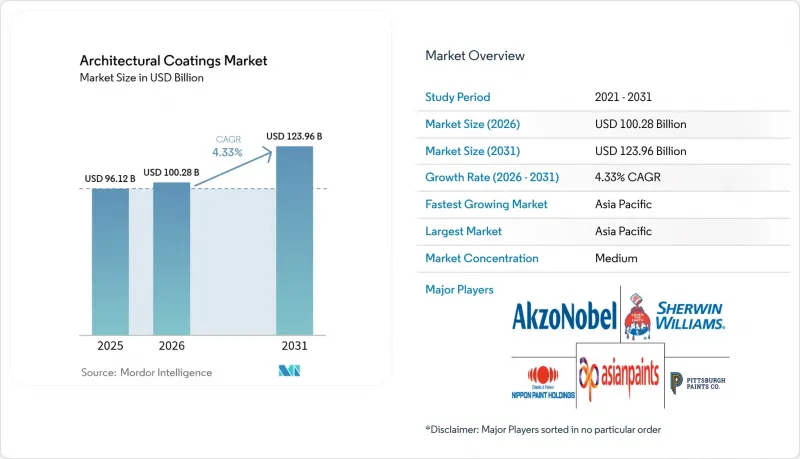
This report is Segmented by Resin Type (Acrylic, Alkyd, Epoxy, Polyester, Polyurethane, and Other Resin Types), Technology (Water-Borne, Solvent-Borne, and Other Technologies), End-Use (Residential and Commercial), and Geography (Asia-Pacific, North America, Europe, South America, and Middle-East and Africa). The Market Forecasts are Provided in Terms of Value (USD).
Global Architectural Coatings Market Trends and Insights
Low-VOC Regulations Accelerating Global Switch to Water-Borne Systems
California lowered the VOC ceiling for interior flats to 50 g/L in 2024, forcing reformulation of 40% of products sold in the state and nudging manufacturers everywhere to harmonize recipes for scale. The EU followed in 2025 with a 30 g/L cap, a level that effectively eliminates traditional solvent-rich alkyd primers unless costly bio-based substitutes are introduced. China's extension of its low-VOC mandate to Tier-3 cities widened compliance coverage to another 180 million residents and accelerated the retirement of solvent lines. Global majors amortize reformulation costs across wider volumes, but small regional firms either license technology at 3%-5% of sales or cede premium segments entirely.
Surging Renovation of Post-1970 Housing Stock in North America and Europe
The United States houses built between 1970 and 1990 now require exterior refreshes, driving USD 510 billion in improvement spending projected for 2026. Canada's Greener Homes Grant covers up to USD 3,700 for energy upgrades, propelling a 19% increase in applications during 2025. Europe's Renovation Wave aims to double retrofit rates by 2030, and Germany alone disbursed USD 13 billion in low-interest loans for facade updates in 2025. These programs tilt demand toward acrylic and elastomeric coatings with 15-20 year lifespans that satisfy homeowners looking to minimize repeat labor. Skilled labor shortages, however, have stretched project lead times to eight-to-twelve weeks, tempering near-term volume growth.
Volatile TiO2 and Epoxy Feedstock Prices Post-2024 Supply Shocks
TiO2 climbed from USD 2,800/t in Q1 2024 to USD 3,300/t in Q1 2025 after Chinese environmental shutdowns, easing later when Saudi capacity came online, yet margins for Indian and Brazilian producers still fell by up to 180 basis points because of currency swings. Epoxy costs spiked 22% after force-majeure events at bisphenol-A plants, forcing formulators to shift to polyester in non-critical roles. Majors hedge via partial ownership of TiO2 assets; PPG's 30% stake in a Chinese supplier secures 40,000 t per year at fixed prices, insulating earnings. Smaller firms negotiate quarterly pass-throughs, limiting strategic flexibility.
Other drivers and restraints analyzed in the detailed report include:
- Explosive Growth of Organized DIFM Trade-Painter Networks in ASEAN Metros
- Rapid E-Commerce Penetration Enabling Direct-to-Consumer Paint Fulfillment
- Scarcity of Skilled Painters in Mature Markets Inflating Installation Costs
For complete list of drivers and restraints, kindly check the Table Of Contents.
Segment Analysis
Acrylic commanded 54.13% of 2025 demand, the largest slice of the architectural coatings market size, and is projected to outpace the overall architectural coatings market at a 4.68% CAGR to 2031. Low-VOC compliance and robust exterior durability in humid climates underpin this leadership. Alkyd demand is contracting as solvent caps render many lines non-compliant without expensive capture systems.
Epoxies are known for their high abrasion resistance but remain constrained by UV instability and elevated cost, while polyurethanes are driven by coastal gloss-retention needs. Polyester powder coatings are favoured for factory-finished metal framing, and bio-based hybrids draw fresh R&D as firms seek differentiators for circular-economy labels.
Complete Report Scope:
- By Resin Type
- Acrylic
- Alkyd
- Epoxy
- Polyester
- Polyurethane
- Other Resin Types
- By Technology
- Water-borne
- Solvent-borne
- Other Technologies
- By End-use
- Residential
- Commercial
- By Geography
- Asia-Pacific
- China
- India
- Japan
- South Korea
- Indonesia
- Vietnam
- Thailand
- Philippines
- Singapore
- Rest of Asia-Pacific
- North America
- United States
- Canada
- Mexico
- Europe
- Germany
- United Kingdom
- France
- Italy
- Spain
- Poland
- NORDIC Countries
- Russia
- Rest of Europe
- South America
- Brazil
- Argentina
- Rest of South America
- Middle-East and Africa
- Saudi Arabia
- South Africa
- Rest of Middle-East and Africa
- Asia-Pacific
Geography Analysis
Asia-Pacific contributed 46.11% of the 2025 volume and will lead the architectural coatings market growth at 5.57%. India is advancing under Smart Cities funding that raised middle-class homeownership to 58%. Southeast Asian markets grew as FDI-backed logistics hubs and social-housing programs expanded coating consumption .
In North America, the United States accounted for most of the spending on architectural finishes as owners chose upgrades over moving in a high-rate mortgage environment. Canada added growth on the back of energy-retrofit incentives, while Mexico grew with near-shoring industrial builds.
In Europe, Germany, France, and the United Kingdom together represented the majority of regional value, each leveraging public loan or grant schemes to spur facade upgrades and low-emission interior paints. Central and Eastern Europe caught up with growth funded by EU structural allocations, while NORDIC markets maintained niche growth under strict environmental codes.
In South America, Brazil's social-housing expansion and agribusiness-led commercial builds drove growth, whereas currency pressures in Argentina redirected buyers to local brands. Chile, Peru, and Colombia benefited from mining-related infrastructure projects needing worker housing.
The Middle-East and Africa comprised lower demand but will post a substantial demand as Saudi Vision 2030 mega-projects require premium exterior coatings tolerant of extreme heat, and sub-Saharan urbanization lifts baseline consumption despite fragmented logistics.
- 3 TREES Group
- AkzoNobel N.V.
- Asian Paints Ltd.
- BASF
- Beckers Group
- Benjamin Moore and Company
- Berger Paints India Ltd.
- Brillux GmbH and Co. KG
- CIN S.A.
- DAW SE
- Flugger group AS
- Hempel A/S
- Jotun
- Kansai Paint Co., Ltd.
- Masco Corporation
- Nippon Paint Holdings Co., Ltd
- Pittsburgh Paints Co.
- RPM International
- Sniezka SA
- The Sherwin-Williams Company
Additional Benefits:
- The market estimate (ME) sheet in Excel format
- 3 months of analyst support
TABLE OF CONTENTS
1 Introduction
- 1.1 Study Assumptions and Market Definition
- 1.2 Scope of the Study
2 Research Methodology
3 Executive Summary
4 Market Landscape
- 4.1 Market Overview
- 4.2 Market Drivers
- 4.2.1 Low-VOC regulations accelerating global switch to water-borne systems
- 4.2.2 Surging renovation of post-1970 housing stock in North America and Europe
- 4.2.3 Explosive growth of organised DIFM trade-painter networks in ASEAN metros
- 4.2.4 Rapid e-commerce penetration enabling direct-to-consumer paint fulfilment
- 4.2.5 On-site robotic/3-D-printed facade modules demanding nano-filled coatings
- 4.3 Market Restraints
- 4.3.1 Volatile TiO2 and epoxy feedstock prices post-2024 supply shocks
- 4.3.2 Scarcity of skilled painters in mature markets inflating installation costs
- 4.3.3 EU biocide restrictions cutting allowable in-can preservative loadings
- 4.4 Value Chain Analysis
- 4.5 Porter's Five Forces
- 4.5.1 Bargaining Power of Suppliers
- 4.5.2 Bargaining Power of Buyers
- 4.5.3 Threat of New Entrants
- 4.5.4 Threat of Substitutes
- 4.5.5 Degree of Competition
5 Market Size and Growth Forecasts (Value)
- 5.1 By Resin Type
- 5.1.1 Acrylic
- 5.1.2 Alkyd
- 5.1.3 Epoxy
- 5.1.4 Polyester
- 5.1.5 Polyurethane
- 5.1.6 Other Resin Types
- 5.2 By Technology
- 5.2.1 Water-borne
- 5.2.2 Solvent-borne
- 5.2.3 Other Technologies
- 5.3 By End-use
- 5.3.1 Residential
- 5.3.2 Commercial
- 5.4 By Geography
- 5.4.1 Asia-Pacific
- 5.4.1.1 China
- 5.4.1.2 India
- 5.4.1.3 Japan
- 5.4.1.4 South Korea
- 5.4.1.5 Indonesia
- 5.4.1.6 Vietnam
- 5.4.1.7 Thailand
- 5.4.1.8 Philippines
- 5.4.1.9 Singapore
- 5.4.1.11 Rest of Asia-Pacific
- 5.4.2 North America
- 5.4.2.1 United States
- 5.4.2.2 Canada
- 5.4.2.3 Mexico
- 5.4.3 Europe
- 5.4.3.1 Germany
- 5.4.3.2 United Kingdom
- 5.4.3.3 France
- 5.4.3.4 Italy
- 5.4.3.5 Spain
- 5.4.3.6 Poland
- 5.4.3.7 NORDIC Countries
- 5.4.3.8 Russia
- 5.4.3.9 Rest of Europe
- 5.4.4 South America
- 5.4.4.1 Brazil
- 5.4.4.2 Argentina
- 5.4.4.3 Rest of South America
- 5.4.5 Middle-East and Africa
- 5.4.5.1 Saudi Arabia
- 5.4.5.2 South Africa
- 5.4.5.3 Rest of Middle-East and Africa
- 5.4.1 Asia-Pacific
6 Competitive Landscape
- 6.1 Market Concentration
- 6.2 Strategic Moves
- 6.3 Market Share(%)/Ranking Analysis
- 6.4 Company Profiles (includes Global Overview, Market Overview, Core Segments, Financials, Strategic Information, Products and Services, Recent Developments)
- 6.4.1 3 TREES Group
- 6.4.2 AkzoNobel N.V.
- 6.4.3 Asian Paints Ltd.
- 6.4.4 BASF
- 6.4.5 Beckers Group
- 6.4.6 Benjamin Moore and Company
- 6.4.7 Berger Paints India Ltd.
- 6.4.8 Brillux GmbH and Co. KG
- 6.4.9 CIN S.A.
- 6.4.10 DAW SE
- 6.4.11 Flugger group AS
- 6.4.12 Hempel A/S
- 6.4.13 Jotun
- 6.4.14 Kansai Paint Co., Ltd.
- 6.4.15 Masco Corporation
- 6.4.16 Nippon Paint Holdings Co., Ltd
- 6.4.17 Pittsburgh Paints Co.
- 6.4.18 RPM International
- 6.4.19 Sniezka SA
- 6.4.20 The Sherwin-Williams Company
7 Market Opportunities and Future Outlook
- 7.1 White-space and Unmet-need Assessment

