PUBLISHER: Mordor Intelligence | PRODUCT CODE: 2120357

PUBLISHER: Mordor Intelligence | PRODUCT CODE: 2120357
Anti-microbial Coatings - Market Share Analysis, Industry Trends & Statistics, Growth Forecasts (2026 - 2031)
According to Mordor Intelligence, the anti-microbial coatings market size is estimated at USD 5.09 billion in 2026, and is expected to reach USD 7.33 billion by 2031, at a CAGR of 7.58% during the forecast period (2026-2031).
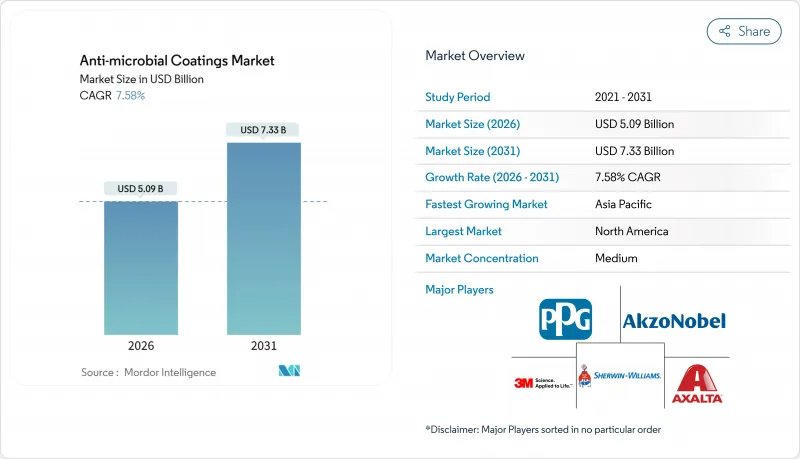
This report is Segmented by Material (Silver, Copper, Polymeric, and More), Coating Form (Powder, Liquid, and Others), Application (Building and Construction, Food Processing, Textiles, Home Appliances, Healthcare, Marine, and Other Applications), and Geography (Asia-Pacific, North America, Europe, South America, and Middle East and Africa). Market Forecasts are Provided in Terms of Value (USD).
Global Anti-microbial Coatings Market Trends and Insights
HAI-Reduction Programs Accelerating Hospital Surface Coating Uptake in North America
The Centers for Disease Control and Prevention reported in 2025 that environmental surfaces contribute up to 40% of pathogen transmission in acute-care settings. Updated CDC guidance now recommends EPA-registered antimicrobial coatings on bed rails, IV poles, and nurse call buttons as a Tier 2 intervention, elevating permanent surface engineering alongside hand hygiene. The Joint Commission incorporated coating audits into its 2025 accreditation surveys, pushing lagging facilities toward retrofits. Reimbursement penalties of up to 3% for hospitals with above-median HAI rates create a direct financial incentive to invest in durable antimicrobial infrastructure. Suppliers have responded with silver-ion and copper-alloy coatings that maintain efficacy for up to five years, repositioning antimicrobial coatings as a capital asset instead of a consumable expense.
Cold-Chain Expansion in India & ASEAN Propelling Antimicrobial Powder Demand
India's National Cold Chain Mission earmarked INR 40 billion (USD 480 million) in 2024 and mandates antimicrobial powder coatings on refrigerated warehouses and transport containers. Revised Good Distribution Practice guidelines, effective January 2025, require ISO 21702-certified antiviral coatings in vaccine storage, following cold-chain failures during the COVID-19 campaign. ASEAN regulators mirror the move: Indonesia's BPOM Regulation No. 12/2025 stipulates antimicrobial treatment in pharmaceutical hubs, and Vietnam allocated USD 120 million to upgrade seafood cold chains that serve EU customers. Electrostatic powder application ensures uniform coverage on corrugated metal and minimizes VOC emissions, aligning with occupational-safety requirements.
Lack of Technological Awareness in Developing & Under-Developed Nations
World Health Organization data show that only 15% of public hospitals in low-income countries reference durable surface treatments in infection-control protocols, compared with 78% in high-income economies. Limited familiarity with ISO 22196 and ISO 21702 standards leaves procurement officials without benchmarks to assess coating claims. Training gaps compound the issue; only 22% of facility managers in sub-Saharan Africa had formal education on antimicrobial coatings, versus 61% in North America. Price sensitivity also restrains uptake, as antimicrobial coatings can command a 30-50% premium over conventional paints. Suppliers are piloting demonstration projects with multilateral lenders to showcase efficacy and build local credibility.
Other drivers and restraints analyzed in the detailed report include:
- Touch-Interface Hygiene Requirements Driving Electronics OEM Coating Integration
- VOC-Cap Compliance Shifting Demand Toward Water-Borne & Nano Formulations
- Emission-Toxicity Concerns for Active Ingredients
For complete list of drivers and restraints, kindly check the Table Of Contents.
Segment Analysis
Silver retained the leading 49.45% revenue share in 2025, underpinned by broad-spectrum efficacy and a regulatory track record that simplifies product approval. Hospitals prefer silver-based coatings that demonstrate multi-year performance, which helps reduce total lifecycle costs. Organic actives, quaternary ammonium, chitosan, and essential-oil derivatives are growing at 9.72% annually through 2031, capturing share in applications that prioritize minimal metal leaching. Copper formulations face input-cost volatility linked to Chilean supply disruptions, driving producers toward polymeric matrices that cut metal usage. Graphene oxide, photocatalytic titanium dioxide, and other emerging materials remain niche but attract sustained R&D investment from suppliers seeking performance at lower cost or toxicity.
Rising ecotoxicity scrutiny has pushed formulators to decouple efficacy from metal loading. Polymer-encapsulated biocides extend release kinetics, allowing a 30-40% reduction in active-ingredient use. Hybrid approaches such as graphene-silver composites target the same antimicrobial log-reduction while cutting silver content by up to 60%, making them attractive where end-users face budget constraints or green-building criteria. As bio-based options scale, competitive pricing is likely to narrow the historical premium of silver-ion coatings.
Complete Report Scope:
- By Material
- Silver
- Copper
- Polymeric
- Organic
- Other Materials
- By Coating Form
- Powder
- Liquid (Solvent- and Water-borne)
- Others (Nano-Engineered Sprays and Films, Surface Modification Treatments)
- By Application
- Building and Construction
- Food Processing
- Textiles
- Home Appliances
- Healthcare
- Marine
- Other Applications
- By Geography
- Asia-Pacific
- China
- India
- Japan
- South Korea
- Rest of Asia-Pacific
- North America
- United States
- Canada
- Mexico
- Europe
- Germany
- United Kingdom
- France
- Italy
- Rest of Europe
- South America
- Brazil
- Argentina
- Rest of South America
- Middle East and Africa
- Saudi Arabia
- South Africa
- Rest of Middle East and Africa
- Asia-Pacific
Geography Analysis
North America captured 45.27% of 2025 revenue, supported by CDC guidance that elevated antimicrobial coatings in infection-control protocols and by EPA VOC regulations that accelerate water-borne adoption. Canada follows a similar path, permitting antimicrobial claims on reusable equipment surfaces, while Mexico retrofits food-processing plants to preserve US export eligibility. Zero-VOC formulations are quickly becoming the standard in healthcare and education tenders, favoring suppliers with advanced water-borne portfolios.
Asia-Pacific is the highest-growth region at a 9.08% CAGR, driven by India's National Cold Chain Mission, China's aggressive hospital-construction pipeline, and Korea's electronics OEM integration. India targets a 50% vaccine spoilage reduction by 2028 through mandatory antimicrobial coatings in refrigerated logistics. China's 14th Five-Year Plan schedules 1,400 new hospitals that must meet infection-control specifications, including coated high-touch surfaces. South Korea's supplier code of conduct for electronics components now mandates ISO 22196 certification, accelerating standardization across the value chain.
Europe's market is shaped by strict Biocidal Products Regulation oversight and VOC caps that encourage bio-based and water-borne solutions. Germany recommends antimicrobial coatings in transit and education infrastructure, while the United Kingdom's National Health Service mandates ISO 22196 retesting every 18 months. Food-processing adoption in France and marine transitions in Italy reflect broader EU environmental priorities. South America and Middle East-Africa remain nascent but show isolated growth pockets tied to hospital construction programs in Brazil and Saudi Arabia.
- 3M
- Advanced Nanotech Lab
- AGC Inc.
- Akzo Nobel N.V.
- AST Products, Inc.
- Axalta Coating Systems, LLC
- BASF
- BioCote Limited
- Bio-Fence
- Covalon Technologies Ltd.
- Diamond Vogel
- dsm-firmenich
- DuPont
- Henkel AG & Co. KGaA
- Hydromer
- Jotun
- Lonza
- Microban International
- NEI Corporation
- Novapura AG
- PPG Industries, Inc.
- Sciessent LLC
- Sono-Tek Corporation
- Specialty Coating Systems Inc.
- The Sherwin-Williams Company
Additional Benefits:
- The market estimate (ME) sheet in Excel format
- 3 months of analyst support
TABLE OF CONTENTS
1 Introduction
- 1.1 Study Assumptions & Market Definition
- 1.2 Scope of the Study
2 Research Methodology
3 Executive Summary
4 Market Landscape
- 4.1 Market Overview
- 4.2 Market Drivers
- 4.2.1 HAI-reduction programs accelerating hospital surface coating uptake in North America
- 4.2.2 Cold-chain expansion in India & ASEAN propelling antimicrobial powder demand
- 4.2.3 Touch-interface hygiene requirements driving electronics OEM coating integration
- 4.2.4 VOC-cap compliance shifting demand toward water-borne & nano formulations in North America & Europe
- 4.2.5 Smart self-sanitising public-transit surfaces linked to micro-mobility adoption
- 4.3 Market Restraints
- 4.3.1 Lack of technological awareness in developing & under-developed nations
- 4.3.2 Emission-toxicity concerns for active ingredients
- 4.3.3 Chilean copper-ore supply strikes inflating raw-material costs
- 4.4 Value Chain Analysis
- 4.5 Porter's Five Forces
- 4.5.1 Bargaining Power of Suppliers
- 4.5.2 Bargaining Power of Buyers
- 4.5.3 Threat of New Entrants
- 4.5.4 Threat of Substitutes
- 4.5.5 Industry Rivalry
5 Market Size and Growth Forecasts (Value)
- 5.1 By Material
- 5.1.1 Silver
- 5.1.2 Copper
- 5.1.3 Polymeric
- 5.1.4 Organic
- 5.1.5 Other Materials
- 5.2 By Coating Form
- 5.2.1 Powder
- 5.2.2 Liquid (Solvent- and Water-borne)
- 5.2.3 Others (Nano-Engineered Sprays and Films, Surface Modification Treatments)
- 5.3 By Application
- 5.3.1 Building and Construction
- 5.3.2 Food Processing
- 5.3.3 Textiles
- 5.3.4 Home Appliances
- 5.3.5 Healthcare
- 5.3.6 Marine
- 5.3.7 Other Applications
- 5.4 By Geography
- 5.4.1 Asia-Pacific
- 5.4.1.1 China
- 5.4.1.2 India
- 5.4.1.3 Japan
- 5.4.1.4 South Korea
- 5.4.1.5 Rest of Asia-Pacific
- 5.4.2 North America
- 5.4.2.1 United States
- 5.4.2.2 Canada
- 5.4.2.3 Mexico
- 5.4.3 Europe
- 5.4.3.1 Germany
- 5.4.3.2 United Kingdom
- 5.4.3.3 France
- 5.4.3.4 Italy
- 5.4.3.5 Rest of Europe
- 5.4.4 South America
- 5.4.4.1 Brazil
- 5.4.4.2 Argentina
- 5.4.4.3 Rest of South America
- 5.4.5 Middle East and Africa
- 5.4.5.1 Saudi Arabia
- 5.4.5.2 South Africa
- 5.4.5.3 Rest of Middle East and Africa
- 5.4.1 Asia-Pacific
6 Competitive Landscape
- 6.1 Market Concentration
- 6.2 Strategic Moves (Mergers and Acquisitions, JV, Funding)
- 6.3 Market Share(%)/Ranking Analysis
- 6.4 Company Profiles {(includes Global level Overview, Market level overview, Core Segments, Financials as available, Strategic Information, Products and Services, and Recent Developments)}
- 6.4.1 3M
- 6.4.2 Advanced Nanotech Lab
- 6.4.3 AGC Inc.
- 6.4.4 Akzo Nobel N.V.
- 6.4.5 AST Products, Inc.
- 6.4.6 Axalta Coating Systems, LLC
- 6.4.7 BASF
- 6.4.8 BioCote Limited
- 6.4.9 Bio-Fence
- 6.4.10 Covalon Technologies Ltd.
- 6.4.11 Diamond Vogel
- 6.4.12 dsm-firmenich
- 6.4.13 DuPont
- 6.4.14 Henkel AG & Co. KGaA
- 6.4.15 Hydromer
- 6.4.16 Jotun
- 6.4.17 Lonza
- 6.4.18 Microban International
- 6.4.19 NEI Corporation
- 6.4.20 Novapura AG
- 6.4.21 PPG Industries, Inc.
- 6.4.22 Sciessent LLC
- 6.4.23 Sono-Tek Corporation
- 6.4.24 Specialty Coating Systems Inc.
- 6.4.25 The Sherwin-Williams Company
7 Market Opportunities and Future Outlook
- 7.1 White-Space and Unmet-Need Assessment
- 7.2 Development of Multi-functional Coatings
- 7.3 Growing Demand for HVAC Applications

