PUBLISHER: Mordor Intelligence | PRODUCT CODE: 2120363

PUBLISHER: Mordor Intelligence | PRODUCT CODE: 2120363
Autoclaved Aerated Concrete (AAC) - Market Share Analysis, Industry Trends & Statistics, Growth Forecasts (2026 - 2031)
According to Mordor Intelligence, the autoclaved aerated concrete market size is projected to be USD 16.58 billion in 2025, USD 17.59 billion in 2026, and reach USD 23.68 billion by 2031, growing at a CAGR of 6.12% from 2026 to 2031.
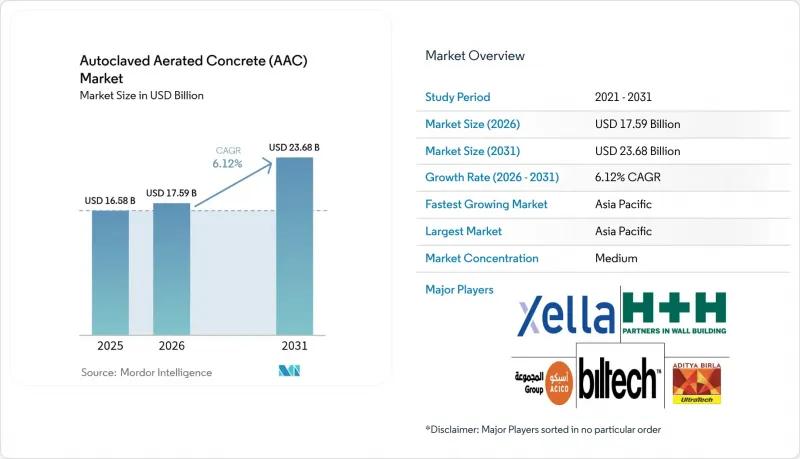
This report is Segmented by Product Type (Block, Panel, Lintel, and More), Construction Method (On-Site Masonry and Prefabricated/Modular), Application (Residential, Commercial, Industrial, and Other Applications), and Geography (Asia-Pacific, North America, Europe, South America, and Middle-East and Africa). The Market Forecasts are Provided in Terms of Value (USD).
Global Autoclaved Aerated Concrete (AAC) Market Trends and Insights
Growing Demand from New-Build and Renovation Construction
Urban housing shortages and mandatory energy-efficiency retrofits are simultaneously expanding new-build pipelines and refurbishment budgets. India targets 25 million affordable units by 2031, while China funded USD 1.4 trillion in 2024 construction outlays. The European Renovation Wave aims to upgrade 35 million buildings by 2030, channeling orders toward insulating AAC envelopes. ISO 16745 whole-life-carbon assessment is becoming a default tender requirement, meaning bids increasingly weigh embodied-carbon disclosures alongside first cost. Large panel-fabrication lines able to deliver cut-to-size elements in days are best positioned to win renovation work that demands schedule compression. Consequently, the Autoclaved aerated concrete market is shifting capital toward automated plants with higher panel output.
Stringent Green-Building Codes and LEED Adoption
Low-carbon clauses in the U.S. Inflation Reduction Act, Canada's Green Buildings Strategy, and the EU's Energy Performance of Buildings Directive require Environmental Product Declarations for public works. LEED v4.1 and analogous Indian Green Building Council criteria reward materials with verified emissions profiles. Suppliers that cannot furnish third-party EPDs risk exclusion from high-value public and commercial bids. Certified producers therefore command price premiums of 5%-8%, reinforcing a two-tier Autoclaved aerated concrete market in which uncertified blocks compete mainly in price-sensitive housing.
High Upfront Cost Versus Clay and Concrete Blocks
AAC commands a 20%-30% price premium over conventional masonry, a hurdle for budget-constrained housing. Lifecycle savings from reduced mortar and quicker erection rarely sway developers targeting immediate cash flow. Public-sector subsidies like EPA C-MORE offset only institutional projects, leaving private residential builders to favor cheaper brick. Until incentives expand, cost sensitivity will cap residential penetration in the Autoclaved aerated concrete market.
Other drivers and restraints analyzed in the detailed report include:
- Government Incentives for Low-Carbon Materials
- Modular Off-Site Construction Uptake
- Structural Limitations in Load-Bearing Applications
For complete list of drivers and restraints, kindly check the Table Of Contents.
Segment Analysis
Blocks generated 54.10% of 2025 revenue, yet panels are forecast to grow at 7.55% through 2031, representing the fastest rising slice of the Autoclaved aerated concrete market size. Aircrete Europe and Yuanzhu's 500,000 m3 annual plant embodies the automation required to hit +-2 mm tolerances demanded by prefab yards. In markets where labor costs outstrip material premiums, contractors prefer ready-to-install panels that shorten wall cycles by two days per floor. The block segment still underpins rural and low-budget projects because it relies on low-skill labor and readily available small-batch mortar. Lintels and specialty elements capture niche demand for thermal-bridge-free openings and fire-rated floor plates, but they lack the volume to move the overall Autoclaved aerated concrete market.
The differential growth path means block-only producers risk stagnation unless they retrofit factories with tilt-cake cutters and reinforcement cages. Such upgrades can lift capital intensity by USD 8-10 million per line, which smaller regional players struggle to finance. Panel producers meanwhile lock in multiyear offtake contracts with modular builders, stabilizing factory utilization at 85%-90%. As more public tenders specify whole-wall U-values rather than R-values per course, integrated panels that combine structure, insulation, and finish gain competitive traction inside the Autoclaved aerated concrete market.
Complete Report Scope:
- By Product Type
- Block
- Panel
- Lintel
- Tile
- Other Product Types (U-blocks, floor/roof elements)
- By Construction Method
- On-site masonry
- Prefabricated/Modular
- By Application
- Residential
- Commercial
- Industrial
- Other Applications (roads, utility enclosures, noise-barrier walls)
- By Geography
- Asia-Pacific
- China
- India
- Japan
- South Korea
- ASEAN Countries
- Rest of Asia-Pacific
- North America
- United States
- Canada
- Mexico
- Europe
- Germany
- United Kingdom
- France
- Italy
- Spain
- NORDIC Countries
- Poland
- Netherlands
- Romania
- Czech Republic
- Rest of Europe
- South America
- Brazil
- Argentina
- Colombia
- Rest of South America
- Middle-East and Africa
- Saudi Arabia
- Israel
- Qatar
- South Africa
- Rest of Middle-East and Africa
- Asia-Pacific
Geography Analysis
Asia-Pacific generated 46.40% of 2025 revenue and is forecast to expand at 7.11% CAGR, reinforcing its role as the core growth engine of the Autoclaved aerated concrete market. India's 60% urbanization target and China's USD 1.4 trillion 2024 construction outlay prioritize lightweight walls that cut foundation loads. ASEAN's adoption of seismic codes that limit wall mass further strengthens regional demand. Local giants such as Infra.Market now run nine AAC factories totaling 3 million m3 per year to serve tier-2 cities where clay brick shortages and rising labor costs make AAC blocks attractive.
Europe demand is fueled by the EU Renovation Wave that mandates upgrades for 35 million buildings by 2030. Germany, France, and the Netherlands retrofit aging masonry with AAC panels to hit EPC C ratings, while Romania's DVI facility positions Central Europe for prefab uptake. The United Kingdom's RAAC crisis creates mixed signals: unreinforced blocks gain share, but reinforced planks undergo heavier scrutiny, pressing suppliers to certify products under BS EN 12602.
North America contributes a smaller yet growing slice, hinging on state modular codes and embodied-carbon procurement. California, Washington, and New York lead in factory-built housing, while AAC East's South Carolina expansion targets hurricane-prone coastal counties where the material's impact and termite resistance add value. Canada's 30% embodied-carbon reduction by 2030 boosts prospects, but clay-brick incumbents lobby aggressively, slowing momentum. South America and the Middle-East present nascent yet strategic options. Brazil's Sao Paulo industrial corridor is investing in AAC for warehouse envelopes, whereas Saudi mega-projects like NEOM need fire-resistant, termite-proof walls for desert climates. Education of local contractors remains the gating factor in these emerging slices of the Autoclaved aerated concrete market.
- ACICO Group
- AERCON AAC
- Asahi Kasei Corporation
- Bauroc AS
- Biltech Building Elements Ltd.
- BirlaNu Limited
- DVI Production
- Eastland Building Materials Co., Ltd
- Eco Green
- Ecostone AAC
- H+H UK Limited
- JK Lakshmi Cement Ltd.
- Renacon
- SOLBET
- Starken AAC Sdn Bhd
- STT Turk Gazbeton
- Thomas Armstrong (Concrete Blocks) Ltd
- UAL Industries Limited
- UltraTech Cement Ltd.
- Xella International
Additional Benefits:
- The market estimate (ME) sheet in Excel format
- 3 months of analyst support
TABLE OF CONTENTS
1 Introduction
- 1.1 Study Assumptions and Market Definition
- 1.2 Scope of the Study
2 Research Methodology
3 Executive Summary
4 Market Landscape
- 4.1 Market Overview
- 4.2 Market Drivers
- 4.2.1 Growing Demand from New-Build and Renovation Construction
- 4.2.2 Stringent Green-Building Codes and LEED Adoption
- 4.2.3 Government Incentives for Low-Carbon Materials
- 4.2.4 Modular Off-Site Construction Uptake
- 4.2.5 Demand for Seismic-Resilient Lightweight Blocks
- 4.3 Market Restraints
- 4.3.1 High Upfront Cost Vs. Clay and Concrete Blocks
- 4.3.2 Structural Limitations in Load-Bearing Applications
- 4.3.3 Volatile Supply and Price of Aluminum Powder Foaming Agent
- 4.4 Value Chain Analysis
- 4.5 Porter's Five Forces
- 4.5.1 Bargaining Power of Suppliers
- 4.5.2 Bargaining Power of Buyers
- 4.5.3 Threat of New Entrants
- 4.5.4 Threat of Substitutes
- 4.5.5 Degree of Competition
5 Market Size and Growth Forecasts (Value)
- 5.1 By Product Type
- 5.1.1 Block
- 5.1.2 Panel
- 5.1.3 Lintel
- 5.1.4 Tile
- 5.1.5 Other Product Types (U-blocks, floor/roof elements)
- 5.2 By Construction Method
- 5.2.1 On-site masonry
- 5.2.2 Prefabricated/Modular
- 5.3 By Application
- 5.3.1 Residential
- 5.3.2 Commercial
- 5.3.3 Industrial
- 5.3.4 Other Applications (roads, utility enclosures, noise-barrier walls)
- 5.4 By Geography
- 5.4.1 Asia-Pacific
- 5.4.1.1 China
- 5.4.1.2 India
- 5.4.1.3 Japan
- 5.4.1.4 South Korea
- 5.4.1.5 ASEAN Countries
- 5.4.1.6 Rest of Asia-Pacific
- 5.4.2 North America
- 5.4.2.1 United States
- 5.4.2.2 Canada
- 5.4.2.3 Mexico
- 5.4.3 Europe
- 5.4.3.1 Germany
- 5.4.3.2 United Kingdom
- 5.4.3.3 France
- 5.4.3.4 Italy
- 5.4.3.5 Spain
- 5.4.3.6 NORDIC Countries
- 5.4.3.7 Poland
- 5.4.3.8 Netherlands
- 5.4.3.9 Romania
- 5.4.3.10 Czech Republic
- 5.4.3.11 Rest of Europe
- 5.4.4 South America
- 5.4.4.1 Brazil
- 5.4.4.2 Argentina
- 5.4.4.3 Colombia
- 5.4.4.4 Rest of South America
- 5.4.5 Middle-East and Africa
- 5.4.5.1 Saudi Arabia
- 5.4.5.2 Israel
- 5.4.5.3 Qatar
- 5.4.5.4 South Africa
- 5.4.5.5 Rest of Middle-East and Africa
- 5.4.1 Asia-Pacific
6 Competitive Landscape
- 6.1 Market Concentration
- 6.2 Strategic Moves
- 6.3 Market Share(%)/Ranking Analysis
- 6.4 Company Profiles (includes Global Overview, Market Overview, Core Segments, Financials, Strategic Information, Products and Services, Recent Developments)
- 6.4.1 ACICO Group
- 6.4.2 AERCON AAC
- 6.4.3 Asahi Kasei Corporation
- 6.4.4 Bauroc AS
- 6.4.5 Biltech Building Elements Ltd.
- 6.4.6 BirlaNu Limited
- 6.4.7 DVI Production
- 6.4.8 Eastland Building Materials Co., Ltd
- 6.4.9 Eco Green
- 6.4.10 Ecostone AAC
- 6.4.11 H+H UK Limited
- 6.4.12 JK Lakshmi Cement Ltd.
- 6.4.13 Renacon
- 6.4.14 SOLBET
- 6.4.15 Starken AAC Sdn Bhd
- 6.4.16 STT Turk Gazbeton
- 6.4.17 Thomas Armstrong (Concrete Blocks) Ltd
- 6.4.18 UAL Industries Limited
- 6.4.19 UltraTech Cement Ltd.
- 6.4.20 Xella International
7 Market Opportunities and Future Outlook
- 7.1 White-space and unmet-need assessment

