PUBLISHER: Mordor Intelligence | PRODUCT CODE: 2120382

PUBLISHER: Mordor Intelligence | PRODUCT CODE: 2120382
Africa Cotton - Market Share Analysis, Industry Trends & Statistics, Growth Forecasts (2026 - 2031)
According to Mordor Intelligence, the Africa cotton market size was valued at USD 6.01 billion in 2025 and estimated to grow from USD 6.27 billion in 2026 to reach USD 7.82 billion by 2031, at a CAGR of 4.53% during the forecast period (2026-2031).
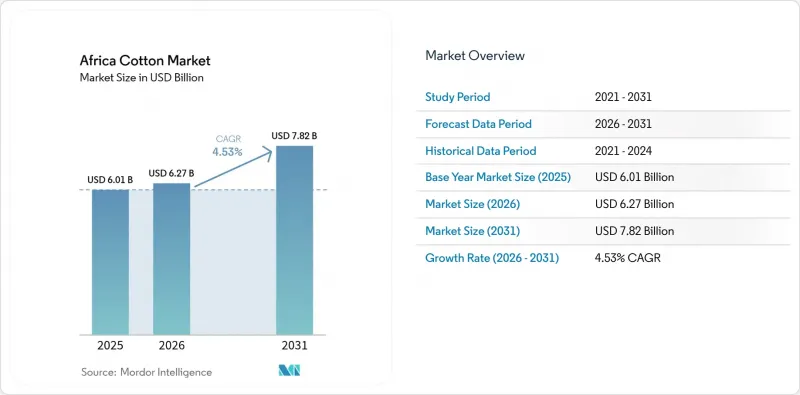
This report is Segmented by Geography (Burkina Faso, Mali, Benin, and More). The Report Includes Production Analysis (Volume), Consumption Analysis (Value and Volume), Import Analysis (Value and Volume), Export Analysis (Value and Volume), Wholesale Price Trend Analysis and Forecast, List of Key Players, and More. The Market Forecasts are Provided in Terms of Value (USD) and Volume (Metric Tons).
Africa Cotton Market Trends and Insights
Rising Area Under Cotton Cultivation
The expansion of land allocated to cotton farming continues to drive growth in the African cotton market, particularly in West Africa, where cotton remains a key cash crop. Governments and farmer cooperatives actively promote cotton cultivation as a dependable source of export revenue and rural income, encouraging farmers to dedicate more acreage to cotton instead of subsistence crops. Government subsidy programs in Benin, Mali, and Burkina Faso added 180,000 hectares during the 2023-2025 period, increasing raw fiber availability and enabling ginners to secure freight discounts. In 2025, Benin provided USD 40 million in subsidized fertilizer to 285,000 smallholder farmers. These efforts collectively strengthen the region's position in the global cotton market.
Growing Chinese Demand for West-African Lint
The growing demand of cotton from Asian textile manufacturers is a significant factor driving African cotton exports. Chinese mills imported 1.2 million metric tons of African lint in 2025, 19% above 2024 volumes. West African cotton is particularly valued for its fiber quality and competitive pricing, making it appealing to spinning mills seeking to diversify their sourcing. Trade partnerships with Asian buyers help stabilize demand, even when local consumption remains low. For instance, export-focused cotton producers benefit from long-term procurement agreements, which help mitigate price fluctuations and support consistent production, thereby strengthening Africa's position as a key supplier in global cotton trade.
Under-Developed Rural Logistics
Inadequate rural transport and storage infrastructure pose significant challenges to the cotton market by driving up costs and increasing post-harvest losses. Many cotton-producing regions rely on unpaved roads, insufficient warehousing, and fragmented transport networks, hindering the efficient movement of seed cotton from farms to gins. In 2025, the 1,028-kilometer Abidjan-Lagos coastal motorway, linking Cote d'Ivoire, Nigeria, Ghana, Togo, and Benin, was set to boost West African connectivity. With USD 15.6 billion in investment interest, construction is slated to start in 2026 and finish by 2030. The African Development Bank funded feasibility studies and developed financing and institutional frameworks to support, the project, yet until the projects finish, logistics bottlenecks continue to restrain the Africa cotton market .
Other drivers and restraints analyzed in the detailed report include:
- Expansion of Irrigation Corridors
- Adoption of Genetically Modified Cotton Seeds
- Aging Smallholder Farmer Base
For complete list of drivers and restraints, kindly check the Table Of Contents.
Complete Report Scope:
- By Geography
- Burkina Faso
- Production Analysis (Area Harvested, Yield, and Production Volume)
- Consumption Analysis (Consumption Value and Volume)
- Import Market Analysis (Import Value, Volume, and Key Supplying Markets)
- Export Market Analysis (Export Value, Volume, and Key Destination Markets)
- Wholesale Price Trend Analysis and Forecast
- Regulatory Framework
- List of Key Players
- Logistics and Infrastructure
- Seasonality Analysis
- Mali
- Production Analysis (Area Harvested, Yield, and Production Volume)
- Consumption Analysis (Consumption Value and Volume)
- Import Market Analysis (Import Value, Volume, and Key Supplying Markets)
- Export Market Analysis (Export Value, Volume, and Key Destination Markets)
- Wholesale Price Trend Analysis and Forecast
- Regulatory Framework
- List of Key Players
- Logistics and Infrastructure
- Seasonality Analysis
- Benin
- Production Analysis (Area Harvested, Yield, and Production Volume)
- Consumption Analysis (Consumption Value and Volume)
- Import Market Analysis (Import Value, Volume, and Key Supplying Markets)
- Export Market Analysis (Export Value, Volume, and Key Destination Markets)
- Wholesale Price Trend Analysis and Forecast
- Regulatory Framework
- List of Key Players
- Logistics and Infrastructure
- Seasonality Analysis
- Kenya
- Production Analysis (Area Harvested, Yield, and Production Volume)
- Consumption Analysis (Consumption Value and Volume)
- Import Market Analysis (Import Value, Volume, and Key Supplying Markets)
- Export Market Analysis (Export Value, Volume, and Key Destination Markets)
- Wholesale Price Trend Analysis and Forecast
- Regulatory Framework
- List of Key Players
- Logistics and Infrastructure
- Seasonality Analysis
- Cameroon
- Production Analysis (Area Harvested, Yield, and Production Volume)
- Consumption Analysis (Consumption Value and Volume)
- Import Market Analysis (Import Value, Volume, and Key Supplying Markets)
- Export Market Analysis (Export Value, Volume, and Key Destination Markets)
- Wholesale Price Trend Analysis and Forecast
- Regulatory Framework
- List of Key Players
- Logistics and Infrastructure
- Seasonality Analysis
- Nigeria
- Production Analysis (Area Harvested, Yield, and Production Volume)
- Consumption Analysis (Consumption Value and Volume)
- Import Market Analysis (Import Value, Volume, and Key Supplying Markets)
- Export Market Analysis (Export Value, Volume, and Key Destination Markets)
- Wholesale Price Trend Analysis and Forecast
- Regulatory Framework
- List of Key Players
- Logistics and Infrastructure
- Seasonality Analysis
- Burkina Faso
Additional Benefits:
- The market estimate (ME) sheet in Excel format
- 3 months of analyst support
TABLE OF CONTENTS
1 Introduction
- 1.1 Study Assumptions and Market Definition
- 1.2 Scope of the Study
2 Research Methodology
3 Executive Summary
4 Market Landscape
- 4.1 Market Overview
- 4.2 Market Drivers
- 4.2.1 Rising area under cotton cultivation
- 4.2.2 Growing chinese demand for West-African lint
- 4.2.3 Expansion of irrigation corridors
- 4.2.4 Adoption of genetically modified cotton seeds
- 4.2.5 Digitized extension platforms
- 4.2.6 Traceability premiums from Environmental, Social, and Governance (ESG)-oriented brands
- 4.3 Market Restraints
- 4.3.1 Low ginning out-turn ratios versus peers
- 4.3.2 Under-developed rural logistics
- 4.3.3 Aging smallholder farmer base
- 4.3.4 Foreign exchange shortages limiting inputs
- 4.4 Opportunities
- 4.5 Challenges
- 4.6 Value Chain Analysis
- 4.7 Technologies and usage of AI in the Industry
- 4.8 Input Market Analysis
- 4.8.1 Seeds
- 4.8.2 Fertilizers
- 4.8.3 Crop Protection Chemicals
- 4.9 Distribution Channel Analysis
- 4.10 Market Sentiment Analysis
- 4.11 PESTLE Analysis
5 Market Size and Growth Forecasts (Value and Volume)
- 5.1 By Geography
- 5.1.1 Burkina Faso
- 5.1.1.1 Production Analysis (Area Harvested, Yield, and Production Volume)
- 5.1.1.2 Consumption Analysis (Consumption Value and Volume)
- 5.1.1.3 Import Market Analysis (Import Value, Volume, and Key Supplying Markets)
- 5.1.1.4 Export Market Analysis (Export Value, Volume, and Key Destination Markets)
- 5.1.1.5 Wholesale Price Trend Analysis and Forecast
- 5.1.1.6 Regulatory Framework
- 5.1.1.7 List of Key Players
- 5.1.1.8 Logistics and Infrastructure
- 5.1.1.9 Seasonality Analysis
- 5.1.2 Mali
- 5.1.2.1 Production Analysis (Area Harvested, Yield, and Production Volume)
- 5.1.2.2 Consumption Analysis (Consumption Value and Volume)
- 5.1.2.3 Import Market Analysis (Import Value, Volume, and Key Supplying Markets)
- 5.1.2.4 Export Market Analysis (Export Value, Volume, and Key Destination Markets)
- 5.1.2.5 Wholesale Price Trend Analysis and Forecast
- 5.1.2.6 Regulatory Framework
- 5.1.2.7 List of Key Players
- 5.1.2.8 Logistics and Infrastructure
- 5.1.2.9 Seasonality Analysis
- 5.1.3 Benin
- 5.1.3.1 Production Analysis (Area Harvested, Yield, and Production Volume)
- 5.1.3.2 Consumption Analysis (Consumption Value and Volume)
- 5.1.3.3 Import Market Analysis (Import Value, Volume, and Key Supplying Markets)
- 5.1.3.4 Export Market Analysis (Export Value, Volume, and Key Destination Markets)
- 5.1.3.5 Wholesale Price Trend Analysis and Forecast
- 5.1.3.6 Regulatory Framework
- 5.1.3.7 List of Key Players
- 5.1.3.8 Logistics and Infrastructure
- 5.1.3.9 Seasonality Analysis
- 5.1.4 Kenya
- 5.1.4.1 Production Analysis (Area Harvested, Yield, and Production Volume)
- 5.1.4.2 Consumption Analysis (Consumption Value and Volume)
- 5.1.4.3 Import Market Analysis (Import Value, Volume, and Key Supplying Markets)
- 5.1.4.4 Export Market Analysis (Export Value, Volume, and Key Destination Markets)
- 5.1.4.5 Wholesale Price Trend Analysis and Forecast
- 5.1.4.6 Regulatory Framework
- 5.1.4.7 List of Key Players
- 5.1.4.8 Logistics and Infrastructure
- 5.1.4.9 Seasonality Analysis
- 5.1.5 Cameroon
- 5.1.5.1 Production Analysis (Area Harvested, Yield, and Production Volume)
- 5.1.5.2 Consumption Analysis (Consumption Value and Volume)
- 5.1.5.3 Import Market Analysis (Import Value, Volume, and Key Supplying Markets)
- 5.1.5.4 Export Market Analysis (Export Value, Volume, and Key Destination Markets)
- 5.1.5.5 Wholesale Price Trend Analysis and Forecast
- 5.1.5.6 Regulatory Framework
- 5.1.5.7 List of Key Players
- 5.1.5.8 Logistics and Infrastructure
- 5.1.5.9 Seasonality Analysis
- 5.1.6 Nigeria
- 5.1.6.1 Production Analysis (Area Harvested, Yield, and Production Volume)
- 5.1.6.2 Consumption Analysis (Consumption Value and Volume)
- 5.1.6.3 Import Market Analysis (Import Value, Volume, and Key Supplying Markets)
- 5.1.6.4 Export Market Analysis (Export Value, Volume, and Key Destination Markets)
- 5.1.6.5 Wholesale Price Trend Analysis and Forecast
- 5.1.6.6 Regulatory Framework
- 5.1.6.7 List of Key Players
- 5.1.6.8 Logistics and Infrastructure
- 5.1.6.9 Seasonality Analysis
- 5.1.1 Burkina Faso
6 End Use Applications and Industries
- 6.1 Primary Applications and Emerging Applications
- 6.2 Consumption Breakdown by Indsutries
7 Competitive Landscape
- 7.1 Overview of the Competition
- 7.2 Recent Developments
- 7.3 Market Concentration Analysis
- 7.4 List of Key Players
- 7.4.1 Olam International Limited
- 7.4.2 Louis Dreyfus Company B.V.
- 7.4.3 Cargill, Incorporated
- 7.4.4 Plexus Cotton Limited (RCMA Group)
- 7.4.5 Paul Reinhart AG
- 7.4.6 Compagnie Malienne pour le Developpement des Textiles SA
- 7.4.7 Societe Burkinabe des Fibres Textiles (SOFITEX)
- 7.4.8 Ivoire Coton SA
- 7.4.9 Societe de Developpement du Coton (SODECOTON)
- 7.4.10 Devcot SA
- 7.4.11 West African Cotton Company Limited (WACOT)
- 7.4.12 Branson Commodities
- 7.4.13 ETG Commodities (ETC Group)
- 7.4.14 Cotton Company of Zimbabwe Limited (COTTCO)
- 7.4.15 Alliance Ginneries Limited
8 Market Opportunities and Future Outlook

