PUBLISHER: Mordor Intelligence | PRODUCT CODE: 2120457

PUBLISHER: Mordor Intelligence | PRODUCT CODE: 2120457
Precision Irrigation - Market Share Analysis, Industry Trends & Statistics, Growth Forecasts (2026 - 2031)
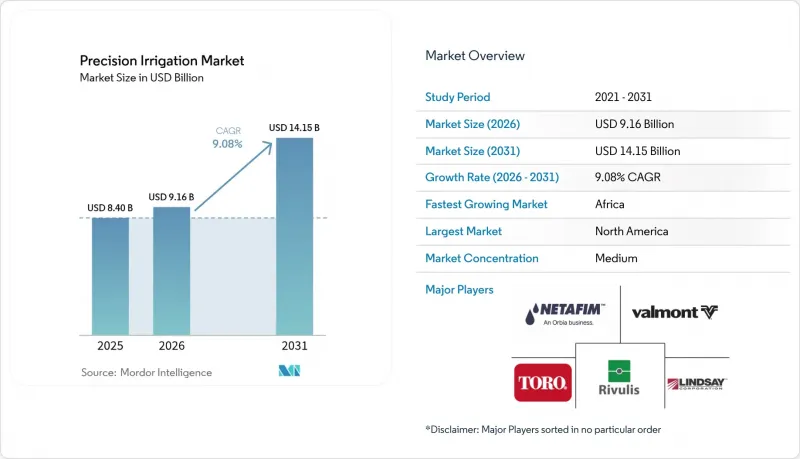
According to Mordor Intelligence, the precision irrigation market size was valued at USD 8.4 billion in 2025 and estimated to grow from USD 9.16 billion in 2026 to reach USD 14.15 billion by 2031, at a CAGR of 9.08% during the forecast period (2026-2031).
This report is Segmented by Irrigation Type (Sprinkler, Drip, and More), by Component (Controllers and Timers, Flow Meters and Valves, and More), by Crop Type (Field Crops, Plantation Crops, Orchards and Vineyards, and More), and by Geography (North America, Europe, Asia-Pacific, and More). The Market Forecasts are Provided in Terms of Value (USD).
Global Precision Irrigation Market Trends and Insights
Subsidy Expansions for Water-Efficient Farming
Rebate programs are cutting payback periods on drip and pivot upgrades from seven to fewer than four years, lifting adoption among cash-constrained growers. Arizona and California disbursed a combined USD 75 million in 2024 to cotton, dairy, and specialty-crop producers, reducing net capital outlays by up to 50% . Australia extended its On-Farm Emergency Water Infrastructure Rebate Scheme through 2025, covering half of sensor and controller costs to counter drought pressure in the Murray-Darling Basin. India's Pradhan Mantri Kisan Urja Suraksha Evam Utthan Mahabhiyan Yojana (PM-KUSUM) initiative paired solar pumps with drip kits for 180,000 farmers, effectively solving energy and water challenges in one bundle. Carbon-credit linkages embedded in many of these programs let growers monetize water savings, further improving project economics for early adopters.
Rising Adoption of Drip Systems in Horticulture Clusters
High-value fruit and vegetable belts are switching from flood to drip at rates surpassing broader row-crop trends. California's Central Valley reached 78% drip penetration in almond acreage during 2024, a surge tied to groundwater caps under the Sustainable Groundwater Management Act. Spain's Almeria greenhouses operate nearly exclusively on recirculating drip networks that exceed 90% water-use efficiency, a benchmark now influencing Morocco and Turkey. India's Nashik grape belt posted 22% annual growth in drip installations, cutting system costs to USD 800 per hectare after subsidies. Chile's export-oriented blueberry growers adopted subsurface drip to mitigate salt stress, lifting yields 18% while trimming water use by 35%.
High Initial Cost Versus Flood Irrigation
Precision systems still cost more than 200% above flood infrastructure, which deters growers without access to low-interest credit. A 40-hectare subsurface drip install in India ranges from USD 2,500 to USD 3,200 per hectare after subsidy, while flood canals need only USD 800, so many vegetable producers delay upgrades until water caps force action. In Kenya, drip kits priced near USD 1,200 per hectare equal roughly 60% of rural household income, leaving adoption almost entirely dependent on donor grants . Annual filtration and emitter maintenance add 15-20% to operating budgets, which weakens the water-savings argument when energy prices remain low.
Other drivers and restraints analyzed in the detailed report include:
- Integration of Soil-Moisture IoT (Internet of Things) Sensors
- Pivot-Retrofit Kits Lowering CAPEX for Mid-Size Farms
- Fragmented Landholding in Emerging Economies
For complete list of drivers and restraints, kindly check the Table Of Contents.
Segment Analysis
Drip irrigation held a 53.35% market share in the precision irrigation segment in 2025 and is projected to grow at a 10.42% CAGR through 2031, making it both the largest and fastest-growing segment. Subsurface drip irrigation is gaining popularity in row crops such as cotton and corn, as buried lines reduce evaporation and deliver nutrients directly to the root zone, resulting in water use reductions of up to 60% compared to sprinklers. Surface drip remains the workhorse in orchards, vineyards, and high-value vegetable crops; California almond growers, facing extraction caps under the state's groundwater law, increased drip penetration to 78% in 2024. A hybrid called precision mobile drip mounts tape on moveable frames so one system can serve several fields, a cost-saving approach now spreading through Israel, Kenya, and India. Spain's 31,000-hectare Almeria greenhouse hub showcases the cutting edge of technology, operating almost entirely on recirculating drip irrigation that utilizes more than 90% of the applied water.
Sprinkler formats, including traditional, center-pivot, and lateral-move units, comprise the remainder of the precision irrigation market size, yet their growth pace lags behind that of drip as regulators favor low-evaporation options. Center pivots still dominate the Great Plains and Brazil's Cerrado, but many owners are adding variable-rate retrofit kits that bring drip-like precision to existing hardware. Lateral-move systems, which run straight instead of pivoting, expanded 9% in 2024 because they cover rectangular edges and irregular parcels where pivots fall short. Traditional solid-set and hand-move sprinklers persist in areas with fragmented land tenure, while micro-sprinklers and bubblers fill nursery niches that need gentle delivery. Drip's edge also comes from fertigation automation, which raised nutrient efficiency 15% in Kansas trials and works on sloped terrain where pivots face engineering limits.
Complete Report Scope:
- By Irrigation Type
- Sprinkler Irrigation
- Traditional Sprinklers
- Center Pivot Sprinklers
- Lateral / Linear Move Sprinklers
- Drip Irrigation
- Surface Drip Irrigation
- Sub-surface Drip Irrigation
- Precision Mobile Drip Irrigation
- Other Types
- Sprinkler Irrigation
- By Component
- Controllers and Timers
- Flow Meters and Valves
- Soil-Moisture Sensors
- Software and Services
- By Crop Type
- Field Crops
- Plantation Crops
- Orchards and Vineyards
- Turf and Ornamentals
- By Geography
- North America
- United States
- Canada
- Mexico
- Rest of North America
- Europe
- Germany
- United Kingdom
- France
- Spain
- Italy
- Russia
- Rest of Europe
- Asia-Pacific
- China
- India
- Japan
- Australia
- South Korea
- Rest of Asia-Pacific
- South America
- Brazil
- Argentina
- Rest of South America
- Middle East
- Saudi Arabia
- United Arab Emirates
- Turkey
- Rest of Middle East
- Africa
- South Africa
- Kenya
- Rest of Africa
- North America
Geography Analysis
North America is projected to lead the precision irrigation market with a 31.55% revenue share in 2025, driven by a substantial center-pivot infrastructure and the United States Department of Agriculture (USDA) programs that subsidize up to 50% of retrofit costs. Additionally, stricter groundwater regulations in California and the Ogallala Aquifer region are increasing the demand for drip irrigation systems and variable-rate pivots. Africa is anticipated to be the fastest-growing market, with a CAGR of 10.05% through 2031, supported by World Bank and African Development Bank loans aimed at financing smallholder drip irrigation projects. Increased donor support and government subsidies in countries such as Kenya, Ethiopia, and Morocco are facilitating the transition of pilot projects into large-scale commercial farming operations.
Europe benefits from Common Agricultural Policy grants that cover half of precision upgrades, while national groundwater caps in Spain and Italy make drip the default choice for fruit and vegetable belts. Asia-Pacific demand is anchored by India's PM-KUSUM solar-pump bundles and China's mandatory precision standards on new farmland, creating the world's largest pipeline of subsidized installations. The Middle East relies on state-backed financing under Saudi Vision 2030 and the United Arab Emirates food-security plan, which require precision systems for new agricultural projects. South America's growth stems from Brazil's Cerrado and Argentina's Pampas, where pivots extend cropping into marginal zones subject to erratic rainfall.
North America is projected to add variable-rate technology to legacy pivots, shortening payback periods as energy costs rise and water allocations tighten. Europe will intensify sensor adoption to meet the European Union's water-footprint reporting rules, driving software subscriptions that layer onto existing drip networks. Asia-Pacific should see sustained momentum as state subsidies expand to mid-size farms and local manufacturers cut system costs with domestic drip-tape production. Africa's next challenge is building spare-parts depots and technician networks to keep newly installed systems running, a service gap that forward-looking vendors are racing to fill.
- Netafim Ltd (Orbia Advance Corporation)
- Valmont Industries, Inc.
- Lindsay Corporation
- Rivulis Pte. Ltd. (Temasek Holdings Pte. Ltd.)
- The Toro Company
- Rain Bird Corporation
- Nelson Irrigation Corporation
- Deere & Company
- Mahindra EPC Irrigation Limited (Mahindra & Mahindra Limited)
- Sistema Azud S.A.
- Hunter Industries, Inc.
- Reinke Manufacturing Co., Inc.
- T-L Irrigation Co.
- Metzerplas Cooperative Agricultural Organization Ltd.
- Irritec S.p.A.
Additional Benefits:
- The market estimate (ME) sheet in Excel format
- 3 months of analyst support
TABLE OF CONTENTS
1 Introduction
- 1.1 Study Assumptions and Market Definition
- 1.2 Scope of the Study
2 Research Methodology
3 Executive Summary
4 Market Landscape
- 4.1 Market Overview
- 4.2 Market Drivers
- 4.2.1 Subsidy Expansions for Water-Efficient Farming
- 4.2.2 Rising Adoption of Drip Systems in Horticulture Clusters
- 4.2.3 Integration of Soil-Moisture IoT (Internet of Things) Sensors
- 4.2.4 Pivot-Retrofit Kits Lowering CAPEX for Mid-Size Farms
- 4.2.5 Corporate Net-Zero Pledges Driving Water-Use KPIs
- 4.2.6 Surge in Agri-Venture Capitalist Funding for Water-Stress Regions
- 4.3 Market Restraints
- 4.3.1 High Initial Cost Versus Flood Irrigation
- 4.3.2 Fragmented Landholding in Emerging Economies
- 4.3.3 Limited After-Sales Service Networks in Africa
- 4.3.4 Data-Privacy Concerns Around Connected Irrigation Controllers
- 4.4 Porter's Five Forces Analysis
- 4.4.1 Bargaining Power of Suppliers
- 4.4.2 Bargaining Power of Buyers
- 4.4.3 Threat of New Entrants
- 4.4.4 Threat of Substitutes
- 4.4.5 Intensity of Competitive Rivalry
5 Market Size and Growth Forecasts (Value)
- 5.1 By Irrigation Type
- 5.1.1 Sprinkler Irrigation
- 5.1.1.1 Traditional Sprinklers
- 5.1.1.2 Center Pivot Sprinklers
- 5.1.1.3 Lateral / Linear Move Sprinklers
- 5.1.2 Drip Irrigation
- 5.1.2.1 Surface Drip Irrigation
- 5.1.2.2 Sub-surface Drip Irrigation
- 5.1.2.3 Precision Mobile Drip Irrigation
- 5.1.3 Other Types
- 5.1.1 Sprinkler Irrigation
- 5.2 By Component
- 5.2.1 Controllers and Timers
- 5.2.2 Flow Meters and Valves
- 5.2.3 Soil-Moisture Sensors
- 5.2.4 Software and Services
- 5.3 By Crop Type
- 5.3.1 Field Crops
- 5.3.2 Plantation Crops
- 5.3.3 Orchards and Vineyards
- 5.3.4 Turf and Ornamentals
- 5.4 By Geography
- 5.4.1 North America
- 5.4.1.1 United States
- 5.4.1.2 Canada
- 5.4.1.3 Mexico
- 5.4.1.4 Rest of North America
- 5.4.2 Europe
- 5.4.2.1 Germany
- 5.4.2.2 United Kingdom
- 5.4.2.3 France
- 5.4.2.4 Spain
- 5.4.2.5 Italy
- 5.4.2.6 Russia
- 5.4.2.7 Rest of Europe
- 5.4.3 Asia-Pacific
- 5.4.3.1 China
- 5.4.3.2 India
- 5.4.3.3 Japan
- 5.4.3.4 Australia
- 5.4.3.5 South Korea
- 5.4.3.6 Rest of Asia-Pacific
- 5.4.4 South America
- 5.4.4.1 Brazil
- 5.4.4.2 Argentina
- 5.4.4.3 Rest of South America
- 5.4.5 Middle East
- 5.4.5.1 Saudi Arabia
- 5.4.5.2 United Arab Emirates
- 5.4.5.3 Turkey
- 5.4.5.4 Rest of Middle East
- 5.4.6 Africa
- 5.4.6.1 South Africa
- 5.4.6.2 Kenya
- 5.4.6.3 Rest of Africa
- 5.4.1 North America
6 Competitive Landscape
- 6.1 Market Concentration
- 6.2 Strategic Moves
- 6.3 Market Share Analysis
- 6.4 Company Profiles (Includes Global Level Overview, Market Level Overview, Core Segments, Financials as Available, Strategic Information, Market Rank/Share, Products and Services, and Recent Developments)
- 6.4.1 Netafim Ltd (Orbia Advance Corporation)
- 6.4.2 Valmont Industries, Inc.
- 6.4.3 Lindsay Corporation
- 6.4.4 Rivulis Pte. Ltd. (Temasek Holdings Pte. Ltd.)
- 6.4.5 The Toro Company
- 6.4.6 Rain Bird Corporation
- 6.4.7 Nelson Irrigation Corporation
- 6.4.8 Deere & Company
- 6.4.9 Mahindra EPC Irrigation Limited (Mahindra & Mahindra Limited)
- 6.4.10 Sistema Azud S.A.
- 6.4.11 Hunter Industries, Inc.
- 6.4.12 Reinke Manufacturing Co., Inc.
- 6.4.13 T-L Irrigation Co.
- 6.4.14 Metzerplas Cooperative Agricultural Organization Ltd.
- 6.4.15 Irritec S.p.A.
7 Market Opportunities and Future Outlook

