PUBLISHER: Mordor Intelligence | PRODUCT CODE: 2120498

PUBLISHER: Mordor Intelligence | PRODUCT CODE: 2120498
India Glass Packaging - Market Share Analysis, Industry Trends & Statistics, Growth Forecasts (2026 - 2031)
According to Mordor Intelligence, the India glass packaging market size was valued at USD 9.94 billion in 2025 and estimated to grow from USD 10.33 billion in 2026 to reach USD 12.52 billion by 2031, at a CAGR of 3.92% during the forecast period (2026-2031).
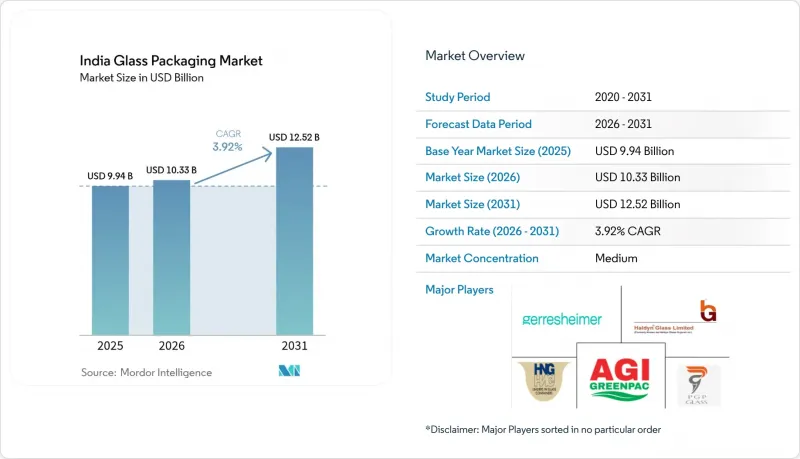
This report is Segmented by Product (Bottles/Containers, Vials, and More), Glass Type (Type I Borosilicate, Type II Treated Soda-Lime, and More), End-User Vertical (Food, Soft-Drink Beverages, Alcoholic Beverages, and More), Capacity Range (<30 Ml, 30-100 Ml, 100-500 Ml and More), and Geography (North India, West India, and More). The Market Forecasts are Provided in Terms of Value (USD).
India Glass Packaging Market Trends and Insights
Craft Spirits Revolution Drives Premium Glass Demand
Consumer migration from standard beer to craft spirits and ready-to-drink cocktails widens opportunities for bespoke bottles in the India glass packaging market. Exports of alcoholic beverages rose to USD 375.09 million in FY 2024, signaling premiumization that spills into domestic shelves. Micro-breweries in Maharashtra and Karnataka commission proprietary molds in flint and amber variants that bolster brand storytelling. Streamlined state licensing and tourism-centric policies sustain this trajectory, although compliance with Bureau of Indian Standards food-grade norms remains compulsory. Glass makers able to deliver small-batch run flexibility and intricate embossing gain a pricing edge over mass-production peers. The result is a diversified revenue stream less exposed to volume swings in mainstream beer.
Pharmaceutical Export Ambitions Fuel Type I Vial Growth
The India glass packaging market benefits directly from the US Biosecure Act, which channels contract manufacturing away from Chinese suppliers toward Indian CDMOs. SGD Pharma's joint venture with Corning in Telangana establishes Velocity Vials capacity aligned with global biologic fill-finish standards. Borosilicate compositions withstand thermal shock and chemical reactivity posed by complex drugs, justifying premium selling prices. India's CDMO revenue is projected to climb from USD 15.63 billion in 2023 to USD 26.73 billion by 2028, ensuring sturdy downstream demand. Government PLI incentives covering 27 bulk-drug parks lower capex hurdles, while dedicated pharma freight corridors shorten export lead times. Collectively, these factors lock in a robust demand pipeline for high-purity vials.
PET Competition Intensifies in Price-Sensitive Segments
Government mandates for 30% recycled PET content in beverage bottles by April 2025, climbing to 60% by FY 2029, spur rapid scale-up of rPET capacity that sustains PET's cost advantage. Ganesha Ecopet alone plans to recycle 42,000 tonnes annually by 2026, capturing roughly one-quarter of national bottle waste. Beverage giants deploy lightweight PET and crystallizable hot-fill grades to replace glass in edible oils and carbonated drinks, where freight and breakage costs weigh heavily. Unless glass makers unlock cost-effective returnable models, PET will continue capturing incremental share in mass-market beverages.
Other drivers and restraints analyzed in the detailed report include:
- Sustainability Mandates Accelerate Glass Substitution
- PLI-Backed Cullet Processing Reduces Cost Base
- Energy Cost Volatility Pressures Manufacturing Economics
For complete list of drivers and restraints, kindly check the Table Of Contents.
Segment Analysis
Bottles and jars retained the largest 2025 share at 67.25% of the India glass packaging market size, anchored by mainstream food and beverage usage. However, vials are advancing at a 4.18% CAGR as pharmaceutical exports pivot toward biologics that require Type I borosilicate formats. The India glass packaging market share held by vials could therefore climb meaningfully by 2031 as CDMOs scale capacity. Ampoules and syringes deliver steady baseline demand, yet premium vial specifications capture value-added margins for specialized converters.
The shift compels container glass majors to diversify into smaller formats or risk over-concentration in legacy beverage lines. Early movers are installing modular forming machines capable of rapid changeovers from 500 ml bottles to 10 ml vials, reducing downtime and broadening customer reach. Pharmaceutical compliance audits drive investments in on-line camera inspection and ISO 15378 cleanroom environments, lifting barriers to entry for new firms but consolidating revenues for integrated players.
Type III soda-lime constituted 57.80% of 2025 revenue thanks to its cost-effectiveness in edible oils and sauces. Yet Type I borosilicate is on a 4.12% CAGR trajectory, propelled by stringent pharmacopeia norms and export-oriented biologics demand. The India glass packaging market size for borosilicate vials is forecast to expand steadily as Telangana and Gujarat commission new melting tanks with low-alkali formulations.
Soda-lime volumes remain essential for scale economics, but margin uplift increasingly hinges on borosilicate. Producers integrating oxy-fuel burners and batch pre-heaters curb energy intensity, narrowing cost gaps. Treated soda-lime (Type II) and UV-shielding amber variants continue to serve vaccines and craft beverages, respectively, underpinning a diversified product stack that insulates revenue streams.
Complete Report Scope:
- By Product
- Bottles / Containers
- Vials
- Ampoules
- Syringes / Cartridges
- By Glass Type
- Type I (Borosilicate)
- Type II (Treated Soda-lime)
- Type III (Soda-lime)
- By End-user Vertical
- Food
- Soft-drink Beverages
- Alcoholic Beverages
- Cosmetics and Personal Care
- Pharmaceutical
- By Capacity Range
- <30 ml
- 30 - 100 ml
- 100 - 500 ml
- 500 - 1 000 ml
- By Region
- North India
- West India
- South India
- East India
List of Companies Covered in this Report:
- AGI Greenpac Limited
- Gerresheimer AG
- Ajanta Bottle Private Limited
- Canpack India Private Limited
- Hindustan National Glass and Industries Limited
- Borosil Glass Works Limited
- G.M Overseas
- Pragati Glass Private Limited
- Piramal Glass Private Limited
- Haldyn Glass Limited
- SGD Pharma India Limited
- Vetropack India
- Schott Kaisha Private Limited
- Sunrise Glass Industries Private Limited
- Kascap Glass Private Limited
Additional Benefits:
- The market estimate (ME) sheet in Excel format
- 3 months of analyst support
TABLE OF CONTENTS
1 INTRODUCTION
- 1.1 Study Assumptions and Market Definition
- 1.2 Scope of the Study
2 RESEARCH METHODOLOGY
3 EXECUTIVE SUMMARY
4 MARKET LANDSCAPE
- 4.1 Market Overview
- 4.2 Market Drivers
- 4.2.1 Shift from mass beer to craft spirits and RTDs raises demand for premium flint bottles
- 4.2.2 Vaccine export push and biologics manufacturing capacity spur Type I vial uptake
- 4.2.3 D2C beauty brands adopt glass jars for sustainable branding
- 4.2.4 Micro-breweries and craft distilleries prefer bespoke glass formats
- 4.2.5 State bans on single-use plastics favour returnable glass containers
- 4.2.6 New PLI-backed cullet-processing plants (e.g., Maharashtra, Telangana) cut raw-material cost and boost demand for recycled glass
- 4.3 Market Restraints
- 4.3.1 Cost-competitive PET bottles erode share in edible oil and soft drinks
- 4.3.2 Volatile LNG and electricity prices squeeze margins for container plants
- 4.3.3 Reverse-logistics for returnable glass remains underdeveloped
- 4.3.4 Banks wary of long-payback furnace rebuilds slowing capacity addition
- 4.4 Industry Value Chain Analysis
- 4.5 Regulatory Landscape
- 4.6 Porter's Five Forces Analysis
- 4.6.1 Bargaining Power of Suppliers
- 4.6.2 Bargaining Power of Buyers
- 4.6.3 Threat of New Entrants
- 4.6.4 Threat of Substitutes
- 4.6.5 Intensity of Rivalry
- 4.7 Trade Scenario Analysis
5 MARKET SIZE AND GROWTH FORECASTS (VALUE)
- 5.1 By Product
- 5.1.1 Bottles / Containers
- 5.1.2 Vials
- 5.1.3 Ampoules
- 5.1.4 Syringes / Cartridges
- 5.2 By Glass Type
- 5.2.1 Type I (Borosilicate)
- 5.2.2 Type II (Treated Soda-lime)
- 5.2.3 Type III (Soda-lime)
- 5.3 By End-user Vertical
- 5.3.1 Food
- 5.3.2 Soft-drink Beverages
- 5.3.3 Alcoholic Beverages
- 5.3.4 Cosmetics and Personal Care
- 5.3.5 Pharmaceutical
- 5.4 By Capacity Range
- 5.4.1 <30 ml
- 5.4.2 30 - 100 ml
- 5.4.3 100 - 500 ml
- 5.4.4 500 - 1 000 ml
- 5.5 By Region
- 5.5.1 North India
- 5.5.2 West India
- 5.5.3 South India
- 5.5.4 East India
6 COMPETITIVE LANDSCAPE
- 6.1 Market Concentration
- 6.2 Strategic Moves
- 6.3 Market Share Analysis
- 6.4 Company Profiles (includes Global level Overview, Market level overview, Core Segments, Financials as available, Strategic Information, Market Rank/Share for key companies, Products and Services, and Recent Developments)
- 6.4.1 AGI Greenpac Limited
- 6.4.2 Gerresheimer AG
- 6.4.3 Ajanta Bottle Private Limited
- 6.4.4 Canpack India Private Limited
- 6.4.5 Hindustan National Glass and Industries Limited
- 6.4.6 Borosil Glass Works Limited
- 6.4.7 G.M Overseas
- 6.4.8 Pragati Glass Private Limited
- 6.4.9 Piramal Glass Private Limited
- 6.4.10 Haldyn Glass Limited
- 6.4.11 SGD Pharma India Limited
- 6.4.12 Vetropack India
- 6.4.13 Schott Kaisha Private Limited
- 6.4.14 Sunrise Glass Industries Private Limited
- 6.4.15 Kascap Glass Private Limited
7 MARKET OPPORTUNITIES ANDFUTURE OUTLOOK
- 7.1 White-space and Unmet-Need Assessment

