PUBLISHER: Mordor Intelligence | PRODUCT CODE: 2120501

PUBLISHER: Mordor Intelligence | PRODUCT CODE: 2120501
Pharmaceutical Excipients - Market Share Analysis, Industry Trends & Statistics, Growth Forecasts (2026 - 2031)
According to Mordor Intelligence, the pharmaceutical excipients market size is expected to grow from USD 10.72 billion in 2025 to USD 11.53 billion in 2026 and is forecast to reach USD 16.62 billion by 2031 at 7.57% CAGR over 2026-2031.
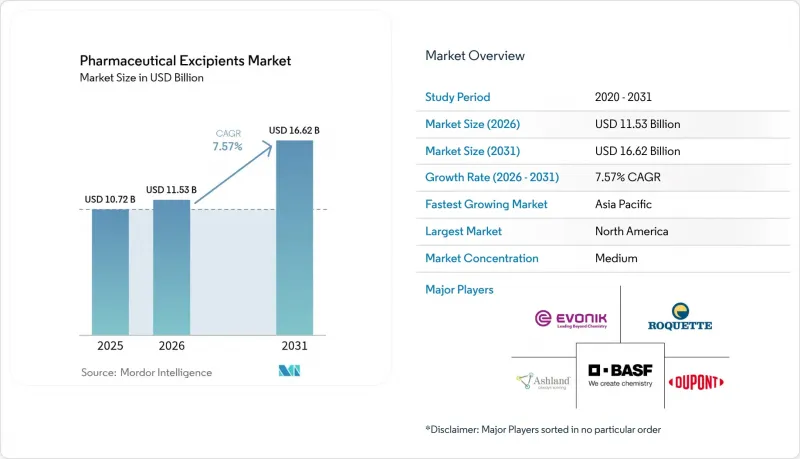
This report is Segmented by Product (Organic Chemicals and Inorganic Chemicals), Functionality (Fillers & Diluents, and More), Formulation (Oral Solid Dosage Forms, and More), Source (Plant-Based, and More), Geography (North America, Europe, Asia-Pacific, The Middle East and Africa, and South America). The Market Forecasts are Provided in Terms of Value (USD).
Global Pharmaceutical Excipients Market Trends and Insights
Rise of Multifunctional Novel Excipients for High-Potency APIs
Formulators working with potent oncology and immunology drugs now demand excipients that combine binding, disintegration, and flow-enhancing roles in one material. Co-processed platforms reduce unit operations, lower dust exposure, and deliver uniform content, making them attractive for continuous lines. Regulatory dossiers remain challenging because safety data must cover combined functionalities, which lengthens approval cycles. North American innovators hold early know-how, yet European manufacturers are rapidly scaling pilot plants to capture demand. Over the medium term, rising potency thresholds in pipeline molecules will keep multifunctional grades at the center of purchasing decisions.
Surging Demand for Biopharmaceutical Excipients Supporting Biosimilars Expansion
Biosimilar launches following monoclonal antibody patent cliffs have lifted global requirements for high-purity sugars, amino acids, and surfactants that guard protein structure during processing. Suppliers often co-develop stabilizers to match reference biologics' profiles while demonstrating bioequivalence with different compositions. Liquid formulations for at-home autoinjectors further magnify stability demands, making low-endotoxin and low-aggregate excipients critical. Costs remain high because multi-column chromatography and aseptic filtration add complexity, yet large-scale capacity in Asia-Pacific is narrowing price gaps. Long-term growth hinges on maintaining stringent microbial specs as volumes ramp.
Regulatory Variability Across Regions Limiting Global Launch Harmonization
Differing dossier formats and excipient listing rules among the FDA, EMA, and regulators in India, Brazil, and China prolong development timelines. The International Council for Harmonisation continues to draft Q14 and Q2(R2) guidelines, yet risk-assessment philosophies vary, especially for multifunctional materials. Companies maintain region-specific master files, inflating administrative overhead and delaying worldwide rollouts. Variability is especially burdensome for small and midsize innovators that lack dedicated regulatory teams. Harmonization progress remains slow, suggesting the restraint will linger into the next decade.
Other drivers and restraints analyzed in the detailed report include:
- Growth in Orally Disintegrating Tablets Driving Superdisintegrants Consumption
- Shift Toward Continuous Manufacturing Requiring Polymer-Based Processing Aids
- Toxicological Concerns Over Residual Solvents in Petrochemical Excipients
For complete list of drivers and restraints, kindly check the Table Of Contents.
Segment Analysis
Organic chemicals made up 74.97% of pharmaceutical excipients market share in 2025, underscoring continued reliance on cellulose, lactose, and starch derivatives for tableting efficiency. The pharmaceutical excipients market size linked to organic categories is expanding steadily because cellulosics match clean-label preferences and retain robust compendial support. Continuous manufacturing further elevates demand for polymer grades engineered to withstand shear and moisture variability. In contrast, inorganic halites such as sodium chloride and potassium chloride display the quickest 7.41% CAGR through 2031, owing to their role in osmotic pumps and modified-release cores. These mineral salts offer stable ionic strength profiles critical for high-load APIs in specialized dosage forms.
Innovation is creating cross-category synergies: oleochemicals derived from fatty acids bridge parenteral and oral use by offering low immunogenicity alongside lubricity advantages. Protein-based stabilizers, though smaller by volume, command premium pricing because they avert aggregation in biologics. Formulators scrutinize petrochemicals for solvent residues, nudging them toward bio-based analogs with equivalent flow properties. As continuous lines proliferate, excipients with tight PSD controls and low endotoxin profiles will dominate procurement lists.
Fillers retained 32.12% share of the pharmaceutical excipients market in 2025, reflective of their indispensable role in achieving target tablet weights and mechanical strength. Lactose monohydrate and microcrystalline cellulose remain default options, yet DMF-graded mannitol and isomalt gain traction where moisture sensitivity persists. The rise of controlled-release therapies elevates sustained-release polymers, which are forecast to grow at 7.12% CAGR to 2031, highlighting patient-centric adherence objectives. These hydrophilic matrices moderate plasma peaks, supporting chronic disease regimens.
Binders designed for twin-screw wet granulation deliver consistent viscosity under elevated shear, meeting continuous-processing specs. Superdisintegrants graduate from simple swelling agents to critical performance determinants in fast-dissolve formats. Meanwhile, coatings evolve from basic protective films to multifunctional layers providing enteric resistance, taste masking, and brand differentiation. Co-processed excipients blur functionality boundaries by merging binding and disintegration, simplifying bill-of-materials while easing regulatory change control.
Complete Report Scope:
- By Product
- Organic Chemicals
- Carbohydrates
- Petrochemicals
- Oleochemicals
- Proteins
- Other Organic Chemicals
- Inorganic Chemicals
- Halites
- Metal Oxides
- Silicates
- Other Inorganic Chemicals
- Organic Chemicals
- By Functionality
- Fillers & Diluents
- Binders
- Suspension and Viscosity Agents
- Coatings (Film & Enteric)
- Flavoring Agents
- Disintegrants
- Colorants
- Preservatives
- Other Functionalities
- By Formulation
- Oral Solid Dosage Forms
- Parenteral Formulations
- Topical & Transdermal
- Pulmonary/Inhalation
- Ophthalmic
- Others (Sublingual, Buccal, etc.)
- By Source
- Plant-based
- Animal-based
- Synthetic
- Mineral-based
- Marine-based
- Geography
- North America
- United States
- Canada
- Mexico
- Europe
- Germany
- United Kingdom
- France
- Italy
- Spain
- Rest of Europe
- Asia-Pacific
- China
- Japan
- India
- Australia
- South Korea
- Rest of Asia-Pacific
- Middle East & Africa
- GCC
- South Africa
- Rest of Middle East & Africa
- South America
- Brazil
- Argentina
- Rest of South America
- North America
Geography Analysis
North America maintained 36.88% share of the pharmaceutical excipients market in 2025, boosted by a dense cluster of innovators, rigorous regulatory oversight, and early adoption of continuous processing. Suppliers capture premium margins on parenteral-grade polysorbates, cyclodextrins, and tailored celluloses used in biologics. Despite leadership, manufacturers face logistics vulnerabilities highlighted by recent supply shocks, prompting contingency sourcing initiatives.
Asia-Pacific is forecast to log a 6.18% CAGR through 2031, spearheaded by India's formulation outsourcing surge and China's scale-up of domestic biologic lines. Contract development and manufacturing organizations in Hyderabad and Suzhou secure multinational contracts that mandate local excipient supply under global quality standards. Investments in spray-dried mannitol, HPMC, and poloxamer plants support regional autonomy. Simultaneously, governments direct incentives toward compliance upgrades, closing historical quality gaps.
Europe represents a mature yet innovative territory, pioneering clean-label policies and biodegradable polymer research that ripple through global standards. Regulatory clarity enables swift uptake of plant-derived carriers and non-petrochemical lubricants. Latin America and the Middle East & Africa show incremental demand as national pharmacopeias toughen import regulations, catalyzing local production ventures for starches and calcium phosphates. Currency-risk mitigation and shorter lead times make domestic sourcing attractive, gradually reshaping trade flows.
- BASF
- Ashland Global
- DuPont
- Roquette Freres SA
- Evonik Industries
- Archer Daniels Midland Co.
- Kerry Group plc
- Lubrizol
- Air Liquide SA
- Croda International plc
- Innophos Holdings Inc.
- Colorcon
- DFE Pharma GmbH & Co. KG
- JRS Pharma GmbH & Co. KG
- Eastman Chemical Company
- International Flavors & Fragrances
- Merck
- Dow Inc.
- Gattefosse SA
- Shin-Etsu Chemical Co. Ltd.
Additional Benefits:
- The market estimate (ME) sheet in Excel format
- 3 months of analyst support
TABLE OF CONTENTS
1 Introduction
- 1.1 Study Assumptions & Market Definition
- 1.2 Scope of the Study
2 Research Methodology
3 Executive Summary
4 Market Landscape
- 4.1 Market Overview
- 4.2 Market Drivers
- 4.2.1 Rise of Multifunctional Novel Excipients for High-Potency APIs
- 4.2.2 Surging Demand for Biopharmaceutical Excipients Supporting Biosimilars Expansion
- 4.2.3 Growth in Orally Disintegrating Tablets Driving Superdisintegrants Consumption
- 4.2.4 Shift Toward Continuous Manufacturing Requiring Polymer-Based Processing Aids
- 4.2.5 Regional Relocation of Formulation Outsourcing to India Favors Local Excipient Suppliers
- 4.2.6 Preference for Plant-Derived Excipients to Meet Clean-Label Requirements
- 4.3 Market Restraints
- 4.3.1 Regulatory Variability Across Regions Limiting Global Launch Harmonization
- 4.3.2 High Purity Requirements Escalating Production Costs for Novel Grades
- 4.3.3 Supply-Chain Exposure to Agricultural Commodity Price Volatility (e.g., Sorbitol)
- 4.3.4 Toxicological Concerns Over Residual Solvents in Petrochemical Excipients
- 4.4 Regulatory Outlook
- 4.5 Porter's Five Forces Analysis
- 4.5.1 Bargaining Power of Suppliers
- 4.5.2 Bargaining Power of Buyers
- 4.5.3 Threat of New Entrants
- 4.5.4 Threat of Substitutes
- 4.5.5 Intensity of Competitive Rivalry
5 Market Size & Growth Forecasts (Value, USD)
- 5.1 By Product
- 5.1.1 Organic Chemicals
- 5.1.1.1 Carbohydrates
- 5.1.1.2 Petrochemicals
- 5.1.1.3 Oleochemicals
- 5.1.1.4 Proteins
- 5.1.1.5 Other Organic Chemicals
- 5.1.2 Inorganic Chemicals
- 5.1.2.1 Halites
- 5.1.2.2 Metal Oxides
- 5.1.2.3 Silicates
- 5.1.2.4 Other Inorganic Chemicals
- 5.1.1 Organic Chemicals
- 5.2 By Functionality
- 5.2.1 Fillers & Diluents
- 5.2.2 Binders
- 5.2.3 Suspension and Viscosity Agents
- 5.2.4 Coatings (Film & Enteric)
- 5.2.5 Flavoring Agents
- 5.2.6 Disintegrants
- 5.2.7 Colorants
- 5.2.8 Preservatives
- 5.2.9 Other Functionalities
- 5.3 By Formulation
- 5.3.1 Oral Solid Dosage Forms
- 5.3.2 Parenteral Formulations
- 5.3.3 Topical & Transdermal
- 5.3.4 Pulmonary/Inhalation
- 5.3.5 Ophthalmic
- 5.3.6 Others (Sublingual, Buccal, etc.)
- 5.4 By Source
- 5.4.1 Plant-based
- 5.4.2 Animal-based
- 5.4.3 Synthetic
- 5.4.4 Mineral-based
- 5.4.5 Marine-based
- 5.5 Geography
- 5.5.1 North America
- 5.5.1.1 United States
- 5.5.1.2 Canada
- 5.5.1.3 Mexico
- 5.5.2 Europe
- 5.5.2.1 Germany
- 5.5.2.2 United Kingdom
- 5.5.2.3 France
- 5.5.2.4 Italy
- 5.5.2.5 Spain
- 5.5.2.6 Rest of Europe
- 5.5.3 Asia-Pacific
- 5.5.3.1 China
- 5.5.3.2 Japan
- 5.5.3.3 India
- 5.5.3.4 Australia
- 5.5.3.5 South Korea
- 5.5.3.6 Rest of Asia-Pacific
- 5.5.4 Middle East & Africa
- 5.5.4.1 GCC
- 5.5.4.2 South Africa
- 5.5.4.3 Rest of Middle East & Africa
- 5.5.5 South America
- 5.5.5.1 Brazil
- 5.5.5.2 Argentina
- 5.5.5.3 Rest of South America
- 5.5.1 North America
6 Competitive Landscape
- 6.1 Market Concentration
- 6.2 Market Share Analysis
- 6.3 Company Profiles (includes Global level Overview, Market level overview, Core Business Segments, Financials, Headcount, Key Information, Market Rank, Market Share, Products and Services, and analysis of Recent Developments)
- 6.3.1 BASF SE
- 6.3.2 Ashland Global Holdings Inc.
- 6.3.3 DuPont de Nemours Inc.
- 6.3.4 Roquette Freres SA
- 6.3.5 Evonik Industries AG
- 6.3.6 Archer Daniels Midland Co.
- 6.3.7 Kerry Group plc
- 6.3.8 The Lubrizol Corporation
- 6.3.9 Air Liquide SA
- 6.3.10 Croda International plc
- 6.3.11 Innophos Holdings Inc.
- 6.3.12 Colorcon Inc.
- 6.3.13 DFE Pharma GmbH & Co. KG
- 6.3.14 JRS Pharma GmbH & Co. KG
- 6.3.15 Eastman Chemical Company
- 6.3.16 International Flavors & Fragrances
- 6.3.17 Merck KGaA
- 6.3.18 Dow Inc.
- 6.3.19 Gattefosse SA
- 6.3.20 Shin-Etsu Chemical Co. Ltd.
7 Market Opportunities & Future Outlook
- 7.1 White-space & Unmet-Need Assessment

