PUBLISHER: Mordor Intelligence | PRODUCT CODE: 2120505

PUBLISHER: Mordor Intelligence | PRODUCT CODE: 2120505
Structural Insulated Panels - Market Share Analysis, Industry Trends & Statistics, Growth Forecasts (2026 - 2031)
According to Mordor Intelligence, the structural insulated panels market size is estimated at USD 623.16 million in 2026, and is expected to reach USD 842.62 million by 2031, at a CAGR of 6.22% during the forecast period (2026-2031).
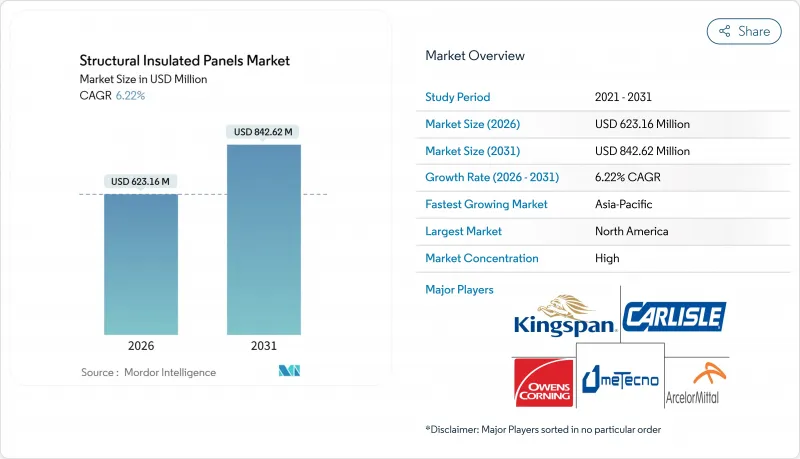
This report is Segmented by Product (EPS Panels, Glass-Wool Panels, and More), Skin Material (Oriented Strand Board, Plywood, and More), Application (Building Wall, Building Roof, and More), End-User Industry (Residential, Commercial, and Industrial and Institutional), and Geography (Asia-Pacific, North America, and More). The Market Forecasts are Provided in Terms of Value (USD).
Global Structural Insulated Panels Market Trends and Insights
Energy Efficiency Regulations Accelerating Adoption
Multiple jurisdictions are tightening thermal-transmittance limits, driving builders toward high-R-value envelopes. The 2024 revision of the European Union's Energy Performance of Buildings Directive phases out fossil-fuel heating in new dwellings by 2028, essentially mandating super-insulated exterior walls. The U.S. Department of Energy raised wall insulation requirements by 20% for climate zones 4-7 in 2025, pushing conventional stick framing to its practical limits. California's updated Title 24 grants compliance credits for factory-built panels that test below 1.5 ACH at 50 Pa, a threshold routinely met by structural insulated panels but seldom achieved by site-built walls. Collectively, these rules reward upfront thermal investment, synchronize builder incentives with occupant energy costs, and add momentum to the structural insulated panels market.
Expansion of Global Cold-Chain Infrastructure
Pharmaceutical distribution and perishable-food logistics continue to add temperature-controlled space at a double-digit clip. The International Air Transport Association logged an 11% year-over-year rise in cold-chain capacity in 2025, with Asia-Pacific capturing 43% of new square footage. Hyperscale grocers such as Walmart adopted insulated-panel envelopes for 14 new facilities in 2025, citing a 22% refrigeration-load cut versus masonry and spray-foam walls. Because energy expenses account for up to 40% of warehouse operating costs, the payback on higher-performance panels is swift, supporting premium pricing for vacuum-insulated cores in the structural insulated panels market.
Higher Upfront Costs Versus Conventional Framing
Structural insulated panels carry a 15-25% material premium over stud walls with batt insulation, a hurdle for builders working on tight gross margins. A 2025 cost study by the National Association of Home Builders pegged the incremental outlay at USD 8-12 per square foot of wall area, stretching the payback period to 12-15 years in markets lacking utility rebates. Financial institutions that underwrite loans on first cost rather than lifecycle savings compound the burden, amplifying the near-term restraint on the structural insulated panels market.
Other drivers and restraints analyzed in the detailed report include:
- Rising Affordable-Housing and Residential Remodeling
- Growing Preference for Rapid, Off-Site Construction
- Substitution Threat from Advanced Prefab Wall Systems
For complete list of drivers and restraints, kindly check the Table Of Contents.
Segment Analysis
Expanded polystyrene panels dominated with 79.94% share in 2025 and are projected to climb at a 6.36% CAGR through 2031. EPS delivers R-3.6-4.2 per inch at 30-40% lower material cost than polyurethane, a differential central to volume adoption. Kingspan noted that EPS accounted for 62% of its insulated-panel revenue in 2025, a testament to deep residential penetration. Fire-code shifts and space constraints sustain niche demand for higher-R-value polyurethane and polyisocyanurate, but those chemistries remain secondary for commodity housing. Glass-wool cores serve fire-rated and acoustic-sensitive projects, while vacuum-insulated panels still sit at lower unit volume, confined to pharma cold chains and aerospace.
A regulatory edge also accrues to EPS because it already relies on pentane, a climate-compliant blowing agent. By contrast, polyurethane suppliers are still retooling to replace HFCs banned by the U.S. Environmental Protection Agency in 2024. That conversion introduces yield uncertainty and scrap risk, temporarily widening the cost gap in favor of EPS and further consolidating leadership in the structural insulated panels market.
Oriented strand board commanded 57.36% segment share in 2025, underpinned by its favorable weight-to-strength profile and compatibility with conventional fastening methods. Yet the structural insulated panels market is recording a notable pivot toward noncombustible skins. Other skin materials are forecast to rise at a 7.19% CAGR to 2031 as urban fire codes stiffen. Tata Steel reported that steel-faced panels captured 14% share in Indian commercial construction by 2025, driven by cold-storage and pharmaceutical demands.
OSB's supply swings also nurture diversification. Beetle-driven log shortages pushed some manufacturers to plywood or hybrid steel laminates, each of which demands requalification under local codes but buffers raw-material risk. Digital design workflows accelerate change; architects now specify fire rating, impact resilience, and surface finish within BIM models, empowering project teams to evaluate multiple skin options early, compressing bid windows, and widening acceptance of nontraditional facings in the structural insulated panels market.
Complete Report Scope:
- By Product
- EPS (Expanded Polystyrene) Panels
- Rigid Polyurethane (PUR) and Rigid Polyisocyanurate (PIR) Panels
- Glass-wool Panels
- Other Products (e.g., Vacuum-insulated, etc.)
- By Skin Material
- Oriented Strand Board (OSB)
- Plywood
- Other Skin Materials (Fibre-cement Board, Galvanised Steel Sheet, etc.)
- By Application
- Building Wall
- Building Roof
- Cold Storage
- Other Applications (e.g., Data Centres, Floor and Deck, etc.)
- By End-user Industry
- Residential
- Commercial
- Industrial and Institutional
- Geography
- Asia-Pacific
- China
- India
- Japan
- South Korea
- ASEAN Countries
- Rest of Asia-Pacific
- North America
- United States
- Canada
- Mexico
- Europe
- Germany
- United Kingdom
- France
- Italy
- Rest of Europe
- South America
- Brazil
- Argentina
- Rest of South America
- Middle-East and Africa
- Saudi Arabia
- South Africa
- Rest of Middle-East and Africa
- Asia-Pacific
Geography Analysis
North America controlled 37.27% of global revenue in 2025, buoyed by U.S. and Canadian housing demand. Canada benefits further from provincial heat-loss caps that favor R-30 walls and airtightness below 2 ACH at 50 Pa. Nevertheless, beetle-induced OSB volatility and growing cross-laminated timber appeal temper North American expansion. Mexico remains an untapped frontier, where low energy costs and abundant skilled labor preserve conventional masonry, although nearshoring-driven industrial builds provide a niche opening for fast-tracked insulated envelopes.
Asia-Pacific is forecast to advance at a 7.41% CAGR, the quickest worldwide. China's prefabricated-construction is growing with insulated panels surfacing in 18% of prefab housing starts, especially in northern provinces that enforce stringent heating-season energy caps. India's market lifts off from a modest base but benefits from state-funded affordable-housing schemes and explosive cold-chain construction linked to pharmaceutical exports. Southeast Asian economies-from Vietnam to Indonesia-deploy panels in temperature-controlled warehouses that support rapidly expanding e-commerce grocery deliveries. Local manufacturing investments by Chinese, Indian, and multinational firms shorten lead times and buffer the structural insulated panels market against currency swings and freight costs.
Europe's demand is anchored by Germany, the United Kingdom, and France. Strict near-zero-energy directives and incentive loans from Germany's KfW bank push adoption toward Passive House-level performance. The United Kingdom targets off-site delivery to shrink its housing shortfall, explicitly including insulated panels in policy roadmaps. Eastern Europe, funded by EU structural packages, emerges as a fast-growing sub-region prioritizing deep-energy retrofits of socialist-era multifamily blocks. Southern Europe remains a relative laggard because milder climates dilute energy-savings economics, yet wildfire risk accelerates interest in fire-rated, noncombustible skins.
South America and the Middle East and Africa collectively form a small but strategic slice. Brazil mandates panel envelopes in vaccine storage under ANVISA regulations. Saudi Arabia integrates panels into data-center shells to lower cooling loads under 50 °C desert temperatures. South Africa's social-housing pilots trial panelized retrofits to upgrade informal settlements. Limited local fabrication capacity, import duties, and volatile currencies restrict scale but also open investment windows for early entrants aiming to capture nascent demand in the structural insulated panels market.
- All Weather Insulated Panels
- Alubel SpA
- ArcelorMittal
- Balex-Metal
- Carlisle Companies Inc.
- Cornerstone Building Brands, Inc.
- DANA Group of Companies
- Italpannelli SRL
- Jiangsu Jingxue Energy Saving Technology Co., Ltd.
- Kingspan Group
- Manni Group
- METECNO GROUP
- Multicolor Steels (India) Pvt. Ltd.
- Nucor Building Systems
- Owens Corning
- PFB Corporation
- Premium Building Systems
- Rautaruukki Corporation (Ruukki Construction)
- Structall Building Systems
- Tata Steel
- Thermocore Structural Insulated Panel Systems
- Zamil Steel Buildings India Private Limited
Additional Benefits:
- The market estimate (ME) sheet in Excel format
- 3 months of analyst support
TABLE OF CONTENTS
1 Introduction
- 1.1 Study Assumptions and Market Definition
- 1.2 Scope of the Study
2 Research Methodology
3 Executive Summary
4 Market Landscape
- 4.1 Market Overview
- 4.2 Market Drivers
- 4.2.1 Energy Efficiency Regulations Accelerating Adoption
- 4.2.2 Expansion of Global Cold-Chain Infrastructure
- 4.2.3 Rising Affordable-Housing and Residential Remodelling
- 4.2.4 Growing Preference for Rapid, Off-Site Construction
- 4.2.5 Carbon-Credit Monetisation for Timber-Based Structural Insulated Panels
- 4.3 Market Restraints
- 4.3.1 Higher Upfront Costs Vs. Conventional Framing
- 4.3.2 Substitution Threat from Advanced Prefab Wall Systems
- 4.3.3 OSB Supply Volatility (Beetle Infestation and Mill Outages)
- 4.4 Value Chain Analysis
- 4.5 Porter's Five Forces
- 4.5.1 Bargaining Power of Suppliers
- 4.5.2 Bargaining Power of Buyers
- 4.5.3 Threat of New Entrants
- 4.5.4 Threat of Substitute Products and Services
- 4.5.5 Degree of Competition
5 Market Size and Growth Forecasts (Value)
- 5.1 By Product
- 5.1.1 EPS (Expanded Polystyrene) Panels
- 5.1.2 Rigid Polyurethane (PUR) and Rigid Polyisocyanurate (PIR) Panels
- 5.1.3 Glass-wool Panels
- 5.1.4 Other Products (e.g., Vacuum-insulated, etc.)
- 5.2 By Skin Material
- 5.2.1 Oriented Strand Board (OSB)
- 5.2.2 Plywood
- 5.2.3 Other Skin Materials (Fibre-cement Board, Galvanised Steel Sheet, etc.)
- 5.3 By Application
- 5.3.1 Building Wall
- 5.3.2 Building Roof
- 5.3.3 Cold Storage
- 5.3.4 Other Applications (e.g., Data Centres, Floor and Deck, etc.)
- 5.4 By End-user Industry
- 5.4.1 Residential
- 5.4.2 Commercial
- 5.4.3 Industrial and Institutional
- 5.5 Geography
- 5.5.1 Asia-Pacific
- 5.5.1.1 China
- 5.5.1.2 India
- 5.5.1.3 Japan
- 5.5.1.4 South Korea
- 5.5.1.5 ASEAN Countries
- 5.5.1.6 Rest of Asia-Pacific
- 5.5.2 North America
- 5.5.2.1 United States
- 5.5.2.2 Canada
- 5.5.2.3 Mexico
- 5.5.3 Europe
- 5.5.3.1 Germany
- 5.5.3.2 United Kingdom
- 5.5.3.3 France
- 5.5.3.4 Italy
- 5.5.3.5 Rest of Europe
- 5.5.4 South America
- 5.5.4.1 Brazil
- 5.5.4.2 Argentina
- 5.5.4.3 Rest of South America
- 5.5.5 Middle-East and Africa
- 5.5.5.1 Saudi Arabia
- 5.5.5.2 South Africa
- 5.5.5.3 Rest of Middle-East and Africa
- 5.5.1 Asia-Pacific
6 Competitive Landscape
- 6.1 Market Concentration
- 6.2 Strategic Moves
- 6.3 Market Share(%)/Ranking Analysis
- 6.4 Company Profiles (includes Global level Overview, Market level overview, Core Segments, Financials as available, Strategic Information, Products and Services, and Recent Developments)
- 6.4.1 All Weather Insulated Panels
- 6.4.2 Alubel SpA
- 6.4.3 ArcelorMittal
- 6.4.4 Balex-Metal
- 6.4.5 Carlisle Companies Inc.
- 6.4.6 Cornerstone Building Brands, Inc.
- 6.4.7 DANA Group of Companies
- 6.4.8 Italpannelli SRL
- 6.4.9 Jiangsu Jingxue Energy Saving Technology Co., Ltd.
- 6.4.10 Kingspan Group
- 6.4.11 Manni Group
- 6.4.12 METECNO GROUP
- 6.4.13 Multicolor Steels (India) Pvt. Ltd.
- 6.4.14 Nucor Building Systems
- 6.4.15 Owens Corning
- 6.4.16 PFB Corporation
- 6.4.17 Premium Building Systems
- 6.4.18 Rautaruukki Corporation (Ruukki Construction)
- 6.4.19 Structall Building Systems
- 6.4.20 Tata Steel
- 6.4.21 Thermocore Structural Insulated Panel Systems
- 6.4.22 Zamil Steel Buildings India Private Limited
7 Market Opportunities and Future Outlook
- 7.1 White-space and Unmet-need Assessment
- 7.2 BIM-driven modular design integration

