PUBLISHER: Mordor Intelligence | PRODUCT CODE: 2120513

PUBLISHER: Mordor Intelligence | PRODUCT CODE: 2120513
Managed Infrastructure Services - Market Share Analysis, Industry Trends & Statistics, Growth Forecasts (2026 - 2031)
According to Mordor Intelligence, the managed infrastructure services market size is expected to increase from USD 129.14 billion in 2025 to USD 140.32 billion in 2026 and reach USD 211.02 billion by 2031, growing at a CAGR of 8.5% over 2026-2031.
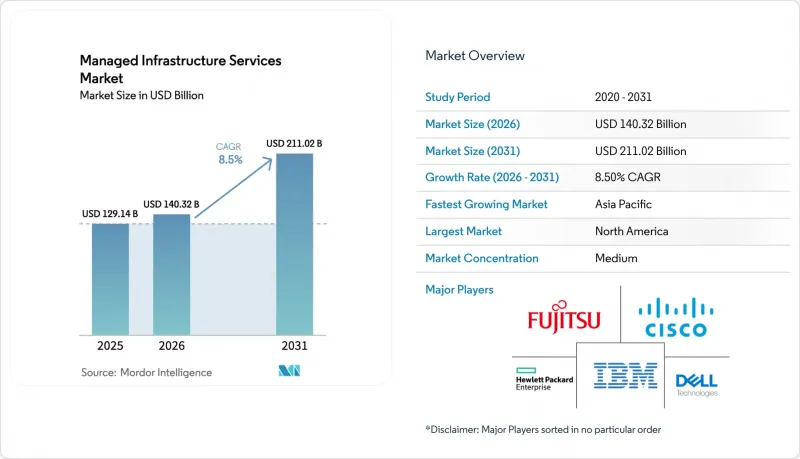
This report is Segmented by Deployment Model (On-Premises, and Cloud), Service Type (Desktop and Print, Server Management, Inventory and Asset Management, and More), Organization Size (Large Enterprises, and SMEs), End-User Vertical (BFSI, IT and Telecom, Healthcare, Manufacturing, Retail, Government, and More), and Geography. The Market Forecasts are Provided in Terms of Value (USD).
Global Managed Infrastructure Services Market Trends and Insights
Shift to Everything-as-a-Service Business Models
Usage-based pricing has moved from software to infrastructure, allowing enterprises to swap fixed depreciation for variable operating costs that flex with real-time demand. Major cloud platforms deepened per-second billing to storage, networking, and database services, erasing long-standing minimum-commit penalties. Board-level scrutiny of supplier concentration risk has accelerated multi-vendor strategies, and managed-service providers now aggregate spend across hyperscalers, colocation, and edge sites to deliver a single invoice that maps cost to business value.
Accelerated Cloud-Native Application Modernization
In 2025, enterprises retired more COBOL lines than they had in the entire previous decade, marking a significant shift in the technology landscape as lift-and-shift economics transitioned to containerized microservices overseen by Kubernetes. This transition highlights the growing adoption of modernized infrastructure solutions aimed at improving efficiency and scalability. By refactoring their core systems, banks in Singapore and Australia achieved a notable 40% reduction in infrastructure costs, alongside API latency improvements to under 50 milliseconds, showcasing the tangible benefits of modernization efforts. Managed-service providers are setting themselves apart in this evolving market by employing factory-style migration playbooks. These playbooks integrate ISO 27001 controls with site-reliability engineering practices, ensuring their environments are not only optimized for performance but also fully prepared for audits, thereby meeting stringent compliance and operational standards.
Rising Hyperscaler Lock-In Risk
Enterprises face rising switching costs and potential egress fees, which can sometimes exceed USD 0.09 per GB, particularly when repatriating petabyte-scale data. These costs can significantly impact operational budgets, especially for organizations managing large-scale data transfers. While managed-service providers offer cross-cloud abstraction layers to simplify operations, these services come with a 12-18% increase to monthly bills. Additionally, they introduce further dependencies, which can complicate vendor relationships and operational flexibility. This growing reliance on managed services has drawn the attention of antitrust regulators, who are increasingly scrutinizing such practices for potential regulatory concerns.
Other drivers and restraints analyzed in the detailed report include:
- Need for Zero-Trust Security Frameworks in Hybrid Estates
- AI-Driven Observability and Self-Healing Infrastructure
- Talent Exodus from Traditional MSPs to Cloud Providers
For complete list of drivers and restraints, kindly check the Table Of Contents.
Segment Analysis
Cloud deployments accounted for 63.14% of the 2025 revenue and are projected to grow at a CAGR of 8.67%. This trend highlights a significant shift in the managed infrastructure services market towards pay-as-you-go models, which offer flexibility and scalability to enterprises. Meanwhile, on-premises setups hold a 36.86% share. This is largely because latency-sensitive trading platforms and classified workloads depend on air-gapped servers to ensure security and performance. Additionally, regulations like DORA mandate documented fallback arrangements, further reinforcing the need for on-premises infrastructure in specific use cases. Service providers are now offering unified control planes that integrate private racks, colocation cages, and public IaaS, merging policy and telemetry into a cohesive and streamlined view for better management and decision-making.
More enterprises are adopting two-tier architectures to optimize their operations and resource utilization. They are positioning real-time analytics at the edge, enabling faster decision-making and reduced latency, while offloading GPU-intensive training tasks to the cloud to leverage its computational power and scalability. Managed-service providers are adeptly orchestrating these placements, considering factors like latency, cost, and sovereignty to ensure optimal performance and compliance. This capability elevates hybrid architecture from merely an exit strategy to a preferred design choice, offering enterprises a balanced approach to meet their evolving business and technical requirements.
Despite commanding a 28.19% share of the revenue pie, server management's growth rate of 7.8% pales in comparison to its AI-infused counterparts. This segment continues to play a critical role in the broader market, but its slower growth highlights the increasing demand for innovative solutions. As enterprises pivot towards predictive maintenance, AI-driven observability is set to spearhead service growth, boasting a projected CAGR of 11.81%. This trend underscores the growing importance of artificial intelligence in driving efficiency and reducing operational downtime.
As hybrid work diminishes office endpoint density, desktop and print services face a 6.9% annual decline. The shift to remote and flexible work environments has significantly impacted the demand for traditional office infrastructure. Meanwhile, network and connectivity services, now accounting for 16.3% of revenue, are bolstered by software-defined WAN overlays, which enhance network performance and scalability. Additionally, inventory and asset management reaps the rewards of ISO 19770 compliance mandates, streamlining license reconciliation through automation. These mandates not only ensure compliance but also help organizations optimize their asset utilization and reduce costs.
Complete Report Scope:
- By Deployment Model
- On-Premises
- Cloud
- By Service Type
- Desktop and Print Services
- Server Management
- Inventory and Asset Management
- Network and Connectivity Services
- Other Managed Infrastructure Services
- By Organization Size
- Large Enterprises
- Small and Mid-Sized Enterprises
- By End-User Vertical
- Banking, Financial Services and Insurance (BFSI)
- Information Technology and Telecommunications
- Healthcare and Life Sciences
- Manufacturing
- Retail and e-Commerce
- Government and Public Sector
- Other Verticals
- By Geography
- North America
- United States
- Canada
- Mexico
- South America
- Brazil
- Argentina
- Rest of South America
- Europe
- Germany
- United Kingdom
- France
- Italy
- Spain
- Rest of Europe
- Asia Pacific
- China
- Japan
- South Korea
- India
- Australia
- New Zealand
- Rest of Asia-Pacific
- Middle East and Africa
- Middle East
- United Arab Emirates
- Saudi Arabia
- Turkey
- Rest of Middle East
- Africa
- South Africa
- Nigeria
- Kenya
- Rest of Africa
- Middle East
- North America
Geography Analysis
In 2025, North America accounted for 42.53% of global revenue, but its 8.2% CAGR lagged behind the global average due to market saturation squeezing unit prices. The region's performance reflects a mature market where growth is constrained by limited opportunities for significant expansion. Demand in the U.S. is heavily skewed towards financial services, technology, and multi-state healthcare networks, which continue to drive investments in advanced cloud solutions. Meanwhile, Canada is adopting cloud-first initiatives, closely aligning with FedRAMP standards to enhance security and compliance. Additionally, Mexico's nearshoring surge is propelling edge computing, especially near its manufacturing hubs, as companies seek to optimize operations and reduce latency in production processes.
Asia-Pacific is leading the charge with a robust 10.21% CAGR, spurred by sovereign-cloud initiatives in nations like India, Indonesia, and Vietnam. The region's growth is underpinned by increasing digitalization efforts and supportive government policies aimed at fostering local cloud ecosystems. India's Digital Personal Data Protection Act bolsters local providers, paving the way for collaborations with hyperscalers such as Tata Consultancy Services and Wipro, which are leveraging regulatory advantages to expand their market presence. While China, propelled by state-backed expansions from giants like Alibaba Cloud and Huawei, stands as the region's dominant player, Japan and South Korea are banking on managed infrastructure to drive their 5G and Industry 4.0 advancements. These advancements are critical for enabling next-generation technologies and maintaining competitiveness in the global market.
Europe, with an 18.3% revenue share, is witnessing an 8.6% growth rate. The Digital Operational Resilience Act is reshaping the landscape, breaking up lengthy contracts and pushing for multi-cloud strategies that benefit vendor-agnostic players. This regulatory shift is creating opportunities for providers that can offer flexible and interoperable solutions. In Germany, there's a strong emphasis on edge-to-core integration for factory automation, which is essential for enhancing productivity and supporting the country's industrial base. At the same time, the UK is consolidating public-sector workloads, favoring ISO 20000-certified providers through concession frameworks that ensure high standards of service delivery. Meanwhile, the Middle East sees a 9.8% growth, anchored by smart-city initiatives that are transforming urban infrastructure and services. Africa boasts an 11% rise, driven by the expansion of fintech and mobile money platforms, which are increasing financial inclusion across the continent. South America, growing at 9.3%, witnesses banks and e-commerce platforms transitioning to managed cloud services, all under regulations reminiscent of GDPR, which aim to enhance data protection and privacy in the region.
- International Business Machines Corporation
- Hewlett Packard Enterprise Company
- Dell Technologies Inc.
- Fujitsu Limited
- Cisco Systems, Inc.
- Microsoft Corporation
- Tata Consultancy Services Limited
- Nokia Corporation
- Verizon Communications Inc.
- Deutsche Telekom AG
- Xerox Holdings Corporation
- Ricoh Company, Ltd.
- Lexmark International, Inc.
- Konica Minolta, Inc.
- Canon Inc.
- Toshiba Corporation
- Citrix Systems, Inc.
- Amazon Web Services, Inc.
- Google LLC
- Atos SE
- NTT DATA Corporation
- Wipro Limited
- Capgemini SE
- Accenture plc
- Lenovo Group Limited
- Kyndryl Holdings, Inc.
- Orange Business Services
- Lumen Technologies, Inc.
Additional Benefits:
- The market estimate (ME) sheet in Excel format
- 3 months of analyst support
TABLE OF CONTENTS
1 INTRODUCTION
- 1.1 Study Assumptions and Market Definition
- 1.2 Scope of the Study
2 RESEARCH METHODOLOGY
3 EXECUTIVE SUMMARY
4 MARKET LANDSCAPE
- 4.1 Market Overview
- 4.2 Market Drivers
- 4.2.1 Shift to Everything-as-a-Service (XaaS) Business Models
- 4.2.2 Accelerated Cloud-Native Application Modernisation
- 4.2.3 Need for Zero-Trust Security Frameworks in Hybrid Estates
- 4.2.4 Edge-to-Core Orchestration for Industry 4.0 Roll-Outs
- 4.2.5 AI-Driven Observability and Self-Healing Infrastructure
- 4.2.6 Sustainability Mandates Driving Green Data-Centre Outsourcing
- 4.3 Market Restraints
- 4.3.1 Rising Hyperscaler Lock-In Risk
- 4.3.2 Talent Exodus from Traditional MSPs to Cloud Providers
- 4.3.3 Data-Sovereignty Barriers in Highly Regulated Sectors
- 4.3.4 Escalating Cyber-Insurance Premiums Eroding TCO Benefits
- 4.4 Industry Value-Chain Analysis
- 4.5 Regulatory Landscape
- 4.6 Technological Outlook
- 4.7 Porter's Five Forces Analysis
- 4.7.1 Bargaining Power of Buyers
- 4.7.2 Bargaining Power of Suppliers
- 4.7.3 Threat of New Entrants
- 4.7.4 Threat of Substitutes
- 4.7.5 Competitive Rivalry
5 MARKET SIZE AND GROWTH FORECASTS (VALUE)
- 5.1 By Deployment Model
- 5.1.1 On-Premises
- 5.1.2 Cloud
- 5.2 By Service Type
- 5.2.1 Desktop and Print Services
- 5.2.2 Server Management
- 5.2.3 Inventory and Asset Management
- 5.2.4 Network and Connectivity Services
- 5.2.5 Other Managed Infrastructure Services
- 5.3 By Organization Size
- 5.3.1 Large Enterprises
- 5.3.2 Small and Mid-Sized Enterprises
- 5.4 By End-User Vertical
- 5.4.1 Banking, Financial Services and Insurance (BFSI)
- 5.4.2 Information Technology and Telecommunications
- 5.4.3 Healthcare and Life Sciences
- 5.4.4 Manufacturing
- 5.4.5 Retail and e-Commerce
- 5.4.6 Government and Public Sector
- 5.4.7 Other Verticals
- 5.5 By Geography
- 5.5.1 North America
- 5.5.1.1 United States
- 5.5.1.2 Canada
- 5.5.1.3 Mexico
- 5.5.2 South America
- 5.5.2.1 Brazil
- 5.5.2.2 Argentina
- 5.5.2.3 Rest of South America
- 5.5.3 Europe
- 5.5.3.1 Germany
- 5.5.3.2 United Kingdom
- 5.5.3.3 France
- 5.5.3.4 Italy
- 5.5.3.5 Spain
- 5.5.3.6 Rest of Europe
- 5.5.4 Asia Pacific
- 5.5.4.1 China
- 5.5.4.2 Japan
- 5.5.4.3 South Korea
- 5.5.4.4 India
- 5.5.4.5 Australia
- 5.5.4.6 New Zealand
- 5.5.4.7 Rest of Asia-Pacific
- 5.5.5 Middle East and Africa
- 5.5.5.1 Middle East
- 5.5.5.1.1 United Arab Emirates
- 5.5.5.1.2 Saudi Arabia
- 5.5.5.1.3 Turkey
- 5.5.5.1.4 Rest of Middle East
- 5.5.5.2 Africa
- 5.5.5.2.1 South Africa
- 5.5.5.2.2 Nigeria
- 5.5.5.2.3 Kenya
- 5.5.5.2.4 Rest of Africa
- 5.5.5.1 Middle East
- 5.5.1 North America
6 COMPETITIVE LANDSCAPE
- 6.1 Market Concentration
- 6.2 Strategic Moves
- 6.3 Market Share Analysis
- 6.4 Company Profiles (includes Global Level Overview, Market Level Overview, Core Segments, Financials as available, Strategic Information, Market Rank/Share, Products and Services, Recent Developments)
- 6.4.1 International Business Machines Corporation
- 6.4.2 Hewlett Packard Enterprise Company
- 6.4.3 Dell Technologies Inc.
- 6.4.4 Fujitsu Limited
- 6.4.5 Cisco Systems, Inc.
- 6.4.6 Microsoft Corporation
- 6.4.7 Tata Consultancy Services Limited
- 6.4.8 Nokia Corporation
- 6.4.9 Verizon Communications Inc.
- 6.4.10 Deutsche Telekom AG
- 6.4.11 Xerox Holdings Corporation
- 6.4.12 Ricoh Company, Ltd.
- 6.4.13 Lexmark International, Inc.
- 6.4.14 Konica Minolta, Inc.
- 6.4.15 Canon Inc.
- 6.4.16 Toshiba Corporation
- 6.4.17 Citrix Systems, Inc.
- 6.4.18 Amazon Web Services, Inc.
- 6.4.19 Google LLC
- 6.4.20 Atos SE
- 6.4.21 NTT DATA Corporation
- 6.4.22 Wipro Limited
- 6.4.23 Capgemini SE
- 6.4.24 Accenture plc
- 6.4.25 Lenovo Group Limited
- 6.4.26 Kyndryl Holdings, Inc.
- 6.4.27 Orange Business Services
- 6.4.28 Lumen Technologies, Inc.
7 MARKET OPPORTUNITIES AND FUTURE OUTLOOK
- 7.1 White-Space and Unmet-Need Assessment

