PUBLISHER: Mordor Intelligence | PRODUCT CODE: 2120525

PUBLISHER: Mordor Intelligence | PRODUCT CODE: 2120525
Fetal And Neonatal Monitoring - Market Share Analysis, Industry Trends & Statistics, Growth Forecasts (2026 - 2031)
According to Mordor Intelligence, the fetal and neonatal monitoring market size is projected to be USD 9.81 billion in 2025, USD 10.47 billion in 2026, and reach USD 14.5 billion by 2031, growing at a CAGR of 6.74% from 2026 to 2031.
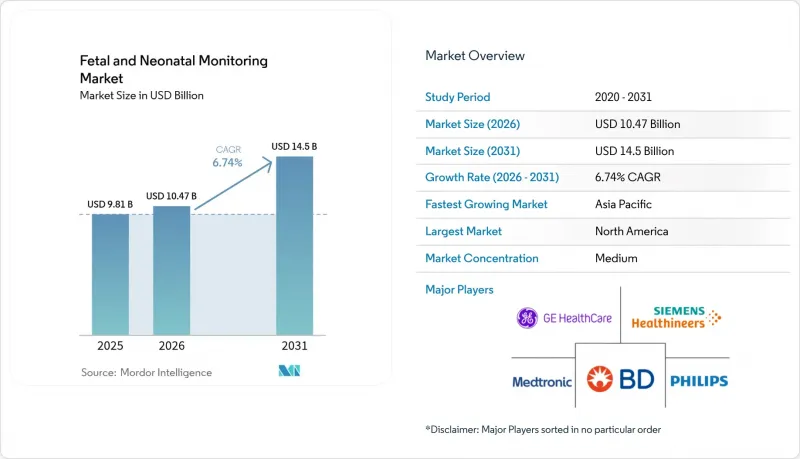
This report is Segmented by Product (Fetal Monitoring Devices, and Neonatal Monitoring Devices), Method (Invasive, Non-Invasive), Portability (Portable, Non-Portable), End User (Hospitals, Neonatal Care Centers, Home-Care Settings, Other End Users), and Geography (North America, Europe, Asia-Pacific, Middle East & Africa, South America). The Market Forecasts are Provided in Terms of Value (USD).
Global Fetal And Neonatal Monitoring Market Trends and Insights
Rising Pre-Term & Low-Birth-Weight Deliveries
The U.S. pre-term rate climbed to 10.41% in 2024 . Hospitals respond by deploying continuous electronic fetal monitoring in labor suites and stocking Level III NICUs with multiparameter devices that track heart rate, oxygen saturation, and transcutaneous carbon dioxide. Demand is also shifting to wireless Doppler patches for high-risk pregnancies managed at home, a segment enabled by permanent U.S. telehealth codes. Portable monitors compliant with ISO 80601-2-85 remain essential in rural Africa and South Asia, where mains power is unreliable. Collectively, these dynamics lift unit volumes faster than population growth, sustaining the fetal and neonatal monitoring market even in low-birth-rate economies.
Government Maternity-Care Initiatives in Emerging Economies
Between 2020 and 2025, India's Janani Suraksha Yojana distributed cash incentives to 30 million mothers, channeling deliveries toward accredited facilities equipped with fetal monitors. China's provinces have earmarked more than CNY 2 billion (USD 280 million) in 2024 for NICU upgrades under the three-child policy . Ethiopia, after equipping 500 health centers with handheld Dopplers, recorded an 18% stillbirth reduction in two years. These policies converge on low-cost, non-invasive devices, accelerating external Doppler and handheld ultrasound sales. Faster regulatory acceptance, with many ministries accepting FDA or CE clearances without in-country trials, condenses vendor entry times to under nine months, widening geographic reach for the fetal and neonatal monitoring market.
Limited Device Accessibility in Rural LMIC Facilities
A 2024 World Bank audit revealed that 43% of primary health centers in Kenya, Tanzania and Uganda face daily power outages over four hours, hampering mains-powered CTG deployment. Consumable spoilage rates exceed 15% in tropical climates, inflating per-use costs. As a result, handheld Dopplers priced below USD 300 dominate, yet lack continuous waveforms needed for quality audits. Stillbirth rates remain stubbornly high-21 per 1,000 in sub-Saharan Africa-highlighting that hardware alone cannot offset workforce and infrastructure gaps. These factors collectively subtract 0.7 percentage points from the long-term CAGR of the fetal and neonatal monitoring market.
Other drivers and restraints analyzed in the detailed report include:
- Expanding NICU Capacity Across Private Hospital Chains
- Increasing Adoption of Advanced CTG & Ultrasound Systems
- Lengthy 510(k)/CE Approval Timelines
For complete list of drivers and restraints, kindly check the Table Of Contents.
Segment Analysis
Neonatal monitors are closing on fetal systems, expanding 7.43% annually against the broader fetal and neonatal monitoring market CAGR of 6.74%. Fetal CTG and external Doppler devices still anchor 61.45% of revenue, but AI-enabled software subscriptions, such as PeriGen Cerebro, blur hardware boundaries. Multiparameter neonatal platforms, exemplified by Mindray BeneVision and Drager Infinity Delta, now bundle capnography, pulse oximetry, and invasive blood pressure in one chassis, driving upgrade cycles. Masimo's 2024 acquisition of Stork extends neonatal surveillance beyond discharge, hinting at post-acute use cases that add fresh volume to the fetal and neonatal monitoring market size.
Demand migrates toward integrated modules because single-function monitors crowd limited NICU head-wall slots. Capnograph volumes rose notably in 2024 as lung-protective strategies targeted extremely low-birth-weight infants. AI layers that predict sepsis risk are next, with patent filings for machine-learning signal processing now 38% of total fetal-monitoring patent applications. Collectively, these shifts set a taller performance bar, tightening competition among incumbents while leaving niche space for cloud-native entrants.
Non-invasive techniques command 69.98% of 2025 revenue and are also expected to register the fastest growth in the forecast period, with a CAGR of 7.65%. Transcutaneous CO2 monitors slash neonatal heel sticks by 30%, improving nursing efficiency. Meanwhile, the ICE 80601 standard aligns alarm protocols across devices, streamlining clinician workflows. Conversely, invasive tools-fetal scalp electrodes, intrauterine pressure catheters-retain use in obese patients or when signal quality degrades. Goldtrace's 2025 wireless scalp electrode mitigates cable clutter, but adoption remains selective, anchoring a low-volume, high-margin niche.
Training requirements are higher for invasive placements, and malpractice insurers in the United States often mandate credentialing, dampening uptake. Still, the devices' diagnostic precision in complex labor ensures continued procurement, safeguarding a small but critical adjacency inside the larger fetal and neonatal monitoring market.
Complete Report Scope:
- By Product
- Fetal Monitoring Devices
- External Doppler HR Monitors
- Cardiotocography (CTG) Systems
- Uterine Contraction Monitors
- Fetal Pulse Oximeters
- Wireless/Wearable Fetal Patches
- AI-Enabled Predictive Platforms
- Other Fetal Monitoring Devices
- Neonatal Monitoring Devices
- Cardiac Monitors
- Capnographs
- Blood-Pressure Monitors
- Pulse Oximeters
- Integrated Multiparameter Monitors
- Respiratory Monitors
- Other Neonatal Monitoring Devices
- Fetal Monitoring Devices
- By Method
- Invasive
- Non-Invasive
- By Poribility
- Portable
- Non Portable
- By End User
- Hospitals
- Neonatal Care Centres
- Home-Care Settings
- Other End Users
- By Geography
- North America
- United States
- Canada
- Mexico
- Europe
- Germany
- United Kingdom
- France
- Italy
- Spain
- Rest of Europe
- Asia-Pacific
- China
- India
- Japan
- South Korea
- Australia
- Rest of Asia-Pacific
- Middle East and Africa
- GCC
- South Africa
- Rest of Middle East and Africa
- South America
- Brazil
- Argentina
- Rest of South America
- North America
Geography Analysis
North America contributed 45.3% of global revenue in 2025, led by 3,000 U.S. hospitals with networked CTG and 800 Level III/IV NICUs. Permanent remote-monitoring codes amplify sales of wearable fetal patches, while the FDA's cybersecurity mandate, activated in 2024, raises entry barriers for low-cost importers. Canada's provincial health services replace decade-old consoles on standard five-year cycles, whereas Mexico lags because public budgets favor basic obstetric kits over digital networks.
Asia-Pacific is the fastest-growing theatre at 8.11% per year. China cut maternal mortality to 15.1 per 100,000 births in 2023 after pouring CNY 2+ billion into county-level maternal-child hospitals. Mindray shipped 18,000 neonatal monitors in 2024, up 22% year-on-year. India's LaQshya program funnels INR 3,200 crore (USD 385 million) into labor-room upgrades across 5,000 facilities, supporting broad diffusion of portable Dopplers. Japan bucks the low-birth trend by spending heavily on AI-enabled monitors to offset staffing gaps, while Australia and South Korea grow at mid-single-digit levels tied to routine replacement.
Europe contributed significant share of 2025 revenue, but MDR-related CE delays and GDPR encryption rules dampen cloud-based deployments. Germany, France and the U.K. still account for majority of regional sales thanks to dense hospital networks. The Middle East and Africa combine for notable share; Gulf states invest in maternal-child megahospitals, but sub-Saharan Africa struggles with power outages that curtail digital uptake. South America faces currency swings that cap capital-equipment budgets.
- Analogic
- Arjo AB
- Atom Medical
- Beckton Dickinson
- Cardinal Health
- The Cooper Companies
- Dragerwerk
- EDAN Instruments Inc.
- Fisher & Paykel Healthcare
- FUJIFILM
- GE Healthcare
- Getinge
- Huntleigh Healthcare Ltd.
- International Biomedical
- Koninklijke Philips
- Masimo
- Medtronic
- Mindray Bio-Medical Electronics
- Natus Medical
- Nihon Kohden
- Phoenix Medical Systems Pvt Ltd.
- Siemens Healthineers
- Spacelabs Healthcare
- Vyaire Medical
Additional Benefits:
- The market estimate (ME) sheet in Excel format
- 3 months of analyst support
TABLE OF CONTENTS
1 Introduction
- 1.1 Study Assumptions & Market Definition
- 1.2 Scope of the Study
2 Research Methodology
3 Executive Summary
4 Market Landscape
- 4.1 Market Overview
- 4.2 Market Drivers
- 4.2.1 Rising Pre-Term & Low-Birth-Weight Deliveries
- 4.2.2 Government Maternity-Care Initiatives in Emerging Economies
- 4.2.3 Expanding NICU Capacity Across Private Hospital Chains
- 4.2.4 Increasing Adoption of Advanced CTG & Ultrasound Systems
- 4.2.5 Integration of Maternal-Fetal Big-Data Platforms with Hospital Command Centers
- 4.2.6 Insurance-Reimbursement Shifts Favoring Remote Fetal Telemetry
- 4.3 Market Restraints
- 4.3.1 Limited Device Accessibility in Rural LMIC Facilities
- 4.3.2 Lengthy 510(K)/CE Approval Timelines
- 4.3.3 Rising Cyber-Security Insurance Premiums for Networked NICU Devices
- 4.3.4 Consumer Data-Privacy Concerns Curbing Home-Monitor Uptake
- 4.4 Supply-Chain Analysis
- 4.5 Regulatory Landscape
- 4.6 Technological Outlook
- 4.7 Porter's Five Forces
- 4.7.1 Threat of New Entrants
- 4.7.2 Bargaining Power of Buyers
- 4.7.3 Bargaining Power of Suppliers
- 4.7.4 Threat of Substitutes
- 4.7.5 Intensity of Competitive Rivalry
5 Market Size & Growth Forecasts (Value, USD)
- 5.1 By Product
- 5.1.1 Fetal Monitoring Devices
- 5.1.1.1 External Doppler HR Monitors
- 5.1.1.2 Cardiotocography (CTG) Systems
- 5.1.1.3 Uterine Contraction Monitors
- 5.1.1.4 Fetal Pulse Oximeters
- 5.1.1.5 Wireless/Wearable Fetal Patches
- 5.1.1.6 AI-Enabled Predictive Platforms
- 5.1.1.7 Other Fetal Monitoring Devices
- 5.1.2 Neonatal Monitoring Devices
- 5.1.2.1 Cardiac Monitors
- 5.1.2.2 Capnographs
- 5.1.2.3 Blood-Pressure Monitors
- 5.1.2.4 Pulse Oximeters
- 5.1.2.5 Integrated Multiparameter Monitors
- 5.1.2.6 Respiratory Monitors
- 5.1.2.7 Other Neonatal Monitoring Devices
- 5.1.1 Fetal Monitoring Devices
- 5.2 By Method
- 5.2.1 Invasive
- 5.2.2 Non-Invasive
- 5.3 By Poribility
- 5.3.1 Portable
- 5.3.2 Non Portable
- 5.4 By End User
- 5.4.1 Hospitals
- 5.4.2 Neonatal Care Centres
- 5.4.3 Home-Care Settings
- 5.4.4 Other End Users
- 5.5 By Geography
- 5.5.1 North America
- 5.5.1.1 United States
- 5.5.1.2 Canada
- 5.5.1.3 Mexico
- 5.5.2 Europe
- 5.5.2.1 Germany
- 5.5.2.2 United Kingdom
- 5.5.2.3 France
- 5.5.2.4 Italy
- 5.5.2.5 Spain
- 5.5.2.6 Rest of Europe
- 5.5.3 Asia-Pacific
- 5.5.3.1 China
- 5.5.3.2 India
- 5.5.3.3 Japan
- 5.5.3.4 South Korea
- 5.5.3.5 Australia
- 5.5.3.6 Rest of Asia-Pacific
- 5.5.4 Middle East and Africa
- 5.5.4.1 GCC
- 5.5.4.2 South Africa
- 5.5.4.3 Rest of Middle East and Africa
- 5.5.5 South America
- 5.5.5.1 Brazil
- 5.5.5.2 Argentina
- 5.5.5.3 Rest of South America
- 5.5.1 North America
6 Competitive Landscape
- 6.1 Market Concentration
- 6.2 Market Share Analysis
- 6.3 Company Profiles (includes Global level Overview, Market level overview, Core Segments, Financials as available, Strategic Information, Market Rank/Share, Products & Services, Recent Developments)
- 6.3.1 Analogic Corporation
- 6.3.2 Arjo AB
- 6.3.3 Atom Medical Corporation
- 6.3.4 Becton, Dickinson and Company
- 6.3.5 Cardinal Health, Inc.
- 6.3.6 CooperSurgical Inc.
- 6.3.7 Dragerwerk AG & Co. KGaA
- 6.3.8 EDAN Instruments Inc.
- 6.3.9 Fisher & Paykel Healthcare
- 6.3.10 Fujifilm Holdings Corporation
- 6.3.11 GE Healthcare
- 6.3.12 Getinge AB
- 6.3.13 Huntleigh Healthcare Ltd.
- 6.3.14 International Biomedical
- 6.3.15 Koninklijke Philips N.V.
- 6.3.16 Masimo Corporation
- 6.3.17 Medtronic plc
- 6.3.18 Mindray Bio-Medical Electronics
- 6.3.19 Natus Medical Incorporated
- 6.3.20 Nihon Kohden Corporation
- 6.3.21 Phoenix Medical Systems Pvt Ltd.
- 6.3.22 Siemens Healthineers
- 6.3.23 Spacelabs Healthcare
- 6.3.24 Vyaire Medical Inc.
7 Market Opportunities & Future Outlook
- 7.1 White-space & Unmet-Need Assessment

