PUBLISHER: Mordor Intelligence | PRODUCT CODE: 2120534

PUBLISHER: Mordor Intelligence | PRODUCT CODE: 2120534
Aluminum Hydroxide - Market Share Analysis, Industry Trends & Statistics, Growth Forecasts (2026 - 2031)
According to Mordor Intelligence, the aluminum hydroxide market size is estimated at 2.01 million tons in 2026, and is expected to reach 2.55 million tons by 2031, at a CAGR of 4.88% during the forecast period (2026-2031).
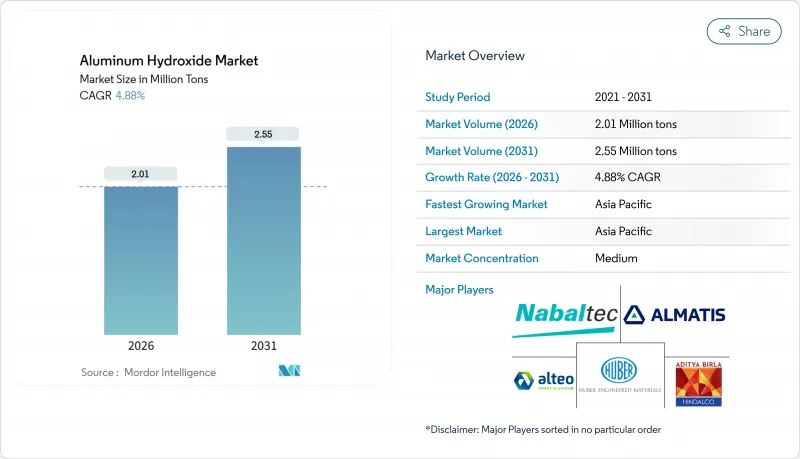
This report is Segmented by Product Type (Industrial, Pharmaceuticals, and Others), Application (Flame-Retardant and Smoke-Suppressant, Filler and Pigment, Antacid, Water-Treatment Chemicals, and Catalyst and Others), End-User Industry (Plastics and Rubber, Pharmaceuticals, CASE, and Others), and Geography (Asia-Pacific, North America, and More). The Market Forecasts are Provided in Terms of Volume (Tons).
Global Aluminum Hydroxide Market Trends and Insights
Fire-Safety Regulations Driving ATH in Polyolefin Cable Compounds
Stricter fire-safety regulations, including the EU's Construction Products Regulation EN 50575 and UL 94 V-0, are driving a transition from brominated additives to aluminum trihydrate fillers. Teknor Apex's Halguard low-smoke cable formulations have secured halogen-free certification under UL 2885, underscoring the rising demand for mineral solutions. Launched in April 2025, Benvic's Linkflex HF series, designed for data-center sheathing, boasts enhanced oil resistance. In transit and tunnel installations, aluminum hydroxide's endothermic water release at 180 °C proves beneficial, diluting combustible gases and cooling substrates. While compounders are pushing filler loadings for Class B flame ratings, the resulting high viscosity necessitates twin-screw extruders - a costly investment for smaller players in South America. With tightening standards, the aluminum hydroxide market is poised for steady growth in the global wire-and-cable sector .
Halogen-Free Flame-Retardant Demand in EV Battery Enclosures
Demand for aluminum hydroxide-filled sheet-molding compounds is surging, driven by UNECE R-100 and proprietary OEM tests that simulate thermal runaway. Hindalco underscored the volume potential by delivering aluminum battery casings to Mahindra Electric. While premium European models prioritize glass-fiber SMCs infused with aluminum hydroxide for underbody shields - valuing dimensional stability up to 150 °C despite a mass penalty over bare aluminum - Huber's Martinal grades, treated with silane, mitigate moisture uptake. This preservation of mechanical properties post-humidity aging aligns with the eight-year warranties mandated for EVs. In Asia, the aluminum hydroxide market is further buoyed as Chinese cell manufacturers, by co-locating module assembly with vehicle plants, secure local supplies..
Bauxite-Supply Volatility
In 2023, Guinea exported bauxite, setting its sights on increased exports by 2025. However, port congestion at Kamsar, coupled with monsoon disruptions, has hampered export consistency. This unpredictability has nudged Chinese buyers to pivot towards Australia, even if it means shouldering higher costs. In 2024, spot bauxite prices fluctuated. This volatility has put pressure on European aluminum hydroxide producers, who are bound by annual downstream contracts. Meanwhile, Rio Tinto's 2024 revival of its Gove refinery bolsters supply for Western smelters. Yet, the refinery grapples with elevated energy and labor expenses. As a result, the aluminum hydroxide market finds itself vulnerable to raw material shocks, leading to pronounced price fluctuations.
Other drivers and restraints analyzed in the detailed report include:
- Rising OTC Antacid Consumption in Aging Economies
- Rapid Adoption of ATH in Solid-Surface Countertops
- Health Concerns on Chronic Aluminum Intake
For complete list of drivers and restraints, kindly check the Table Of Contents.
Segment Analysis
Industrial grade represented 65.12% of volume in 2025, owing to cost-effective flame retardancy in plastics and rubber. This slice of the aluminum hydroxide market is forecast to rise at 5.11% through 2031 as cable makers swap brominated additives for mineral fillers. Converters can now balance mechanical strength with flame performance, thanks to Huber's Martinal range, which spans from 1 to 80 µm. While smaller in size, the pharmaceutical-grade variant commands a price premium. This is due to USP's stringent limit on heavy metals, ensuring the purity essential for antacid tablets and vaccine adjuvants. Specialty nano-scale grades, measuring below 200 nm, are being utilized for lithium-ion separator coatings. In a bid to boost its financials, Sumitomo's NXA series is targeting a revenue increase in FY 2025. Meanwhile, reclaimed aluminum hydroxide, sourced from refinery waste, is making waves in Europe, aligning with the region's circular-economy aspirations.
Industrial demand is on the rise, driven by the need for halogen-free cable compounds to achieve filler loading for UL 94 V-0 compliance. Additionally, fine grades are enhancing opacity in cast-polymer countertops, and stearate-treated particles are improving flow in powder paints. The pharmaceutical sector is witnessing steady growth, as an aging population increasingly opts for OTC remedies over pricier proton-pump inhibitors. The stringent ultra-high-purity requirements are narrowing the supplier pool, thereby bolstering profit margins. While specialty segments present lucrative opportunities, they remain niche. For instance, nano grades are commanding a higher price compared to standard industrial material, yet their volumes are modest in the broader aluminum hydroxide market.
Complete Report Scope:
- By Product Type
- Industrial
- Pharmaceuticals
- Others (Specialty Nano Grade and Reclaimed / Recycled Grade)
- By Application
- Flame-Retardant and Smoke-Suppressant
- Filler and Pigment
- Antacid
- Water-Treatment Chemicals
- Catalyst and Others
- By End-User Industry
- Plastics and Rubber
- Pharmaceuticals
- Paints, Coatings, Adhesives and Sealants (CASE)
- Others (Paper and Others)
- By Geography
- Asia-Pacific
- China
- India
- Japan
- South Korea
- Rest of Asia-Pacific
- North America
- United States
- Canada
- Mexico
- Europe
- Germany
- United Kingdom
- France
- Italy
- Rest of Europe
- South America
- Brazil
- Argentina
- Rest of South America
- Middle-East and Africa
- Saudi Arabia
- South Africa
- Rest of Middle-East and Africa
- Asia-Pacific
Geography Analysis
Asia-Pacific accounted for 54.22% of volume in 2025 and is set to post a 5.23% CAGR to 2031. In 2023, China imported bauxite, fueling its low-cost alumina plants. This strategic move allowed China to export aluminum hydroxide at prices lower than its European counterparts. Meanwhile, India's ambitious Jal Jeevan Mission, which is setting up rural water plants, is heavily reliant on aluminum sulfate, ensuring a steady demand for its precursor. In Japan, a significant portion of the population is seniors who drive consistent antacid consumption. At the same time, South Korea's leading battery manufacturers are opting for nano-grade aluminum hydroxide in their separators, citing its thermal stability benefits.
North America commands a significant share of the aluminum hydroxide market. While Huber and Martin Marietta capitalize on short lead times, they grapple with energy cost surges. Europe faces constraints due to power costs. This has led Nabaltec to contemplate shifting capacities to clusters in the gas-abundant Middle East. South America and the combined regions of the Middle East and Africa account for a smaller share of the market volume. While Brazil's automotive components and Saudi Arabia's hospitality projects drive growth, both regions still find themselves as net importers, hindered by limited alumina refining capabilities.
- Akrochem Corporation
- Almatis
- Alteo
- Aluminum Corporation of China Limited
- Hindalco Industries Ltd
- HONGHE CHEMICAL
- Huber Engineered Materials
- KC
- LKAB Minerals
- Martin Marietta Materials
- Nabaltec AG
- Nippon Light Metal Holdings Co., Ltd
- Resonac Holdings Corporation
- Sankyo Chemical Co. Ltd
- Sibelco
- Sumitomo Chemical Co. Ltd
- TOR Minerals
Additional Benefits:
- The market estimate (ME) sheet in Excel format
- 3 months of analyst support
TABLE OF CONTENTS
1 Introduction
- 1.1 Study Assumptions and Market Definition
- 1.2 Scope of the Study
2 Research Methodology
3 Executive Summary
4 Market Landscape
- 4.1 Market Drivers
- 4.1.1 Fire-Safety Regulations Driving ATH in Polyolefin Cable Compounds
- 4.1.2 Halogen-Free Flame-Retardant Demand in EV Battery Enclosures
- 4.1.3 Rising OTC Antacid Consumption in Ageing Economies
- 4.1.4 Rapid Adoption of ATH in Solid-Surface Countertops
- 4.1.5 Water-Treatment Infrastructure Expansion in Emerging Nations
- 4.2 Market Restraints
- 4.2.1 Bauxite-Supply Volatility
- 4.2.2 Health Concerns on Chronic Aluminum Intake
- 4.2.3 High Energy Cost of Precipitated ATH Production
- 4.3 Value Chain Analysis
- 4.4 Porter's Five Forces
- 4.4.1 Bargaining Power of Suppliers
- 4.4.2 Bargaining Power of Buyers
- 4.4.3 Threat of New Entrants
- 4.4.4 Threat of Substitutes
- 4.4.5 Degree of Competition
5 Market Size and Growth Forecasts (Volume)
- 5.1 By Product Type
- 5.1.1 Industrial
- 5.1.2 Pharmaceuticals
- 5.1.3 Others (Specialty Nano Grade and Reclaimed / Recycled Grade)
- 5.2 By Application
- 5.2.1 Flame-Retardant and Smoke-Suppressant
- 5.2.2 Filler and Pigment
- 5.2.3 Antacid
- 5.2.4 Water-Treatment Chemicals
- 5.2.5 Catalyst and Others
- 5.3 By End-User Industry
- 5.3.1 Plastics and Rubber
- 5.3.2 Pharmaceuticals
- 5.3.3 Paints, Coatings, Adhesives and Sealants (CASE)
- 5.3.4 Others (Paper and Others)
- 5.4 By Geography
- 5.4.1 Asia-Pacific
- 5.4.1.1 China
- 5.4.1.2 India
- 5.4.1.3 Japan
- 5.4.1.4 South Korea
- 5.4.1.5 Rest of Asia-Pacific
- 5.4.2 North America
- 5.4.2.1 United States
- 5.4.2.2 Canada
- 5.4.2.3 Mexico
- 5.4.3 Europe
- 5.4.3.1 Germany
- 5.4.3.2 United Kingdom
- 5.4.3.3 France
- 5.4.3.4 Italy
- 5.4.3.5 Rest of Europe
- 5.4.4 South America
- 5.4.4.1 Brazil
- 5.4.4.2 Argentina
- 5.4.4.3 Rest of South America
- 5.4.5 Middle-East and Africa
- 5.4.5.1 Saudi Arabia
- 5.4.5.2 South Africa
- 5.4.5.3 Rest of Middle-East and Africa
- 5.4.1 Asia-Pacific
6 Competitive Landscape
- 6.1 Market Concentration
- 6.2 Strategic Moves
- 6.3 Market Share/Ranking Analysis
- 6.4 Company Profiles (includes Global overview, Market overview, Core Segments, Financials, Strategic Information, Products and Services, Recent Developments)
- 6.4.1 Akrochem Corporation
- 6.4.2 Almatis
- 6.4.3 Alteo
- 6.4.4 Aluminum Corporation of China Limited
- 6.4.5 Hindalco Industries Ltd
- 6.4.6 HONGHE CHEMICAL
- 6.4.7 Huber Engineered Materials
- 6.4.8 KC
- 6.4.9 LKAB Minerals
- 6.4.10 Martin Marietta Materials
- 6.4.11 Nabaltec AG
- 6.4.12 Nippon Light Metal Holdings Co., Ltd
- 6.4.13 Resonac Holdings Corporation
- 6.4.14 Sankyo Chemical Co. Ltd
- 6.4.15 Sibelco
- 6.4.16 Sumitomo Chemical Co. Ltd
- 6.4.17 TOR Minerals
7 Market Opportunities and Future Outlook
- 7.1 White-space and Unmet-Need Assessment

