PUBLISHER: Mordor Intelligence | PRODUCT CODE: 2120539

PUBLISHER: Mordor Intelligence | PRODUCT CODE: 2120539
Healthcare Operational Analytics - Market Share Analysis, Industry Trends & Statistics, Growth Forecasts (2026 - 2031)
According to Mordor Intelligence, the healthcare operational analytics market size in 2026 is estimated at USD 15.57 billion, growing from 2025 value of USD 13.75 billion with 2031 projections showing USD 28.98 billion, growing at 13.22% CAGR over 2026-2031.
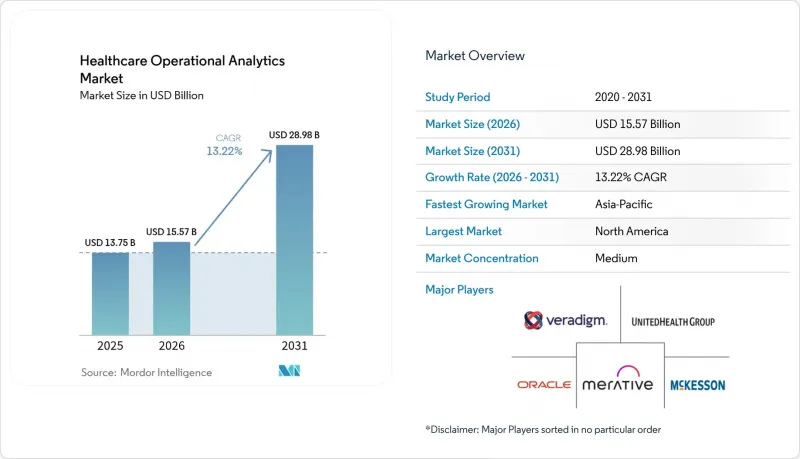
This report is Segmented by Component (Software, Hardware, Services), Deployment Mode (Cloud-Based, and More), Application (Supply Chain & Inventory Management, and More), End User (Hospitals & Health Systems, and More), and Geography (North America, and More). The Market Forecasts are Provided in Terms of Value (USD).
Global Healthcare Operational Analytics Market Trends and Insights
Value-based-care cost-containment push
Centers for Medicare & Medicaid Services finalized 97 quality measures for program year 2025, compelling providers to embed analytics into reimbursement workflows and strengthening the growth outlook for the healthcare operational analytics market . Early adopters have reported savings of USD 45 million across five years after linking outcome dashboards to bundled-payment contracts. Financial incentives in the Medicare Shared Savings Program secure long-term demand irrespective of macroeconomic cycles . As Medicare aims for universal value-based coverage by 2030, analytics platforms become infrastructure rather than optional upgrades. Competitive differentiation now hinges on the precision and timeliness of cost-quality insights delivered to clinical teams.
Data deluge from EHR digitization
Nearly half of the data stored in hospital systems remains unused for decision-making even though 95% of executives believe better use would raise clinician productivity. EHR adoption has created mixed data types-structured codes, unstructured notes, imaging metadata that exceed the capability of legacy business-intelligence tools. The healthcare operational analytics market responds with scalable machine-learning engines compliant with HIPAA and GDPR, unlocking value from long-tail clinical variables. Data-quality, provenance, and governance modules are bundled into modern solutions to reduce compliance workloads. As interoperability frameworks mature, cross-provider longitudinal datasets fuel population-health risk models that enhance preventive-care outreach.
High legacy integration costs
Case studies show multimillion-dollar variances when migrating historical data into new analytic environments, with scarce benchmarks for CIO planning. Parallel run periods inflate operating budgets and extend payback periods, causing some mid-tier hospitals to defer analytics upgrades that rely on modern EHR architectures. Vendors in the healthcare operational analytics market now package conversion accelerators using FHIR and bulk-export tooling to ease pain points, yet budgetary hesitation persists.
Other drivers and restraints analyzed in the detailed report include:
- Hospital efficiency needs amid staffing gaps
- Shift to cloud-native analytics platforms
- Data-privacy & security compliance burden
For complete list of drivers and restraints, kindly check the Table Of Contents.
Segment Analysis
Services revenue, though smaller than software, is poised to grow at a 14.05% CAGR because implementation expertise determines return on analytics investments. Hospital groups purchasing enterprise licenses often realize value only after consulting teams align dashboards with clinical workflows and build FHIR pipelines from ancillary systems. McKinsey found that holistic revenue-cycle automation programs combining leadership coaching, process redesign, and data-science support accelerate margin gains.
Software still represents 45.92% of the healthcare operational analytics market share due to embedded EHR modules and subscription contracts. However, consumption models now bundle managed services, blurring lines between license and support revenue. Hardware remains niche, limited to high-security edge appliances protecting imaging archives or military treatment facilities. Overall, the healthcare operational analytics market sees services as the catalyst for sustainable software usage and continuous-improvement cycles.
Cloud deployments held 56.78% share of the healthcare operational analytics market in 2025 and post the fastest 13.41% CAGR through 2031. Organizations migrating Epic workloads reported smoother monthly update cycles and more predictable cost structures versus on-premise environments. Hybrid models persist where imaging archives or genomic datasets must remain on local servers, but containerization eases workload portability.
Cost optimization is the next frontier, with many health systems over-provisioned on reserved instances. Rightsizing initiatives unlock funds for advanced AI projects, reinforcing cloud momentum inside the healthcare operational analytics market. On-premise deployments survive primarily in single-facility hospitals or defense installations with strict data-sovereignty mandates.
Complete Report Scope:
- By Component
- Software
- Hardware
- Services
- By Deployment Mode
- Cloud-based
- On-premise
- Hybrid
- By Application
- Supply Chain & Inventory Management
- Workforce Management
- Financial & Revenue-Cycle Management
- Patient Care & Performance Management
- Risk & Compliance Management
- Others
- By End User
- Hospitals & Health Systems
- Payers
- Ambulatory Care Centers
- Others
- By Geography
- North America
- United States
- Canada
- Mexico
- Europe
- Germany
- United Kingdom
- France
- Italy
- Spain
- Rest of Europe
- Asia-Pacific
- China
- India
- Japan
- South Korea
- Australia
- Rest of Asia-Pacific
- South America
- Brazil
- Argentina
- Rest of South America
- Middle East and Africa
- GCC
- South Africa
- Rest of Middle East and Africa
- North America
Geography Analysis
North America remains the largest region with 37.75% of healthcare operational analytics market size, benefiting from mature interoperability mandates. CMS rules linking payment to digital-quality reporting sustain purchasing even amid tight margins. However, integration costs and cyber-security spending absorb budgets, leading to selective feature rollouts instead of enterprise-wide deployments.
Asia-Pacific posts the highest 13.92% CAGR, catalyzed by demographic aging, rising consumer expectations, and government cloud-first strategies. The region's digital-health market could unlock USD 100 billion in value by 2025, prompting hospitals to leapfrog legacy systems and install cloud analytics from day one. IDC forecasts 28.9% AI spending growth through 2027, with healthcare a top vertical.
Europe shows steady uptake as GDPR and soon-to-be-effective AI regulations elevate data-privacy governance. Providers invest in consent-management dashboards and zero-trust architectures. South America and Middle East & Africa represent emerging pockets where mobile penetration and public-sector funding begin to seed analytics pilot programs, expanding the global healthcare operational analytics market footprint.
- Altera Digital Health
- Athenahealth
- GE HealthCare Technologies Inc.
- Health Catalyst
- Inovalon Holdings Inc.
- IBM
- Koninklijke Philips
- Mckesson
- MedeAnalytics
- Oracle
- Premier
- Qlik Tech International AB
- SAS Institute
- Siemens Healthineers
- TIBCO Software Inc.
- TransUnion LLC (Healthcare)
- UnitedHealth Group Incorporated (OptumInsight)
- Vizient
- Wolters Kluwer N.V. (Health)
Additional Benefits:
- The market estimate (ME) sheet in Excel format
- 3 months of analyst support
TABLE OF CONTENTS
1 Introduction
- 1.1 Study Assumptions & Market Definition
- 1.2 Scope of the Study
2 Research Methodology
3 Executive Summary
4 Market Landscape
- 4.1 Market Overview
- 4.2 Market Drivers
- 4.2.1 Value-based-care cost-containment push
- 4.2.2 Data deluge from EHR digitization
- 4.2.3 Hospital efficiency needs amid staffing gaps
- 4.2.4 Shift to cloud-native analytics platforms
- 4.2.5 RTLS-enabled real-time throughput insights
- 4.2.6 Predictive maintenance for equipment uptime
- 4.3 Market Restraints
- 4.3.1 High legacy integration costs
- 4.3.2 Data-privacy & security compliance burden
- 4.3.3 Operations-analytics talent shortage
- 4.3.4 Clinical-workflow disruption resistance
- 4.4 Value / Supply-Chain Analysis
- 4.5 Regulatory Landscape
- 4.6 Technological Outlook
- 4.7 Porter's Five Forces
- 4.7.1 Threat of New Entrants
- 4.7.2 Bargaining Power of Suppliers
- 4.7.3 Bargaining Power of Buyers
- 4.7.4 Threat of Substitutes
- 4.7.5 Competitive Rivalry
5 Market Size & Growth Forecasts (Value)
- 5.1 By Component
- 5.1.1 Software
- 5.1.2 Hardware
- 5.1.3 Services
- 5.2 By Deployment Mode
- 5.2.1 Cloud-based
- 5.2.2 On-premise
- 5.2.3 Hybrid
- 5.3 By Application
- 5.3.1 Supply Chain & Inventory Management
- 5.3.2 Workforce Management
- 5.3.3 Financial & Revenue-Cycle Management
- 5.3.4 Patient Care & Performance Management
- 5.3.5 Risk & Compliance Management
- 5.3.6 Others
- 5.4 By End User
- 5.4.1 Hospitals & Health Systems
- 5.4.2 Payers
- 5.4.3 Ambulatory Care Centers
- 5.4.4 Others
- 5.5 By Geography
- 5.5.1 North America
- 5.5.1.1 United States
- 5.5.1.2 Canada
- 5.5.1.3 Mexico
- 5.5.2 Europe
- 5.5.2.1 Germany
- 5.5.2.2 United Kingdom
- 5.5.2.3 France
- 5.5.2.4 Italy
- 5.5.2.5 Spain
- 5.5.2.6 Rest of Europe
- 5.5.3 Asia-Pacific
- 5.5.3.1 China
- 5.5.3.2 India
- 5.5.3.3 Japan
- 5.5.3.4 South Korea
- 5.5.3.5 Australia
- 5.5.3.6 Rest of Asia-Pacific
- 5.5.4 South America
- 5.5.4.1 Brazil
- 5.5.4.2 Argentina
- 5.5.4.3 Rest of South America
- 5.5.5 Middle East and Africa
- 5.5.5.1 GCC
- 5.5.5.2 South Africa
- 5.5.5.3 Rest of Middle East and Africa
- 5.5.1 North America
6 Competitive Landscape
- 6.1 Market Concentration
- 6.2 Market Share Analysis
- 6.3 Company Profiles {(includes Global level Overview, Market level overview, Core Segments, Financials as available, Strategic Information, Market Rank/Share, Products & Services, and Recent Developments)}
- 6.3.1 Altera Digital Health Inc.
- 6.3.2 Athenahealth Inc.
- 6.3.3 GE HealthCare Technologies Inc.
- 6.3.4 Health Catalyst Inc.
- 6.3.5 Inovalon Holdings Inc.
- 6.3.6 International Business Machines Corporation
- 6.3.7 Koninklijke Philips N.V.
- 6.3.8 McKesson Corporation
- 6.3.9 MedeAnalytics Inc.
- 6.3.10 Oracle Corporation
- 6.3.11 Premier Inc.
- 6.3.12 Qlik Tech International AB
- 6.3.13 SAS Institute Inc.
- 6.3.14 Siemens Healthineers AG
- 6.3.15 TIBCO Software Inc.
- 6.3.16 TransUnion LLC (Healthcare)
- 6.3.17 UnitedHealth Group Incorporated (OptumInsight)
- 6.3.18 Vizient Inc.
- 6.3.19 Wolters Kluwer N.V. (Health)
7 Market Opportunities & Future Outlook
- 7.1 White-space & Unmet-need Assessment

