PUBLISHER: Mordor Intelligence | PRODUCT CODE: 2120581

PUBLISHER: Mordor Intelligence | PRODUCT CODE: 2120581
Drug Discovery - Market Share Analysis, Industry Trends & Statistics, Growth Forecasts (2026 - 2031)
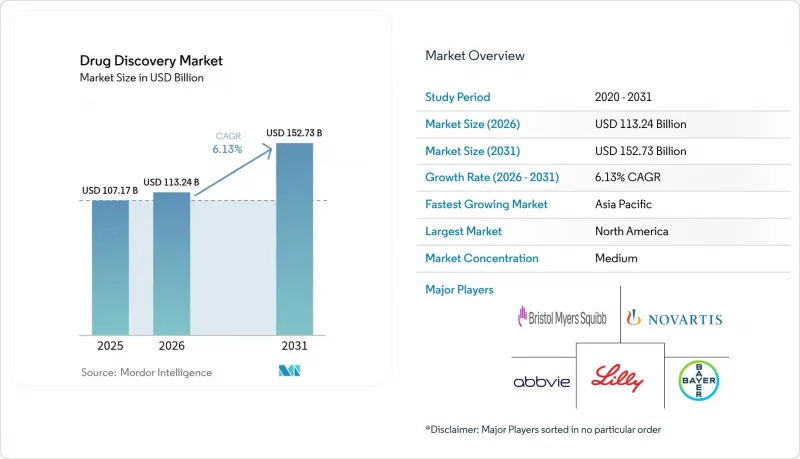
According to Mordor Intelligence, the drug discovery market size is projected to be USD 107.17 billion in 2025, USD 113.24 billion in 2026, and reach USD 152.73 billion by 2031, growing at a CAGR of 6.13% from 2026 to 2031.
This report is Segmented by Process Phase (Target Identification, Hit Generation, Lead Optimization, Pre-Clinical Selection), Technology (HTS, Bioinformatics, AI/ML, and More), Drug Type (Small-Molecule, Biologics), Therapeutic Area (Oncology, CNS, and More), End User (Pharma/Biotech, Cros, Academia), and Geography (North America, Europe, Asia-Pacific, MEA, South America). Market Forecasts are in Value (USD).
Global Drug Discovery Market Trends and Insights
AI-Driven Target Identification Gains Mainstream Adoption
Generative platforms reduced target-to-hit timelines by up to half during 2024-2025, as shown by TuneLab, which relied on large language models to predict binding affinities and ADMET profiles. Xaira Therapeutics demonstrated the commercial traction of this approach by announcing its first oncology candidate only 14 months after founding. NVIDIA joined forces with Eli Lilly in a USD 1 billion initiative that combines genomic and proteomic datasets to pinpoint novel targets in metabolic and neurodegenerative diseases. Start-ups such as Chai Discovery and Genesis Therapeutics attracted USD 130 million and USD 200 million, respectively, in 2024, validating the appetite for transformer-based models that flag off-target liabilities early. The FDA issued draft guidance in 2025 that requires sponsors to document model provenance, favoring platforms with transparent data pipelines.
Rising Biologics Pipeline Complexity Boosts Outsourced Discovery
Biologics accounted for 38.28% of drug-type revenue in 2025 and are projected to grow at 8.18% through 2031, driven by antibody-drug conjugates, bispecific formats, and cell therapies that require specialized infrastructure. Contract development and manufacturing organizations responded by adding capacity; WuXi Biologics commissioned 12,000 liters of bioreactor volume in Ireland, while Lonza opened a USD 400 million facility in Singapore to support antibody discovery. High costs for post-translational optimization and immunogenicity testing have driven many sponsors to partner with external providers that maintain validated expression systems. With biologics requiring greater discovery investment yet enjoying higher clinical success rates, the economic rationale for outsourcing is growing stronger.
Escalating Discovery Costs Amid Macro-Inflationary Pressure
Discovery spending per candidate rose between 8% and 12% from 2023 to 2025 as wages for specialist scientists increased and reagent supply chains tightened. Smaller biotechs with market capitalizations below USD 500 million felt the squeeze most acutely; 18 such firms exited the market in 2024 because they could not fund programs to investigational new drug filing. Contract research organizations also raised fees as they encountered higher utility and instrumentation costs, and sponsors with pre-inflation agreements saw immediate margin erosion. Many firms now consolidate work with fewer vendors and relocate early-stage activities to lower-cost science parks in India and Eastern Europe.
Other drivers and restraints analyzed in the detailed report include:
- Venture-Capital Funding Surge for Platform Biotech
- Accelerated FDA Fast-Track Designations for Rare-Disease Assets
- Clinical Translation Failures in Novel Modalities
For complete list of drivers and restraints, kindly check the Table Of Contents.
Segment Analysis
Hit generation and high-throughput screening commanded 36.02% of 2025 revenue, demonstrating the capital intensity of robotic liquid handlers and compound warehouses that dominate early discovery. Sponsors acknowledge, however, that physical assays alone cannot sustain speed in the drug discovery market, so virtual screens now filter libraries before reagents are consumed. Target identification and validation, roughly 22% of spend, benefits from consortia that release validated chemical probes, reducing redundant experiments. Lead optimization, about 28% of budgets, now couples structure-activity relationships with AI-guided ADMET profiling to mitigate downstream failure risk.
Pre-clinical candidate selection is the only phase projected to outpace the overall drug discovery market at a 7.06% CAGR, reflecting pressure to enter the clinic with greater confidence. Charles River Laboratories expanded its capacity in the United Kingdom and China by 15% to offer integrated toxicology, pharmacokinetics, and formulation packages. Thermo Fisher Scientific introduced a cloud-linked optimization toolkit that integrates in vitro screens with in silico pharmacophore modeling, reducing lead refinement time by 20%. Sponsors frequently invest an additional USD 2-5 million during this stage to avert a USD 50 million Phase II setback, a trade-off that tilts budgets toward late-stage discovery services.
High-throughput screening delivered 34.27% of technology revenue in 2025, yet growth is tapering as machine-learning triage reduces laboratory throughput pressures. The drug discovery market size tied to AI platforms is projected to grow fastest, with a 9.63% CAGR, more than offsetting incremental cloud compute costs. Bioinformatics and in-silico modeling, 24% of technology spend, now ride on hyperscale infrastructure; AWS released life-sciences-tuned instances that cut molecular-dynamics simulation prices by 40%. Combinatorial chemistry's renaissance is evident in DNA-encoded libraries that assign a unique oligonucleotide barcode to each compound, enabling sponsors to screen billions of variants in a single experiment.
HitGen's USD 100 million funding round and DyNAbind's USD 45 million infusion in 2024 expanded global DEL capacity. Schrodinger's physics-based algorithms guided eight pre-clinical candidates to IND filing in 2024, a milestone that elevates virtual screening credibility beyond proof-of-concept. Exscientia dosed a first patient with an AI-designed molecule in 2024, marking a watershed moment for software-led chemistry. These wins cement AI as a defining feature of platform differentiation.
Complete Report Scope:
- By Process Phase
- Target Identification & Validation
- Hit Generation / High-throughput Screening
- Lead Optimization
- Pre-clinical Candidate Selection
- By Technology
- High-throughput Screening (HTS)
- Bioinformatics & In-silico Modelling
- Artificial Intelligence & Machine Learning
- Combinatorial Chemistry
- DNA-Encoded Libraries & Other Emerging Tech
- By Drug Type
- Small-Molecule
- Biologics & Large-Molecule
- By Therapeutic Area
- Oncology
- Central Nervous System Disorders
- Cardiovascular Diseases
- Infectious Diseases
- Metabolic Disorders
- Other Therapeutic Areas
- By End User
- Pharmaceutical & Biotechnology Companies
- Contract Research Organizations (CROs)
- Academic & Research Institutes
- By Geography
- North America
- United States
- Canada
- Mexico
- Europe
- Germany
- United Kingdom
- France
- Italy
- Spain
- Rest of Europe
- Asia-Pacific
- China
- Japan
- India
- Australia
- South Korea
- Rest of Asia-Pacific
- Middle East & Africa
- GCC
- South Africa
- Rest of Middle East & Africa
- South America
- Brazil
- Argentina
- Rest of South America
- North America
Geography Analysis
North America accounted for 43.78% of 2025 revenue in the drug discovery market, driven by venture capital density, a deep talent pool, and proximity to the FDA. Cost inflation plus talent shortages, however, constrain further acceleration and make outsourcing attractive.
Asia-Pacific is projected to climb at an 11.27% CAGR, the fastest regional clip, driven by India's 40% to 50% cost advantage and China's domestic demand following the BIOSECURE Act sanctions. Indian players hired an additional 2,200 scientists and expanded laboratory space by 1.2 million square feet in 2024 alone. Japan funds biotech innovation hubs that anchor joint academic-industry projects, and Singapore offers tax holidays for biologics investment, strengthening regional competitiveness.
- Abbvie
- Amgen
- AstraZeneca
- Bayer
- BeiGene Ltd.
- Beckton Dickinson
- Boehringer Ingelheim
- Bristol-Myers Squibb
- Charles River
- Daiichi Sankyo
- Eli Lilly and Company
- Exscientia plc
- Gilead Sciences
- GlaxoSmithKline
- Johnson & Johnson
- Merck
- Novartis
- Pfizer
- Regeneron Pharmaceuticals
- Roche
- Sanofi
- Schrodinger Inc.
- Takeda Pharmaceuticals
- Thermo Fisher Scientific
- Vertex Pharmaceuticals
- WuXi App Tec
Additional Benefits:
- The market estimate (ME) sheet in Excel format
- 3 months of analyst support
TABLE OF CONTENTS
1 Introduction
- 1.1 Study Assumptions & Market Definition
- 1.2 Scope of the Study
2 Research Methodology
3 Executive Summary
4 Market Landscape
- 4.1 Market Overview
- 4.2 Market Drivers
- 4.2.1 AI-Driven Target Identification Gains Mainstream Adoption
- 4.2.2 Rising Biologics Pipeline Complexity Boosts Outsourced Discovery
- 4.2.3 Venture-Capital Funding Surge for Platform Biotech (Post-2025)
- 4.2.4 Accelerated FDA Fast-Track Designations for Rare-Disease Assets
- 4.2.5 DNA-Encoded Libraries Slash Early-Stage Cycle-Times
- 4.2.6 Open-Science Consortia Lowering IP Barriers In Pre-Competitive Space
- 4.3 Market Restraints
- 4.3.1 Escalating Discovery Costs Amid Macro-Inflationary Pressure
- 4.3.2 Clinical Translation Failures in Novel Modalities
- 4.3.3 Data-Integrity Gaps in AI Training Sets
- 4.3.4 Growing Cyber-Biosecurity Threats to Proprietary Pipelines
- 4.4 Regulatory Landscape
- 4.5 Technological Outlook
- 4.6 Porter's Five Forces Analysis
- 4.6.1 Threat of New Entrants
- 4.6.2 Bargaining Power of Buyers
- 4.6.3 Bargaining Power of Suppliers
- 4.6.4 Threat of Substitute Products
- 4.6.5 Intensity of Competitive Rivalry
5 Market Size & Growth Forecasts
- 5.1 By Process Phase
- 5.1.1 Target Identification & Validation
- 5.1.2 Hit Generation / High-throughput Screening
- 5.1.3 Lead Optimization
- 5.1.4 Pre-clinical Candidate Selection
- 5.2 By Technology
- 5.2.1 High-throughput Screening (HTS)
- 5.2.2 Bioinformatics & In-silico Modelling
- 5.2.3 Artificial Intelligence & Machine Learning
- 5.2.4 Combinatorial Chemistry
- 5.2.5 DNA-Encoded Libraries & Other Emerging Tech
- 5.3 By Drug Type
- 5.3.1 Small-Molecule
- 5.3.2 Biologics & Large-Molecule
- 5.4 By Therapeutic Area
- 5.4.1 Oncology
- 5.4.2 Central Nervous System Disorders
- 5.4.3 Cardiovascular Diseases
- 5.4.4 Infectious Diseases
- 5.4.5 Metabolic Disorders
- 5.4.6 Other Therapeutic Areas
- 5.5 By End User
- 5.5.1 Pharmaceutical & Biotechnology Companies
- 5.5.2 Contract Research Organizations (CROs)
- 5.5.3 Academic & Research Institutes
- 5.6 By Geography
- 5.6.1 North America
- 5.6.1.1 United States
- 5.6.1.2 Canada
- 5.6.1.3 Mexico
- 5.6.2 Europe
- 5.6.2.1 Germany
- 5.6.2.2 United Kingdom
- 5.6.2.3 France
- 5.6.2.4 Italy
- 5.6.2.5 Spain
- 5.6.2.6 Rest of Europe
- 5.6.3 Asia-Pacific
- 5.6.3.1 China
- 5.6.3.2 Japan
- 5.6.3.3 India
- 5.6.3.4 Australia
- 5.6.3.5 South Korea
- 5.6.3.6 Rest of Asia-Pacific
- 5.6.4 Middle East & Africa
- 5.6.4.1 GCC
- 5.6.4.2 South Africa
- 5.6.4.3 Rest of Middle East & Africa
- 5.6.5 South America
- 5.6.5.1 Brazil
- 5.6.5.2 Argentina
- 5.6.5.3 Rest of South America
- 5.6.1 North America
6 Competitive Landscape
- 6.1 Market Concentration
- 6.2 Market Share Analysis
- 6.3 Company Profiles (includes Global Level Overview, Market Level Overview, Core Segments, Financials as Available, Strategic Information, Market Rank/Share for Key Companies, Products & Services, and Recent Developments)
- 6.3.1 AbbVie Inc.
- 6.3.2 Amgen Inc.
- 6.3.3 AstraZeneca PLC
- 6.3.4 Bayer AG
- 6.3.5 BeiGene Ltd.
- 6.3.6 Becton, Dickinson and Company
- 6.3.7 Boehringer Ingelheim GmbH
- 6.3.8 Bristol-Myers Squibb Company
- 6.3.9 Charles River Laboratories International Inc.
- 6.3.10 Daiichi Sankyo Company, Limited
- 6.3.11 Eli Lilly and Company
- 6.3.12 Exscientia plc
- 6.3.13 Gilead Sciences, Inc.
- 6.3.14 GlaxoSmithKline plc
- 6.3.15 Johnson & Johnson
- 6.3.16 Merck & Co., Inc.
- 6.3.17 Novartis AG
- 6.3.18 Pfizer Inc.
- 6.3.19 Regeneron Pharmaceuticals Inc.
- 6.3.20 Roche Holding AG
- 6.3.21 Sanofi S.A.
- 6.3.22 Schrodinger Inc.
- 6.3.23 Takeda Pharmaceutical Company Limited
- 6.3.24 Thermo Fisher Scientific Inc.
- 6.3.25 Vertex Pharmaceuticals Incorporated
- 6.3.26 WuXi AppTec
7 Market Opportunities & Future Outlook
- 7.1 White-space & Unmet-Need Assessment

