PUBLISHER: Mordor Intelligence | PRODUCT CODE: 2120598

PUBLISHER: Mordor Intelligence | PRODUCT CODE: 2120598
Data Center Managed Services - Market Share Analysis, Industry Trends & Statistics, Growth Forecasts (2026 - 2031)
According to Mordor Intelligence, the data center managed services market size is expected to grow from USD 54.23 billion in 2025 to USD 62.05 billion in 2026 and is forecast to reach USD 121.67 billion by 2031 at 14.42% CAGR over 2026-2031.
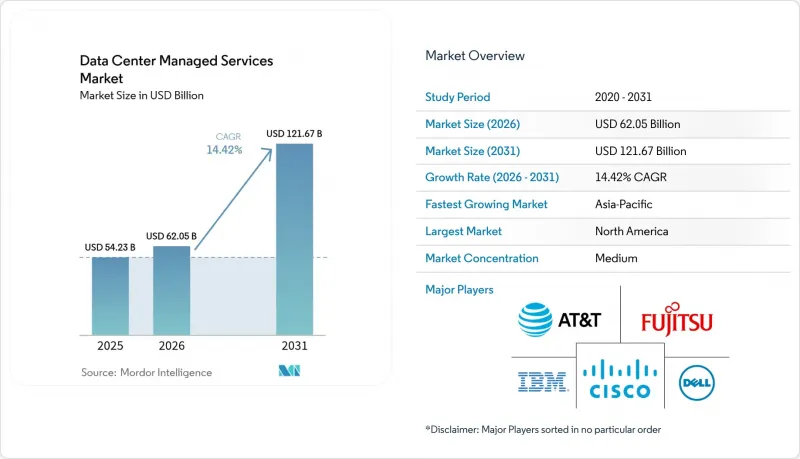
This report is Segmented by Service Type (Managed IT Infrastructure, Managed Network Services, and More), Deployment Model (Cloud, On-Premise, and More), Data Center Type (Colocation Facilities, Hyperscale-Owned Sites, and More), End-User Industry (IT and Telecommunication, BFSI, Healthcare, Retail and E-Commerce, and More), and Geography. The Market Forecasts are Provided in Terms of Value (USD).
Global Data Center Managed Services Market Trends and Insights
Growing Hyperscale-Led Colocation Demand
Hyperscale operators secured more than 1,200 MW of colocation capacity in 2024 to circumvent the 24-to-36-month lead time of greenfield builds. Equinix reported 89% utilization across its global portfolio, while Digital Realty booked USD 1.2 billion in new contracts, underscoring urgency for immediately available space. MSPs bundle remote operations, network optimization, and managed security into turnkey packages that reduce hyperscalers' overhead and accelerate go-to-market cycles. The effect is pronounced in Asia-Pacific, where sovereign cloud mandates obligate partnerships with locally licensed providers.
AI-Driven Predictive Operations
AI-enabled monitoring platforms are lowering unplanned downtime by 30-40% through predictive failure analytics. IBM's Maximo Application Suite trimmed mean-time-to-resolution by 35% in early data center rollouts during 2024, validating the economic case for AI-augmented operations. Providers that integrate telemetry from power, cooling, and network assets offer 15-20% premium SLA tiers, attracting enterprises seeking higher reliability without scaling head-count.
Power-Grid Capacity Bottlenecks
Utility queues now stretch 18-36 months in Northern Virginia, Frankfurt, and Singapore. Dominion Energy flagged a 30-month interconnection backlog in 2024, forcing operators to evaluate secondary markets such as Ohio and Texas. AI clusters seeking contiguous 50-100 MW blocks feel the pinch most acutely, prompting some MSPs to add on-site gas turbines or fuel cells despite higher complexity.
Other drivers and restraints analyzed in the detailed report include:
- Edge Data Center Roll-Outs
- Sustainability-Linked SLA Adoption
- Vendor Lock-In and Repatriation Risk
For complete list of drivers and restraints, kindly check the Table Of Contents.
Segment Analysis
Managed security services are registering a 15.52% CAGR to 2031, the fastest among all service layers. Zero-trust architecture mandates, with ransomware liabilities averaging USD 4.5 million per incident, and ISO 27001 adoption funnel budgets are directed toward continuous threat monitoring. Managed IT infrastructure still accounts for 41.10% of data center managed services market share, underscoring its role as the operational backbone.
Providers are expanding security operations centers to meet 24/7 coverage commitments while integrating immutable storage snapshots and AI-driven anomaly detection. The data center managed services market size for security services is poised to capture a larger share of enterprise spending as compliance penalties escalate. Mid-tier MSPs without in-house security expertise often pursue acquisitions to fill capability gaps, a trend that was mirrored by Rackspace's 2024 deal, which broadened its managed detection and response portfolio.
Cloud deployments captured 62.30% share in 2025, reflecting a decade of rapid migration; however, hybrid models are accelerating at a 15.21% CAGR. Enterprises see improved economics for predictable 24/7 workloads by retaining core compute on-premise while using cloud for burst capacity. Financial services institutions exemplify this balance, hosting transaction engines in compliant colocation cages and leveraging cloud analytics for customer-facing insights.
MSPs differentiate through orchestration layers that abstract infrastructure heterogeneity, enforcing uniform security and cost policies. The data center managed services market size tied to hybrid frameworks rises as sovereign data laws demand localized storage while maintaining global application responsiveness. Successful MSPs embed policy engines that trigger automated workload moves based on latency, cost, and compliance thresholds without service disruption.
Complete Report Scope:
- By Service Type
- Managed IT Infrastructure
- Managed Network Services
- Managed Security Services
- Managed Storage and Backup
- Managed Application Hosting
- By Deployment Model
- Cloud
- On-Premise
- Hybrid
- By Data Center Type
- Colocation Facilities
- Hyperscale-Owned Sites
- Enterprise On-Premise Sites
- Edge / Micro Data Centers
- By End-User Industry
- IT and Telecommunication
- BFSI
- Healthcare
- Retail and e-Commerce
- Manufacturing
- Government and Defense
- Energy and Utilities
- By Geography
- North America
- United States
- Canada
- South America
- Brazil
- Mexico
- Argentina
- Rest of South America
- Europe
- Germany
- United Kingdom
- France
- Italy
- Rest of Europe
- Asia-Pacific
- China
- Japan
- India
- South Korea
- Rest of Asia-Pacific
- Middle East and Africa
- Middle East
- United Arab Emirates
- Saudi Arabia
- Rest of Middle East
- Africa
- South Africa
- Nigeria
- Rest of Africa
- Middle East
- North America
Geography Analysis
North America retained 41.20% share in 2025. Power constraints in Northern Virginia, Phoenix, and Silicon Valley push new capacity to Columbus, Dallas, and Atlanta, where utilities offer surplus load and land prices remain moderate. Canada leverages hydropower and cooler climates to attract latency-tolerant workloads, while Mexico hosts near-shore deployments targeting South America. A mature MSP ecosystem and deep enterprise outsourcing culture support continued regional leadership.
Asia-Pacific grows at a 15.14% CAGR to 2031, the fastest among regions. China's Data Security Law and India's Digital Personal Data Protection Act drive localized infrastructure mandates, boosting demand in Beijing, Mumbai, and Bangalore. Japan faces capacity challenges in Tokyo, shifting builds to Osaka. Singapore's moratorium on new permits until 2027 channels investment to Malaysia and Indonesia. Sovereign cloud strategies and government subsidy programs underpin the region's robust expansion.
Europe commands considerable revenue, anchored by Germany, the United Kingdom, and France. Frankfurt's power backlog elongates approval cycles beyond 24 months. Brexit dynamics encourage dual-site footprints across EU and UK jurisdictions. Nordic countries offer 100% renewable grids and free cooling benefits, although added latency to central European populations limits adoption for real-time workloads. The Middle East, led by the United Arab Emirates and Saudi Arabia, invests heavily to diversify economies, while Africa's progress remains uneven outside South Africa and Nigeria.
- Equinix, Inc.
- Digital Realty Trust, Inc.
- NTT Ltd.
- IBM Corporation
- Rackspace Technology, Inc.
- Hewlett Packard Enterprise Company
- Atos SE
- Fujitsu Limited
- Tata Consultancy Services Limited
- Cognizant Technology Solutions Corporation
- Accenture plc
- Verizon Communications Inc.
- Lumen Technologies, Inc.
- China Telecom Corporation Limited
- Telefonaktiebolaget LM Ericsson
- Alibaba Cloud (Alibaba Group Holding Limited)
- Cisco Systems, Inc.
- Dell Technologies Inc.
- Schneider Electric SE
- AT&T Corporation
- Vertiv Holdings Co.
- Iron Mountain Incorporated
Additional Benefits:
- The market estimate (ME) sheet in Excel format
- 3 months of analyst support
TABLE OF CONTENTS
1 INTRODUCTION
- 1.1 Study Assumptions and Market Definition
- 1.2 Scope of the Study
2 RESEARCH METHODOLOGY
3 EXECUTIVE SUMMARY
4 MARKET LANDSCAPE
- 4.1 Market Overview
- 4.2 Market Drivers
- 4.2.1 Growing Hyperscale-Led Colo Demand
- 4.2.2 Sustainability-Linked SLA Adoption
- 4.2.3 AI-Driven Predictive Operations
- 4.2.4 Cloud Cost-Optimization Outsourcing
- 4.2.5 Edge Data Center Roll-Outs
- 4.2.6 Skill-Gap Outsourcing In Ops And Sec
- 4.3 Market Restraints
- 4.3.1 Power-Grid Capacity Bottlenecks
- 4.3.2 Vendor Lock-In And Repatriation Risk
- 4.3.3 Scarcity Of Specialist Labor
- 4.3.4 Heightened Data-Sovereignty Rules
- 4.4 Industry Value Chain Analysis
- 4.5 Regulatory Landscape
- 4.6 Technological Outlook
- 4.7 Porter's Five Forces Analysis
- 4.7.1 Threat of New Entrants
- 4.7.2 Bargaining Power of Buyers
- 4.7.3 Bargaining Power of Suppliers
- 4.7.4 Threat of Substitutes
- 4.7.5 Intensity of Competitive Rivalry
5 MARKET SIZE AND GROWTH FORECASTS (VALUE)
- 5.1 By Service Type
- 5.1.1 Managed IT Infrastructure
- 5.1.2 Managed Network Services
- 5.1.3 Managed Security Services
- 5.1.4 Managed Storage and Backup
- 5.1.5 Managed Application Hosting
- 5.2 By Deployment Model
- 5.2.1 Cloud
- 5.2.2 On-Premise
- 5.2.3 Hybrid
- 5.3 By Data Center Type
- 5.3.1 Colocation Facilities
- 5.3.2 Hyperscale-Owned Sites
- 5.3.3 Enterprise On-Premise Sites
- 5.3.4 Edge / Micro Data Centers
- 5.4 By End-User Industry
- 5.4.1 IT and Telecommunication
- 5.4.2 BFSI
- 5.4.3 Healthcare
- 5.4.4 Retail and e-Commerce
- 5.4.5 Manufacturing
- 5.4.6 Government and Defense
- 5.4.7 Energy and Utilities
- 5.5 By Geography
- 5.5.1 North America
- 5.5.1.1 United States
- 5.5.1.2 Canada
- 5.5.2 South America
- 5.5.2.1 Brazil
- 5.5.2.2 Mexico
- 5.5.2.3 Argentina
- 5.5.2.4 Rest of South America
- 5.5.3 Europe
- 5.5.3.1 Germany
- 5.5.3.2 United Kingdom
- 5.5.3.3 France
- 5.5.3.4 Italy
- 5.5.3.5 Rest of Europe
- 5.5.4 Asia-Pacific
- 5.5.4.1 China
- 5.5.4.2 Japan
- 5.5.4.3 India
- 5.5.4.4 South Korea
- 5.5.4.5 Rest of Asia-Pacific
- 5.5.5 Middle East and Africa
- 5.5.5.1 Middle East
- 5.5.5.1.1 United Arab Emirates
- 5.5.5.1.2 Saudi Arabia
- 5.5.5.1.3 Rest of Middle East
- 5.5.5.2 Africa
- 5.5.5.2.1 South Africa
- 5.5.5.2.2 Nigeria
- 5.5.5.2.3 Rest of Africa
- 5.5.5.1 Middle East
- 5.5.1 North America
6 COMPETITIVE LANDSCAPE
- 6.1 Market Concentration
- 6.2 Strategic Moves
- 6.3 Market Share Analysis
- 6.4 Company Profiles (includes Global level Overview, Market level overview, Core Segments, Financials as available, Strategic Information, Market Rank/Share for key companies, Products and Services, and Recent Developments)
- 6.4.1 Equinix, Inc.
- 6.4.2 Digital Realty Trust, Inc.
- 6.4.3 NTT Ltd.
- 6.4.4 IBM Corporation
- 6.4.5 Rackspace Technology, Inc.
- 6.4.6 Hewlett Packard Enterprise Company
- 6.4.7 Atos SE
- 6.4.8 Fujitsu Limited
- 6.4.9 Tata Consultancy Services Limited
- 6.4.10 Cognizant Technology Solutions Corporation
- 6.4.11 Accenture plc
- 6.4.12 Verizon Communications Inc.
- 6.4.13 Lumen Technologies, Inc.
- 6.4.14 China Telecom Corporation Limited
- 6.4.15 Telefonaktiebolaget LM Ericsson
- 6.4.16 Alibaba Cloud (Alibaba Group Holding Limited)
- 6.4.17 Cisco Systems, Inc.
- 6.4.18 Dell Technologies Inc.
- 6.4.19 Schneider Electric SE
- 6.4.20 AT&T Corporation
- 6.4.21 Vertiv Holdings Co.
- 6.4.22 Iron Mountain Incorporated
7 MARKET OPPORTUNITIES AND FUTURE OUTLOOK
- 7.1 White-Space and Unmet-Need Assessment

