PUBLISHER: Mordor Intelligence | PRODUCT CODE: 2120602

PUBLISHER: Mordor Intelligence | PRODUCT CODE: 2120602
Curcumin - Market Share Analysis, Industry Trends & Statistics, Growth Forecasts (2026 - 2031)
According to Mordor Intelligence, curcumin market size in 2026 is estimated at USD 120.88 million, growing from 2025 value of USD 108.79 million with 2031 projections showing USD 204.95 million, growing at 11.14% CAGR over 2026-2031.
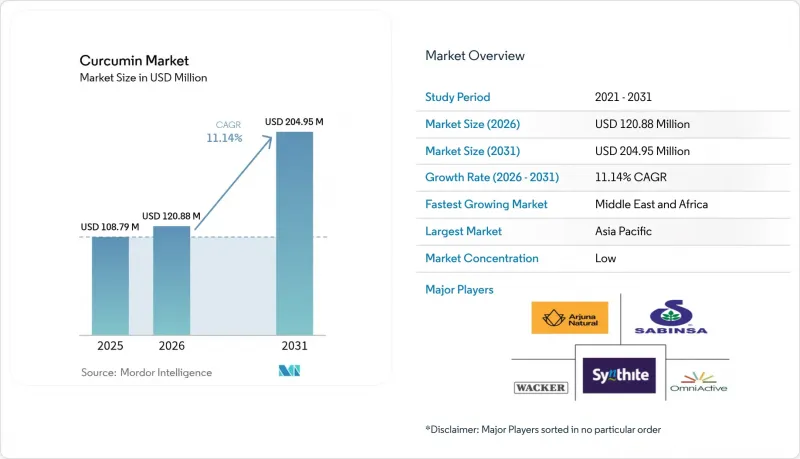
This report is Segmented by Form (Powder and Liquid), Nature (Organic and Conventional), Applications (Dietary Supplement, Food and Beverages, Cosmetic and Personal Care, and Others), and Geography (North America, Europe, Asia-Pacific, South America and Middle East and Africa). The Market Forecasts are Provided in Terms of Value (USD).
Global Curcumin Market Trends and Insights
Shift towards plant-based and herbal ingredients in dietary supplements
Growing consumer demand for plant-based ingredients is driving a transformation in supplement formulation strategies, with curcumin positioned as a pivotal botanical ingredient bridging traditional medicine and modern wellness solutions. This shift is particularly prominent in North America and Europe, where regulatory environments increasingly support natural ingredients with proven safety credentials. The FDA's GRAS Notice 822 for curcumin reinforces its safety for food applications, enabling manufacturers to confidently expand their product offerings Companies are leveraging this trend by producing standardized curcumin extracts that meet pharmaceutical-grade requirements, exemplified by Sabinsa Corporation's Curcumin C3 Complex, which has received EFSA approval for the European market. Additionally, the trend is advancing beyond ingredient substitution to include whole-plant extracts that retain synergistic compounds. For instance, Cellavent's fermentation technology enhances turmeric's bioactive properties through controlled Lactobacillus fermentation, showcasing innovation in the sector.
Rising demand for anti-inflammatory nutraceuticals in joint health formulations
Curcumin has established itself as a scientifically validated solution in the joint health market, gaining significant adoption among aging demographics and active lifestyle consumers due to growing clinical evidence. Its mechanism of action involves inhibiting key inflammatory mediators, such as cyclooxygenase-2 and lipoxygenase, positioning it as a natural alternative to non-steroidal anti-inflammatory drugs. This scientific validation is driving commercial growth, with companies developing targeted joint health formulations that integrate curcumin with complementary ingredients like glucosamine and hyaluronic acid. The segment's expansion is further supported by its applications in sports nutrition, where curcumin's anti-inflammatory properties enhance exercise recovery and optimize performance. Indena's Meriva curcumin phytosome technology exemplifies this market trend, with clinical studies demonstrating measurable benefits for chronic kidney disease patients, including reduced inflammatory mediators and improved oxidative stress management.
High cost associated with extraction technologies
Producing high-purity curcumin extracts using advanced extraction technologies presents a significant cost challenge, restricting market penetration, particularly in price-sensitive segments and emerging markets. The incorporation of bioavailability enhancement technologies further escalates the cost structure. This cost pressure is driving industry consolidation, as smaller manufacturers face difficulties competing with vertically integrated companies managing the entire value chain, from turmeric cultivation to finished product manufacturing. The USDA NIFA's investment in green technology research, focusing on high-bioavailability curcumin nanoparticles through supercritical CO2 drying methods, reflects governmental efforts to lower extraction costs via technological advancements. In response, companies are adopting hybrid extraction processes to balance purity standards with cost efficiency, while exploring FDA-approved alternative solvents to reduce operational expenses without compromising product quality.
Other drivers and restraints analyzed in the detailed report include:
- Curcumin as a natural antioxidant in anti-aging cosmetic formulations
- Boosting immunity naturally-curcumin in immune support supplements
- Strict regulatory scrutiny in the EU and U.S. for health claims
For complete list of drivers and restraints, kindly check the Table Of Contents.
Segment Analysis
Powder formulations command 72.86% market share in 2025, reflecting established manufacturing infrastructure and cost advantages that make curcumin accessible across diverse price points and applications. The dominance of the powder segment is attributed to its versatility in encapsulation, tablet production, and direct integration into food products, coupled with superior stability and extended shelf life compared to liquid alternatives. However, liquid curcumin formulations are poised for significant growth, with a projected CAGR of 11.72% from 2026 to 2031, propelled by increasing consumer demand for convenient delivery formats and advancements in solubility-enhancing technologies.
The rapid growth of the liquid segment is underpinned by innovations in water-soluble curcumin complexes and emulsion technologies that address curcumin's hydrophobic nature. Companies are investing in advanced delivery systems, such as liposomal curcumin, which improves bioavailability through phospholipid encapsulation. When combined with ultrasound-mediated release mechanisms, these systems demonstrate notable efficacy in cancer treatment. Additionally, the Facilitated Self-Assembling Technology (FAST) represents a breakthrough by enabling nanoparticle production without the need for surfactants or stabilizers, making liquid curcumin formulations more cost-effective and consumer-friendly. Liquid formulations are gaining significant traction in functional beverages and sports nutrition, where their rapid absorption and convenience offer a competitive edge over traditional powder formats.
Complete Report Scope:
- By Form
- Powder
- Liquid
- By Nature
- Organic
- Conventional
- By Application
- Dietary Supplement
- Food and Beverage
- Cosmetic and Personal Care
- Others
- By Geography
- North America
- United States
- Canada
- Mexico
- Rest of North America
- Europe
- Germany
- United Kingdom
- Italy
- France
- Spain
- Netherlands
- Poland
- Belgium
- Sweden
- Rest of Europe
- Asia-Pacific
- China
- India
- Japan
- Australia
- Indonesia
- South Korea
- Thailand
- Singapore
- Rest of Asia-Pacific
- South America
- Brazil
- Argentina
- Colombia
- Chile
- Peru
- Rest of South America
- Middle East and Africa
- South Africa
- Saudi Arabia
- United Arab Emirates
- Nigeria
- Egypt
- Morocco
- Turkey
- Rest of Middle East and Africa
- North America
Geography Analysis
Asia-Pacific commands a significant 34.12% share of global revenue, bolstered by India's dominant position, contributing over 65% to the world's turmeric harvest. In the 2023-24 season, India exported 162,018 tonnes of turmeric, fetching a value of USD 226.5 million. The establishment of the National Turmeric Board in January 2025 highlights a policy shift towards promoting higher-margin, value-added exports. Additionally, as disposable incomes rise in Southeast Asia, there's a noticeable uptick in local consumption of supplements.
North America and Europe, while established markets, are hubs of innovation. The evolving dossier requirements set by EFSA have spurred a demand for standardized extracts, benefiting tech leaders like Sabinsa, Indena, and Wacker. In these regions, the market share for premium grades of curcumin is witnessing the fastest growth, particularly driven by functional beverages and joint-health capsules.
The Middle East and Africa are leading with the highest regional CAGR at 13.05%. Countries like Ethiopia, Madagascar, and Nigeria are ramping up turmeric cultivation, aiming to provide European buyers with dependable alternatives to Indian sources. At the same time, nations within the Gulf Cooperation Council are broadening their supplement offerings, catering to a younger demographic that emphasizes preventive wellness. This shift is notably boosting the popularity of private-label products in the region.
- Arjuna Natural Pvt Ltd.
- Sabinsa Corporation
- Synthite Industries Ltd.
- OmniActive Health Technologies
- Wacker Chemie AG
- Indena S.p.A.
- The Green Labs LLC
- S V Agro Foods
- Hebei Tianxu Biotech Co. Ltd.
- Herboveda India Pvt Ltd.
- Konark Herbals and Health Care
- DolCas Biotech LLC
- Lipoid GmbH
- Hindustan Mint and Agro Products Pvt. Ltd.
- Phyto Life Sciences
- Ennature Biopharma
- Sichuan Benepure Pharmaceutica
- Sunpure Extracts Pvt Ltd
- Sunriver Biotech
- Akay Group
Additional Benefits:
- The market estimate (ME) sheet in Excel format
- 3 months of analyst support
TABLE OF CONTENTS
1 INTRODUCTION
- 1.1 Study Assumptions and Market Definition
- 1.2 Scope of the Study
2 RESEARCH METHODOLOGY
3 EXECUTIVE SUMMARY
4 MARKET LANDSCAPE
- 4.1 Market Overview
- 4.2 Market Drivers
- 4.2.1 Shift towards plant-based and herbal ingredients in dietary supplements
- 4.2.2 Rising demand for anti-inflammatory nutraceuticals in joint health formulations
- 4.2.3 Curcumin as a natural antioxidant in anti-aging cosemetic formulations
- 4.2.4 Boostering immunity naturally-curcumin in immune support supplements
- 4.2.5 Curcumin as a natural food colorant with health benefits
- 4.2.6 Bioavailability enhancers expanding functional product efficacy
- 4.3 Market Restraints
- 4.3.1 High cost associated with extraction technologies
- 4.3.2 Lack of standardization in curcumin concentration across products
- 4.3.3 Strict regulatory scrutiny in the EU and U.S. for heath claims
- 4.3.4 Shelf life instability and degradation in light and heat
- 4.4 Supply Chain Analysis
- 4.5 Regulatory Outlook
- 4.6 Porter's Five Forces
- 4.6.1 Threat of New Entrants
- 4.6.2 Bargaining Power of Buyers/Consumers
- 4.6.3 Bargaining Power of Suppliers
- 4.6.4 Threat of Substitute Products
- 4.6.5 Intensity of Competitive Rivalry
5 MARKET SIZE AND GROWTH FORECASTS (VALUE)
- 5.1 By Form
- 5.1.1 Powder
- 5.1.2 Liquid
- 5.2 By Nature
- 5.2.1 Organic
- 5.2.2 Conventional
- 5.3 By Application
- 5.3.1 Dietary Supplement
- 5.3.2 Food and Beverage
- 5.3.3 Cosmetic and Personal Care
- 5.3.4 Others
- 5.4 By Geography
- 5.4.1 North America
- 5.4.1.1 United States
- 5.4.1.2 Canada
- 5.4.1.3 Mexico
- 5.4.1.4 Rest of North America
- 5.4.2 Europe
- 5.4.2.1 Germany
- 5.4.2.2 United Kingdom
- 5.4.2.3 Italy
- 5.4.2.4 France
- 5.4.2.5 Spain
- 5.4.2.6 Netherlands
- 5.4.2.7 Poland
- 5.4.2.8 Belgium
- 5.4.2.9 Sweden
- 5.4.2.10 Rest of Europe
- 5.4.3 Asia-Pacific
- 5.4.3.1 China
- 5.4.3.2 India
- 5.4.3.3 Japan
- 5.4.3.4 Australia
- 5.4.3.5 Indonesia
- 5.4.3.6 South Korea
- 5.4.3.7 Thailand
- 5.4.3.8 Singapore
- 5.4.3.9 Rest of Asia-Pacific
- 5.4.4 South America
- 5.4.4.1 Brazil
- 5.4.4.2 Argentina
- 5.4.4.3 Colombia
- 5.4.4.4 Chile
- 5.4.4.5 Peru
- 5.4.4.6 Rest of South America
- 5.4.5 Middle East and Africa
- 5.4.5.1 South Africa
- 5.4.5.2 Saudi Arabia
- 5.4.5.3 United Arab Emirates
- 5.4.5.4 Nigeria
- 5.4.5.5 Egypt
- 5.4.5.6 Morocco
- 5.4.5.7 Turkey
- 5.4.5.8 Rest of Middle East and Africa
- 5.4.1 North America
6 COMPETITIVE LANDSCAPE
- 6.1 Market Concentration
- 6.2 Strategic Moves
- 6.3 Market Ranking Analysis
- 6.4 Company Profiles (includes Global-level Overview, Market-level Overview, Core Segments, Financials (if available), Strategic Information, Market Rank/Share, Products and Services, Recent Developments)
- 6.4.1 Arjuna Natural Pvt Ltd.
- 6.4.2 Sabinsa Corporation
- 6.4.3 Synthite Industries Ltd.
- 6.4.4 OmniActive Health Technologies
- 6.4.5 Wacker Chemie AG
- 6.4.6 Indena S.p.A.
- 6.4.7 The Green Labs LLC
- 6.4.8 S V Agro Foods
- 6.4.9 Hebei Tianxu Biotech Co. Ltd.
- 6.4.10 Herboveda India Pvt Ltd.
- 6.4.11 Konark Herbals and Health Care
- 6.4.12 DolCas Biotech LLC
- 6.4.13 Lipoid GmbH
- 6.4.14 Hindustan Mint and Agro Products Pvt. Ltd.
- 6.4.15 Phyto Life Sciences
- 6.4.16 Ennature Biopharma
- 6.4.17 Sichuan Benepure Pharmaceutica
- 6.4.18 Sunpure Extracts Pvt Ltd
- 6.4.19 Sunriver Biotech
- 6.4.20 Akay Group
7 MARKET OPPORTUNITIES AND FUTURE OUTLOOK

