PUBLISHER: Mordor Intelligence | PRODUCT CODE: 2120610

PUBLISHER: Mordor Intelligence | PRODUCT CODE: 2120610
Learning Management System (LMS) - Market Share Analysis, Industry Trends & Statistics, Growth Forecasts (2026 - 2031)
According to Mordor Intelligence, the learning management system market size is expected to increase from USD 27.13 billion in 2025 to USD 30.51 billion in 2026 and reach USD 54.86 billion by 2031, growing at a CAGR of 12.45% over 2026-2031.
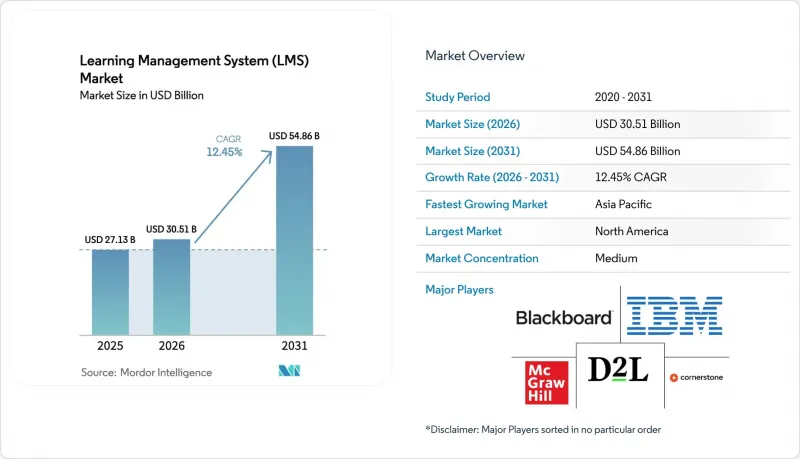
This report is Segmented by Component (Solutions, and Services), Deployment Mode (Cloud, and On-Premise), Delivery Mode (Distance Learning, Instructor-Led Training, and More), Organization Size (Large Enterprises, Small and Medium Enterprises), End-User Vertical (BFSI, Healthcare and Pharmaceuticals, Manufacturing, and More), and Geography. The Market Forecasts are Provided in Terms of Value (USD).
Global Learning Management System (LMS) Market Trends and Insights
Accelerated Remote and Hybrid Work Models Sustaining Corporate LMS Demand
Permanent hybrid work norms have reshaped enterprise approaches to onboarding and compliance training. As of December 2025, 58% of Fortune 500 employers retained flexible location policies, prompting learning teams to replace static portals with mobile-responsive platforms that surface micro-lessons inside Slack and Microsoft Teams. Open xAPI telemetry now captures engagement across virtual-reality simulations, quick-reference videos, and live webinars, enabling learning-and-development managers to intervene before compliance deadlines lapse. Peer-generated video explainers, indexed by AI search, have shortened time-to-competency for new hires by 23% according to a 2025 McKinsey digital upskilling study. Corporations are inserting these social-learning artifacts into curricula, creating a knowledge-sharing culture that reduces reliance on expensive instructor-led sessions. The upshot is continued budget allocation to platforms that can orchestrate asynchronous and synchronous modalities without geographic constraints.
Integration of AI-Driven Adaptive Learning Algorithms Boosting Course-Completion Rates
Generative AI transforms the learning management system market from a content repository into a dynamic tutoring environment. In 2025, Instructure embedded GPT-4 to auto-generate quizzes and summarize discussions, cutting instructor grading time by 30% while maintaining academic rigor. Adaptive engines monitor quiz scores, navigation patterns, and time-on-task to predict drop-off risk, then trigger interventions such as simplified materials or peer mentoring. Community colleges piloting adaptive workflows posted an 18-percentage-point improvement in completion rates versus cohort-based instruction. The same algorithms underpin competency-based education models that let adult learners progress upon demonstrating mastery, an approach that aligns with the gig economy's demand for just-in-time upskilling.
Rising Per-Learner SaaS-Licensing Inflation Squeezing K-12 Budgets
Average per-learner fees jumped 11% in 2025, consuming 22% of instructional-technology budgets in many U.S. districts. Renewal sticker shock forces administrators to choose between premium LMS features and essential hardware purchases, widening equity gaps between affluent and under-resourced schools. Some districts negotiate consortium pricing, while others migrate to open-source Moodle instances. Freemium tiers introduced by commercial vendors create a two-speed ecosystem in which premium analytics and adaptive assessments remain out of reach for cash-strapped institutions. Without relief, districts risk reverting to outdated learning methods that undercut digital-literacy gains achieved during the pandemic.
Other drivers and restraints analyzed in the detailed report include:
- Government Funding for Digital Education Infrastructure
- Employer Demand for Skills-Verification Micro-Credentials in Asia Pacific Manufacturing Hubs
- Patchy Broadband Coverage Limiting Immersive-Content Delivery in Rural Africa and South Asia
For complete list of drivers and restraints, kindly check the Table Of Contents.
Segment Analysis
By component, packaged solutions dominated with a 71.44% revenue share in 2025, while services are projected to accelerate at a 14.86% CAGR through 2031 as buyers increasingly outsource customization and managed administration. Solutions generated the bulk of revenue in 2025, yet the services segment is widening its footprint on the strength of double-digit growth. Enterprises that deployed best-of-breed learning suites now face mounting integration chores, from mapping competency frameworks to configuring single-sign-on across disparate HR and payroll systems. Many rely on managed-services providers that guarantee 99.9% uptime and manage global content catalogs aligned with regional data-residency rules.
Services growth is further boosted by outcome-based contracts that peg fees to measurable gains such as course-completion rates. This realigns vendor incentives toward learner success and encourages risk-averse buyers to approve larger transformation budgets. Educational institutions also benefit from train-the-trainer bootcamps that reduce dependence on external consultants and enable faculty to design digital courses in-house. The dual dynamic of corporate outsourcing and academic capacity building reinforces services as a pivotal revenue lever in the learning management system (LMS) market.
Cloud deployments commanded 88.24% of the learning management system market in 2025, underscoring the appeal of elastic infrastructure that adapts to fluctuating enrollment. Multinationals favor multi-tenant SaaS models because open REST APIs allow platforms to ingest learner data from CRM, e-commerce, and marketing-automation stacks, creating unified profiles that support lifetime engagement. Even industries with sovereign data mandates, such as defense and banking, are exploring hybrid architectures that keep sensitive records on local servers while shifting analytics dashboards to the public cloud. Edge-computing caches placed inside manufacturing plants and remote campuses serve high-resolution content with low latency while synchronizing mastery records to central data lakes, broadening addressable demand and reinforcing cloud's primacy.
By deployment mode, cloud platforms not only held 88.24% market share in 2025, but are also projected to expand at a 14.22% CAGR through 2031, while on-premise and hybrid models post only single-digit growth. Adoption is further fueled by organizations seeking scalable delivery without the overhead of hardware refresh cycles, particularly as global learning ecosystems grow more distributed. Hybrid blueprints continue to gain selective traction for regulated sectors, yet the operational efficiencies, integration depth, and analytics capabilities of cloud deployments secure their position as the dominant backbone of the learning management system (LMS) market.
Complete Report Scope:
- By Component
- Solutions
- Services
- By Deployment Mode
- Cloud
- On-Premise
- By Delivery Mode
- Distance Learning
- Instructor-Led Training
- Blended Learning
- By Organization Size
- Large Enterprises
- Small and Medium Enterprises
- By End-User Vertical
- BFSI
- Healthcare and Pharmaceuticals
- Manufacturing
- Retail and Consumer Goods
- Educational Institutions
- Government Agencies
- Rest of End-User Verticals
- By Geography
- North America
- United States
- Canada
- Mexico
- Europe
- United Kingdom
- France
- Germany
- Nordics
- Rest of Europe
- Asia Pacific
- China
- India
- Japan
- South Korea
- Rest of Asia Pacific
- South America
- Brazil
- Mexico
- Rest of South America
- Middle East
- Gulf Cooperation Council Countries
- Turkey
- Rest of Middle East
- Africa
- South Africa
- Nigeria
- Rest of Africa
- North America
Geography Analysis
North America retained the largest regional share at 36.52% in 2025. United States enterprises invest heavily in xAPI-compliant analytics that surface granular skill gaps, while Canadian government agencies prioritize bilingual delivery to meet PIPEDA privacy mandates. Mexico is emerging as a near-shore hub for implementation services, letting vendors extend North American support windows without incurring Silicon Valley salary costs.
Asia Pacific is the fastest-growing territory with a 12.88% CAGR, propelled by India's PM eVIDYA 2.0 rollout and China's mandate that state-owned enterprises certify smart-manufacturing competencies. Japan subsidizes corporate reskilling to offset workforce shrinkage, covering up to 70% of LMS licensing fees. Southeast Asian manufacturers adopt blockchain-verified credentials to accommodate high labor turnover, cementing the region as a growth engine for the learning management system (LMS) market.
Europe shows steady adoption, but fragmented data-protection statutes force vendors to maintain multiple data-residency zones. Nordic countries pilot competency-based education that relies on adaptive assessments, Germany digitizes apprenticeship tracking, and pan-European content consortia share course libraries to dilute development costs. Middle East investments center on mobile-first platforms with offline-sync, while Africa's barrier remains last-mile connectivity. South America gains momentum as Brazil digitizes university curricula and Chile explores public-private licensing models that exchange anonymized analytics for platform discounts.
- Cornerstone OnDemand Inc.
- Anthology Inc. (Blackboard)
- Instructure Inc.
- D2L Corporation
- SAP SE
- Oracle Corporation
- IBM Corporation
- Docebo SpA
- Adobe Inc.
- Absorb Software Inc.
- TalentLMS (Epignosis LLC)
- McGraw-Hill
- Saba Software
- Infor
- Skillsoft Corporation
- PowerSchool Holdings Inc.
- 360Learning SA
- Thought Industries Inc.
- Meridian Knowledge Solutions
- Google (Classroom)
- Microsoft Corporation
Additional Benefits:
- The market estimate (ME) sheet in Excel format
- 3 months of analyst support
TABLE OF CONTENTS
1 INTRODUCTION
- 1.1 Study Assumptions and Market Definition
- 1.2 Scope of the Study
2 RESEARCH METHODOLOGY
3 EXECUTIVE SUMMARY
4 MARKET LANDSCAPE
- 4.1 Market Overview
- 4.2 Market Drivers
- 4.2.1 Accelerated Remote and Hybrid Work Models Sustaining Corporate LMS Demand
- 4.2.2 Government Funding for Digital Education Infrastructure
- 4.2.3 Integration of AI-Driven Adaptive Learning Algorithms Boosting Course-Completion Rates
- 4.2.4 Employer Demand for Skills-Verification Micro-Credentials in Asia Pacific Manufacturing Hubs
- 4.2.5 Mandatory CPD Regulations in EU Healthcare Catalyzing Specialised LMS Modules
- 4.2.6 BYOD Workforce Mobility Accelerating Mobile-First Cloud LMS Adoption in the Middle East
- 4.3 Market Restraints
- 4.3.1 Rising Per-Learner SaaS-Licensing Inflation Squeezing K-12 Budgets
- 4.3.2 Patchy Broadband Coverage Limiting Immersive-Content Delivery in Rural Africa and South Asia
- 4.3.3 Fragmented Data Standards Hindering HRIS-LMS Integrations in Legacy European Corporates
- 4.3.4 Escalating Cyber-Insurance Premiums Deterring Small Healthcare Providers from Cloud Migration
- 4.4 Industry Value Chain Analysis
- 4.5 Regulatory Landscape
- 4.6 Technological Outlook
- 4.7 Impact of Macroeconomic Factors on the Market
- 4.8 Porter's Five Forces Analysis
- 4.8.1 Threat of New Entrants
- 4.8.2 Bargaining Power of Buyers / Learners
- 4.8.3 Bargaining Power of Suppliers
- 4.8.4 Threat of Substitute Products
- 4.8.5 Intensity of Competitive Rivalry
5 MARKET SIZE AND GROWTH FORECASTS (VALUE)
- 5.1 By Component
- 5.1.1 Solutions
- 5.1.2 Services
- 5.2 By Deployment Mode
- 5.2.1 Cloud
- 5.2.2 On-Premise
- 5.3 By Delivery Mode
- 5.3.1 Distance Learning
- 5.3.2 Instructor-Led Training
- 5.3.3 Blended Learning
- 5.4 By Organization Size
- 5.4.1 Large Enterprises
- 5.4.2 Small and Medium Enterprises
- 5.5 By End-User Vertical
- 5.5.1 BFSI
- 5.5.2 Healthcare and Pharmaceuticals
- 5.5.3 Manufacturing
- 5.5.4 Retail and Consumer Goods
- 5.5.5 Educational Institutions
- 5.5.6 Government Agencies
- 5.5.7 Rest of End-User Verticals
- 5.6 By Geography
- 5.6.1 North America
- 5.6.1.1 United States
- 5.6.1.2 Canada
- 5.6.1.3 Mexico
- 5.6.2 Europe
- 5.6.2.1 United Kingdom
- 5.6.2.2 France
- 5.6.2.3 Germany
- 5.6.2.4 Nordics
- 5.6.2.5 Rest of Europe
- 5.6.3 Asia Pacific
- 5.6.3.1 China
- 5.6.3.2 India
- 5.6.3.3 Japan
- 5.6.3.4 South Korea
- 5.6.3.5 Rest of Asia Pacific
- 5.6.4 South America
- 5.6.4.1 Brazil
- 5.6.4.2 Mexico
- 5.6.4.3 Rest of South America
- 5.6.5 Middle East
- 5.6.5.1 Gulf Cooperation Council Countries
- 5.6.5.2 Turkey
- 5.6.5.3 Rest of Middle East
- 5.6.6 Africa
- 5.6.6.1 South Africa
- 5.6.6.2 Nigeria
- 5.6.6.3 Rest of Africa
- 5.6.1 North America
6 COMPETITIVE LANDSCAPE
- 6.1 Market Concentration
- 6.2 Strategic Moves
- 6.3 Market Share Analysis
- 6.4 Company Profiles (includes Global Level Overview, Market Level Overview, Core Segments, Financials as Available, Strategic Information, Market Rank/Share for Key Companies, Products and Services, and Recent Developments)
- 6.4.1 Cornerstone OnDemand Inc.
- 6.4.2 Anthology Inc. (Blackboard)
- 6.4.3 Instructure Inc.
- 6.4.4 D2L Corporation
- 6.4.5 SAP SE
- 6.4.6 Oracle Corporation
- 6.4.7 IBM Corporation
- 6.4.8 Docebo SpA
- 6.4.9 Adobe Inc.
- 6.4.10 Absorb Software Inc.
- 6.4.11 TalentLMS (Epignosis LLC)
- 6.4.12 McGraw-Hill
- 6.4.13 Saba Software
- 6.4.14 Infor
- 6.4.15 Skillsoft Corporation
- 6.4.16 PowerSchool Holdings Inc.
- 6.4.17 360Learning SA
- 6.4.18 Thought Industries Inc.
- 6.4.19 Meridian Knowledge Solutions
- 6.4.20 Google (Classroom)
- 6.4.21 Microsoft Corporation
7 MARKET OPPORTUNITIES AND FUTURE OUTLOOK
- 7.1 White-Space and Unmet-Need Assessment

