PUBLISHER: Mordor Intelligence | PRODUCT CODE: 2120617

PUBLISHER: Mordor Intelligence | PRODUCT CODE: 2120617
Enterprise Firewall - Market Share Analysis, Industry Trends & Statistics, Growth Forecasts (2026 - 2031)
According to Mordor Intelligence, the enterprise firewall market size in 2026 is estimated at USD 15.12 billion, growing from 2025 value of USD 13.72 billion with 2031 projections showing USD 24.61 billion, growing at 10.23% CAGR over 2026-2031.
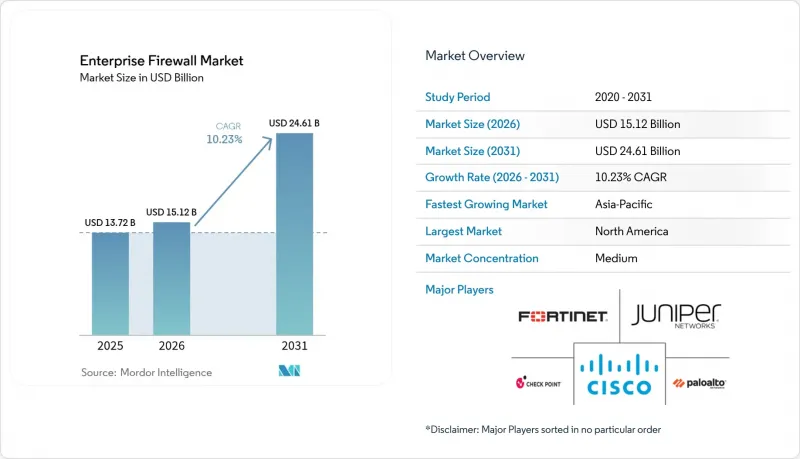
This report is Segmented by Deployment Type (On-Premise Appliance, Cloud-Native Firewall-As-A-Service, and Hybrid/Virtual Appliance), Component (Hardware Appliance, Virtual Appliance/Software, and Managed and Professional Services), Enterprise Size (Small and Micro Enterprises, Mid-Sized Enterprises, and Large Enterprises), End-User Industry (BFSI, Healthcare and Life Sciences, and More), and Geography.
Global Enterprise Firewall Market Trends and Insights
Escalating Sophistication of Multi-Vector Attacks
Attackers now weaponize legitimate software and AI to breach endpoints, cloud workloads, and lateral pathways in one campaign, leaving static rule sets ineffective. Palo Alto Networks observed that 86% of incidents in 2024 caused direct business disruption, prompting enterprises to deploy next-generation firewalls that correlate real-time intelligence across distributed sensors. A global telecom uncovered more than 200 privileged sessions sitting outside domain controllers, underscoring east-west blind spots. Vendors embed machine-learning inspection to flag behavioral anomalies, enabling enterprises to quarantine suspicious traffic within milliseconds and cut dwell time.
Rapid Adoption of Hybrid and Remote Work Architectures
Decentralized workforces rely on home networks and unmanaged devices, expanding the threat surface far beyond data-center perimeters. Organizations shift toward secure access service edge models that fuse identity, device health, and firewall controls inside a single cloud point of enforcement. Microsoft notes that encrypted VPN tunnels often evade traditional inspection, so many firms migrate to Firewall-as-a-Service for uniform policy wherever users connect. Partnerships such as Bell Canada with Palo Alto Networks highlight how carriers wrap AI-powered firewalls around managed connectivity for remote teams.
Budget Constraints Among SMBs
Many small firms lack full-time security personnel and face pressure to allocate limited capital to core operations, slowing the adoption of advanced firewalls. Cyber-insurance carriers now offer premium reductions to policyholders that deploy managed security services, but up-front subscription costs still deter buyers in price-sensitive regions. Vendors respond with entry-level cloud firewalls that include automated policy templates and usage-based billing, lowering procurement hurdles.
Other drivers and restraints analyzed in the detailed report include:
- Regulatory Mandates for Zero-Trust and Segmentation
- Cloud Workload Proliferation Requiring East-West Security
- Skills Shortage to Manage Complex Policies
For complete list of drivers and restraints, kindly check the Table Of Contents.
Segment Analysis
On-premise appliances retained 46.58% of the 2025 enterprise firewall market share on the back of predictable throughput and regulatory comfort with air-gapped designs. In revenue terms, the segment accounted for the largest slice of the enterprise firewall market size, even as refresh cycles extend because of protocol migration uncertainty. Enterprises running latency-sensitive workloads in data centers continue to favor purpose-built hardware that embeds accelerators for high-speed TLS inspection.
Cloud-native Firewall-as-a-Service, advancing at a 13.68% CAGR through 2031, brings centralized policy, elastic scale, and pay-as-you-grow economics that resonate with firms embracing multicloud and remote work strategies. The model also simplifies compliance evidence because providers surface continuous audit logs via portals. Virtual appliances sit between both worlds, letting enterprises replicate rule sets across private clouds and edge locations without shipping hardware, which eases branch rollouts during zero-trust transitions. The blended approach underlines how buyers now map firewall form factor to workload locality rather than defaulting to a single architecture.
Hardware appliances captured 47.65% of 2025 revenues, reflecting persistent demand for deterministic performance, hardware encryption offload, and tamper-resistant designs that satisfy audit teams. This slice of the enterprise firewall market size is expected to grow steadily, yet its proportion declines as buyers shift budget toward lifecycle services that unlock the appliance's full potential.
Managed and professional services are forecast to expand at 13.52% CAGR because continuous tuning, threat-feed integration, and compliance reporting outstrip many in-house teams' bandwidth. Service providers bundle playbooks for DORA, HIPAA, and sector-specific standards, helping clients cut mean-time-to-respond and satisfy regulators. Vendors increasingly embed AI-driven copilots into management consoles, yet human specialists remain essential for contextualising anomalies and aligning policies with evolving business objectives.
Complete Report Scope:
- By Deployment Type
- On-Premise Appliance
- Cloud-Native Firewall-as-a-Service (FWaaS)
- Hybrid/Virtual Appliance
- By Component
- Hardware Appliance
- Virtual Appliance/Software
- Managed and Professional Services
- By Enterprise Size
- Small and Micro Enterprises ( <100 employees )
- Mid-sized Enterprises (100-999)
- Large Enterprises (>=1,000)
- By End-user Industry
- BFSI
- Healthcare and Life Sciences
- Manufacturing and Industrial
- Government and Defense
- Retail and E-commerce
- Telecom and Media
- Education and Research
- Energy and Utilities
- Other End-user Industries
- By Geography
- North America
- United States
- Canada
- Mexico
- South America
- Brazil
- Argentina
- Chile
- Rest of South America
- Europe
- Germany
- United Kingdom
- France
- Italy
- Spain
- Russia
- Rest of Europe
- Asia-Pacific
- China
- India
- Japan
- South Korea
- Singapore
- Malaysia
- Australia
- Rest of Asia-Pacific
- Middle East and Africa
- Middle East
- United Arab Emirates
- Saudi Arabia
- Turkey
- Rest of Middle East
- Africa
- South Africa
- Nigeria
- Egypt
- Rest of Africa
- Middle East
- North America
Geography Analysis
North America led with 35.02% of 2025 revenues, anchored by strict federal rules and high breach remediation costs that spur proactive purchasing. Enterprises there standardize on zero-trust architectures and increasingly choose consolidated platforms to cut operational fragments. Bell Canada's alliance with Palo Alto Networks shows how telcos bundle AI-driven firewalls with connectivity to serve a dispersed workforce.
Asia-Pacific is set for a 12.38% CAGR through 2031, the fastest across regions. Governments in India, Indonesia, and Japan press for local inspection of citizen data, encouraging procurement of firewalls deployable in country-specific clouds. Domestic vendors in China gain share by aligning with encryption rules and supplying inline machine-learning modules that process Mandarin threat intel. Multinational cloud providers partner with regional SOC operators to satisfy sovereignty clauses while maintaining global telemetry reach.
Europe maintains steady momentum on GDPR and the upcoming DORA framework, which requires demonstrable segmentation and incident reporting. SonicWall's new European SOC exemplifies vendor investment to provide local data handling and rapid response aligned with residency laws. Germany and the United Kingdom focus on industrial espionage defenses, whereas France and Spain invest in cloud firewalls capable of per-tenant policy isolation for multicloud expansion.
- Fortinet, Inc.
- Palo Alto Networks, Inc.
- Check Point Software Technologies Ltd.
- Cisco Systems, Inc.
- Juniper Networks, Inc.
- Sophos Ltd.
- WatchGuard Technologies, Inc.
- SonicWall LLC
- Forcepoint LLC
- Barracuda Networks, Inc.
- Hillstone Networks Co., Ltd.
- Stormshield SAS
- AhnLab, Inc.
- Clavister AB
- Untangle, Inc.
- GajShield Infotech (India) Pvt. Ltd.
- F-Secure Corp.
- OPNsense (Deciso B.V.)
- Gateworks Corp.
- Sangfor Technologies Inc.
- Huawei Technologies Co., Ltd.
- Hillstone Networks
- Array Networks, Inc.
- Stonesoft Oy (a McAfee company)
- Netgate (ESF)
Additional Benefits:
- The market estimate (ME) sheet in Excel format
- 3 months of analyst support
TABLE OF CONTENTS
1 INTRODUCTION
- 1.1 Study Assumptions and Market Definition
- 1.2 Scope of the Study
2 RESEARCH METHODOLOGY
3 EXECUTIVE SUMMARY
4 MARKET LANDSCAPE
- 4.1 Market Overview
- 4.2 Market Drivers
- 4.2.1 Escalating sophistication of multi-vector cyber-attacks
- 4.2.2 Rapid adoption of hybrid/remote work architectures
- 4.2.3 Regulatory mandates for zero-trust and segmentation
- 4.2.4 Cloud workload proliferation requiring east-west security
- 4.2.5 AI-driven polymorphic malware forcing adaptive firewalls
- 4.2.6 Sovereign traffic-inspection clauses in emerging economies
- 4.3 Market Restraints
- 4.3.1 Budget constraints among SMBs
- 4.3.2 Skills shortage to manage complex policies
- 4.3.3 IPv6 transition delaying hardware refresh cycles
- 4.3.4 Data-residency-driven shift to regional cloud SOCs
- 4.4 Industry Value Chain Analysis
- 4.5 Regulatory Landscape
- 4.6 Technological Outlook
- 4.7 Industry Attractiveness - Porter's Five Forces Analysis
- 4.7.1 Threat of New Entrants
- 4.7.2 Bargaining Power of Buyers
- 4.7.3 Bargaining Power of Suppliers
- 4.7.4 Threat of Substitutes
- 4.7.5 Intensity of Competitive Rivalry
- 4.8 Impact of Macroeconomic Factors on the Market
5 MARKET SIZE AND GROWTH FORECASTS (VALUES)
- 5.1 By Deployment Type
- 5.1.1 On-Premise Appliance
- 5.1.2 Cloud-Native Firewall-as-a-Service (FWaaS)
- 5.1.3 Hybrid/Virtual Appliance
- 5.2 By Component
- 5.2.1 Hardware Appliance
- 5.2.2 Virtual Appliance/Software
- 5.2.3 Managed and Professional Services
- 5.3 By Enterprise Size
- 5.3.1 Small and Micro Enterprises ( <100 employees )
- 5.3.2 Mid-sized Enterprises (100-999)
- 5.3.3 Large Enterprises (>=1,000)
- 5.4 By End-user Industry
- 5.4.1 BFSI
- 5.4.2 Healthcare and Life Sciences
- 5.4.3 Manufacturing and Industrial
- 5.4.4 Government and Defense
- 5.4.5 Retail and E-commerce
- 5.4.6 Telecom and Media
- 5.4.7 Education and Research
- 5.4.8 Energy and Utilities
- 5.4.9 Other End-user Industries
- 5.5 By Geography
- 5.5.1 North America
- 5.5.1.1 United States
- 5.5.1.2 Canada
- 5.5.1.3 Mexico
- 5.5.2 South America
- 5.5.2.1 Brazil
- 5.5.2.2 Argentina
- 5.5.2.3 Chile
- 5.5.2.4 Rest of South America
- 5.5.3 Europe
- 5.5.3.1 Germany
- 5.5.3.2 United Kingdom
- 5.5.3.3 France
- 5.5.3.4 Italy
- 5.5.3.5 Spain
- 5.5.3.6 Russia
- 5.5.3.7 Rest of Europe
- 5.5.4 Asia-Pacific
- 5.5.4.1 China
- 5.5.4.2 India
- 5.5.4.3 Japan
- 5.5.4.4 South Korea
- 5.5.4.5 Singapore
- 5.5.4.6 Malaysia
- 5.5.4.7 Australia
- 5.5.4.8 Rest of Asia-Pacific
- 5.5.5 Middle East and Africa
- 5.5.5.1 Middle East
- 5.5.5.1.1 United Arab Emirates
- 5.5.5.1.2 Saudi Arabia
- 5.5.5.1.3 Turkey
- 5.5.5.1.4 Rest of Middle East
- 5.5.5.2 Africa
- 5.5.5.2.1 South Africa
- 5.5.5.2.2 Nigeria
- 5.5.5.2.3 Egypt
- 5.5.5.2.4 Rest of Africa
- 5.5.5.1 Middle East
- 5.5.1 North America
6 COMPETITIVE LANDSCAPE
- 6.1 Market Concentration
- 6.2 Strategic Moves
- 6.3 Market Share Analysis
- 6.4 Company Profiles (includes Global level Overview, Market level overview, Core Segments, Financials as available, Strategic Information, Market Rank/Share for key companies, Products and Services, and Recent Developments)
- 6.4.1 Fortinet, Inc.
- 6.4.2 Palo Alto Networks, Inc.
- 6.4.3 Check Point Software Technologies Ltd.
- 6.4.4 Cisco Systems, Inc.
- 6.4.5 Juniper Networks, Inc.
- 6.4.6 Sophos Ltd.
- 6.4.7 WatchGuard Technologies, Inc.
- 6.4.8 SonicWall LLC
- 6.4.9 Forcepoint LLC
- 6.4.10 Barracuda Networks, Inc.
- 6.4.11 Hillstone Networks Co., Ltd.
- 6.4.12 Stormshield SAS
- 6.4.13 AhnLab, Inc.
- 6.4.14 Clavister AB
- 6.4.15 Untangle, Inc.
- 6.4.16 GajShield Infotech (India) Pvt. Ltd.
- 6.4.17 F-Secure Corp.
- 6.4.18 OPNsense (Deciso B.V.)
- 6.4.19 Gateworks Corp.
- 6.4.20 Sangfor Technologies Inc.
- 6.4.21 Huawei Technologies Co., Ltd.
- 6.4.22 Hillstone Networks
- 6.4.23 Array Networks, Inc.
- 6.4.24 Stonesoft Oy (a McAfee company)
- 6.4.25 Netgate (ESF)
7 MARKET OPPORTUNITIES AND FUTURE TRENDS
- 7.1 White-Space and Unmet-Need Assessment

