PUBLISHER: Mordor Intelligence | PRODUCT CODE: 2120638

PUBLISHER: Mordor Intelligence | PRODUCT CODE: 2120638
Next Generation Biometric - Market Share Analysis, Industry Trends & Statistics, Growth Forecasts (2026 - 2031)
According to Mordor Intelligence, the next generation biometric market size is projected to be USD 40.61 billion in 2025, USD 52.33 billion in 2026, and reach USD 137.04 billion by 2031, growing at a CAGR of 21.23% from 2026 to 2031.
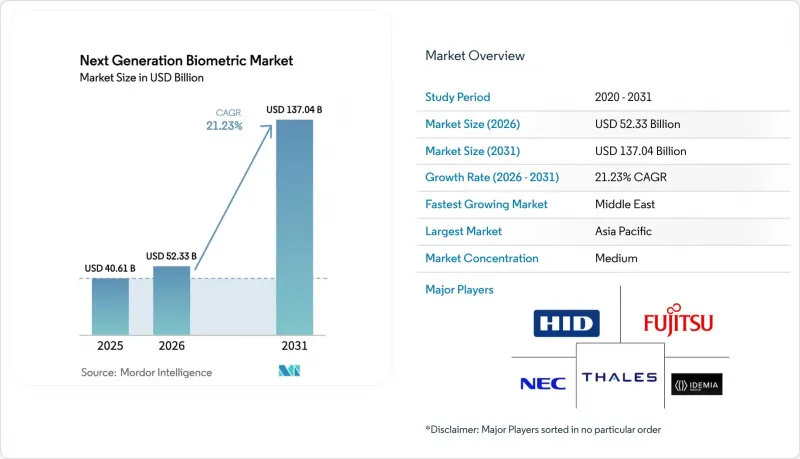
This report is Segmented by Biometric Modality (Face Recognition, Iris Recognition, and More), Component (Hardware, Software, Services), Function (Access Control, Forensics, and More), End-User Industry (Government, Healthcare, Consumer Electronics and Home Security, Retail and E-Commerce, Education, and More), and Geography. The Market Forecasts are Provided in Terms of Value (USD).
Global Next Generation Biometric Market Trends and Insights
Government-Mandated National ID Rollouts
National programs are transforming optional digital IDs into mandatory public infrastructure that buffers vendors from cyclical IT spending. India expanded face-based Aadhaar authentication to private entities in 2025, enabling fintech onboarding without the need for paper documents. The European Union aims to have interoperable biometric wallets for all citizens by 2026, shifting liability for breaches from states to certified wallet providers. Nigeria and Kenya are following similar paths, backed by multilateral funding, which creates guaranteed demand for fingerprint and iris sensors. These high-volume procurements shorten vendor payback periods and lift the overall next generation biometric market.
Integration of Biometrics in Smartphones
Mobile devices are setting new performance baselines that ripple into enterprise expectations. Samsung's Galaxy S25 ultrasonic sensor achieves a false reject rate of less than 1% and meets EMVCo payment standards. Qualcomm's larger 3D Sonic Max allows two-finger verification, targeting high-value transactions. Apple's Face ID keeps all processing within its Secure Enclave, aligning with GDPR data-minimization rules. As consumers unlock phones thousands of times a year, sectors such as banking and healthcare must match that frictionless experience, accelerating adoption across the next generation biometric market.
Privacy and Civil-Liberty Concerns
Special-category status under the GDPR requires explicit consent and strict security measures, leading to multimillion-euro fines for non-compliance, as seen in the Clearview AI case. The EU AI Act now bans most real-time public face scans, and California residents can opt out of non-essential biometric use. Civil-rights groups continue to highlight disproportionate impact on minorities, prompting city-level bans. Vendors must therefore maintain country-specific software builds, which raises compliance costs and slows rollouts in the next generation biometric market.
Other drivers and restraints analyzed in the detailed report include:
- Advancements in Contactless 3D Vein Imaging
- Expansion of E-Passport Programs
- Algorithmic Bias Driving Stricter Regulation
For complete list of drivers and restraints, kindly check the Table Of Contents.
Segment Analysis
Fingerprint systems accounted for 39.26% of the next generation biometric market share in 2025, benefiting from long-established bases and low sensor prices. However, vein recognition is charting a 22.83% CAGR thanks to contactless capture and near-zero spoofing risk, positioning it to chip away at the entrenched modality. Fujitsu's PalmSecure rollouts in Japanese banking and Hitachi's hospital deployments illustrate real-world momentum. Face recognition remains ubiquitous in travel and smartphones, while iris recognition stays focused on defense and refugee management, where its low false-match rate justifies the higher costs. Palm-print, gait, voice, and behavioral systems each fill niche needs, and multimodal platforms are emerging to blend strengths and mask weaknesses. As enterprises evaluate upgrades, the next generation biometric market size for multimodal solutions is expected to widen, reflecting growing confidence in layered security.
Second-generation ultrasonic palm-print sensors, patented by Samsung, hint at a future convergence, allowing a single gesture to satisfy both hygiene and accuracy requirements. Voice recognition adoption is throttled by deepfake risks unless paired with liveness checks. Meanwhile, behavioral biometrics from firms such as BioCatch supply continuous authentication during a user session, reducing fraud in financial applications. Collectively, these advances are reallocating capital from legacy single-mode readers toward software-defined orchestration layers, an evolution that favors service revenue over hardware margins inside the next generation biometric market.
Hardware still accounted for 63.78% of revenue in 2025; however, pricing pressure from sub-USD 50 fingerprint modules has diluted margins. Vendors now package algorithm updates, compliance reporting, and liveness-detection enhancements into cloud subscriptions that grow at a rate of 21.77% annually. IDEMIA's pay-per-transaction API for identity verification captures deferred spend from customers who once balked at large capital layouts. At the same time, the next generation biometric market size for hardware is sustained by mandatory sensor refreshes in e-gates and national ID kiosks, ensuring a stable but lower-margin revenue floor.
System integrators are extracting value by stitching together access control, payments, and e-passport verification into unified dashboards. Software license income increases when clients opt to standardize on a single stack rather than managing disparate readers. Qualcomm's premium 3D Sonic Max sensors underline a hardware differentiation strategy focused on larger capture zones and on-device processing. Yet, most vendors view service annuities as the clearest path to expanding lifetime value within the next generation biometric market.
Complete Report Scope:
- By Biometric Modality
- Face Recognition
- Fingerprint Recognition
- Iris Recognition
- Palm-print Recognition
- Voice Recognition
- Vein Recognition
- Gait and Behavioral Biometrics
- Multimodal Biometrics
- By Component
- Hardware
- Software
- Services
- By Function
- Access Control
- Identification and Verification
- Payments and Transactions
- Surveillance and Monitoring
- Time and Attendance
- Forensics
- Other Functions
- By End-user Industry
- Government
- Defense and Public Safety
- Travel and Immigration
- Banking and Financial Services
- Healthcare
- Consumer Electronics and Home Security
- Retail and E-commerce
- Education
- Other End-user Industries
- By Geography
- North America
- United States
- Canada
- Mexico
- Europe
- Germany
- United Kingdom
- France
- Russia
- Rest of Europe
- Asia-Pacific
- China
- Japan
- India
- South Korea
- Australia
- Rest of Asia-Pacific
- Middle East and Africa
- Middle East
- Saudi Arabia
- United Arab Emirates
- Rest of Middle East
- Africa
- South Africa
- Egypt
- Rest of Africa
- Middle East
- South America
- Brazil
- Argentina
- Rest of South America
- North America
Geography Analysis
Asia-Pacific contributed 36.84% of 2025 revenue, anchored by China's ubiquitous surveillance cameras and India's Aadhaar platform. India's 2025 decision to extend face authentication to the private sector opened fintech and telemedicine channels that accelerate local demand. China continues installing multimodal checkpoints linked to social-credit profiles, while Japan relies on NEC's biometric e-gates across major airports. South Korea mandates biometric confirmation for mobile transactions exceeding KRW 300,000, thereby bolstering smartphone reader adoption. Australia processes almost all arrivals through SmartGate, showcasing automated border control at scale. Together, these developments maintain Asia-Pacific as the largest contributor to the next generation biometric market.
The Middle East is on a faster trajectory, with a 22.19% CAGR predicted through 2031. The UAE Pass now underpins more than 5,000 public and private digital services, and Saudi Arabia aims for 70% digital ID coverage by 2030. Qatar retained its iris-based airport system after the World Cup due to throughput gains, and Israel has issued biometric passports to more than 4 million citizens. These state-backed schemes provide firm order books for global and regional vendors, thereby expanding the next generation biometric market size in a geography that large integrators have historically overlooked.
North America and Europe face tighter regulation yet benefit from policy clarity. The EU Digital Identity Wallet will make cross-border credentialing mandatory by 2026, ensuring budget allocation even amid ongoing privacy debates. Germany's Federal Office for Information Security now publishes technical guidelines aimed at reducing procurement uncertainty. In the United States, Customs and Border Protection has expanded facial-matching exit gates to 32 airports, scanning more than 100 million passengers annually. South American and African nations are still in the early stages of their journeys, but Nigeria's and Kenya's biometric ID programs, as well as Brazil's and Argentina's pilots, suggest that the next generation biometric market will eventually expand across emerging economies.
- IDEMIA Identity & Security France SAS
- NEC Corporation
- Thales SA
- Fujitsu Limited
- HID Global Corporation
- Fingerprint Cards AB
- Synaptics Incorporated
- Suprema Inc.
- Apple Inc.
- Samsung Electronics Co., Ltd.
- Qualcomm Incorporated
- Gemalto N.V.
- BioCatch Ltd.
- Aware, Inc.
- Cognitec Systems GmbH
- DERMALOG Identification Systems GmbH
- Vision-Box, S.A.
- Precise Biometrics AB
- IDEX Biometrics ASA
- Innovatrics, s.r.o.
Additional Benefits:
- The market estimate (ME) sheet in Excel format
- 3 months of analyst support
TABLE OF CONTENTS
1 INTRODUCTION
- 1.1 Study Assumptions and Market Definition
- 1.2 Scope of the Study
2 RESEARCH METHODOLOGY
3 EXECUTIVE SUMMARY
4 MARKET LANDSCAPE
- 4.1 Market Overview
- 4.2 Market Drivers
- 4.2.1 Expansion Of E-Passport Programs
- 4.2.2 Integration Of Biometrics In Smartphones
- 4.2.3 Government-Mandated National ID Rollouts
- 4.2.4 Advancements In Contactless 3D Vein Imaging
- 4.2.5 Rise Of Decentralized Blockchain-Based Digital Identity
- 4.2.6 Multimodal Biometrics For Remote Workforce Management
- 4.3 Market Restraints
- 4.3.1 Privacy And Civil-Liberty Concerns
- 4.3.2 High Upfront System Costs
- 4.3.3 Algorithmic Bias Driving Stricter Regulation
- 4.3.4 Supply-Chain Shortages Of Near-IR Sensors
- 4.4 Industry Value Chain Analysis
- 4.5 Regulatory Landscape
- 4.6 Technological Outlook
- 4.7 Impact of Macroeconomic Factors on the Market
- 4.8 Porter's Five Forces Analysis
- 4.8.1 Bargaining Power of Suppliers
- 4.8.2 Bargaining Power of Buyers
- 4.8.3 Threat of New Entrants
- 4.8.4 Threat of Substitute Products
- 4.8.5 Intensity of Competitive Rivalry
5 MARKET SIZE AND GROWTH FORECASTS (VALUE)
- 5.1 By Biometric Modality
- 5.1.1 Face Recognition
- 5.1.2 Fingerprint Recognition
- 5.1.3 Iris Recognition
- 5.1.4 Palm-print Recognition
- 5.1.5 Voice Recognition
- 5.1.6 Vein Recognition
- 5.1.7 Gait and Behavioral Biometrics
- 5.1.8 Multimodal Biometrics
- 5.2 By Component
- 5.2.1 Hardware
- 5.2.2 Software
- 5.2.3 Services
- 5.3 By Function
- 5.3.1 Access Control
- 5.3.2 Identification and Verification
- 5.3.3 Payments and Transactions
- 5.3.4 Surveillance and Monitoring
- 5.3.5 Time and Attendance
- 5.3.6 Forensics
- 5.3.7 Other Functions
- 5.4 By End-user Industry
- 5.4.1 Government
- 5.4.2 Defense and Public Safety
- 5.4.3 Travel and Immigration
- 5.4.4 Banking and Financial Services
- 5.4.5 Healthcare
- 5.4.6 Consumer Electronics and Home Security
- 5.4.7 Retail and E-commerce
- 5.4.8 Education
- 5.4.9 Other End-user Industries
- 5.5 By Geography
- 5.5.1 North America
- 5.5.1.1 United States
- 5.5.1.2 Canada
- 5.5.1.3 Mexico
- 5.5.2 Europe
- 5.5.2.1 Germany
- 5.5.2.2 United Kingdom
- 5.5.2.3 France
- 5.5.2.4 Russia
- 5.5.2.5 Rest of Europe
- 5.5.3 Asia-Pacific
- 5.5.3.1 China
- 5.5.3.2 Japan
- 5.5.3.3 India
- 5.5.3.4 South Korea
- 5.5.3.5 Australia
- 5.5.3.6 Rest of Asia-Pacific
- 5.5.4 Middle East and Africa
- 5.5.4.1 Middle East
- 5.5.4.1.1 Saudi Arabia
- 5.5.4.1.2 United Arab Emirates
- 5.5.4.1.3 Rest of Middle East
- 5.5.4.2 Africa
- 5.5.4.2.1 South Africa
- 5.5.4.2.2 Egypt
- 5.5.4.2.3 Rest of Africa
- 5.5.4.1 Middle East
- 5.5.5 South America
- 5.5.5.1 Brazil
- 5.5.5.2 Argentina
- 5.5.5.3 Rest of South America
- 5.5.1 North America
6 COMPETITIVE LANDSCAPE
- 6.1 Market Concentration
- 6.2 Strategic Moves
- 6.3 Market Share Analysis
- 6.4 Company Profiles (includes Global Level Overview, Market Level Overview, Core Segments, Financials as Available, Strategic Information, Market Rank/Share for Key Companies, Products and Services, and Recent Developments)
- 6.4.1 IDEMIA Identity & Security France SAS
- 6.4.2 NEC Corporation
- 6.4.3 Thales SA
- 6.4.4 Fujitsu Limited
- 6.4.5 HID Global Corporation
- 6.4.6 Fingerprint Cards AB
- 6.4.7 Synaptics Incorporated
- 6.4.8 Suprema Inc.
- 6.4.9 Apple Inc.
- 6.4.10 Samsung Electronics Co., Ltd.
- 6.4.11 Qualcomm Incorporated
- 6.4.12 Gemalto N.V.
- 6.4.13 BioCatch Ltd.
- 6.4.14 Aware, Inc.
- 6.4.15 Cognitec Systems GmbH
- 6.4.16 DERMALOG Identification Systems GmbH
- 6.4.17 Vision-Box, S.A.
- 6.4.18 Precise Biometrics AB
- 6.4.19 IDEX Biometrics ASA
- 6.4.20 Innovatrics, s.r.o.
7 MARKET OPPORTUNITIES AND FUTURE OUTLOOK
- 7.1 White-space and Unmet-need Assessment

