PUBLISHER: Mordor Intelligence | PRODUCT CODE: 2120676

PUBLISHER: Mordor Intelligence | PRODUCT CODE: 2120676
IoT Middleware - Market Share Analysis, Industry Trends & Statistics, Growth Forecasts (2026 - 2031)
According to Mordor Intelligence, IoT middleware market size in 2026 is estimated at USD 21.33 billion, growing from 2025 value of USD 18.01 billion with 2031 projections showing USD 49.72 billion, growing at 18.43% CAGR over 2026-2031.
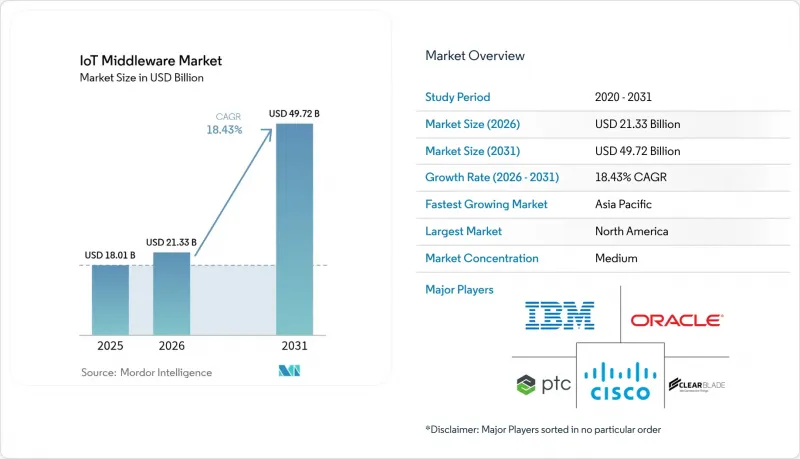
This report is Segmented by Platform (Application Enablement, Device Management, Connectivity Management), Deployment Model (Cloud, On-Premise, Edge / Fog), End-User Industry (Manufacturing, Healthcare, and More), Organization Size ( Large Enterprises, Small and Medium Enterprises (SMEs)), and Geography (North America, Europe, South America, and More). The Market Forecasts are Provided in Terms of Value (USD).
Global IoT Middleware Market Trends and Insights
Proliferation of Connected Devices Demanding Scalable Application-Enablement Platforms
Cellular IoT links are expected to reach 7.5 billion by 2033, with NB-IoT and LoRaWAN representing 86% of LPWAN connections, creating unprecedented scale requirements for middleware. Platforms must handle 5G RedCap for high-throughput data as well as energy-harvesting ambient IoT tags predicted to surface with 5G-Advanced around 2027. Eaton improved equipment effectiveness by up to 15% after rolling out PTC's ThingWorx suite across 200 factories, illustrating the ROI of high-capacity application environments.
Rapid Adoption of Industry 4.0 and IIoT in Manufacturing Lines
Although 95% of manufacturers assess smart-factory tools, only 5% run enterprise-wide programs, leaving space for middleware that unites siloed pilots. Industrial IoT can trim cost of goods sold by one-quarter when data flows freely between OT and IT domains. Woodward's adoption of ThingWorx linked product-lifecycle and execution systems to deliver real-time insights across plants, proving middleware's bridging value.
Complex Integration of Heterogeneous Legacy OT Systems
Plants worldwide still depend on machinery worth USD 6.8 trillion that was never designed for IP networking, demanding costly adapters and specialized skills for middleware onboarding. Although low-cost boards have proven integration feasibility on select lines, full rollouts multiply testing and cybersecurity overhead.
Other drivers and restraints analyzed in the detailed report include:
- Evolution of 5G & LPWAN Enhancing Massive IoT Connectivity
- Cloud-Native Middleware Subscription Models Lowering Upfront CAPEX
- Escalating Data-Sovereignty and Privacy Compliance Costs
For complete list of drivers and restraints, kindly check the Table Of Contents.
Segment Analysis
Application-enablement suites generated 47.35% of 2025 revenue as organizations favored end-to-end environments that speed prototype-to-production cycles. The IoT middleware market size for these suites is positioned to cross USD 19.14 billion by 2031 at an 10.6% CAGR. Connectivity-management solutions, the fastest sub-segment, benefit from remote SIM provisioning and eUICC mandates, delivering a 19.20% CAGR that lifts their value to USD 10.02 billion by 2031. Vendors now embed AI-driven anomaly detection and over-the-air firmware orchestration, blurring the line between application enablement and device management.
Enterprises migrating from proofs of concept to fleet-wide deployments need single control planes that tackle device onboarding, protocol translation, and data normalization. Low-code interfaces extend development to operational staff, while integrated edge runtimes cut latency for motion-control or AGV scenarios. These enhancements show how the IoT middleware market pushes toward unified, AI-ready environments that condense integration efforts.
Cloud architectures captured 70.40% of shipments in 2025 thanks to global availability and mature DevOps ecosystems. Yet edge and fog nodes are projected to post a 21.05% CAGR, lifting their IoT middleware market size above USD 15.05 billion by 2031 as factories and hospitals require local inference. Fog nodes deliver deterministic response for machine vision, and micro data centers respect regional data-protection rules.
A hybrid topology now dominates design blueprints. Central clouds provide noncritical analytics, while on-premise gateways process time-sensitive telemetry. Products such as SECO's CLEA suite combine Yocto-based firmware with Kubernetes-native orchestration to simplify end-to-end observability. Hyperscalers complement this direction with managed edge containers, ensuring that the IoT middleware market meets both latency and compliance imperatives.
Complete Report Scope:
- By Platform
- Application Enablement
- Integrated Suites
- Low-Code Platforms
- Device Management
- OTA Firmware Updates
- Remote Provisioning and Diagnostics
- Connectivity Management
- Cellular CMP
- LPWAN CMP
- Application Enablement
- By Deployment Model
- Cloud
- On-Premise
- Edge / Fog
- By End-User Industry
- Manufacturing
- Healthcare
- Energy and Utilities
- Transportation and Logistics
- Agriculture
- Retail and E-Commerce
- Smart Cities (Municipal and Gov.)
- Other Industries
- By Organization Size
- Large Enterprises
- Small and Medium Enterprises (SMEs)
- By Geography
- North America
- United States
- Canada
- Mexico
- South America
- Brazil
- Argentina
- Rest of South America
- Europe
- Germany
- United Kingdom
- France
- Italy
- Spain
- Rest of Europe
- Asia Pacific
- China
- Japan
- India
- South Korea
- Rest of Asia Pacific
- Middle East and Africa
- Middle East
- United Arab Emirates
- Saudi Arabia
- Turkey
- Rest of Middle East
- Africa
- South Africa
- Nigeria
- Rest of Africa
- Middle East
- North America
Geography Analysis
North America generated 36.90% of 2025 revenue through deep IT penetration and extensive venture funding for sensor-driven startups. United States cloud providers invested more than USD 80 billion in AI-ready data centers, feeding middleware innovation at scale. Canada's Terrestar-Monogoto alliance merges cellular and satellite to cover remote assets, a model likely to spread across energy and transportation corridors. Mexico's automotive clusters leverage middleware for traceability and downtime avoidance, bridging supply-chain gaps with near-real-time dashboards.
Asia Pacific is set to record a 20.95% CAGR up to 2031, driven by 1.8 billion mobile subscribers and public-sector pushes toward smart manufacturing. China leads NB-IoT roll-outs under state-backed budget subsidies, while India pilots regulatory sandboxes focused on indigenous encryption to secure local patient data. Japan and South Korea dominate 5G SA coverage, delivering fertile ground for edge-AI middleware in automotive plants and micro-factories.
Europe enjoys steady, compliance-driven adoption. The Gaia-X blueprint obliges providers to enable federated identity and lineage tracking, influencing architecture choices across Germany's automotive suppliers and France's energy utilities. The United Kingdom channels funds into smart-city pilots that rely on multi-service middleware for congestion analytics and emissions monitoring. Eastern Europe upgrades brownfield factories with LoRaWAN telemetry, using low-cost open-source stacks to bypass capital constraints, reinforcing the breadth of the IoT middleware market.
- Amazon Web Services Inc.
- Microsoft Corp. (Azure IoT)
- Cisco Systems Inc.
- IBM Corp. (incl. Red Hat)
- Oracle Corporation
- PTC Inc. (ThingWorx)
- Google LLC (Cloud IoT)
- Bosch.IO GmbH
- Siemens AG (MindSphere)
- Software AG (Cumulocity)
- Arm Ltd. (Pelion)
- ClearBlade Inc.
- Axiros GmbH
- Davra Networks
- Telit IoT Platforms
- KORE Wireless Group
- Huawei Technologies Co. Ltd.
- Ayla Networks Inc.
- Samsung Electronics (SmartThings)
- Arrayent Inc.
Additional Benefits:
- The market estimate (ME) sheet in Excel format
- 3 months of analyst support
TABLE OF CONTENTS
1 Introduction
- 1.1 Study Assumptions and Market Definition
- 1.2 Scope of the Study
2 Research Methodology
3 Executive Summary
4 Market Landscape
- 4.1 Market Overview
- 4.2 Market Drivers
- 4.2.1 Proliferation of connected devices demanding scalable application-enablement platforms
- 4.2.2 Rapid adoption of Industry 4.0 and IIoT in manufacturing lines
- 4.2.3 Evolution of 5G and LPWAN enhancing massive IoT connectivity
- 4.2.4 Cloud-native middleware subscription models lowering upfront CAPEX
- 4.2.5 Convergence of AIoT requiring real-time edge-AI middleware
- 4.2.6 Government push for open-source, sovereign IoT stacks
- 4.3 Market Restraints
- 4.3.1 Complex integration of heterogeneous legacy OT systems
- 4.3.2 Escalating data-sovereignty and privacy compliance costs
- 4.3.3 Lack of unified cross-domain semantic data models
- 4.3.4 Rising cloud-egress fees squeezing ROI for middleware deployments
- 4.4 Value / Supply-Chain Analysis
- 4.5 Regulatory Landscape
- 4.6 Technological Outlook
- 4.7 Porter's Five Forces Analysis
- 4.7.1 Bargaining Power of Suppliers
- 4.7.2 Bargaining Power of Buyers
- 4.7.3 Threat of New Entrants
- 4.7.4 Threat of Substitutes
- 4.7.5 Intensity of Competitive Rivalry
- 4.8 IoT Middleware Application Analysis
- 4.9 Impact of COVID-19 and Post-pandemic Recovery
- 4.10 Investment Analysis
5 Market Size and Growth Forecasts (Value, USD)
- 5.1 By Platform
- 5.1.1 Application Enablement
- 5.1.1.1 Integrated Suites
- 5.1.1.2 Low-Code Platforms
- 5.1.2 Device Management
- 5.1.2.1 OTA Firmware Updates
- 5.1.2.2 Remote Provisioning and Diagnostics
- 5.1.3 Connectivity Management
- 5.1.3.1 Cellular CMP
- 5.1.3.2 LPWAN CMP
- 5.1.1 Application Enablement
- 5.2 By Deployment Model
- 5.2.1 Cloud
- 5.2.2 On-Premise
- 5.2.3 Edge / Fog
- 5.3 By End-User Industry
- 5.3.1 Manufacturing
- 5.3.2 Healthcare
- 5.3.3 Energy and Utilities
- 5.3.4 Transportation and Logistics
- 5.3.5 Agriculture
- 5.3.6 Retail and E-Commerce
- 5.3.7 Smart Cities (Municipal and Gov.)
- 5.3.8 Other Industries
- 5.4 By Organization Size
- 5.4.1 Large Enterprises
- 5.4.2 Small and Medium Enterprises (SMEs)
- 5.5 By Geography
- 5.5.1 North America
- 5.5.1.1 United States
- 5.5.1.2 Canada
- 5.5.1.3 Mexico
- 5.5.2 South America
- 5.5.2.1 Brazil
- 5.5.2.2 Argentina
- 5.5.2.3 Rest of South America
- 5.5.3 Europe
- 5.5.3.1 Germany
- 5.5.3.2 United Kingdom
- 5.5.3.3 France
- 5.5.3.4 Italy
- 5.5.3.5 Spain
- 5.5.3.6 Rest of Europe
- 5.5.4 Asia Pacific
- 5.5.4.1 China
- 5.5.4.2 Japan
- 5.5.4.3 India
- 5.5.4.4 South Korea
- 5.5.4.5 Rest of Asia Pacific
- 5.5.5 Middle East and Africa
- 5.5.5.1 Middle East
- 5.5.5.1.1 United Arab Emirates
- 5.5.5.1.2 Saudi Arabia
- 5.5.5.1.3 Turkey
- 5.5.5.1.4 Rest of Middle East
- 5.5.5.2 Africa
- 5.5.5.2.1 South Africa
- 5.5.5.2.2 Nigeria
- 5.5.5.2.3 Rest of Africa
- 5.5.5.1 Middle East
- 5.5.1 North America
6 Competitive Landscape
- 6.1 Market Concentration
- 6.2 Strategic Moves
- 6.3 Market Share Analysis
- 6.4 Company Profiles (includes Global level Overview, Market level overview, Core Segments, Financials as available, Strategic Information, Market Rank/Share for key companies, Products and Services, and Recent Developments)
- 6.4.1 Amazon Web Services Inc.
- 6.4.2 Microsoft Corp. (Azure IoT)
- 6.4.3 Cisco Systems Inc.
- 6.4.4 IBM Corp. (incl. Red Hat)
- 6.4.5 Oracle Corporation
- 6.4.6 PTC Inc. (ThingWorx)
- 6.4.7 Google LLC (Cloud IoT)
- 6.4.8 Bosch.IO GmbH
- 6.4.9 Siemens AG (MindSphere)
- 6.4.10 Software AG (Cumulocity)
- 6.4.11 Arm Ltd. (Pelion)
- 6.4.12 ClearBlade Inc.
- 6.4.13 Axiros GmbH
- 6.4.14 Davra Networks
- 6.4.15 Telit IoT Platforms
- 6.4.16 KORE Wireless Group
- 6.4.17 Huawei Technologies Co. Ltd.
- 6.4.18 Ayla Networks Inc.
- 6.4.19 Samsung Electronics (SmartThings)
- 6.4.20 Arrayent Inc.
7 Market Opportunities and Future Outlook
- 7.1 White-space and Unmet-need Assessment

