PUBLISHER: Mordor Intelligence | PRODUCT CODE: 2120719

PUBLISHER: Mordor Intelligence | PRODUCT CODE: 2120719
Riding Gear - Market Share Analysis, Industry Trends & Statistics, Growth Forecasts (2026 - 2031)
According to Mordor Intelligence, the riding gear market size is projected to expand from USD 35.44 billion in 2025 and USD 37.24 billion in 2026 to USD 47.71 billion by 2031, registering a 5.08% CAGR between 2026 and 2031.
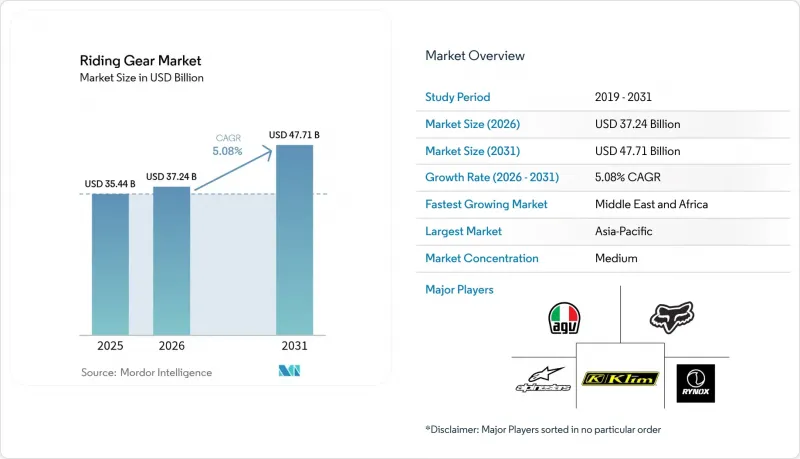
This report is Segmented by Product Type (Jackets, Helmets, and More), Material (Leather, Textile, and More), Distribution Channel (Online and Offline), End-User (On-Road Riding, Off-road/Motocross, and More), Price Range (Premium, Mid-Range, and Economy), and Geography. The Market Forecasts are Provided in Terms of Value (USD).
Global Riding Gear Market Trends and Insights
Rising Motorcycle Ownership in Emerging Markets
Urbanization, income growth, and congested public transit systems are propelling millions of first-time riders in India, Indonesia, Thailand, and Vietnam to choose two-wheelers for daily mobility. As this installed base swells, each new vehicle purchase triggers follow-on demand for certified helmets, jackets, gloves, and boots that many governments now require at the point of registration. Motorcycle brands accelerate the cycle by adding retail capacity. Royal Enfield alone operates more than 900 dealerships across India, making it easier for novice riders to bundle protective gear with finance or insurance packages. Social-media communities further amplify safety messaging, normalizing protective apparel as an integral part of ownership rather than a discretionary add-on. The net effect is a self-reinforcing loop: higher motorcycle penetration expands the addressable apparel audience, and widespread gear visibility on city streets nudges successive cohorts to adopt certified products from their very first ride.
Stricter Global Safety Regulations Mandating Protective Gear
FIM's FRHPhe-02 helmet protocol became compulsory for all sanctioned racing in 2026, creating a halo effect that pushes consumers to seek the same specification in street helmets. Europe's ECE 22.06 regulation, which adds rotational-impact and retention testing, forces manufacturers to redesign shell geometries, liners, and visors, raising the technical baseline across product ranges. Retailers increasingly stock only fully compliant models, using certification badges as quick visual assurances of quality. Small brands without in-house test labs now partner with independent facilities or risk delisting, a shift that consolidates share toward technically capable incumbents. Over the forecast horizon, converging standards will lower approval complexity for cross-border sales, further globalizing the riding gear market.
High Cost Of Certified Premium Protective Gear
Top-tier laminated touring suits, carbon shells, and electronic airbag systems command prices that eclipse average monthly wages in many emerging economies. Although installment plans and micro-credit mitigate sticker shock, they also lengthen replacement cycles and amplify default risk. To bridge the gap, some brands introduce modular armor kits that retrofit into existing jackets, yet uptake remains niche. Currency volatility further complicates retail pricing, prompting distributors to hedge inventory costs and limit product breadth. Unless scale economies or material breakthroughs compress unit costs, price will stay a friction point that tempers the riding gear market's full potential.
Other drivers and restraints analyzed in the detailed report include:
- Boom In Adventure-Touring And Long-Distance Riding Culture
- Rapid Adoption of Airbag-Integrated Jackets After Price Drop
- Proliferation Of Counterfeit Ce-Marked Products Eroding Trust
For complete list of drivers and restraints, kindly check the Table Of Contents.
Segment Analysis
Helmets contributed 25.01% of the riding gear market share in 2025, confirming their status as non-negotiable safety basics, while airbag jackets and vests are growing at a 5.44% CAGR, reflecting a shift toward active protection. Brands pair electronic sensors with subscription-free algorithms, making airbags attractive to commuters and weekend tourers alike. Meanwhile, traditional jackets incorporate ventilated armor pockets and quick-detach liners that widen climate adaptability without electronic complexity. Gloves, boots, and standalone protectors round out full-body coverage, marketed as modular add-ons that upscale rider safety in stages.
Carbon-composite helmet shells integrate Bluetooth comms and tinted drop-down visors, aligning with rising demand for connectivity. Boots feature pivot hinges and toe sliders that originate in superbike racing, now repurposed for urban riding to improve walkability and crash resilience. Body armor inserts employ viscoelastic foams that harden on impact, offering stealth protection under casual outerwear. Collectively, these innovations reinvent familiar categories, sustaining the riding gear market through iterative value-add rather than wholesale upheaval.
Leather captured 54.32% of the riding gear market in 2025, driven by abrasion performance and classic aesthetics, while carbon-fiber composites posted a 5.47% CAGR as weight reduction becomes a selling point for helmets and back plates. Multi-axial carbon weaves permit thinner shell profiles that dissipate energy without bulk, easing neck strain on long rides. Aramid-reinforced textiles and laminated membranes now achieve CE level-2 impact ratings, making them credible leather alternatives in humid and wet climates.
Mesh-panel hybrids push airflow farther, inviting riders in tropical zones into the protective gear fold. Eco-concerns spur interest in plant-based and recycled synthetics, though commercial volumes remain exploratory. Brands advertise waterless tanning and traceable hides to offset animal-welfare critiques. Carbon and aramid suppliers court OEM partnerships to secure scale, offering pre-preg sheets tailored to helmet molds and armor shapes. This material arms race fuels continuous differentiation, ensuring the riding gear market remains fertile ground for breakthroughs in textile science.
Complete Report Scope:
- By Product Type
- Jackets
- Helmets
- Gloves
- Pants / Trousers
- Boots / Shoes
- Body Armor & Protectors
- Airbag Jackets & Vests
- By Material
- Leather
- Textile
- Mesh
- Carbon-Fiber Composites
- Kevlar / Aramid Blends
- Other Materials
- By Distribution Channel
- Online
- Offline
- By End-user
- On-road Riding
- Off-road / Motocross
- Adventure & Touring
- Commuter
- By Price Range
- Premium
- Mid-range
- Economy
- By Geography
- North America
- United States
- Canada
- Rest of North America
- South America
- Brazil
- Argentina
- Rest of South America
- Europe
- Germany
- United Kingdom
- France
- Italy
- Spain
- Russia
- Rest of Europe
- Asia-Pacific
- China
- Japan
- India
- South Korea
- Rest of Asia-Pacific
- Middle East and Africa
- United Arab Emirates
- Saudi Arabia
- Turkey
- Egypt
- South Africa
- Rest of Middle East and Africa
- North America
Geography Analysis
Asia-Pacific accounted for 39.21% of the riding gear market share in 2025, underpinned by high two-wheeler ownership in India, Indonesia, and Thailand. Governments intensify helmet enforcement and explore subsidies for certified products, nudging first-time buyers toward regulated gear. Domestic manufacturers scale up automated molding and robotic stitching to serve both local demand and export contracts, reinforcing regional cost advantages. Meanwhile, China's electric scooter boom fuels appetite for lightweight, urban-flavored helmets and waterproof commuter jackets, broadening the region's material palette.
Europe and North America together represent a mature yet lucrative arena for high-feature gear because discretionary incomes and stringent safety standards converge. ECE 22.06 and DOT labeling make certification table stakes, pushing innovation into ventilation, acoustics, and integration of communication modules. Touring culture, track-day hobbyists, and year-round commuters sustain multiple sub-segments, each craving specialized performance attributes. Dealer consolidation in both regions gives larger chains buying leverage, pressuring smaller brands to differentiate through online storytelling or bespoke sizing services. Currency fluctuations between USD and EUR slightly reshape import cost dynamics but leave underlying demand intact.
The Middle East and Africa region posts the quickest 5.59% CAGR as urbanization, infrastructure build-out, and rising disposable incomes lift motorcycle purchases from a low base. Gulf Cooperation Council countries tighten helmet mandates with on-the-spot fines, stimulating sales of certified helmets among expatriate workers and young nationals alike. Local climates, ranging from desert heat to coastal humidity, spur demand for ventilated textiles and moisture-wicking liners. Counterfeit detection remains uneven, but public awareness campaigns are beginning to shift preferences toward authorized outlets. As distributors add micro-financing and e-commerce to reach remote customers, the riding gear market unlocks substantial latent volume across the region.
- AGV
- Alpinestars S.p.A.
- Dainese S.p.A.
- Fox Racing Inc.
- Klim Technical Riding Gear
- REV'IT! Sport International
- ScorpionEXO
- Icon Motorsports
- Royal Enfield Gear
- HJC Helmets
- Shoei Co., Ltd.
- Arai Helmet Ltd.
- Bell Helmets
- Rynox Gears India Pvt. Ltd.
- Spartan ProGear Co.
- Kushitani Co., Ltd.
- Held GmbH
- Sena Technologies Inc.
- LS2 Helmets
- Studds Accessories Ltd.
- Komine Co., Ltd.
- Oxford Products Ltd.
- Thor MX
Additional Benefits:
- The market estimate (ME) sheet in Excel format
- 3 months of analyst support
TABLE OF CONTENTS
1 Introduction
- 1.1 Study Assumptions & Market Definition
- 1.2 Scope of the Study
2 Research Methodology
3 Executive Summary
4 Market Landscape
- 4.1 Market Overview
- 4.2 Market Drivers
- 4.2.1 Rising Motorcycle Ownership in Emerging Markets
- 4.2.2 Stricter Global Safety Regulations Mandating Protective Gear
- 4.2.3 Boom in Adventure-Touring and Long-Distance Riding Culture
- 4.2.4 Rapid Adoption of Airbag-Integrated Jackets After Price Drop
- 4.2.5 OEM Lifestyle Merchandise Expansion by Motorcycle Brands
- 4.2.6 Growing Female Rider Segment Demanding Tailored Apparel
- 4.3 Market Restraints
- 4.3.1 High Cost of Certified Premium Protective Gear
- 4.3.2 Proliferation of Counterfeit CE-Marked Products Eroding Trust
- 4.3.3 Seasonality Dampening Demand in Cold Regions
- 4.3.4 Sustainability Backlash Against Animal-Based Leather Materials
- 4.4 Value / Supply-Chain Analysis
- 4.5 Regulatory Landscape
- 4.6 Technological Outlook
- 4.7 Porter's Five Forces
- 4.7.1 Threat of New Entrants
- 4.7.2 Bargaining Power of Buyers/Consumers
- 4.7.3 Bargaining Power of Suppliers
- 4.7.4 Threat of Substitute Products
- 4.7.5 Intensity of Competitive Rivalry
5 Market Size & Growth Forecasts (Value (USD))
- 5.1 By Product Type
- 5.1.1 Jackets
- 5.1.2 Helmets
- 5.1.3 Gloves
- 5.1.4 Pants / Trousers
- 5.1.5 Boots / Shoes
- 5.1.6 Body Armor & Protectors
- 5.1.7 Airbag Jackets & Vests
- 5.2 By Material
- 5.2.1 Leather
- 5.2.2 Textile
- 5.2.3 Mesh
- 5.2.4 Carbon-Fiber Composites
- 5.2.5 Kevlar / Aramid Blends
- 5.2.6 Other Materials
- 5.3 By Distribution Channel
- 5.3.1 Online
- 5.3.2 Offline
- 5.4 By End-user
- 5.4.1 On-road Riding
- 5.4.2 Off-road / Motocross
- 5.4.3 Adventure & Touring
- 5.4.4 Commuter
- 5.5 By Price Range
- 5.5.1 Premium
- 5.5.2 Mid-range
- 5.5.3 Economy
- 5.6 By Geography
- 5.6.1 North America
- 5.6.1.1 United States
- 5.6.1.2 Canada
- 5.6.1.3 Rest of North America
- 5.6.2 South America
- 5.6.2.1 Brazil
- 5.6.2.2 Argentina
- 5.6.2.3 Rest of South America
- 5.6.3 Europe
- 5.6.3.1 Germany
- 5.6.3.2 United Kingdom
- 5.6.3.3 France
- 5.6.3.4 Italy
- 5.6.3.5 Spain
- 5.6.3.6 Russia
- 5.6.3.7 Rest of Europe
- 5.6.4 Asia-Pacific
- 5.6.4.1 China
- 5.6.4.2 Japan
- 5.6.4.3 India
- 5.6.4.4 South Korea
- 5.6.4.5 Rest of Asia-Pacific
- 5.6.5 Middle East and Africa
- 5.6.5.1 United Arab Emirates
- 5.6.5.2 Saudi Arabia
- 5.6.5.3 Turkey
- 5.6.5.4 Egypt
- 5.6.5.5 South Africa
- 5.6.5.6 Rest of Middle East and Africa
- 5.6.1 North America
6 Competitive Landscape
- 6.1 Market Concentration
- 6.2 Strategic Moves
- 6.3 Market Share Analysis
- 6.4 Company Profiles (Includes Global Level Overview, Market Level Overview, Core Segments, Financials as Available, Strategic Information, Market Rank/Share for Key Companies, Products and Services, SWOT Analysis, and Recent Developments)
- 6.4.1 AGV
- 6.4.2 Alpinestars S.p.A.
- 6.4.3 Dainese S.p.A.
- 6.4.4 Fox Racing Inc.
- 6.4.5 Klim Technical Riding Gear
- 6.4.6 REV'IT! Sport International
- 6.4.7 ScorpionEXO
- 6.4.8 Icon Motorsports
- 6.4.9 Royal Enfield Gear
- 6.4.10 HJC Helmets
- 6.4.11 Shoei Co., Ltd.
- 6.4.12 Arai Helmet Ltd.
- 6.4.13 Bell Helmets
- 6.4.14 Rynox Gears India Pvt. Ltd.
- 6.4.15 Spartan ProGear Co.
- 6.4.16 Kushitani Co., Ltd.
- 6.4.17 Held GmbH
- 6.4.18 Sena Technologies Inc.
- 6.4.19 LS2 Helmets
- 6.4.20 Studds Accessories Ltd.
- 6.4.21 Komine Co., Ltd.
- 6.4.22 Oxford Products Ltd.
- 6.4.23 Thor MX
7 Market Opportunities & Future Outlook
- 7.1 White-space & Unmet-need Assessment

