PUBLISHER: Mordor Intelligence | PRODUCT CODE: 2120763

PUBLISHER: Mordor Intelligence | PRODUCT CODE: 2120763
Counter Cyberterrorism - Market Share Analysis, Industry Trends & Statistics, Growth Forecasts (2026 - 2031)
According to Mordor Intelligence, the counter cyberterrorism market size was valued at USD 33.87 billion in 2025 and estimated to grow from USD 34.96 billion in 2026 to reach USD 40.94 billion by 2031, at a CAGR of 3.22% during the forecast period (2026-2031).
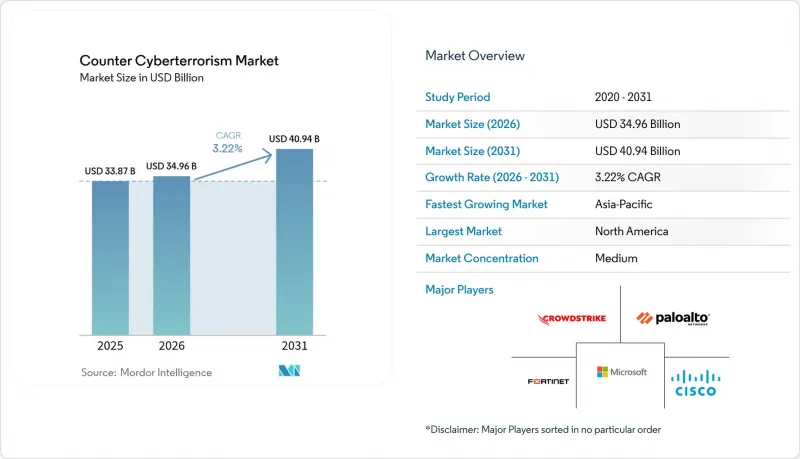
This report is Segmented by End-User Industry (Defense, Aerospace, BFSI, and More), Solution Type (Network Security Solutions, Endpoint Security Solutions, and More), Deployment Mode (On-Premise, Cloud, Hybrid, and More), Security Layer (Network Layer, Endpoint Layer, and More), and Geography (North America, South America, Europe, and More). The Market Forecasts are Provided in Terms of Value (USD).
Global Counter Cyberterrorism Market Trends and Insights
Growing Nation-State Cyber Offensives Drive Defense Modernization
Persistent state-backed campaigns now target critical infrastructure and democratic processes with multi-vector tactics. The Pentagon earmarked USD 3.1 billion for zero-trust and next-generation encryption in its 2025 cyber budget, anchoring moves from incident response to active threat-hunting.U.S. Cyber Command's USD 1.7 billion appropriation further prioritizes counteroffensive readiness and multi-domain coordination.Such high-level focus incentivizes platform vendors to embed attribution, forensics, and automation features that satisfy national-security procurement criteria.
AI-Enabled Threat Detection Transforms Security Operations
Production-scale AI now shapes security operating centers as average breakout times shrink to 62 minutes. CrowdStrike-NVIDIA tests halve processing loads while doubling detection speeds, easing analyst fatigue. Adaptive models ingest endpoint, network, and cloud telemetry to predict adversary behavior, yet 40% of analyst hours still chase false positives. Vendors thus refine generative-AI enrichment and context-aware prioritization to boost signal-to-noise ratios and maximize limited human expertise.
Shortage of Tier-1 Cyber Warfare Talent Constrains Growth
The U.S. alone posts 663,000 unfilled roles, inflating wage premiums and throttling project rollouts. With advanced skills requiring 5-7 years of experiential learning, enterprises pivot to automation and MSSP partnerships to bridge gaps, reinforcing demand for C-aa-S offerings over in-house builds.
Other drivers and restraints analyzed in the detailed report include:
- Expansion of 5G/IIoT Attack Surface Creates New Vulnerabilities
- Rise of Cybersecurity-as-a-Service Reshapes Market Dynamics
For complete list of drivers and restraints, kindly check the Table Of Contents.
Segment Analysis
Healthcare's 17.20% CAGR through 2031 outpaces all sectors, even as BFSI retains the largest slice of the counter cyberterrorism market share in 2025. Daily incident losses reached USD 2 million, and 92% of providers reported targeted attacks, pushing hospitals to adopt zero-trust and managed detection despite budget constraints. Government grants worth USD 800 million help low-resourced facilities modernize defenses. BFSI maintains robust controls driven by regulatory audits and high-value data, while defense-aerospace budgets anchor classified-system requirements.
Rising ransomware premiums and patient-safety implications move boards to treat cybersecurity as enterprise risk, not IT overhead. Overlapping IoT medical devices and legacy electronic-health-record systems add complexity, reinforcing integration demand for AI-driven anomaly detection. Across sectors, the counter cyberterrorism market supports bespoke service tiers that map vertical regulations, demonstrating why industry-aligned MSSPs capture expanding wallet share.
Network security tools hold 27.10% of the counter cyberterrorism market size; yet predictive AI solutions registering a 22.80% CAGR signal a strategic tilt from perimeter hardening to behavior analytics. Endpoint suites remain indispensable as remote work persists, and cloud security surges alongside multi-cloud adoption. Data-centric controls grow amid stricter privacy mandates, while identity platforms evolve continuous-auth models assessing both user intent and device posture.
Software-supply-chain attacks elevate application-security budgets, spurring demand for SBOM validation and DevSecOps automation. Vendors fuse threat-intel feeds with zero-trust orchestration, creating unified consoles that slash tool sprawl an attractive proposition as procurement favors platform breadth over point-solution depth.
Complete Report Scope:
- By End-user Industry
- Defense
- Aerospace
- BFSI
- Corporate/Enterprise
- Power and Utilities
- Government and Intelligence Agencies
- Healthcare
- By Solution Type
- Network Security Solutions
- Endpoint Security Solutions
- Cloud Security Solutions
- Application Security
- Data and Database Security
- Identity and Access Management
- Threat Intelligence and MSSP
- By Deployment Mode
- On-premise
- Cloud
- Hybrid
- Managed / Hosted
- By Security Layer
- Network Layer
- Endpoint Layer
- Application Layer
- Data / Cloud Layer
- By Geography
- North America
- United States
- Canada
- Mexico
- South America
- Brazil
- Argentina
- Rest of South America
- Europe
- Germany
- United Kingdom
- France
- Italy
- Spain
- Russia
- Rest of Europe
- Asia-Pacific
- China
- Japan
- India
- South Korea
- Rest of Asia-Pacific
- Middle East and Africa
- Middle East
- Saudi Arabia
- United Arab Emirates
- Turkey
- Israel
- Rest of Middle East
- Africa
- South Africa
- Nigeria
- Rest of Africa
- Middle East
- North America
Geography Analysis
North America anchors 34.80% of the counter cyberterrorism market size, driven by the U.S. federal USD 27.5 billion cybersecurity allocation and USD 30 billion annual military cyber outlays. Canada cooperates through the U.S.-Canada Cyber Action Plan, and Mexico accelerates critical-infrastructure safeguards under trilateral frameworks. Mature compliance regimes such as CMMC and GLBA push enterprises toward continuous threat monitoring, sustaining platform renewals across sectors.
Asia-Pacific records the fastest 13.95% CAGR as governments respond to a 16% jump in weekly attacks and 50% growth in cyber-insurance uptake. China's Data Security Law and India's CERT-IN mandates expand mandatory reporting, while Japan funds USD 6 billion for industrial cyber-fortification. Australia's 2025-2030 Cyber Strategy emphasizes sovereign capability development, amplifying MSSP demand across mid-market enterprises.
Europe holds a steady share under GDPR-driven accountability measures that levied EUR 1.2 billion in 2024 fines. The EU's coordinated post-quantum roadmap catalyzes member-state grants for cryptographic retrofits, benefiting platform vendors offering hybrid encryption. The U.K.'s National Cyber Force merges offense-defense mandates, France accelerates SecNumCloud certifications, and Germany's KRITIS-Dachgesetz expands critical-infrastructure scope, stimulating integrated-security procurement.
- Palo Alto Networks, Inc.
- Cisco Systems, Inc.
- Microsoft Corporation
- Fortinet, Inc.
- International Business Machines Corporation
- AO Kaspersky Lab
- Dell Technologies Inc.
- DXC Technology Company
- International Intelligence Limited
- Nexusguard Limited
- Leidos Holdings, Inc.
- Raytheon Technologies Corporation
- Broadcom Inc. (Symantec Enterprise)
- SAP SE
- CrowdStrike Holdings, Inc.
- Check Point Software Technologies Ltd.
- Okta, Inc.
- Zscaler, Inc.
- Cloudflare, Inc.
- Trend Micro Incorporated
- BAE Systems plc
- Booz Allen Hamilton Holding Corporation
Additional Benefits:
- The market estimate (ME) sheet in Excel format
- 3 months of analyst support
TABLE OF CONTENTS
1 INTRODUCTION
- 1.1 Study Assumptions and Market Definition
- 1.2 Scope of the Study
2 RESEARCH METHODOLOGY
3 EXECUTIVE SUMMARY
4 MARKET LANDSCAPE
- 4.1 Market Overview
- 4.2 Market Drivers
- 4.2.1 Growing nation-state cyber offensives
- 4.2.2 AI-enabled threat detection adoption
- 4.2.3 Expansion of 5G/IIoT attack surface
- 4.2.4 Rise of Cybersecurity-as-a-Service (C-aa-S)
- 4.2.5 Escalating regulatory fines on data breaches
- 4.2.6 Real-time dark-web threat-intel exchanges
- 4.3 Market Restraints
- 4.3.1 Shortage of tier-1 cyber warfare talent
- 4.3.2 Inter-agency data-sharing silos
- 4.3.3 Legacy OT systems with proprietary protocols
- 4.3.4 High false-positive rates in ML models
- 4.4 Industry Value Chain Analysis
- 4.5 Regulatory Landscape
- 4.6 Technological Outlook
- 4.7 Porter's Five Forces Analysis
- 4.7.1 Bargaining Power of Suppliers
- 4.7.2 Bargaining Power of Consumers
- 4.7.3 Threat of New Entrants
- 4.7.4 Competitive Rivalry
- 4.7.5 Threat of Substitutes
- 4.8 Impact of Macroeconomic Factors
5 MARKET SIZE AND GROWTH FORECASTS (VALUE)
- 5.1 By End-user Industry
- 5.1.1 Defense
- 5.1.2 Aerospace
- 5.1.3 BFSI
- 5.1.4 Corporate/Enterprise
- 5.1.5 Power and Utilities
- 5.1.6 Government and Intelligence Agencies
- 5.1.7 Healthcare
- 5.2 By Solution Type
- 5.2.1 Network Security Solutions
- 5.2.2 Endpoint Security Solutions
- 5.2.3 Cloud Security Solutions
- 5.2.4 Application Security
- 5.2.5 Data and Database Security
- 5.2.6 Identity and Access Management
- 5.2.7 Threat Intelligence and MSSP
- 5.3 By Deployment Mode
- 5.3.1 On-premise
- 5.3.2 Cloud
- 5.3.3 Hybrid
- 5.3.4 Managed / Hosted
- 5.4 By Security Layer
- 5.4.1 Network Layer
- 5.4.2 Endpoint Layer
- 5.4.3 Application Layer
- 5.4.4 Data / Cloud Layer
- 5.5 By Geography
- 5.5.1 North America
- 5.5.1.1 United States
- 5.5.1.2 Canada
- 5.5.1.3 Mexico
- 5.5.2 South America
- 5.5.2.1 Brazil
- 5.5.2.2 Argentina
- 5.5.2.3 Rest of South America
- 5.5.3 Europe
- 5.5.3.1 Germany
- 5.5.3.2 United Kingdom
- 5.5.3.3 France
- 5.5.3.4 Italy
- 5.5.3.5 Spain
- 5.5.3.6 Russia
- 5.5.3.7 Rest of Europe
- 5.5.4 Asia-Pacific
- 5.5.4.1 China
- 5.5.4.2 Japan
- 5.5.4.3 India
- 5.5.4.4 South Korea
- 5.5.4.5 Rest of Asia-Pacific
- 5.5.5 Middle East and Africa
- 5.5.5.1 Middle East
- 5.5.5.1.1 Saudi Arabia
- 5.5.5.1.2 United Arab Emirates
- 5.5.5.1.3 Turkey
- 5.5.5.1.4 Israel
- 5.5.5.1.5 Rest of Middle East
- 5.5.5.2 Africa
- 5.5.5.2.1 South Africa
- 5.5.5.2.2 Nigeria
- 5.5.5.2.3 Rest of Africa
- 5.5.5.1 Middle East
- 5.5.1 North America
6 COMPETITIVE LANDSCAPE
- 6.1 Market Concentration
- 6.2 Strategic Moves
- 6.3 Market Share Analysis
- 6.4 Company Profiles (includes Global level Overview, Market level overview, Core Segments, Financials as available, Strategic Information, Market Rank/Share for key companies, Products and Services, and Recent Developments)
- 6.4.1 Palo Alto Networks, Inc.
- 6.4.2 Cisco Systems, Inc.
- 6.4.3 Microsoft Corporation
- 6.4.4 Fortinet, Inc.
- 6.4.5 International Business Machines Corporation
- 6.4.6 AO Kaspersky Lab
- 6.4.7 Dell Technologies Inc.
- 6.4.8 DXC Technology Company
- 6.4.9 International Intelligence Limited
- 6.4.10 Nexusguard Limited
- 6.4.11 Leidos Holdings, Inc.
- 6.4.12 Raytheon Technologies Corporation
- 6.4.13 Broadcom Inc. (Symantec Enterprise)
- 6.4.14 SAP SE
- 6.4.15 CrowdStrike Holdings, Inc.
- 6.4.16 Check Point Software Technologies Ltd.
- 6.4.17 Okta, Inc.
- 6.4.18 Zscaler, Inc.
- 6.4.19 Cloudflare, Inc.
- 6.4.20 Trend Micro Incorporated
- 6.4.21 BAE Systems plc
- 6.4.22 Booz Allen Hamilton Holding Corporation
7 MARKET OPPORTUNITIES AND FUTURE OUTLOOK
- 7.1 White-space and Unmet-Need Assessment

