PUBLISHER: Mordor Intelligence | PRODUCT CODE: 2120772

PUBLISHER: Mordor Intelligence | PRODUCT CODE: 2120772
Antibiotics - Market Share Analysis, Industry Trends & Statistics, Growth Forecasts (2026 - 2031)
According to Mordor Intelligence, the antibiotics market size was valued at USD 55.60 billion in 2025 and is estimated to grow from USD 57.86 billion in 2026 to reach USD 70.64 billion by 2031, at a CAGR of 4.07% during the forecast period (2026-2031).
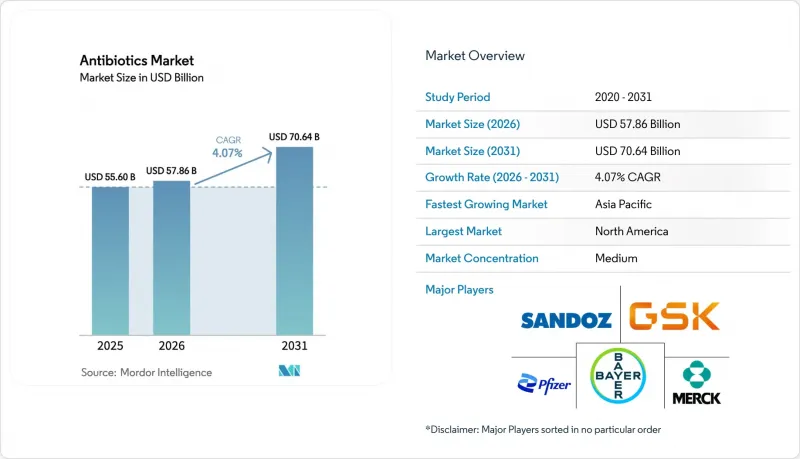
This report is Segmented by Product Class (Cephalosporins, Penicillins, Fluoroquinolones, Macrolides, Carbapenems, Aminoglycosides, Sulfonamides, and More), Spectrum (Broad-Spectrum Antibiotics and Narrow-Spectrum Antibiotics), Route of Administration (Oral, Intravenous, and More), and Geography (North America, Europe, Asia-Pacific, and More). The Market Sizes and Forecasts are Provided in Terms of Value (USD).
Global Antibiotics Market Trends and Insights
Escalating Antimicrobial Resistance Necessitating Continual Antibiotic Innovation and Stockpiling
Carbapenem-resistant Enterobacteriaceae infections now carry case-fatality rates above 40%, prompting governments to hold 30-day strategic reserves of colistin and tigecycline. BARDA directed USD 500 million to CARB-X in 2024, yet only two of 11 funded candidates reached Phase II by mid-2025, underscoring translational bottlenecks. The WHO AWaRe list added six new Reserve agents in 2024, stabilizing demand through advance-purchase agreements while compressing margins. U.S. hospitals must document Reserve-category inventory under updated Strategic National Stockpile rules, creating predictable base volumes. These policies together support steady but regulated uptake of novel drugs.
Rising Incidence of Hospital-Acquired Infections in Tertiary-Care Settings Across Emerging Economies
A 2024 Indian multicenter study recorded surgical-site infection rates of 12.3% versus the 4.1% benchmark in high-income countries, with MRSA isolated in 38% of samples. Overcrowded wards and sub-50% hand-hygiene compliance intensify empiric broad-spectrum prescribing. China reported ICU pneumonia at 18 cases per 1,000 patient-days in 2025, up from 14 in 2023, driven by an aging population and ventilator use. Vietnam's 2024 surveillance found 22% of bloodstream infections involved ESBL-positive E. coli, shifting guidelines toward carbapenems. Joint Commission International accreditation is spreading in Southeast Asia, but compliance outside certified centers remains inconsistent.
Multidrug-Resistant Pathogens Outpacing Commercial Development Timelines
U.S. cases of carbapenem-resistant Acinetobacter doubled from 8,500 in 2022 to 17,200 in 2024 without a new late-stage agent in sight. Plasmid-mediated colistin resistance spread to 47 countries by 2025, eroding the last-line safety net. Pew's 2024 analysis shows antibiotic programs average 13.2 years from Phase I to approval-longer than oncology-while resistance can surface within three years of launch. MDR-TB strains resistant to bedaquiline and delamanid emerged in 14 nations by 2025. A Clinical Infectious Diseases study pegged the median net present value for a novel antibiotic at negative USD 50 million, deterring private capital.
Other drivers and restraints analyzed in the detailed report include:
- Expansion of Universal Healthcare Coverage and Public Reimbursement for Essential Antibiotics in High-Burden Regions
- Technological Advances in B-Lactamase-Inhibitor Combinations and Novel Modalities Improving Outcomes
- Stringent Stewardship Policies Limiting Use of "Watch" and "Reserve" Classes
For complete list of drivers and restraints, kindly check the Table Of Contents.
Segment Analysis
Cephalosporins delivered 38.56% of 2025 revenue, supported by ceftriaxone's once-daily regimen and room-temperature stability that lower cold-chain costs in low-resource settings. Fluoroquinolones are projected to grow at 5.25% through 2031, buoyed by their indispensable role in MDR-TB protocols and high oral bioavailability that avoids hospitalization for complicated urinary infections, contributing to incremental antibiotics market growth. Penicillins maintain volume through public tenders, highlighted by Aurobindo's 15,000-tonne Penicillin G plant commissioned in 2024. Carbapenems, though smaller in volume, command premium pricing but face stewardship caps limiting empiric use.
Fluoroquinolone safety warnings issued in 2024 have not dented uptake in TB-endemic regions, where alternatives are few. Macrolides remain steady thanks to mass azithromycin distribution for trachoma control in Africa, guaranteeing a baseline antibiotics market size for this class. Aminoglycosides retain hospital niches, and tetracyclines gain fresh interest after eravacycline's label expansion, though its USD 4,500 price confines utilization to severe infections. Collectively, class diversification cushions manufacturers from resistance-driven declines in any single group.
Complete Report Scope:
- By Product Class
- Cephalosporins
- Penicillins
- Fluoroquinolones
- Macrolides
- Carbapenems
- Aminoglycosides
- Sulfonamides
- Tetracyclines
- Other Classes
- By Spectrum
- Broad-spectrum Antibiotics
- Narrow-spectrum Antibiotics
- By Route of Administration
- Oral
- Intravenous
- Intramuscular
- Topical
- Other Routes
- By Geography
- North America
- United States
- Canada
- Mexico
- Europe
- Germany
- United Kingdom
- France
- Italy
- Spain
- Rest of Europe
- Asia-Pacific
- China
- Japan
- India
- South Korea
- Australia
- Rest of Asia-Pacific
- Middle East & Africa
- GCC
- South Africa
- Rest of Middle East & Africa
- South America
- Brazil
- Argentina
- Rest of South America
- North America
Geography Analysis
North America delivered 33.13% of 2025 revenue thanks to Medicare Part B mark-ups that price hospital IV drugs 200%-300% above ex-factory cost, underpinning high regional antibiotics market share. Asia-Pacific is expected to post the fastest 4.51% CAGR through 2031 as India's Ayushman Bharat and China's Healthy China 2030 digitize reimbursement and stewardship, enlarging the antibiotics market size across populous nations. Japan's aging population drives steady pneumonia admissions that sustain ceftriaxone and fluoroquinolone uptake despite stewardship pressures.
Europe's demand levels off under generic competition, but Germany's 2025 pediatric approval of ceftazidime-avibactam opens a new revenue pocket. The U.K.'s subscription model pays Shionogi GBP 10 million annually for cefiderocol access, an experiment watched by other EU health systems. The GCC invests heavily in new hospitals; Saudi Arabia's USD 2.4 billion program added 12,000 beds in 2024, boosting formulary volumes.
South Africa centralized procurement in 2024, saving 28% on acquisition costs but hitting supply snags when a key supplier defaulted in early 2025. Brazil's SUS purchased 1.8 billion defined daily doses in 2024, making it South America's largest buyer. Argentina's 2024 survey showed 41% of pharmacies still dispense antibiotics without prescriptions, undermining stewardship and accelerating resistance. Mexico added meropenem and linezolid to IMSS formularies in 2024, yet funding constraints limited procurement to 60% of need. PAHO is streamlining regional registration, aiming to cut new-drug approval time from 36 months to 18 months, but implementation remains early-stage.
- Abbott Laboratories
- AstraZeneca
- Aurobindo Pharma Ltd.
- Bayer
- Cipla
- Dr. Reddy's Laboratories
- Eli Lilly and Company
- Fresenius
- GlaxoSmithKline
- Hikma Pharmaceuticals
- Johnson & Johnson
- Lupin
- Melinta Therapeutics
- Merck
- Sandoz Group
- Otsuka
- Paratek Pharmaceuticals
- Pfizer
- Sanofi
- Shionogi & Co., Ltd.
- Sun Pharmaceuticals Industries
- Teva Pharmaceutical Industries
- Viatris
Additional Benefits:
- The market estimate (ME) sheet in Excel format
- 3 months of analyst support
TABLE OF CONTENTS
1 Introduction
- 1.1 Study Assumptions & Market Definition
- 1.2 Scope of the Study
2 Research Methodology
3 Executive Summary
4 Market Landscape
- 4.1 Market Overview
- 4.2 Market Drivers
- 4.2.1 Escalating antimicrobial resistance (AMR) necessitating continual antibiotic innovation & stockpiling
- 4.2.2 Rising incidence of hospital-acquired infections (HAIs) in tertiary-care settings across emerging economies
- 4.2.3 Expansion of universal healthcare coverage & public reimbursement for essential antibiotics in high-burden regions
- 4.2.4 Technological advances in B-lactamase-inhibitor combinations & novel modalities improving outcomes
- 4.2.5 Growing focus on pandemic preparedness & strategic national antibiotic reserves
- 4.2.6 Surge in AI-enabled drug-discovery platforms shortening antibiotic R&D cycles
- 4.3 Market Restraints
- 4.3.1 Multidrug-resistant pathogens outpacing commercial development timelines
- 4.3.2 Stringent stewardship policies limiting use of Watch & Reserve classes
- 4.3.3 High late-stage clinical-trial failure rates & weak ROI deterring private funding
- 4.3.4 Concentrated API supply chains vulnerable to geopolitical shocks
- 4.4 Supply-Chain Analysis
- 4.5 Regulatory Landscape
- 4.6 Technological Outlook
- 4.7 Porter's Five Forces
- 4.7.1 Threat of New Entrants
- 4.7.2 Bargaining Power of Buyers
- 4.7.3 Bargaining Power of Suppliers
- 4.7.4 Threat of Substitutes
- 4.7.5 Competitive Rivalry
5 Market Size & Growth Forecasts (Value, USD)
- 5.1 By Product Class
- 5.1.1 Cephalosporins
- 5.1.2 Penicillins
- 5.1.3 Fluoroquinolones
- 5.1.4 Macrolides
- 5.1.5 Carbapenems
- 5.1.6 Aminoglycosides
- 5.1.7 Sulfonamides
- 5.1.8 Tetracyclines
- 5.1.9 Other Classes
- 5.2 By Spectrum
- 5.2.1 Broad-spectrum Antibiotics
- 5.2.2 Narrow-spectrum Antibiotics
- 5.3 By Route of Administration
- 5.3.1 Oral
- 5.3.2 Intravenous
- 5.3.3 Intramuscular
- 5.3.4 Topical
- 5.3.5 Other Routes
- 5.4 By Geography
- 5.4.1 North America
- 5.4.1.1 United States
- 5.4.1.2 Canada
- 5.4.1.3 Mexico
- 5.4.2 Europe
- 5.4.2.1 Germany
- 5.4.2.2 United Kingdom
- 5.4.2.3 France
- 5.4.2.4 Italy
- 5.4.2.5 Spain
- 5.4.2.6 Rest of Europe
- 5.4.3 Asia-Pacific
- 5.4.3.1 China
- 5.4.3.2 Japan
- 5.4.3.3 India
- 5.4.3.4 South Korea
- 5.4.3.5 Australia
- 5.4.3.6 Rest of Asia-Pacific
- 5.4.4 Middle East & Africa
- 5.4.4.1 GCC
- 5.4.4.2 South Africa
- 5.4.4.3 Rest of Middle East & Africa
- 5.4.5 South America
- 5.4.5.1 Brazil
- 5.4.5.2 Argentina
- 5.4.5.3 Rest of South America
- 5.4.1 North America
6 Competitive Landscape
- 6.1 Market Concentration
- 6.2 Market Share Analysis
- 6.3 Company Profiles (includes Global level Overview, Market level overview, Core Segments, Financials as available, Strategic Information, Market Rank/Share, Products & Services, Recent Developments)
- 6.3.1 Abbott Laboratories
- 6.3.2 AstraZeneca plc
- 6.3.3 Aurobindo Pharma Ltd.
- 6.3.4 Bayer AG
- 6.3.5 Cipla Ltd.
- 6.3.6 Dr. Reddy's Laboratories Ltd.
- 6.3.7 Eli Lilly and Company
- 6.3.8 Fresenius Kabi
- 6.3.9 GSK plc
- 6.3.10 Hikma Pharmaceuticals PLC
- 6.3.11 Johnson & Johnson
- 6.3.12 Lupin Limited
- 6.3.13 Melinta Therapeutics
- 6.3.14 Merck & Co., Inc.
- 6.3.15 Sandoz AG
- 6.3.16 Otsuka Pharmaceutical Co., Ltd.
- 6.3.17 Paratek Pharmaceuticals
- 6.3.18 Pfizer Inc.
- 6.3.19 Sanofi
- 6.3.20 Shionogi & Co., Ltd.
- 6.3.21 Sun Pharmaceutical Industries Ltd.
- 6.3.22 Teva Pharmaceutical Industries Ltd.
- 6.3.23 Viatris Inc.
7 Market Opportunities & Future Outlook
- 7.1 White-space & Unmet-Need Assessment

