PUBLISHER: Mordor Intelligence | PRODUCT CODE: 2120803

PUBLISHER: Mordor Intelligence | PRODUCT CODE: 2120803
Managed Mobility Services - Market Share Analysis, Industry Trends & Statistics, Growth Forecasts (2026 - 2031)
According to Mordor Intelligence, the managed mobility services market size is expected to grow from USD 7.61 billion in 2025 to USD 9.5 billion in 2026 and is forecast to reach USD 28.84 billion by 2031 at 24.86% CAGR over 2026-2031.
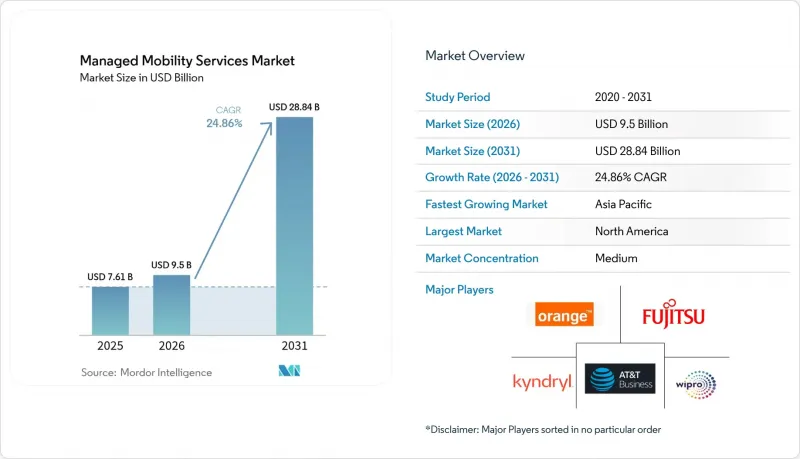
This report is Segmented by Function (Mobile Device Management, Mobile Application Management, and More), Deployment Model (Cloud-Based and On-Premises), Organization Size (Large Enterprises and Small and Medium-Sized Enterprises), End-User Industry (IT and Telecom, BFSI, Healthcare, and More), and Geography. The Market Forecasts are Provided in Terms of Value (USD).
Global Managed Mobility Services Market Trends and Insights
BYOD proliferation and hybrid work normalization
Firms now manage unprecedented endpoint diversity because 80% of employees access corporate data from personal devices, a scenario that stretches internal IT teams beyond practical limits. Cyber-risks rise when unmanaged smartphones and tablets handle sensitive files, so enterprises seek external specialists able to impose policy uniformity without limiting user freedom. Managed mobility services market vendors respond with containerization and real-time threat detection that secure data in motion and at rest. Demand rises fastest among knowledge-intensive industries where productivity gains offset device heterogeneity. Service providers that can blend security, user experience, and regulatory compliance stand to win large multiyear contracts as hybrid work policies solidify.
Outsourcing of IT and mobility lifecycle to cut TCO
Budget ownership has shifted from capital to operating expense, making predictable subscription models attractive. Comparative studies show per-device support costs drop 30% when lifecycle tasks move to a multi-tenant provider that leverages automation and scale. Outsourcing frees overstretched IT teams for strategic digital programs while giving executives uniform dashboards for usage, compliance, and spend. The managed mobility services market therefore grows rapidly among mid-market companies that lack mobility specialists. Vendors win deals when they can prove measurable savings, rapid onboarding, and SLA-based quality metrics that outclass in-house alternatives.
Perceived loss of operational control and cost visibility
Executives hesitate to hand key mobility functions to third parties when budget accountability and live performance data appear opaque. Concerns grow when variable fees, custom reporting surcharges, or vendor lock-in clauses come to light during contract negotiations. Providers now counter by exposing granular dashboards, flexible exit options, and benchmark pricing to rebuild trust. Transparent governance frameworks and co-managed models help sustain momentum in the managed mobility services market even among risk-averse organizations.
Other drivers and restraints analyzed in the detailed report include:
- Rapid cloud adoption enabling scalable MMS delivery
- Need for unified security and compliance across endpoints
- Integration complexity with legacy infrastructure
For complete list of drivers and restraints, kindly check the Table Of Contents.
Segment Analysis
Mobile device management delivered 61.98% of the managed mobility services market share in 2025 because enterprises initially prioritized uniform policy enforcement, asset tracking, and remote wipe capabilities across smartphones, tablets, and rugged endpoints. Comprehensive control over firmware updates and encryption status made the device layer an indispensable foundation for compliance audits and incident response. However, the segment's expansion rate now lags more agile application-centric options as organizations refine security to the data layer.
Mobile application management is forecast to post a 26.64% CAGR, the strongest among functional categories, as containerization separates corporate and personal contexts on BYOD hardware without intrusive full-device controls. Healthcare providers adopt app-level management to safeguard patient records while permitting clinicians to use personal phones, and financial institutions deploy secure app wrappers for mobile banking advisors. The shift encourages service vendors to bundle device, app, and content modules so clients avoid multiple contracts. Such convergence keeps the managed mobility services market adaptable to evolving endpoint threats and workforce expectations.
Cloud solutions held 68.15% of managed mobility services market size in 2025 and they will maintain momentum with a 26.92% CAGR as enterprises seek elastic capacity, uniform policy propagation, and rapid feature rollout. Multi-tenant architectures offer economies of scale for patch distribution, analytics processing, and compliance reporting that on-premises stacks cannot match. CIOs also value geographic redundancy delivered through hyperscale data centers that satisfy uptime commitments without capital expenditure.
On-premises deployments persist in defense, public sector, and heavily regulated utilities that require data residency or air-gapped operations. Even within those verticals, hybrid models emerge where core identity stores remain on site but device telemetry and AI analytics reside in the cloud. Service providers therefore invest in flexible architectures with connectors that move workloads seamlessly across environments. This approach keeps their addressable universe broad as sovereignty rules evolve, reinforcing the managed mobility services market as a pragmatic pathway to unified endpoint oversight.
Complete Report Scope:
- By Function
- Mobile Device Management
- Mobile Application Management
- Mobile Security Management
- Support and Maintenance
- By Deployment Model
- Cloud-based
- On-premises
- By Organization Size
- Large Enterprises
- Small and Medium-Sized Enterprises
- By End-user Industry
- IT and Telecom
- BFSI
- Healthcare
- Manufacturing
- Retail and E-commerce
- Education
- Government and Public Sector
- By Geography
- North America
- United States
- Canada
- Mexico
- South America
- Brazil
- Argentina
- Rest of South America
- Europe
- Germany
- United Kingdom
- France
- Italy
- Spain
- Rest of Europe
- Asia-Pacific
- China
- Japan
- South Korea
- India
- ASEAN
- Rest of Asia-Pacific
- Middle East and Africa
- Middle East
- Saudi Arabia
- United Arab Emirates
- Turkey
- Rest of Middle East
- Africa
- South Africa
- Nigeria
- Rest of Africa
- Middle East
- North America
Geography Analysis
North America retained 39.35% share in 2025 because early BYOD acceptance, mature cloud adoption, and stringent privacy rules together encouraged investment in full-featured managed programs. Enterprises routinely integrate mobile threat defense, secure connectivity, and analytics within unified contracts, raising average deal values. Public sector demand also rises as agencies modernize service delivery while satisfying FedRAMP and CJIS mandates, all of which magnify regional revenue pools for the managed mobility services market.
Asia-Pacific will advance at a 26.21% CAGR, the fastest worldwide, underpinned by industrial digitalization, government smart city agendas, and multifaceted e-commerce ecosystems. China's domestic cloud champions bundle mobility services with 5G private networks, while India's IT service integrators extend global best practices to local SMEs eager for remote support. ASEAN nations invest in workforce mobility to streamline tourism border checks, logistics corridors, and financial inclusion programs that rely on robust endpoint security. These varied deployments deepen regional expertise and attract fresh capital into the managed mobility services market.
Europe records steady growth due to GDPR enforcement, digital identity schemes, and demand for sovereignty-compliant clouds. Enterprises adjust procurement to favor providers that host telemetry within the bloc and can certify ISO 27001 compliance. Although budget cycles remain cautious, repeat contract renewals sustain predictable momentum. South America and the Middle East and Africa exhibit emerging demand as mobile broadband penetration climbs and multinational firms roll out standardized policies across affiliates. Capacity building by regional telecoms further enlarges the managed mobility services market footprint.
- AT&T Inc.
- Fujitsu Limited
- Kyndryl Holdings, Inc.
- Wipro Limited
- Orange S.A.
- Telefonica S.A.
- Samsung Electronics Co., Ltd.
- Hewlett Packard Enterprise Company
- Vodafone Group Plc
- Microsoft Corporation
- Tech Mahindra Limited
- Accenture plc
- International Business Machines Corporation
- Deutsche Telekom AG
- Verizon Communications Inc.
- Tata Consultancy Services Limited
- Infosys Limited
- DXC Technology Company
- Calero-MDSL, LLC
- Tangoe, Inc.
- SOTI Inc.
- Stratix Corporation
- Brightfin, LLC
- DMI (Digital Management, LLC)
Additional Benefits:
- The market estimate (ME) sheet in Excel format
- 3 months of analyst support
TABLE OF CONTENTS
1 INTRODUCTION
- 1.1 Study Assumptions and Market Definition
- 1.2 Scope of the Study
2 RESEARCH METHODOLOGY
3 EXECUTIVE SUMMARY
4 MARKET LANDSCAPE
- 4.1 Market Overview
- 4.2 Market Drivers
- 4.2.1 BYOD proliferation and hybrid-work normalization
- 4.2.2 Outsourcing of IT and mobility lifecycle to cut TCO
- 4.2.3 Rapid cloud adoption enabling scalable MMS delivery
- 4.2.4 Need for unified security and compliance across endpoints
- 4.2.5 eSIM/iSIM and remote SIM-OTA fueling zero-touch global fleets
- 4.2.6 AI-driven predictive support slashing device downtime
- 4.3 Market Restraints
- 4.3.1 Perceived loss of operational control and cost visibility
- 4.3.2 Integration complexity with legacy infrastructure
- 4.3.3 Rising SLA penalties from customization and high-touch support
- 4.3.4 Shortage of skilled mobility professionals
- 4.4 Industry Value Chain Analysis
- 4.5 Regulatory Landscape
- 4.6 Technological Outlook
- 4.7 Porter's Five Forces Analysis
- 4.7.1 Bargaining Power of Suppliers
- 4.7.2 Bargaining Power of Buyers/Consumers
- 4.7.3 Threat of New Entrants
- 4.7.4 Intensity of Competitive Rivalry
- 4.7.5 Threat of Substitutes
5 MARKET SIZE AND GROWTH FORECASTS (VALUE)
- 5.1 By Function
- 5.1.1 Mobile Device Management
- 5.1.2 Mobile Application Management
- 5.1.3 Mobile Security Management
- 5.1.4 Support and Maintenance
- 5.2 By Deployment Model
- 5.2.1 Cloud-based
- 5.2.2 On-premises
- 5.3 By Organization Size
- 5.3.1 Large Enterprises
- 5.3.2 Small and Medium-Sized Enterprises
- 5.4 By End-user Industry
- 5.4.1 IT and Telecom
- 5.4.2 BFSI
- 5.4.3 Healthcare
- 5.4.4 Manufacturing
- 5.4.5 Retail and E-commerce
- 5.4.6 Education
- 5.4.7 Government and Public Sector
- 5.5 By Geography
- 5.5.1 North America
- 5.5.1.1 United States
- 5.5.1.2 Canada
- 5.5.1.3 Mexico
- 5.5.2 South America
- 5.5.2.1 Brazil
- 5.5.2.2 Argentina
- 5.5.2.3 Rest of South America
- 5.5.3 Europe
- 5.5.3.1 Germany
- 5.5.3.2 United Kingdom
- 5.5.3.3 France
- 5.5.3.4 Italy
- 5.5.3.5 Spain
- 5.5.3.6 Rest of Europe
- 5.5.4 Asia-Pacific
- 5.5.4.1 China
- 5.5.4.2 Japan
- 5.5.4.3 South Korea
- 5.5.4.4 India
- 5.5.4.5 ASEAN
- 5.5.4.6 Rest of Asia-Pacific
- 5.5.5 Middle East and Africa
- 5.5.5.1 Middle East
- 5.5.5.1.1 Saudi Arabia
- 5.5.5.1.2 United Arab Emirates
- 5.5.5.1.3 Turkey
- 5.5.5.1.4 Rest of Middle East
- 5.5.5.2 Africa
- 5.5.5.2.1 South Africa
- 5.5.5.2.2 Nigeria
- 5.5.5.2.3 Rest of Africa
- 5.5.5.1 Middle East
- 5.5.1 North America
6 COMPETITIVE LANDSCAPE
- 6.1 Market Concentration Analysis
- 6.2 Strategic Moves (MandA, Partnerships, Product Launches)
- 6.3 Market Share Analysis
- 6.4 Company Profiles (includes Global overview, Market-level overview, Core Segments, Financials as available, Strategic Information, Market Rank/Share, Products and Services, Recent Developments)
- 6.4.1 AT&T Inc.
- 6.4.2 Fujitsu Limited
- 6.4.3 Kyndryl Holdings, Inc.
- 6.4.4 Wipro Limited
- 6.4.5 Orange S.A.
- 6.4.6 Telefonica S.A.
- 6.4.7 Samsung Electronics Co., Ltd.
- 6.4.8 Hewlett Packard Enterprise Company
- 6.4.9 Vodafone Group Plc
- 6.4.10 Microsoft Corporation
- 6.4.11 Tech Mahindra Limited
- 6.4.12 Accenture plc
- 6.4.13 International Business Machines Corporation
- 6.4.14 Deutsche Telekom AG
- 6.4.15 Verizon Communications Inc.
- 6.4.16 Tata Consultancy Services Limited
- 6.4.17 Infosys Limited
- 6.4.18 DXC Technology Company
- 6.4.19 Calero-MDSL, LLC
- 6.4.20 Tangoe, Inc.
- 6.4.21 SOTI Inc.
- 6.4.22 Stratix Corporation
- 6.4.23 Brightfin, LLC
- 6.4.24 DMI (Digital Management, LLC)
7 MARKET OPPORTUNITIES AND FUTURE OUTLOOK
- 7.1 White-space and Unmet-need Assessment

