PUBLISHER: Mordor Intelligence | PRODUCT CODE: 2120813

PUBLISHER: Mordor Intelligence | PRODUCT CODE: 2120813
Professional Cloud Services - Market Share Analysis, Industry Trends & Statistics, Growth Forecasts (2026 - 2031)
According to Mordor Intelligence, the professional cloud services market size is estimated at USD 31.07 billion in 2026, and is expected to reach USD 47.23 billion by 2031, at a CAGR of 8.74% during the forecast period (2026-2031).
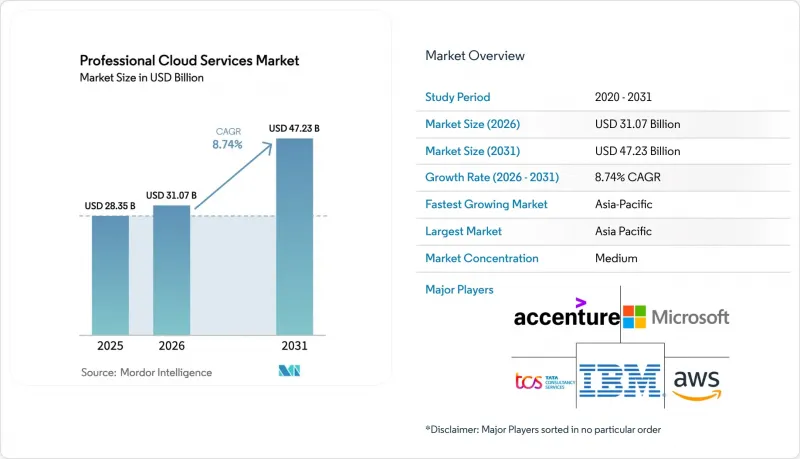
This report is Segmented by Type of Deployment (Public, Private, and Hybrid), Service Model (Software As A Service, Platform As A Service, and More), End-User Industry (Government and Public Sector, Banking Finance Services and Insurance, and More), Organization Size (Large Enterprises, and Small and Medium Enterprises), and Geography. The Market Forecasts are Provided in Terms of Value (USD).
Global Professional Cloud Services Market Trends and Insights
Hyperscaler Price-Performance Gains Accelerate Cloud Migration
Custom silicon is reducing compute cost per transaction by roughly one-third, encouraging enterprises to move even batch workloads into public regions. AWS Graviton4, Azure Maia 100, and Google Cloud TPU v5 all launched in 2024-2025, improving performance while lowering total monthly bills and cutting the payback period for migrations from three years to under 18 months. Price visibility and quicker returns are expanding the professional cloud services market among cost-sensitive verticals, such as manufacturing and logistics, where cloud adoption has historically lagged.
Generative AI Workload Surge Demands Specialized Cloud Expertise
Training and inference for large language models require high-bandwidth networking, low-latency storage, and elastic clusters that most corporate data centers cannot supply. OpenAI's GPT-4 consumed about 25,000 GPUs in 2024, while Anthropic's Claude 3 added multimodal inputs in 2025, driving enterprises toward turnkey platforms that bundle vector databases, prompt-engineering tools, and managed model hosting. Integrators capable of orchestrating these stacks are commanding premium consulting rates, adding momentum to the professional cloud services market.
Talent Shortage in Advanced Cloud Specializations
While demand for cloud FinOps engineers rose 85% year-over-year in 2025, supply grew only 22%, creating a structural skills gap and inflating salaries for multi-cloud architects above USD 200,000 in North America. Enterprises struggling to recruit talent rely heavily on external consultants, adding cost and stretching project timelines across the professional cloud services market.
Other drivers and restraints analyzed in the detailed report include:
- Sovereign-Cloud Mandates Fragment Global Scale
- Edge-to-Cloud Integration Enables Low-Latency Applications
- Escalating Egress and Inter-Cloud Transfer Costs
For complete list of drivers and restraints, kindly check the Table Of Contents.
Segment Analysis
Hybrid deployments accounted for 43% of 2025 revenue, underscoring enterprises' wish to preserve existing capital investments while tapping public elasticity. Public cloud, however, is poised to advance at a 9.02% CAGR, the fastest within the professional cloud services market, as cost transparency and variable pricing attract new adopters. Private cloud retains traction in strictly regulated sectors such as banking and government, though its share is slowly eroding thanks to isolated tenancy options offered by hyperscalers.
Kubernetes is leveling the differences among deployment models by making workloads portable. In 2025 the Cloud Native Computing Foundation reported that 78% of enterprises ran Kubernetes in production, leading firms to shift applications between private and public clouds based on cost and performance considerations. This portability is commoditizing infrastructure and pushing competition into higher-value services like managed databases and AI platforms, elements now decisive in the professional cloud services market.
Infrastructure as a Service held 35% of the market share in 2025 because compute-intensive workloads still need granular control. Software as a Service is expected to grow the fastest, at a 9.31% CAGR, as vendors package industry workflows into pre-integrated suites, shortening deployment from months to weeks. Salesforce, Microsoft Dynamics, and Oracle Fusion now embed generative AI features, delivering outcomes without clients managing the underlying infrastructure.
The rise of AI is redrawing service-model boundaries. Training requires IaaS-level GPU clusters, whereas deployment favors SaaS offerings that bundle pre-trained models. OpenAI's ChatGPT Enterprise illustrates this duality by providing turnkey conversational AI while delegating infrastructure concerns to hyperscalers. As the professional cloud services market matures, vendors that combine stack depth with vertical functionality are best positioned for sustained growth.
Complete Report Scope:
- By Type of Deployment
- Public
- Private
- Hybrid
- By Service Model
- Software as a Service (SaaS)
- Platform as a Service (PaaS)
- Infrastructure as a Service (IaaS)
- By End-User Industry
- Government and Public Sector
- Healthcare
- Banking, Finance, Services and Insurance (BFSI)
- Retail
- IT and Telecommunications
- Media and Entertainment
- Other End-User Industries
- By Organization Size
- Large Enterprises
- Small and Medium Enterprises
- By Geography
- North America
- United States
- Canada
- Mexico
- South America
- Brazil
- Argentina
- Rest of South America
- Europe
- United Kingdom
- Germany
- France
- Italy
- Spain
- Russia
- Rest of Europe
- Asia-Pacific
- China
- Japan
- India
- South Korea
- Australia
- Rest of Asia-Pacific
- Middle East
- Saudi Arabia
- United Arab Emirates
- Turkey
- Rest of Middle East
- Africa
- South Africa
- Nigeria
- Egypt
- Rest of Africa
- North America
Geography Analysis
Asia-Pacific held 28.3% of the professional cloud services market share in 2025 and is projected to rise at an 8.93% CAGR through 2031. Digital-transformation mandates in India, Indonesia, and Vietnam, together with China's drive for domestic hyperscaler dominance, are widening regional demand. India's Digital India initiative earmarked USD 10 billion for public cloud procurement, anchoring adoption that spills over into private enterprise.
North America remains a major market, but growth is moderating as enterprises optimize existing estates rather than migrate new workloads. In the United States, the FedRAMP program's rigorous certification timeline limits the number of authorized providers, slowing federal-sector expansion. Canada's Personal Information Protection and Electronic Documents Act steers enterprises toward local data centers, but cross-border collaboration tools still benefit from hyperscaler footprints.
Europe's sovereign-cloud ambitions, led by Gaia-X and national data-localization policies, are fragmenting the regional market. AWS introduced its European Sovereign Cloud in 2025 to address local compliance demands, while French and German strategies privilege domestic providers, raising costs and narrowing service breadth. The United Kingdom adopted a more pragmatic stance, allowing hyperscaler participation provided security standards are met.
The Middle East and Africa are following a public-sector-first trajectory. Saudi Arabia's Vision 2030 allocated USD 6.4 billion to digital infrastructure, triggering partnerships that bring hyperscaler regions into the kingdom. The United Arab Emirates and South Africa enforce data-protection laws that steer sensitive workloads to in-country data centers. Across Africa, Nigeria's 2024 cloud guidelines signal government willingness to lead by example.
South America's outlook is mixed. Currency depreciation in Brazil and triple-digit inflation in Argentina raise the cost of dollar-denominated services, slowing near-term adoption. Nonetheless, e-commerce expansion and fintech innovation underpin a gradual increase in regional professional cloud services market penetration.
- Accenture plc
- Amazon Web Services, Inc.
- Microsoft Corporation
- IBM Corporation
- Alphabet Inc. (Google Cloud)
- Deloitte Touche Tohmatsu Limited
- Tata Consultancy Services Limited
- Infosys Limited
- Capgemini SE
- Wipro Limited
- HCL Technologies Limited
- Cognizant Technology Solutions Corporation
- Rackspace Technology, Inc.
- Oracle Corporation
- Alibaba Group Holding Limited (Alibaba Cloud)
- Salesforce, Inc.
- SAP SE
- NTT DATA Corporation
- Huawei Technologies Co., Ltd.
- Google Professional Services, LLC
Additional Benefits:
- The market estimate (ME) sheet in Excel format
- 3 months of analyst support
TABLE OF CONTENTS
1 INTRODUCTION
- 1.1 Study Assumptions and Market Definition
- 1.2 Scope of the Study
2 RESEARCH METHODOLOGY
3 EXECUTIVE SUMMARY
4 MARKET LANDSCAPE
- 4.1 Market Overview
- 4.2 Market Drivers
- 4.2.1 Hyperscaler Price-Performance Gains Accelerate Cloud Migration
- 4.2.2 Generative AI Workload Surge Demands Specialized Cloud Expertise
- 4.2.3 Shift to Outcome-Based Service-as-a-Software Contracts
- 4.2.4 Sovereign-Cloud Mandates in Europe and Asia-Pacific
- 4.2.5 Edge-to-Cloud Integration for Low-Latency Applications
- 4.2.6 Cloud FinOps Tools Drive Spend Transparency and Adoption
- 4.3 Market Restraints
- 4.3.1 Talent Shortage in Advanced Cloud Specializations
- 4.3.2 Escalating Egress and Inter-Cloud Transfer Costs
- 4.3.3 Fragmented Regional Compliance Frameworks
- 4.3.4 Inflation-Driven Opex Scrutiny in SME Segment
- 4.4 Impact of Macroeconomic Factors on the Market
- 4.5 Industry Value / Supply-Chain Analysis
- 4.6 Regulatory Landscape
- 4.7 Technological Outlook
- 4.8 Porter's Five Forces Analysis
- 4.8.1 Bargaining Power of Buyers
- 4.8.2 Bargaining Power of Suppliers
- 4.8.3 Threat of New Entrants
- 4.8.4 Threat of Substitutes
- 4.8.5 Competitive Rivalry
5 MARKET SIZE AND GROWTH FORECASTS
- 5.1 By Type of Deployment
- 5.1.1 Public
- 5.1.2 Private
- 5.1.3 Hybrid
- 5.2 By Service Model
- 5.2.1 Software as a Service (SaaS)
- 5.2.2 Platform as a Service (PaaS)
- 5.2.3 Infrastructure as a Service (IaaS)
- 5.3 By End-User Industry
- 5.3.1 Government and Public Sector
- 5.3.2 Healthcare
- 5.3.3 Banking, Finance, Services and Insurance (BFSI)
- 5.3.4 Retail
- 5.3.5 IT and Telecommunications
- 5.3.6 Media and Entertainment
- 5.3.7 Other End-User Industries
- 5.4 By Organization Size
- 5.4.1 Large Enterprises
- 5.4.2 Small and Medium Enterprises
- 5.5 By Geography
- 5.5.1 North America
- 5.5.1.1 United States
- 5.5.1.2 Canada
- 5.5.1.3 Mexico
- 5.5.2 South America
- 5.5.2.1 Brazil
- 5.5.2.2 Argentina
- 5.5.2.3 Rest of South America
- 5.5.3 Europe
- 5.5.3.1 United Kingdom
- 5.5.3.2 Germany
- 5.5.3.3 France
- 5.5.3.4 Italy
- 5.5.3.5 Spain
- 5.5.3.6 Russia
- 5.5.3.7 Rest of Europe
- 5.5.4 Asia-Pacific
- 5.5.4.1 China
- 5.5.4.2 Japan
- 5.5.4.3 India
- 5.5.4.4 South Korea
- 5.5.4.5 Australia
- 5.5.4.6 Rest of Asia-Pacific
- 5.5.5 Middle East
- 5.5.5.1 Saudi Arabia
- 5.5.5.2 United Arab Emirates
- 5.5.5.3 Turkey
- 5.5.5.4 Rest of Middle East
- 5.5.6 Africa
- 5.5.6.1 South Africa
- 5.5.6.2 Nigeria
- 5.5.6.3 Egypt
- 5.5.6.4 Rest of Africa
- 5.5.1 North America
6 COMPETITIVE LANDSCAPE
- 6.1 Market Concentration
- 6.2 Strategic Moves
- 6.3 Market Share Analysis
- 6.4 Company Profiles (includes Global Level Overview, Market Level Overview, Core Segments, Financials as available, Strategic Information, Market Rank/Share for key companies, Products and Services, and Recent Developments)
- 6.4.1 Accenture plc
- 6.4.2 Amazon Web Services, Inc.
- 6.4.3 Microsoft Corporation
- 6.4.4 IBM Corporation
- 6.4.5 Alphabet Inc. (Google Cloud)
- 6.4.6 Deloitte Touche Tohmatsu Limited
- 6.4.7 Tata Consultancy Services Limited
- 6.4.8 Infosys Limited
- 6.4.9 Capgemini SE
- 6.4.10 Wipro Limited
- 6.4.11 HCL Technologies Limited
- 6.4.12 Cognizant Technology Solutions Corporation
- 6.4.13 Rackspace Technology, Inc.
- 6.4.14 Oracle Corporation
- 6.4.15 Alibaba Group Holding Limited (Alibaba Cloud)
- 6.4.16 Salesforce, Inc.
- 6.4.17 SAP SE
- 6.4.18 NTT DATA Corporation
- 6.4.19 Huawei Technologies Co., Ltd.
- 6.4.20 Google Professional Services, LLC
7 MARKET OPPORTUNITIES AND FUTURE OUTLOOK
- 7.1 White-Space and Unmet-Need Assessment

