PUBLISHER: Mordor Intelligence | PRODUCT CODE: 2121224

PUBLISHER: Mordor Intelligence | PRODUCT CODE: 2121224
Proteases - Market Share Analysis, Industry Trends & Statistics, Growth Forecasts (2026 - 2031)
According to Mordor Intelligence, the protease enzymes market size was valued at USD 2.03 billion in 2025 and estimated to grow from USD 2.23 billion in 2026 to reach USD 3.61 billion by 2031, at a CAGR of 10.05% during the forecast period (2026-2031).
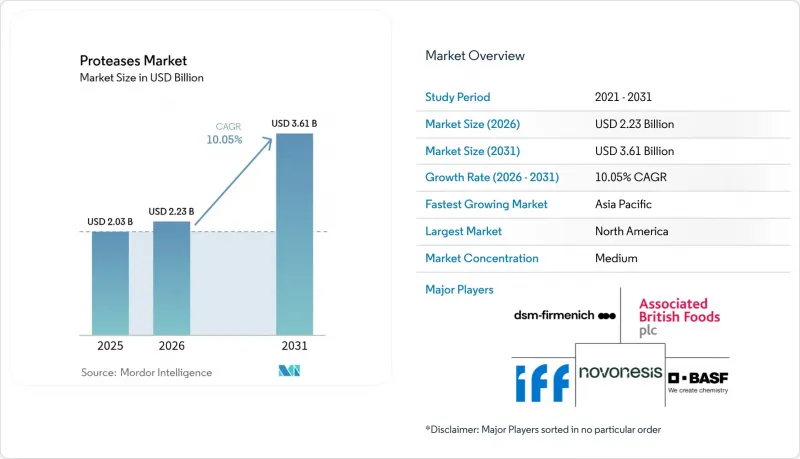
This report is Segmented by Source (Animal, Plant, and Microbial), Application (Food and Beverage, Pharmaceuticals, Animal Feed, and Other Applications), and Geography (North America, Europe, Asia-Pacific, South America, and Middle East and Africa). The Market Forecasts are Provided in Terms of Value (USD).
Global Proteases Market Trends and Insights
Expansion of Protein-Hydrolysate Demand in Functional Foods and Beverages
The growing demand for protein hydrolysates in functional foods and beverages drives the protease market growth, as these enzymes break down proteins into bioactive peptides that improve digestibility, solubility, and nutritional value. Consumer preferences significantly influence this trend, with 72% of consumers choosing functional beverages with health benefits and 44% selecting products with natural ingredients in 2023, as per the Glanbia Nutritionals report. In response, manufacturers have incorporated natural and clean-label protease solutions. The increasing popularity of protein-enriched drinks for muscle recovery, weight management, and wellness, along with enzyme technology improvements that minimize bitterness and enhance amino acid profiles, continues to drive demand. The combination of heightened health consciousness and expanding functional beverage consumption increases protease requirements in the food and beverage industry.
Growing Inclination Toward Specialty and Sustainable Ingredients
Consumer preference for sustainable and specialty ingredients is reshaping enzyme procurement strategies across food and beverage manufacturers, with plant-based and microbially-derived proteases gaining market share over animal-derived alternatives. Proteases sourced from these sustainable origins support clean-label, natural, and environmentally friendly formulations, aligning with the growing demand for specialty ingredients that promote health, wellness, and ethical considerations. According to the International Food Information Council 2024 Report, 36% of U.S. consumers stated that products labeled as natural or organic enhance their confidence in safety, further highlighting the importance of transparency and sustainability in food production. Additionally, regulatory frameworks such as the European Commission's biotechnology strategy, which emphasizes bio-based product development through lifecycle assessment frameworks and potential bio-content requirements, are creating favorable conditions for enzymatic processing solutions. Collectively, these consumer trends and regulatory tailwinds are driving increased adoption of proteases in the food and beverage industry.
Complex Regulatory Compliance Requirements
Regulatory frameworks for enzyme applications differ across regions, creating compliance challenges that affect smaller enzyme producers and delay market entry for new protease variants. The FDA's GRAS approval process for food enzymes requires extensive safety documentation and extends development timelines by 12-18 months. The European Food Safety Authority implements stricter evaluation criteria, requiring additional toxicological studies. China's evolving regulatory system for novel food ingredients creates further complexity for companies seeking global market access, with recent amendments to food standards codes mandating comprehensive safety assessments for genetically modified enzyme preparations. Pharmaceutical applications face more rigorous requirements, as enzyme-based therapeutics must undergo clinical trials and comply with Good Manufacturing Practices standards. Companies must demonstrate enzyme purity, absence of microbial contaminants, and consistent activity levels across production batches. To address these requirements, companies are investing in regulatory affairs expertise and implementing dedicated quality systems. Compliance costs typically account for 15-20% of total development expenses for new enzyme products.
Other drivers and restraints analyzed in the detailed report include:
- Strategic Investments by Market Players
- Technological Advancements in Enzyme Engineering and Bioprocessing
- High Production Costs Impede Market Growth
For complete list of drivers and restraints, kindly check the Table Of Contents.
Segment Analysis
Microbial sources hold a 63.62% market share in 2025, as fermentation-based protease production offers better scalability and consistency compared to plant and animal extraction methods. Fungal and bacterial platforms allow precise control of enzyme properties through genetic modification, while utilizing existing bioprocessing infrastructure and regulatory pathways to maintain cost efficiency. Plant-derived proteases show the highest growth rate at 10.42% CAGR through 2031, supported by clean-label trends and increased consumer demand for natural food ingredients. Bromelain from pineapple and papain from papaya maintain commercial importance, despite supply chain uncertainties and seasonal availability limitations.
Animal-derived proteases experience reduced demand due to religious dietary restrictions, sustainability issues, and regulations concerning bovine spongiform encephalopathy prevention. This segment's market share decreases as microbial fermentation through synthetic biology produces animal-equivalent enzymes with identical functionality but reduced supply chain risks. New microbial platforms using extremophile organisms generate interest for their thermostable proteases suited to high-temperature industrial processes, though high production costs and lengthy regulatory approvals limit commercial implementation.
Complete Report Scope:
- Source
- Animal
- Plant
- Microbial
- Application
- Food and Beverage
- Dairy
- Bakery
- Beverages
- Meat and Poultry
- Others
- Pharmaceuticals
- Animal Feed
- Other Applications
- Food and Beverage
- Geography
- North America
- United States
- Canada
- Mexico
- Rest of North America
- Europe
- Spain
- United Kingdom
- France
- Germany
- Italy
- Rest of Europe
- Asia-Pacific
- China
- Japan
- India
- Singapore
- Australia
- Rest of Asia-Pacific
- South America
- Brazil
- Argentina
- Rest of South America
- Middle East and Africa
- South Africa
- United Arab Emirates
- Saudi Arabia
- Rest of Middle East and Africa
- North America
Geography Analysis
North America holds 33.10% market share in 2025, driven by advanced biotechnology infrastructure, strict food safety regulations supporting enzymatic processing, and established pharmaceutical manufacturing capabilities. The region's strong intellectual property protection and substantial research and development investment in enzyme engineering reinforce its market position. Asia-Pacific exhibits the highest growth rate at 10.74% CAGR, attributed to expanding biopharmaceutical manufacturing capacity, government biotechnology initiatives, and increased enzymatic processing adoption in food production.
China's regulatory framework continues to adapt to accommodate enzyme applications in novel food ingredients, while India's pharmaceutical sector implements enzymatic processes for efficient production of generic drugs and biosimilars. Europe maintains consistent growth in its mature markets, with environmental regulations promoting bio-based processing solutions and circular economy practices. The European Commission's biotechnology strategy supports protease enzyme development, though strict regulatory requirements affect the timeline for new product launches.
South America, the Middle East, and Africa present growth opportunities in animal feed and food processing applications. These regions show potential for protease applications in livestock nutrition, aquaculture feed formulation, and food manufacturing processes. However, the market expansion faces constraints due to insufficient biotechnology infrastructure, including limited research facilities and production capabilities, as well as underdeveloped regulatory frameworks that slow down product approvals and market entry in these regions.
- Novonesis Group
- DSM-Firmenich AG
- International Flavors & Fragrances Inc.
- Associated British Foods plc (AB Enzymes)
- Amano Enzyme Inc.
- Advanced Enzyme Technologies Ltd.
- Novus International Inc.
- Biocatalysts Ltd.
- BASF SE
- Kemin Industries Inc.
- Enzyme Development Corp.
- Dyadic International Inc.
- Specialty Enzymes & Probiotics
- Sunson Industry Group Co., Ltd.
- Jiangsu Boli Bioproducts Co., Ltd.
- Chr. Hansen Holding A/S
- Shanghai Shinge Biochemical Industry Co., Ltd.
- Aumgene Biosciences
- Bioven Ingredients
- Sichuan Deebio Pharmaceutical Co., Ltd.
- Riken Vitamin Co., Ltd.
- Guangdong VTR Bio-Tech Co., Ltd.
Additional Benefits:
- The market estimate (ME) sheet in Excel format
- 3 months of analyst support
TABLE OF CONTENTS
1 INTRODUCTION
- 1.1 Study Assumptions and Market Definition
- 1.2 Scope of the Study
2 RESEARCH METHODOLOGY
3 EXECUTIVE SUMMARY
4 MARKET LANDSCAPE
- 4.1 Market Overview
- 4.2 Market Drivers
- 4.2.1 Expansion of protein-hydrolysate demand in functional foods and beverages
- 4.2.2 Growing inclination toward specialty and sustainable ingredients
- 4.2.3 Strategic investments by market players
- 4.2.4 Technological advancements in enzyme engineering and bioprocessing
- 4.2.5 Increasing use in animal feed
- 4.2.6 Growing sports nutrition market driving protease adoption
- 4.3 Market Restraints
- 4.3.1 Complex regulatory compliance requirements
- 4.3.2 Allergenic-safety perception among food processors
- 4.3.3 High production costs impede market growth
- 4.3.4 Limited enzyme stability and shelf life
- 4.4 Supply-Chain Analysis
- 4.5 Regulatory and Technological Outlook
- 4.6 Porter's Five Forces Analysis
- 4.6.1 Threat of New Entrants
- 4.6.2 Bargaining Power of Buyers
- 4.6.3 Bargaining Power of Suppliers
- 4.6.4 Threat of Substitutes
- 4.6.5 Intensity of Competitive Rivalry
5 MARKET SIZE AND GROWTH FORECATS (VALUE)
- 5.1 Source
- 5.1.1 Animal
- 5.1.2 Plant
- 5.1.3 Microbial
- 5.2 Application
- 5.2.1 Food and Beverage
- 5.2.1.1 Dairy
- 5.2.1.2 Bakery
- 5.2.1.3 Beverages
- 5.2.1.4 Meat and Poultry
- 5.2.1.5 Others
- 5.2.2 Pharmaceuticals
- 5.2.3 Animal Feed
- 5.2.4 Other Applications
- 5.2.1 Food and Beverage
- 5.3 Geography
- 5.3.1 North America
- 5.3.1.1 United States
- 5.3.1.2 Canada
- 5.3.1.3 Mexico
- 5.3.1.4 Rest of North America
- 5.3.2 Europe
- 5.3.2.1 Spain
- 5.3.2.2 United Kingdom
- 5.3.2.3 France
- 5.3.2.4 Germany
- 5.3.2.5 Italy
- 5.3.2.6 Rest of Europe
- 5.3.3 Asia-Pacific
- 5.3.3.1 China
- 5.3.3.2 Japan
- 5.3.3.3 India
- 5.3.3.4 Singapore
- 5.3.3.5 Australia
- 5.3.3.6 Rest of Asia-Pacific
- 5.3.4 South America
- 5.3.4.1 Brazil
- 5.3.4.2 Argentina
- 5.3.4.3 Rest of South America
- 5.3.5 Middle East and Africa
- 5.3.5.1 South Africa
- 5.3.5.2 United Arab Emirates
- 5.3.5.3 Saudi Arabia
- 5.3.5.4 Rest of Middle East and Africa
- 5.3.1 North America
6 COMPETITIVE LANDSCAPE
- 6.1 Most Active Companies
- 6.2 Market Positioning Analysis
- 6.3 Company Profiles
- 6.3.1 Novonesis Group
- 6.3.2 DSM-Firmenich AG
- 6.3.3 International Flavors & Fragrances Inc.
- 6.3.4 Associated British Foods plc (AB Enzymes)
- 6.3.5 Amano Enzyme Inc.
- 6.3.6 Advanced Enzyme Technologies Ltd.
- 6.3.7 Novus International Inc.
- 6.3.8 Biocatalysts Ltd.
- 6.3.9 BASF SE
- 6.3.10 Kemin Industries Inc.
- 6.3.11 Enzyme Development Corp.
- 6.3.12 Dyadic International Inc.
- 6.3.13 Specialty Enzymes & Probiotics
- 6.3.14 Sunson Industry Group Co., Ltd.
- 6.3.15 Jiangsu Boli Bioproducts Co., Ltd.
- 6.3.16 Chr. Hansen Holding A/S
- 6.3.17 Shanghai Shinge Biochemical Industry Co., Ltd.
- 6.3.18 Aumgene Biosciences
- 6.3.19 Bioven Ingredients
- 6.3.20 Sichuan Deebio Pharmaceutical Co., Ltd.
- 6.3.21 Riken Vitamin Co., Ltd.
- 6.3.22 Guangdong VTR Bio-Tech Co., Ltd.
7 MARKET OPPORTUNITIES AND FUTURE OUTLOOK

