PUBLISHER: Mordor Intelligence | PRODUCT CODE: 2121241

PUBLISHER: Mordor Intelligence | PRODUCT CODE: 2121241
Europe Plastic Caps And Closures - Market Share Analysis, Industry Trends & Statistics, Growth Forecasts (2026 - 2031)
According to Mordor Intelligence, the Europe plastic caps and closures market size is projected to be 2.02 Million Tonnes in 2025, 2.09 Million Tonnes in 2026, and reach 2.45 Million Tonnes by 2031, growing at a CAGR of 3.23% from 2026 to 2031.
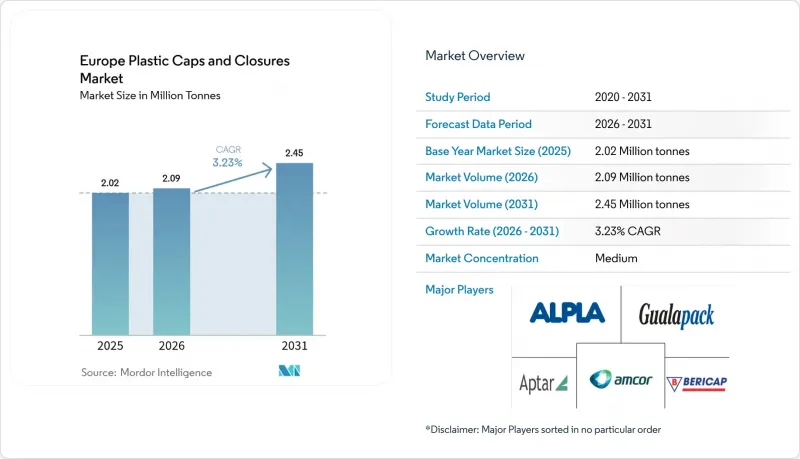
This report is Segmented by Material Type (PET, PP, LDPE, HDPE, PVC, and More), Product Type (Screw Caps, Snap-On Caps, Dispensing Closures, Child-Resistant Closures, and More), Manufacturing Technology (Injection Molding, and More), End-User Industry (Beverage, Food, and More), and Geography. The Market Forecasts are Provided in Terms of Volume (Tonnes).
Europe Plastic Caps And Closures Market Trends and Insights
High Adoption of Tethered Caps Ahead of the 2024 Deadline
Demand for tethered designs spiked once the Single-Use Plastics Directive became enforceable, forcing 450 million beverage lines to retool at speed. Orders at Guala Closures surged 340% in 2024, stretching mold lead times to 16 weeks. The new hinges must withstand 10,000 open-close cycles, effectively excluding commodity PP grades. Patent-protected stress-relief grooves from BERICAP keep failure rates below 0.5% in field trials. Although tethering raises per-cap resin use by 8-12%, the design is now non-negotiable for carbonated drinks, locking in a near-term volume uplift for the Europe plastic caps and closures market.
Lightweighting Mandates from EU Packaging Regulation
Regulation 2025/40 caps closure mass and links compliance to design-for-recycling criteria under ISO 18604. Coca-Cola European Partners reported an 18% resin saving after switching to thin-wall caps, equivalent to 12,000 metric tons in 2025. Thin walls, however, risk hinge brittleness at sub-zero haulage temperatures, pushing converters toward higher-molecular-weight PP grades. Precision tooling for sub-2-gram closures gives early movers a cost edge, even as higher scrap rates accompany the learning curve. The combined effect is a measurable 0.9% uplift to CAGR across the forecast period.
Deposit-Return Schemes Steering Brands Toward Aluminium Cans
Collection rates for cans now exceed 92% in key DRS markets, compared with 78-82% for PET bottles. Coca-Cola Europacific Partners raised its can mix to 38% of European volume in 2025. Each 1-point share shift removes 450 million plastic closures per year, a structural drag that subtracts 0.9% from forecast CAGR. Closure suppliers are pivoting toward non-carbonated beverages and functional waters to cushion the blow.
Other drivers and restraints analyzed in the detailed report include:
- Aseptic-Ready Closure Demand in Dairy RTD Lines
- Brand-Owner Shift Toward Recycled-Content Caps
- High Capital Intensity for Tethered-Cap Retrofits
For complete list of drivers and restraints, kindly check the Table Of Contents.
Segment Analysis
Polypropylene claimed 46.16% of the Europe plastic caps and closures market share in 2025 because it balances heat resistance with low unit cost. Growth skews toward low-density polyethylene, which is advancing at a 5.52% CAGR through 2031 as squeezable tubes in beauty and condiment lines favour softer resins for fingertip control.
Lower melt viscosity allows LDPE to form thinner walls, shaving 12% average resin per cap. High-density polyethylene retains pharma and child-resistant niches that demand ISO 8317 torque resistance, while bio-attributed PP under ISCC PLUS is on track for price parity by 2028, giving sustainability-minded brands a drop-in alternative without tooling changes.
Threaded screw caps still accounted for 57.85% of 2025 revenue, confirming their ubiquity in water and CSD segments of the Europe plastic caps and closures market. Dispensing variants, however, are growing 5.21% per year as airless pumps protect antioxidant serums from oxidation.
Aptar's silicone-free valve removes elastomer migration, a key clean-beauty ask. Child-resistant push-and-turn formats climbed 4.3% in 2025, and NFC-enabled tamper-evident bands are turning closures into authentication tools. Sports caps and flip-tops round out the portfolio, chasing hydration and condiment trends.
Complete Report Scope:
- By Material Type
- Polyethylene Terephthalate (PET)
- Polypropylene (PP)
- Low-Density Polyethylene (LDPE)
- High-Density Polyethylene (HDPE)
- Polyvinyl Chloride (PVC)
- Other Materials
- By Product Type
- Screw Caps
- Snap-On Caps
- Dispensing Closures
- Child-Resistant Closures
- Tamper-Evident Closures
- Other Product Types
- By Manufacturing Type
- Injection Molding
- Compression Molding
- Blow Molding
- By End-User Industry
- Beverage
- Food
- Pharmaceutical and Healthcare
- Cosmetics and Toiletries
- Household Chemicals
- Other Industries
- By Country
- Germany
- United Kingdom
- Spain
- France
- Italy
- Slovenia
- Austria
- Switzerland
- Hungary
- Croatia
- Romania
- Greece
- Russia
- Rest of Europe
List of Companies Covered in this Report:
- BERICAP GmbH and Co. KG
- Guala Closures Group
- Pelliconi and C. S.p.A.
- UNITED CAPS Luxembourg S.A.
- Closure Systems International Europe GmbH
- AptarGroup Inc.
- Amcor plc
- ALPLA Werke Alwin Lehner GmbH and Co KG
- Georg Menshen GmbH and Co. KG
- Weener Plastics Group
- Tetra Pak International S.A.
- Coral Products PLC
- Greiner Packaging International GmbH
- Logoplaste
- Pano Cap Europe Ltd.
Additional Benefits:
- The market estimate (ME) sheet in Excel format
- 3 months of analyst support
TABLE OF CONTENTS
1 INTRODUCTION
- 1.1 Study Assumptions and Market Definition
- 1.2 Scope of the Study
2 RESEARCH METHODOLOGY
3 EXECUTIVE SUMMARY
4 MARKET LANDSCAPE
- 4.1 Market Overview
- 4.2 Market Drivers
- 4.2.1 Lightweighting mandates from EU Packaging and Packaging-Waste Regulation
- 4.2.2 High adoption of tethered caps ahead of 2024 EU directive deadline
- 4.2.3 Growing demand for high-barrier, aseptic-ready closures in dairy RTD lines
- 4.2.4 Brand-owner shift toward recycled-content caps
- 4.2.5 Craft spirits boom driving premium, tamper-evident closures
- 4.2.6 Rapid growth of e-commerce refill formats requiring leak-proof closures
- 4.3 Market Restraints
- 4.3.1 Stand-up pouches encroaching on household-chemical SKUs
- 4.3.2 Deposit-return schemes steering beverage players to aluminum cans
- 4.3.3 Lack of continent-wide rPET/rHDPE food-grade supply
- 4.3.4 High capital intensity for tethered-cap retrofits in legacy PET lines
- 4.4 Industry Value Chain Analysis
- 4.5 Regulatory Landscape
- 4.6 Technological Outlook
- 4.7 Porter's Five Forces Analysis
- 4.7.1 Bargaining Power of Suppliers
- 4.7.2 Bargaining Power of Buyers
- 4.7.3 Threat of New Entrants
- 4.7.4 Intensity of Competitive Rivalry
- 4.7.5 Threat of Substitute Products
5 MARKET SIZE AND GROWTH FORECASTS (VOLUME)
- 5.1 By Material Type
- 5.1.1 Polyethylene Terephthalate (PET)
- 5.1.2 Polypropylene (PP)
- 5.1.3 Low-Density Polyethylene (LDPE)
- 5.1.4 High-Density Polyethylene (HDPE)
- 5.1.5 Polyvinyl Chloride (PVC)
- 5.1.6 Other Materials
- 5.2 By Product Type
- 5.2.1 Screw Caps
- 5.2.2 Snap-On Caps
- 5.2.3 Dispensing Closures
- 5.2.4 Child-Resistant Closures
- 5.2.5 Tamper-Evident Closures
- 5.2.6 Other Product Types
- 5.3 By Manufacturing Type
- 5.3.1 Injection Molding
- 5.3.2 Compression Molding
- 5.3.3 Blow Molding
- 5.4 By End-User Industry
- 5.4.1 Beverage
- 5.4.2 Food
- 5.4.3 Pharmaceutical and Healthcare
- 5.4.4 Cosmetics and Toiletries
- 5.4.5 Household Chemicals
- 5.4.6 Other Industries
- 5.5 By Country
- 5.5.1 Germany
- 5.5.2 United Kingdom
- 5.5.3 Spain
- 5.5.4 France
- 5.5.5 Italy
- 5.5.6 Slovenia
- 5.5.7 Austria
- 5.5.8 Switzerland
- 5.5.9 Hungary
- 5.5.10 Croatia
- 5.5.11 Romania
- 5.5.12 Greece
- 5.5.13 Russia
- 5.5.14 Rest of Europe
6 COMPETITIVE LANDSCAPE
- 6.1 Market Concentration
- 6.2 Strategic Moves
- 6.3 Market Share Analysis
- 6.4 Company Profiles (includes Global level Overview, Market level overview, Core Segments, Financials as available, Strategic Information, Market Rank/Share for key companies, Products and Services, and Recent Developments)
- 6.4.1 BERICAP GmbH and Co. KG
- 6.4.2 Guala Closures Group
- 6.4.3 Pelliconi and C. S.p.A.
- 6.4.4 UNITED CAPS Luxembourg S.A.
- 6.4.5 Closure Systems International Europe GmbH
- 6.4.6 AptarGroup Inc.
- 6.4.7 Amcor plc
- 6.4.8 ALPLA Werke Alwin Lehner GmbH and Co KG
- 6.4.9 Georg Menshen GmbH and Co. KG
- 6.4.10 Weener Plastics Group
- 6.4.11 Tetra Pak International S.A.
- 6.4.12 Coral Products PLC
- 6.4.13 Greiner Packaging International GmbH
- 6.4.14 Logoplaste
- 6.4.15 Pano Cap Europe Ltd.
7 MARKET OPPORTUNITIES AND FUTURE OUTLOOK
- 7.1 White-Space and Unmet-Need Assessment

