PUBLISHER: Mordor Intelligence | PRODUCT CODE: 2121249

PUBLISHER: Mordor Intelligence | PRODUCT CODE: 2121249
Asia-Pacific Operation Intelligence - Market Share Analysis, Industry Trends & Statistics, Growth Forecasts (2026 - 2031)
According to Mordor Intelligence, the Asia-Pacific operation intelligence market size was valued at USD 8.96 billion in 2025 and estimated to grow from USD 9.87 billion in 2026 to reach USD 16.06 billion by 2031, at a CAGR of 10.19% during the forecast period (2026-2031).
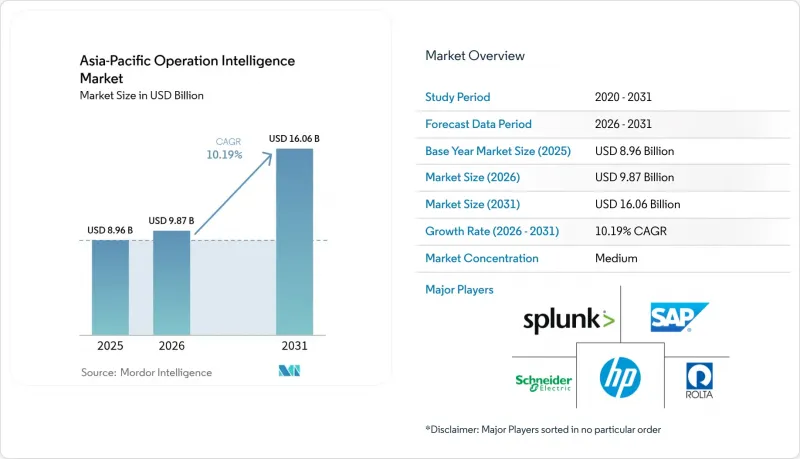
This report is Segmented by Component (Software and Services), Deployment Type (Cloud, On-Premise, and Hybrid), Application (Predictive Equipment Maintenance, Security and Surveillance Analytics, and More), End-User Vertical (Retail and E-Commerce, Manufacturing, , Government and Public Sector, and More), and Geography. The Market Forecasts are Provided in Terms of Value (USD).
Asia-Pacific Operation Intelligence Market Trends and Insights
Proliferation Of IoT Devices Generating Real-Time Data Streams
Industrial facilities across Asia-Pacific continue to embed sensors in production assets, assembly-line robots, and utility infrastructure. Midea Group's smart-appliance factories in Foshan now stream 14 terabytes of time-series data each day from 87,000 connected actuators, cutting scrap by 19% in 2024. BMW Brilliance's Shenyang plant ingests vibration and thermal signals from 12,000 CNC spindles to forecast bearing failures 72 hours ahead and reduce unplanned downtime by 34%. Edge gateways that aggregate sensor bursts before cloud upload have trimmed egress costs by as much as 70% while still meeting sub-second response requirements. The resulting data deluge is pushing enterprises toward stream-native architectures anchored in Apache Kafka and MQTT, strengthening long-term demand for scalable operation intelligence market platforms.
Government-Led 5G Private-Network Roll-Outs In Asia-Pacific Smart Factories
Thailand's regulator allocated 100 MHz in the 3.7 GHz band for private 5G in 2024, enabling Charoen Pokphand Foods to support 4,500 devices with guaranteed 10-millisecond latency at its Saraburi complex. South Korea subsidized up to 40% of private-5G infrastructure costs for small and mid-size manufacturers, catalyzing 230 deployments across Gyeonggi and Ulsan industrial parks. Singapore's 5G testbed at Jurong Innovation District lets 18 manufacturers stream 4K video from helmet cameras to cloud-vision models for augmented-reality maintenance. Toyota's Guangzhou plant synchronizes press-shop and welding operations in real time over 5G, cutting work-in-process inventory by 22%. These roll-outs reinforce the operation intelligence market by making deterministic, wire-free data transport a factory-floor default.
Integration Complexity With Legacy OT Systems
Brownfield factories in Japan and South Korea often rely on Mitsubishi MELSEC, Omron FINS, and serial Modbus links that lack native IP connectivity. Retrofitting a single cell with protocol-translation gateways costs USD 8,000-15,000 and can take up to 14 months once validation and cybersecurity hardening are included. Siemens disclosed that 62% of its 2024 Asia-Pacific integration projects faced delays caused by undocumented ladder logic and missing electrical drawings. A typical automotive line may run 14 field-bus standards, each needing custom drivers. Air-gapped facilities in defense elevate cost further because all analytics must execute on-premise, increasing total cost of ownership by up to 60%.
Other drivers and restraints analyzed in the detailed report include:
- Growing Need For Real-Time Operational Visibility In Manufacturing And Logistics
- Increasing Demand For "Green" OI In Carbon-Compliance Reporting
- Shortage Of Skilled Data-Engineering And DevOps Talent
For complete list of drivers and restraints, kindly check the Table Of Contents.
Segment Analysis
Software retained a 62.10% revenue share in 2025, anchored by real-time analytics engines such as Apache Flink and TIBCO StreamBase that transform multi-protocol telemetry into actionable insights. However, services are projected to outpace software at an 11.23% CAGR through 2031 as companies seek expert help to map business processes to event-driven architectures aligned with ISA-95. Integration engagements that retrofit decades-old SCADA lines with MQTT gateways accounted for 42% of 2024 services revenue, and average project value at Hitachi Vantara reached USD 1.8 million. Support contracts are also expanding as enterprises shift from perpetual licenses to subscription bundles that guarantee 99.9% uptime.
Demand for machine-learning inference directly inside streaming pipelines is sharpening focus on unified development stacks. Alibaba Cloud's DataWorks and Databricks Delta Live Tables let data engineers orchestrate both batch ETL and low-latency scoring without managing multiple tools. This convergence accelerates deployment cycles and improves stickiness for platform vendors, further enlarging the operation intelligence market.
Cloud held 71.05% of revenue in 2025, buoyed by the pay-as-you-go convenience of hyperscale IoT suites. Yet hybrid architectures are forecast to rise at an 11.58% CAGR because regulatory friction and latency constraints make full off-premise hosting impractical for many time-sensitive workloads. China's data-localization rules require that production telemetry stay on domestic servers unless security reviews are passed, a process that can add 6-12 months to rollout timelines. Huawei's FusionPlant, which combines on-premise edge nodes with domestic cloud regions, saw installs climb 52% in 2024.
In India, logistics operators keep driver and customer data in-country to comply with the Digital Personal Data Protection Act, while forwarding non-sensitive route analytics to global regions for fleet-wide optimization. Hybrid models also mitigate 80-150 millisecond RTTs common in Indonesia's Java corridor by performing anomaly detection and closed-loop control locally before forwarding aggregates to a central lake. The resulting architectural mix positions hybrid as the fastest-growing slice of the operation intelligence market.
Complete Report Scope:
- By Component
- Software
- Real-time Analytics Platforms
- Data-visualisation Tools
- Complex-event-processing Engines
- Services
- Consulting and Advisory
- Integration and Deployment
- Support and Maintenance
- Software
- By Deployment Type
- Cloud
- On-Premise
- Hybrid
- By Application
- Predictive Equipment Maintenance
- Security and Surveillance Analytics
- Customer-experience Management
- Supply-chain and Logistics Optimisation
- Energy Management
- Fraud Detection and Risk Management
- IT Operations Analytics
- Other Application
- By End-user Vertical
- Retail and E-commerce
- Manufacturing
- Banking, Financial Services and Insurance (BFSI)
- Government and Public Sector
- Information Technology and Telecommunications
- Defence and Aerospace
- Transportation and Logistics
- Healthcare and Life Sciences
- Energy and Utilities
- Other End-user Vertical
- By Country
- China
- Japan
- India
- South Korea
- Australia and New Zealand
- Southeast Asia
- Indonesia
- Malaysia
- Philippines
- Singapore
- Thailand
- Vietnam
- Rest of Asia-Pacific
List of Companies Covered in this Report:
- Alibaba Cloud Computing Co., Ltd.
- Cloudera, Inc.
- Databricks, Inc.
- Fujitsu Limited
- Hitachi, Ltd.
- Hewlett Packard Enterprise Company
- Huawei Technologies Co., Ltd.
- IBM Corporation
- Microsoft Corporation
- NEC Corporation
- Oracle Corporation
- PTC Inc.
- QlikTech International AB
- SAS Institute Inc.
- Schneider Electric SE
- Software AG
- Splunk Inc.
- Rolta India Limited
- Teradata Corporation
- TIBCO Software Inc.
- Vitria Technology, Inc.
- Yokogawa Electric Corporation
Additional Benefits:
- The market estimate (ME) sheet in Excel format
- 3 months of analyst support
TABLE OF CONTENTS
1 INTRODUCTION
- 1.1 Study Assumptions and Market Definition
- 1.2 Scope of the Study
2 RESEARCH METHODOLOGY
3 EXECUTIVE SUMMARY
4 MARKET LANDSCAPE
- 4.1 Market Overview
- 4.2 Market Drivers
- 4.2.1 Proliferation Of IoT Devices Generating Real-Time Data Streams
- 4.2.2 Rapid Adoption Of Cloud-Based Big-Data Analytics Platforms
- 4.2.3 Growing Need For Real-Time Operational Visibility In Manufacturing And Logistics
- 4.2.4 Government-Led 5G Private-Network Roll-Outs In Asia-Pacific Smart Factories
- 4.2.5 Rising Adoption Of Event-Driven Micro-Services Architecture
- 4.2.6 Increasing Demand For "Green" OI In Carbon-Compliance Reporting
- 4.3 Market Restraints
- 4.3.1 Integration Complexity With Legacy OT Systems
- 4.3.2 Shortage Of Skilled Data-Engineering And Devops Talent
- 4.3.3 Escalating Data-Sovereignty Regulations Limiting Cross-Border Streaming
- 4.3.4 High Latency In Rural Areas Limiting Edge Analytics Quality
- 4.4 Industry Value Chain Analysis
- 4.5 Regulatory Landscape
- 4.6 Technological Outlook
- 4.7 Porter's Five Forces Analysis
- 4.7.1 Threat of New Entrants
- 4.7.2 Bargaining Power of Buyers
- 4.7.3 Bargaining Power of Suppliers
- 4.7.4 Threat of Substitute Products
- 4.7.5 Intensity of Competitive Rivalry
- 4.8 Impact of Macroeconomic Factors on the Market
5 MARKET SIZE AND GROWTH FORECASTS (VALUE)
- 5.1 By Component
- 5.1.1 Software
- 5.1.1.1 Real-time Analytics Platforms
- 5.1.1.2 Data-visualisation Tools
- 5.1.1.3 Complex-event-processing Engines
- 5.1.2 Services
- 5.1.2.1 Consulting and Advisory
- 5.1.2.2 Integration and Deployment
- 5.1.2.3 Support and Maintenance
- 5.1.1 Software
- 5.2 By Deployment Type
- 5.2.1 Cloud
- 5.2.2 On-Premise
- 5.2.3 Hybrid
- 5.3 By Application
- 5.3.1 Predictive Equipment Maintenance
- 5.3.2 Security and Surveillance Analytics
- 5.3.3 Customer-experience Management
- 5.3.4 Supply-chain and Logistics Optimisation
- 5.3.5 Energy Management
- 5.3.6 Fraud Detection and Risk Management
- 5.3.7 IT Operations Analytics
- 5.3.8 Other Application
- 5.4 By End-user Vertical
- 5.4.1 Retail and E-commerce
- 5.4.2 Manufacturing
- 5.4.3 Banking, Financial Services and Insurance (BFSI)
- 5.4.4 Government and Public Sector
- 5.4.5 Information Technology and Telecommunications
- 5.4.6 Defence and Aerospace
- 5.4.7 Transportation and Logistics
- 5.4.8 Healthcare and Life Sciences
- 5.4.9 Energy and Utilities
- 5.4.10 Other End-user Vertical
- 5.5 By Country
- 5.5.1 China
- 5.5.2 Japan
- 5.5.3 India
- 5.5.4 South Korea
- 5.5.5 Australia and New Zealand
- 5.5.6 Southeast Asia
- 5.5.7 Indonesia
- 5.5.8 Malaysia
- 5.5.9 Philippines
- 5.5.10 Singapore
- 5.5.11 Thailand
- 5.5.12 Vietnam
- 5.5.13 Rest of Asia-Pacific
6 COMPETITIVE LANDSCAPE
- 6.1 Market Concentration
- 6.2 Strategic Moves
- 6.3 Market Share Analysis
- 6.4 Company Profiles (includes Global-level Overview, Market-level Overview, Core Segments, Financials as available, Strategic Information, Market Rank/Share, Products and Services, Recent Developments)
- 6.4.1 Alibaba Cloud Computing Co., Ltd.
- 6.4.2 Cloudera, Inc.
- 6.4.3 Databricks, Inc.
- 6.4.4 Fujitsu Limited
- 6.4.5 Hitachi, Ltd.
- 6.4.6 Hewlett Packard Enterprise Company
- 6.4.7 Huawei Technologies Co., Ltd.
- 6.4.8 IBM Corporation
- 6.4.9 Microsoft Corporation
- 6.4.10 NEC Corporation
- 6.4.11 Oracle Corporation
- 6.4.12 PTC Inc.
- 6.4.13 QlikTech International AB
- 6.4.14 SAS Institute Inc.
- 6.4.15 Schneider Electric SE
- 6.4.16 Software AG
- 6.4.17 Splunk Inc.
- 6.4.18 Rolta India Limited
- 6.4.19 Teradata Corporation
- 6.4.20 TIBCO Software Inc.
- 6.4.21 Vitria Technology, Inc.
- 6.4.22 Yokogawa Electric Corporation
7 MARKET OPPORTUNITIES AND FUTURE OUTLOOK
- 7.1 White-space and Unmet-need Assessment

