PUBLISHER: Mordor Intelligence | PRODUCT CODE: 2121320

PUBLISHER: Mordor Intelligence | PRODUCT CODE: 2121320
Braze Alloys - Market Share Analysis, Industry Trends & Statistics, Growth Forecasts (2026 - 2031)
According to Mordor Intelligence, the braze alloys market size is estimated at USD 2.58 billion in 2026, and is expected to reach USD 3.16 billion by 2031, at a CAGR of 4.12% during the forecast period (2026-2031).
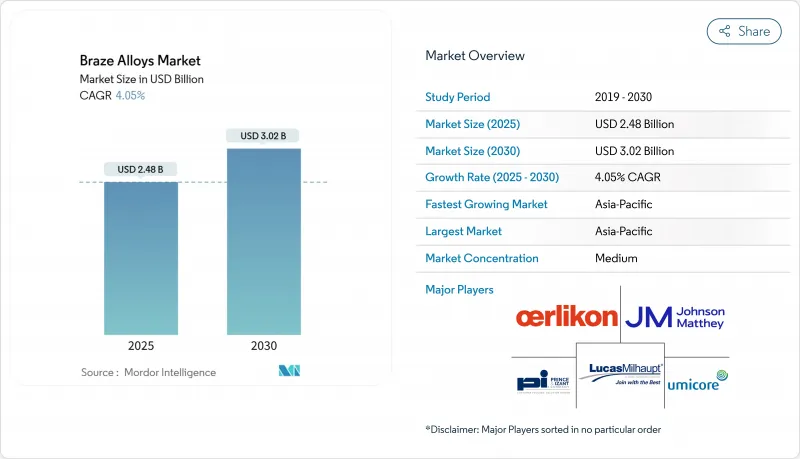
This report is Segmented by Base Metal (Copper, Silver, Gold, and More), Filler Form (Powder, Paste, Foil/Ribbon, and More), Temperature Range (Low, Medium, and High), End-User Industry (Automotive, Aerospace and Defense, Electrical and Electronics, and More), and Geography (Asia-Pacific, North America, Europe, South America, Middle East and Africa). The Market Forecasts are Provided in Terms of Value (USD).
Global Braze Alloys Market Trends and Insights
Adoption of Brazing Over Welding and Soldering
Manufacturers are pivoting toward brazing because it secures joint strengths approaching 90% of parent-metal yield while avoiding heat-affected-zone cracking that often follows fusion welding. Controlled-atmosphere furnaces now dominate aluminum radiator production, cutting scrap from 8% to under 2% and saving up to USD 1.8 million per assembly line annually. Soldering cannot meet 150 °C under-hood duty cycles, so OEMs increasingly specify brazed busbars and cooling plates for electric-drive platforms. Equipment suppliers confirm that 60% of all new brazing furnace orders booked in 2025 were for automotive Tier-1 plants in China and Mexico, regions that previously relied on spot welding.
Surging Demand for Aluminum-Based Brazes in Automotive Heat Exchangers
Al-Si brazes in the 7-12 % silicon range remain the backbone of heat-exchanger cores, and battery electric vehicles multiply surface-area requirements two to three times versus internal-combustion layouts. A typical EV pack now houses up to six liquid-cooling circuits, each demanding leak-rate guarantees below 1 g/year over a 150,000 km service life. India's component exports grew 18% in fiscal 2025 as global OEMs diversified their supply chains. Alloy tweaks that add manganese and copper are extending fatigue life by 25% in accelerated thermal-shock tests, helping suppliers meet warranty targets.
Base-Metal Price Volatility
Silver prices swung between USD 22 and USD 32 per troy ounce during 2024-2025. Every 10% uptick pushes finished alloy cost by up to 6%, yet annual contracts delay pass-through for nine months, pressuring margins. Copper prices likewise fluctuated from USD 8,200 to USD 10,500 per metric ton, hitting HVAC-R filler economics. Smaller suppliers lacking hedging programs defer research and development spending, slowing new alloy development.
Other drivers and restraints analyzed in the detailed report include:
- EV Power-Electronics Uptake of Nickel-Based Induction Pastes
- Growth of the HVAC-R Industry Raising Braze Consumption
- Toxic-Metal (Cd, Pb) Regulatory Bans
For complete list of drivers and restraints, kindly check the Table Of Contents.
Segment Analysis
Copper-based fillers captured 35.92% of the braze alloys market share in 2025, reflecting their low unit cost in HVAC-R coils and power-distribution busbars. The other base metals segment, including Nickel and cobalt systems, is forecast for a 4.82% CAGR, riding on aerospace turbine-blade refurbishment and SiC power module adoption. Gold and silver fillers occupy high-reliability niches where biocompatibility or thermal stability warrants premium pricing. Aluminum-silicon alloys underpin vehicle heat exchangers, with controlled-atmosphere brazing enabling thin-wall geometries and corrosion resistance.
Processability and temperature ceilings explain adoption curves. Copper-phosphorus compositions melt at 700-850 °C, balancing throughput and joint strength for refrigerant circuits. Nickel-chromium-boron blends withstand 1,000 °C and oxidative exhaust gases, suiting turbine repairs. These distinctions underpin the braze alloys market as manufacturers match performance envelopes to new duty cycles.
Rod and wire formats remained top-selling at 40.04% of the 2025 value, favored in manual torch operations and batch furnaces. However, rings and preforms are growing at 5.04% CAGR thanks to induction-brazing robotics in EV inverter assembly lines. Pre-shaped aluminum-silicon rings allow simultaneous joining of up to 16 cold-plate ports per furnace run, trimming takt time by 35% and lifting first-pass yield.
Powder and paste fillers dominate electronics and small-joint work, where screen-printing and dispensing heads deposit 0.05-gram charges with +-0.01-gram accuracy. Foil and ribbon variants address aerospace honeycomb structures, delivering uniform melt layers that avoid starved joints. The outcome is a diverse form-factor portfolio that keeps the braze alloys market responsive to automation trends.
Complete Report Scope:
- By Base Metal
- Copper
- Silver
- Gold
- Aluminum
- Other Base Metals (Nickel,Cobalt, etc.)
- By Filler Form
- Powder
- Paste
- Foil / Ribbon
- Rod / Wire
- Rings and Preforms
- By Temperature Range
- Low-Temperature (Less than 450 °C)
- Medium-Temperature (450-800 °C)
- High-Temperature (Greater than 800 °C)
- By End-User Industry
- Automotive
- Aerospace and Defense
- Electrical and Electronics
- Construction
- Other End-User Industries(Medical Devices, Energy and Power, etc.)
- By Geography
- Asia-Pacific
- China
- Japan
- India
- South Korea
- ASEAN Countries
- Rest of Asia-Pacific
- North America
- United States
- Canada
- Mexico
- Europe
- Germany
- United Kingdom
- France
- Italy
- Spain
- NORDIC Countries
- Rest of Europe
- South America
- Brazil
- Argentina
- Rest of South America
- Middle East and Africa
- Saudi Arabia
- South Africa
- Rest of Middle East and Africa
- Asia-Pacific
Geography Analysis
Asia-Pacific commanded 46.38% of 2025 revenue and is projected to grow 5.16% annually through 2031, driven by China's 9 million BEV output and India's double-digit heat-exchanger export growth. Japan supplies precision nickel-based brazing for turbine components, whereas South Korea's battery-pack lines demand tight-leak aluminum cold-plate joints. Southeast Asia captures production relocating from higher-cost Chinese provinces, with Vietnam scaling electronics contract manufacturing.
North America's braze alloys demand is led by aerospace MRO activity requiring high-temperature nickel fillers. Mexico exported USD 8 billion in thermal-management modules, leveraging trade agreements and near-shoring trends. The United States benefits from the Inflation Reduction Act, which funds domestic inverter and battery assembly, thereby enlarging local filler-powder demand.
Europe accounted for a considerable market share in 2025 but faces compliance costs tied to toxic-metal bans. Germany's automotive sector drives copper and aluminum filler use, whereas France leans on nickel fillers for jet-engine parts. Nordic countries invest in vacuum-brazed marine heat exchangers. South America and the Middle East and Africa each supplied under 5% of value yet register steady growth tied to Brazilian vehicle output and Gulf HVAC construction.
- Aimtek, Inc.
- Bellman-Melcor, LLC
- Cupro Alloys Corporation
- Fusion, Inc.
- Indian Solder and Braze Alloys Pvt. Ltd.
- Johnson Matthey
- Lucas-Milhaupt Inc.
- Materion Corporation
- Morgan Advanced Materials plc
- Nihon Superior Co., Ltd.
- OC Oerlikon Management AG
- Prince & Izant Company
- Saru Silver Alloy Private Limited
- Sulzer Ltd
- The Lincoln Electric Company
- Umicore
- VBC Group
- Wall Colmonoy
- Wieland Group
Additional Benefits:
- The market estimate (ME) sheet in Excel format
- 3 months of analyst support
TABLE OF CONTENTS
1 Introduction
- 1.1 Study Assumptions and Market Definition
- 1.2 Scope of the Study
2 Research Methodology
3 Executive Summary
4 Market Landscape
- 4.1 Market Overview
- 4.2 Market Drivers
- 4.2.1 Adoption of brazing over welding and soldering
- 4.2.2 Surging demand for Aluminum based brazes in automotive heat-exchangers
- 4.2.3 EV power-electronics uptake of Ni-based induction pastes
- 4.2.4 Growth of the HVAC-R industry increasing demand for brazes
- 4.2.5 Emergence of high-entropy braze alloys for extreme environments
- 4.3 Market Restraints
- 4.3.1 Base-metal price volatility
- 4.3.2 Toxic-metal (Cd, Pb) regulatory bans
- 4.3.3 Shortage of furnace-qualified labour
- 4.4 Value Chain Analysis
- 4.5 Porter's Five Forces Analysis
- 4.5.1 Bargaining Power of Suppliers
- 4.5.2 Bargaining Power of Buyers
- 4.5.3 Threat of New Entrants
- 4.5.4 Threat of Substitutes
- 4.5.5 Degree of Competition
5 Market Size and Growth Forecasts (Value)
- 5.1 By Base Metal
- 5.1.1 Copper
- 5.1.2 Silver
- 5.1.3 Gold
- 5.1.4 Aluminum
- 5.1.5 Other Base Metals (Nickel,Cobalt, etc.)
- 5.2 By Filler Form
- 5.2.1 Powder
- 5.2.2 Paste
- 5.2.3 Foil / Ribbon
- 5.2.4 Rod / Wire
- 5.2.5 Rings and Preforms
- 5.3 By Temperature Range
- 5.3.1 Low-Temperature (Less than 450 °C)
- 5.3.2 Medium-Temperature (450-800 °C)
- 5.3.3 High-Temperature (Greater than 800 °C)
- 5.4 By End-User Industry
- 5.4.1 Automotive
- 5.4.2 Aerospace and Defense
- 5.4.3 Electrical and Electronics
- 5.4.4 Construction
- 5.4.5 Other End-User Industries(Medical Devices, Energy and Power, etc.)
- 5.5 By Geography
- 5.5.1 Asia-Pacific
- 5.5.1.1 China
- 5.5.1.2 Japan
- 5.5.1.3 India
- 5.5.1.4 South Korea
- 5.5.1.5 ASEAN Countries
- 5.5.1.6 Rest of Asia-Pacific
- 5.5.2 North America
- 5.5.2.1 United States
- 5.5.2.2 Canada
- 5.5.2.3 Mexico
- 5.5.3 Europe
- 5.5.3.1 Germany
- 5.5.3.2 United Kingdom
- 5.5.3.3 France
- 5.5.3.4 Italy
- 5.5.3.5 Spain
- 5.5.3.6 NORDIC Countries
- 5.5.3.7 Rest of Europe
- 5.5.4 South America
- 5.5.4.1 Brazil
- 5.5.4.2 Argentina
- 5.5.4.3 Rest of South America
- 5.5.5 Middle East and Africa
- 5.5.5.1 Saudi Arabia
- 5.5.5.2 South Africa
- 5.5.5.3 Rest of Middle East and Africa
- 5.5.1 Asia-Pacific
6 Competitive Landscape
- 6.1 Market Concentration
- 6.2 Strategic Moves
- 6.3 Market Share(%)/Ranking Analysis
- 6.4 Company Profiles (includes Global level Overview, Market level overview, Core Segments, Financials as available, Strategic Information, Products and Services, and Recent Developments)
- 6.4.1 Aimtek, Inc.
- 6.4.2 Bellman-Melcor, LLC
- 6.4.3 Cupro Alloys Corporation
- 6.4.4 Fusion, Inc.
- 6.4.5 Indian Solder and Braze Alloys Pvt. Ltd.
- 6.4.6 Johnson Matthey
- 6.4.7 Lucas-Milhaupt Inc.
- 6.4.8 Materion Corporation
- 6.4.9 Morgan Advanced Materials plc
- 6.4.10 Nihon Superior Co., Ltd.
- 6.4.11 OC Oerlikon Management AG
- 6.4.12 Prince & Izant Company
- 6.4.13 Saru Silver Alloy Private Limited
- 6.4.14 Sulzer Ltd
- 6.4.15 The Lincoln Electric Company
- 6.4.16 Umicore
- 6.4.17 VBC Group
- 6.4.18 Wall Colmonoy
- 6.4.19 Wieland Group
7 Market Opportunities and Future Outlook
- 7.1 White-space and Unmet-Need Assessment
- 7.2 Development of Vacuum Brazing Technology

