PUBLISHER: Mordor Intelligence | PRODUCT CODE: 2121330

PUBLISHER: Mordor Intelligence | PRODUCT CODE: 2121330
Artificial Turf - Market Share Analysis, Industry Trends & Statistics, Growth Forecasts (2026 - 2031)
According to Mordor Intelligence, artificial turf market size in 2026 is estimated at USD 7.31 billion, growing from 2025 value of USD 6.5 billion with 2031 projections showing USD 13.16 billion, growing at 12.46% CAGR over 2026-2031.
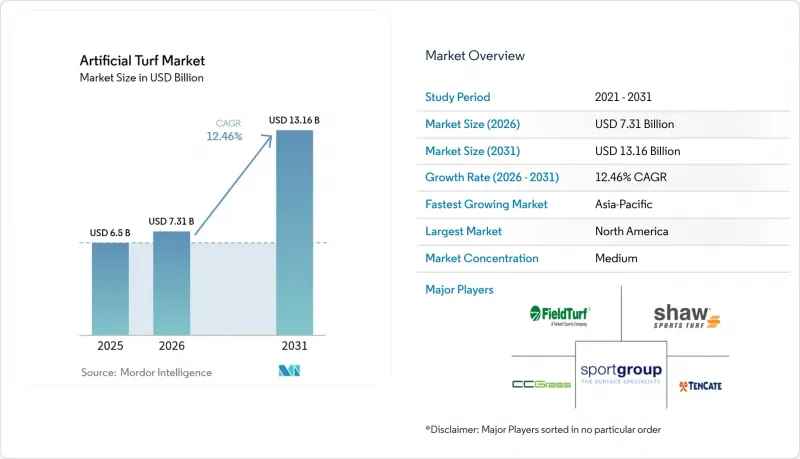
This report is Segmented by Usage (Sports, Leisure, and Landscape) and by Geography (North America, Europe, Asia-Pacific, South America, Middle East, and Africa). The Market Forecasts are Provided in Terms of Value (USD).
Global Artificial Turf Market Trends and Insights
Stringent Water-Conservation Mandates
California's AB 1572 and Colorado's SB 24-005 remove potable-water irrigation from nonfunctional lawns and ban new nonfunctional turf, converting discretionary upgrades into compliance obligations. Accelerated timelines strain installer capacity and pull forward replacement cycles, effectively anchoring the artificial turf market to public-policy calendars rather than team-season budgets. Municipalities in Arizona, Nevada, and parts of Australia have begun drafting parallel ordinances to safeguard dwindling aquifers.
Expanding Installation in Multi-Sport Stadia
Elite venues increasingly demand fields that can host football, soccer, and concerts within compressed scheduling windows. Mercedes-Benz Stadium's 2025 FieldTurf CORE installation and SoFi Stadium's hybrid turf pilot for the 2026 World Cup illustrate the visibility that large contracts create for next-generation systems. These specification uplifts migrate to collegiate and secondary facilities within two to three bid cycles, multiplying the revenue influence of each flagship project.
Micro- and Nano-Plastic Pollution Scrutiny
The European Chemicals Agency estimates sports pitches contribute 16,000 metric tons of microplastics annually, accelerating momentum for a continent-wide crumb-rubber phase-out Manufacturers must redesign infill containment and explore polymer-bound or plant-based alternatives, which could increase system costs by 8-12%. The European Chemicals Agency has now confirmed the shedding of nano-plastic fibers under mechanical wear, strengthening arguments for tighter specification limits and extended producer responsibility schemes.
Other drivers and restraints analyzed in the detailed report include:
- Surging Residential and Commercial Landscaping Demand
- Urban Heat-Island Climate-Resilience Projects
- High Upfront Installation Cost
For complete list of drivers and restraints, kindly check the Table Of Contents.
Segment Analysis
Sports accounted for a 42.15% slice of the artificial turf market in 2025, anchoring recurring eight- to ten-year replacement cycles across professional and collegiate venues. Contact Sports, such as hockey, tennis, and baseball fields, pursue fiber blends that optimize ball roll and shock attenuation, reinforcing a premium tier that shields margins even when resin costs rise. Other sports applications, including baseball and multi-purpose fields, are increasingly specifying hybrid systems that combine synthetic reinforcement with natural grass playing surfaces.
Upgrades now include heat-reflective pigments and stitched labels that log maintenance data for warranty validation. Meanwhile, the landscape is advancing at a 14.62% CAGR to 2031, outpacing every sports sub-segment as municipalities pivot toward drought resilience. This acceleration reflects fundamental shifts in property management economics, where artificial turf's higher upfront costs become justified by the elimination of irrigation and maintenance expenses. Leisure applications, encompassing playgrounds and recreational areas, benefit from safety improvements and year-round usability that natural surfaces cannot provide consistently.
Complete Report Scope:
- By Usage
- Sports
- Contact Sports
- Field Hockey
- Tennis
- Other Sports
- Leisure
- Landscape
- Sports
- Geography
- North America
- United States
- Canada
- Mexico
- Rest of Noth America
- South America
- Brazil
- Argentina
- Rest of South America
- Europe
- Germany
- United Kingdom
- France
- Italy
- Spain
- Russia
- Rest of Europe
- Asia-Pacific
- China
- Japan
- India
- Australia
- Rest of Asia-Pacific
- Middle East
- Saudi Arabia
- Rest of Middle East
- Africa
- South Africa
- Rest of Africa
- North America
Geography Analysis
North America is projected to command a 37.74% market share in 2025, driven by its established sports infrastructure and predictable replacement cycle across professional, collegiate, and municipal facilities. The region's market maturity generates stable revenue streams through scheduled field renewals and regulatory compliance installations, particularly following the implementation of water conservation mandates. California's potable-water ban for nonfunctional lawns and Colorado's turf-planting moratorium create immediate compliance projects with limited scheduling flexibility. Mexico's municipal parks favor synthetics to curb rising water bills and extend play hours despite temperature spikes.
The Asia-Pacific region emerges as the fastest-growing region, with a 13.98% CAGR from 2026 to 2031, driven by urbanization pressures and the development of sports infrastructure across major economies. China's massive stadium construction programs and India's growing investments in sports facilities create substantial installation opportunities that dwarf replacement-driven demand in mature markets. The region's freight advantage supports exports across Southeast Asia, while Japan's dense urban zones provide test beds for heat-mitigating fibers. Government grants in South Korea offset upfront costs for school pitches, thereby accelerating the penetration of primary education facilities.
The Europe, Middle East, and Africa regions represent emerging growth opportunities, despite regulatory headwinds from environmental restrictions. The European Union's ban on crumb rubber infill creates short-term disruption but drives innovation toward sustainable alternatives that may establish competitive advantages in global markets. South America's market development reflects economic constraints and infrastructure priorities that favor cost-effective solutions over premium specifications. Africa's limited current market presence suggests significant long-term potential as economic development and sports infrastructure investment accelerate across the continent.
- Tarkett (FieldTurf)
- TenCate Grass (Leonard Green & Partners, L.P.)
- Shaw Sports Turf
- CCGrass
- Sports Group (Polytan)
- Act Global (Beaulieu International Group)
- SprinTurf (Integrated Turf Solutions LLC)
- ForeverLawn
- SIS Pitches
- Victoria PLC
- Global Syn-Turf
- Lano Sports (Lano Carpets NV)
- Watershed Geo
Additional Benefits:
- The market estimate (ME) sheet in Excel format
- 3 months of analyst support
TABLE OF CONTENTS
1 Introduction
- 1.1 Study Assumptions and Market Definition
- 1.2 Scope of the Study
2 Research Methodology
3 Executive Summary
4 Market Landscape
- 4.1 Market Overview
- 4.2 Market Drivers
- 4.2.1 Stringent water-conservation mandates
- 4.2.2 Expanding installation in multi-sport stadia
- 4.2.3 Surging residential and commercial landscaping demand
- 4.2.4 Urban-heat-island climate resilience projects
- 4.2.5 Adoption of autonomous turf-laying robots
- 4.2.6 Circular turf recycling/Extended Producer Responsibility programs
- 4.3 Market Restraints
- 4.3.1 Micro and nano-plastic pollution scrutiny
- 4.3.2 High upfront installation cost
- 4.3.3 European Union ban on crumb-rubber infill
- 4.3.4 Player heat-stress litigation risk
- 4.4 Regulatory Landscape
- 4.5 Technological Outlook
- 4.6 Porter's Five Forces Analysis
- 4.6.1 Bargaining Power of Suppliers
- 4.6.2 Bargaining Power of Buyers/Consumers
- 4.6.3 Threat of New Entrants
- 4.6.4 Threat from Substitute Products
- 4.6.5 Intensity of Competitive Rivalry
5 Market Size and Growth Forecasts (Value)
- 5.1 By Usage
- 5.1.1 Sports
- 5.1.1.1 Contact Sports
- 5.1.1.2 Field Hockey
- 5.1.1.3 Tennis
- 5.1.1.4 Other Sports
- 5.1.2 Leisure
- 5.1.3 Landscape
- 5.1.1 Sports
- 5.2 Geography
- 5.2.1 North America
- 5.2.1.1 United States
- 5.2.1.2 Canada
- 5.2.1.3 Mexico
- 5.2.1.4 Rest of Noth America
- 5.2.2 South America
- 5.2.2.1 Brazil
- 5.2.2.2 Argentina
- 5.2.2.3 Rest of South America
- 5.2.3 Europe
- 5.2.3.1 Germany
- 5.2.3.2 United Kingdom
- 5.2.3.3 France
- 5.2.3.4 Italy
- 5.2.3.5 Spain
- 5.2.3.6 Russia
- 5.2.3.7 Rest of Europe
- 5.2.4 Asia-Pacific
- 5.2.4.1 China
- 5.2.4.2 Japan
- 5.2.4.3 India
- 5.2.4.4 Australia
- 5.2.4.5 Rest of Asia-Pacific
- 5.2.5 Middle East
- 5.2.5.1 Saudi Arabia
- 5.2.5.2 Rest of Middle East
- 5.2.6 Africa
- 5.2.6.1 South Africa
- 5.2.6.2 Rest of Africa
- 5.2.1 North America
6 Competitive Landscape
- 6.1 Market Concentration
- 6.2 Strategic Moves
- 6.3 Market Share Analysis
- 6.4 Company Profiles (Includes Global Level Overview, Market Level Overview, Core Segments, Financials as Available, Strategic Information, Market Rank/Share for Key Companies, Products & Services, and Recent Developments)
- 6.4.1 Tarkett (FieldTurf)
- 6.4.2 TenCate Grass (Leonard Green & Partners, L.P.)
- 6.4.3 Shaw Sports Turf
- 6.4.4 CCGrass
- 6.4.5 Sports Group (Polytan)
- 6.4.6 Act Global (Beaulieu International Group)
- 6.4.7 SprinTurf (Integrated Turf Solutions LLC)
- 6.4.8 ForeverLawn
- 6.4.9 SIS Pitches
- 6.4.10 Victoria PLC
- 6.4.11 Global Syn-Turf
- 6.4.12 Lano Sports (Lano Carpets NV)
- 6.4.13 Watershed Geo
7 Market Opportunities and Future Outlook

