PUBLISHER: Mordor Intelligence | PRODUCT CODE: 2121353

PUBLISHER: Mordor Intelligence | PRODUCT CODE: 2121353
Financial Services Application - Market Share Analysis, Industry Trends & Statistics, Growth Forecasts (2026 - 2031)
According to Mordor Intelligence, the financial services applications market size was valued at USD 165.91 billion in 2025 and estimated to grow from USD 187.37 billion in 2026 to reach USD 343.64 billion by 2031, at a CAGR of 12.92% during the forecast period (2026-2031).
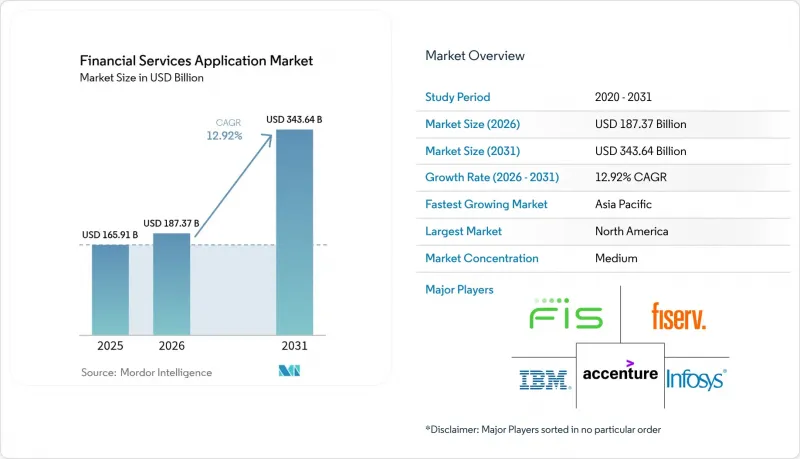
This report is Segmented by Offerings (Software, and Services), Deployment (Cloud, and On-Premise), Organization Size (Small and Medium Enterprises, and Large Enterprises), End-User( Banking, Insurance, Capital Markets, and Fintech/Neo Banks), and Geography. The Market Forecasts are Provided in Terms of Value (USD).
Global Financial Services Application Market Trends and Insights
Rapid Cloud-First Core Modernisation Among Tier-1 Banks
Legacy cores restrict scalability, so leading banks are shifting workloads to cloud-native engines that support embedded finance, real-time analytics and continuous deployment. Commerce Bank's go-live on a Temenos platform cut product launch cycles from months to weeks and illustrated how elastic infrastructure improves customer experience . European and North American institutions are renegotiating outsourcing contracts to accelerate decommissioning of on-premise stacks, freeing capital for innovation. Regulators have clarified that public-cloud usage is acceptable if operational-resilience rules are met, further unlocking budgets. As migration templates mature, mid-tier lenders can reuse proven blueprints, widening the addressable financial services applications market.
AI-Driven Hyper-Personalisation to Lift Share-of-Wallet
Banks now embed generative AI directly inside their core workflow to craft context-aware offers, nudge savings behaviour and price risk dynamically. Temenos' secured AI module runs inference in real time and meets banking-grade privacy rules, helping lenders tailor messages that raise product adoption. Asia-Pacific institutions are pairing alternative data-such as gig-economy income feeds-with AI scoring to reach first-time borrowers. Early adopters report double-digit gains in cross-sell ratios, proving that algorithmic personalisation lifts revenues faster than rate promotions. Continual model-monitoring remains essential, yet institutions that link AI to clean data pipelines are widening the service gap with slower peers.
Escalating Core-Banking Migration Costs
Banks budgeting only for licence fees often discover that data cleansing, parallel runs and staff retraining multiply total spend three- to five-fold. IBS Intelligence reported that 55% of institutions see legacy complexity as the primary transformation hurdle. Mid-size lenders face the brunt because they lack dedicated change-management teams, leading to schedule slips that erode projected ROI. Each delay postpones downstream projects such as AI analytics and open-API roll-outs, dampening near-term demand growth for the financial services applications market.
Other drivers and restraints analyzed in the detailed report include:
- Open-Banking APIs Catalysing Fintech-Bank Collaboration
- Regulatory Push for Real-Time Payment Rails
- Vendor Lock-In and Multi-Cloud Complexity
For complete list of drivers and restraints, kindly check the Table Of Contents.
Segment Analysis
Software solutions held 71.55% of financial services applications market share in 2025 as institutions gravitated toward unified suites that reduce integration effort. BI, analytics and AI modules are projected to post a 14.32% CAGR to 2031, powered by demand for predictive risk scoring and hyper-personalisation.
Services such as consulting, migration and managed operations fill capability gaps for banks without deep IT teams. As cloud adoption scales, vendors are bundling implementation accelerators and low-code tooling to shrink go-live timelines, keeping service revenue on a steady upward path.
Cloud deployments represented 63.05% of the financial services applications market size in 2025, with public cloud usage climbing 17.55% CAGR through 2031. High-availability zones, sovereign-cloud options and regulator-approved blueprints have eased prior security concerns.
Private-cloud and on-premise models persist in jurisdictions with strict data-residency rules, yet cost-benefit analyses increasingly favor refactoring workloads into cloud-native micro-services. Vendors are responding with containerized editions that run identically across environments, giving banks a phased exit route from legacy data centers.
Complete Report Scope:
- By Offerings
- Software
- Core Banking Platforms
- Audit, Risk and Compliance
- Business Transaction Processing
- BI, Analytics and AI Suites
- Customer Experience and CRM
- Enterprise IT (ERP, HR, Finance)
- Services
- Consulting
- Integration and Migration
- Training and Support
- Operations and Managed Services
- Software
- By Deployment
- Cloud
- On-premise
- By Enterprise Size
- Small and Medium Enterprises
- Large Enterprises
- By End-User
- Banking
- Insurance
- Capital Markets
- FinTech / Neo-banks
- By Geography
- North America
- United States
- Canada
- Mexico
- South America
- Brazil
- Argentina
- Rest of South America
- Europe
- Germany
- United Kingdom
- France
- Italy
- Spain
- Russia
- Rest of Europe
- Asia-Pacific
- China
- Japan
- India
- South Korea
- Australia and New Zealand
- Rest of Asia-Pacific
- Middle East and Africa
- Middle East
- Saudi Arabia
- United Arab Emirates
- Turkey
- Rest of Middle East
- Africa
- South Africa
- Nigeria
- Egypt
- Rest of Africa
- Middle East
- North America
Geography Analysis
North America led with 37.85% revenue in 2025, underpinned by early cloud adoption, robust venture funding and regulatory clarity around open banking. United States banks pilot AI-driven credit models and instant-payment engines, while Canadian and Mexican lenders prioritise modern savings platforms and card-issuing services.
Asia-Pacific is set to deliver the highest 12.58% CAGR, fuelled by smartphone-first consumer behaviour, government incentives for digital payments and rapid neo-bank launches. Markets such as India benefit from nationwide real-time payment rails, whereas Australia and Singapore focus on open-data frameworks that spur account-switching and product innovation.
Europe remains a sizeable, regulation-led buyer segment. PSD2 and the impending instant-payments mandate oblige every credit institution to upgrade API security, fraud analytics and liquidity tools simultaneously. Coupled with post-Brexit competition among UK, German and French fintech hubs, the region keeps vendor pipelines active despite macroeconomic headwinds.
- Accenture plc
- Fidelity National Information Services, Inc. (FIS)
- Fiserv, Inc.
- International Business Machines Corporation (IBM)
- Infosys Limited
- Finastra Group Holdings Limited
- Oracle Corporation
- SAP SE
- Tata Consultancy Services Limited
- Temenos AG
- Microsoft Corporation
- Salesforce, Inc.
- Avaloq Group AG
- Intellect Design Arena Limited
- Jack Henry and Associates, Inc.
- Cognizant Technology Solutions Corporation
- NCR Corporation
- Silverlake Axis Ltd
- Mambu B.V.
- nCino, Inc.
Additional Benefits:
- The market estimate (ME) sheet in Excel format
- 3 months of analyst support
TABLE OF CONTENTS
1 INTRODUCTION
- 1.1 Study Assumptions and Market Definition
- 1.2 Scope of the Study
2 RESEARCH METHODOLOGY
3 EXECUTIVE SUMMARY
4 MARKET LANDSCAPE
- 4.1 Market Overview
- 4.2 Market Drivers
- 4.2.1 Rapid cloud-first core modernisation among Tier-1 banks
- 4.2.2 AI-driven hyper-personalisation to lift share-of-wallet
- 4.2.3 Open-banking APIs catalysing fintech-bank collaboration
- 4.2.4 Regulatory push for real-time payment rails
- 4.2.5 Alternative data monetisation platforms
- 4.2.6 Quantum-secure cryptography pilots
- 4.3 Market Restraints
- 4.3.1 Escalating core-banking migration costs
- 4.3.2 Vendor lock-in and multi-cloud complexity
- 4.3.3 Scarcity of domain-ready Gen-AI training data
- 4.3.4 Post-quantum compliance uncertainty
- 4.4 Evaluation of Critical Regulatory Framework
- 4.5 Value Chain Analysis
- 4.6 Technological Outlook
- 4.7 Porter's Five Forces
- 4.7.1 Bargaining Power of Suppliers
- 4.7.2 Bargaining Power of Buyers
- 4.7.3 Threat of New Entrants
- 4.7.4 Threat of Substitutes
- 4.7.5 Competitive Rivalry
- 4.8 Key Use Cases and Case Studies
- 4.9 Impact on Macroeconomic Factors of the Market
- 4.10 Investment Analysis
5 MARKET SEGMENTATION
- 5.1 By Offerings
- 5.1.1 Software
- 5.1.1.1 Core Banking Platforms
- 5.1.1.2 Audit, Risk and Compliance
- 5.1.1.3 Business Transaction Processing
- 5.1.1.4 BI, Analytics and AI Suites
- 5.1.1.5 Customer Experience and CRM
- 5.1.1.6 Enterprise IT (ERP, HR, Finance)
- 5.1.2 Services
- 5.1.2.1 Consulting
- 5.1.2.2 Integration and Migration
- 5.1.2.3 Training and Support
- 5.1.2.4 Operations and Managed Services
- 5.1.1 Software
- 5.2 By Deployment
- 5.2.1 Cloud
- 5.2.2 On-premise
- 5.3 By Enterprise Size
- 5.3.1 Small and Medium Enterprises
- 5.3.2 Large Enterprises
- 5.4 By End-User
- 5.4.1 Banking
- 5.4.2 Insurance
- 5.4.3 Capital Markets
- 5.4.4 FinTech / Neo-banks
- 5.5 By Geography
- 5.5.1 North America
- 5.5.1.1 United States
- 5.5.1.2 Canada
- 5.5.1.3 Mexico
- 5.5.2 South America
- 5.5.2.1 Brazil
- 5.5.2.2 Argentina
- 5.5.2.3 Rest of South America
- 5.5.3 Europe
- 5.5.3.1 Germany
- 5.5.3.2 United Kingdom
- 5.5.3.3 France
- 5.5.3.4 Italy
- 5.5.3.5 Spain
- 5.5.3.6 Russia
- 5.5.3.7 Rest of Europe
- 5.5.4 Asia-Pacific
- 5.5.4.1 China
- 5.5.4.2 Japan
- 5.5.4.3 India
- 5.5.4.4 South Korea
- 5.5.4.5 Australia and New Zealand
- 5.5.4.6 Rest of Asia-Pacific
- 5.5.5 Middle East and Africa
- 5.5.5.1 Middle East
- 5.5.5.1.1 Saudi Arabia
- 5.5.5.1.2 United Arab Emirates
- 5.5.5.1.3 Turkey
- 5.5.5.1.4 Rest of Middle East
- 5.5.5.2 Africa
- 5.5.5.2.1 South Africa
- 5.5.5.2.2 Nigeria
- 5.5.5.2.3 Egypt
- 5.5.5.2.4 Rest of Africa
- 5.5.5.1 Middle East
- 5.5.1 North America
6 COMPETITIVE LANDSCAPE
- 6.1 Market Concentration
- 6.2 Strategic Moves
- 6.3 Market Share Analysis
- 6.4 Company Profiles {(includes Global level Overview, Market level overview, Core Segments, Financials as available, Strategic Information, Market Rank/Share for key companies, Products and Services, and Recent Developments)}
- 6.4.1 Accenture plc
- 6.4.2 Fidelity National Information Services, Inc. (FIS)
- 6.4.3 Fiserv, Inc.
- 6.4.4 International Business Machines Corporation (IBM)
- 6.4.5 Infosys Limited
- 6.4.6 Finastra Group Holdings Limited
- 6.4.7 Oracle Corporation
- 6.4.8 SAP SE
- 6.4.9 Tata Consultancy Services Limited
- 6.4.10 Temenos AG
- 6.4.11 Microsoft Corporation
- 6.4.12 Salesforce, Inc.
- 6.4.13 Avaloq Group AG
- 6.4.14 Intellect Design Arena Limited
- 6.4.15 Jack Henry and Associates, Inc.
- 6.4.16 Cognizant Technology Solutions Corporation
- 6.4.17 NCR Corporation
- 6.4.18 Silverlake Axis Ltd
- 6.4.19 Mambu B.V.
- 6.4.20 nCino, Inc.
7 MARKET OPPORTUNITIES AND FUTURE OUTLOOK
- 7.1 White-space and Unmet-Need Assessment

