PUBLISHER: Mordor Intelligence | PRODUCT CODE: 2121360

PUBLISHER: Mordor Intelligence | PRODUCT CODE: 2121360
Optical Sensor - Market Share Analysis, Industry Trends & Statistics, Growth Forecasts (2026 - 2031)
According to Mordor Intelligence, the optical sensors market size in 2026 is estimated at USD 29.38 billion, growing from 2025 value of USD 26.61 billion with 2031 projections showing USD 48.21 billion, growing at 10.42% CAGR over 2026-2031.
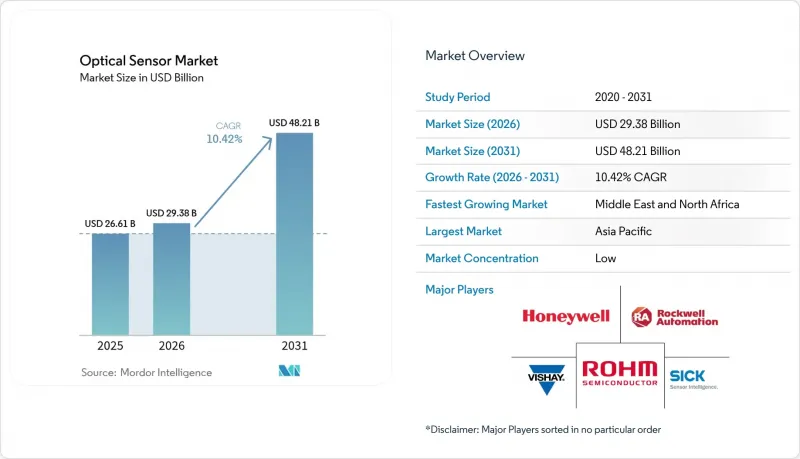
This report is Segmented by Sensor Type (Image Sensor, Fiber-Optic Sensor, and More), Sensing Technology (Extrinsic Optical Sensor and More), Component (Photodetectors, Light Sources, and More), Wavelength (Ultraviolet, Visible, and More), Output End-User Application (Consumer Electronics, Industrial Automation & Robotics and More), and Geography. The Market Forecasts are Provided in Terms of Value (USD).
Global Optical Sensor Market Trends and Insights
Miniaturization Demand for Wearable Optics in APAC Consumer Electronics
AR glasses and smart wearables now require sub-millimeter optical stacks that still meet luminous-efficiency targets. Single-layer meta-optics introduced by STMicroelectronics cut lens height by 70%, permitting under-display proximity sensing in flagship smartphones. Indium-phosphide VCSELs are replacing GaAs emitters, delivering tighter beam divergence for space-constrained devices. APAC contract manufacturers leverage these developments to secure design wins from Western brands, reinforcing the region's 33% revenue share position.
Industrial IoT Adoption Fuelling Fiber-optic Sensors in Harsh Environments
Distributed fiber sensing provides kilometre-scale temperature and strain data immune to electromagnetic interference, enabling predictive maintenance across refineries, pipelines, and high-voltage substations. Rockwell Automation notes that early-warning analytics on such data can eliminate 30% of unplanned downtime in process industries. Coupling AI-based pattern recognition with continuous optical feedback is becoming a cornerstone of Industry 4.0 strategies in North America and Europe.
Supply-Chain Constraints for High-Purity Silica Preforms
Quartz mined from a handful of Appalachian deposits accounts for most global preform feedstock; Hurricane-induced outages in 2024 exposed how a single locale can squeeze optical-fiber availability. Coupled with China's export restrictions on germanium, manufacturers are negotiating long-term contracts at price premiums, delaying large-volume deployments of distributed fiber solutions. Synthetic-silica start-ups are emerging, but commercial scaling remains two to three years out.
Other drivers and restraints analyzed in the detailed report include:
- Automotive ADAS & LiDAR Integration Accelerating NIR Image Sensors in Europe
- Advances in Silicon Photonics Lowering Bill-of-Materials Cost for Integrated Optical Sensors
- Data-Privacy Concerns Around Biometric Optical Sensors in EU
For complete list of drivers and restraints, kindly check the Table Of Contents.
Segment Analysis
Image sensors retained 41.35% share of the optical sensors market in 2025, buoyed by multi-camera smartphones and ADAS roll-outs. Sony's stacked CMOS technology pushes 120 fps 4-K capture, meeting machine-vision tolerances for factory automation. Fiber-optic sensors, while smaller in absolute revenue, are forecast to post the highest 12.05% CAGR as infrastructure operators shift toward kilometre-scale structural health monitoring. This traction lifts the optical sensors market size for fiber-optic solutions from USD 4.7 billion in 2025 toward USD 9.27 billion by 2031. Distributed acoustic sensing, pipeline security, and perimeter intrusion systems are the chief volume drivers.
Diversification across photoelectric, ambient light, and proximity sensors remains steady, although ASP erosion pressures component suppliers. Ultra-mini proximity modules like Vishay's 0.5 mm-thick device cater to bezel-less phone designs, while global-shutter industrial cameras eliminate motion blur in robotic pick-and-place. Multi-spectral imagers within the "Others" bucket are gaining double-digit growth, supporting precision agriculture and food-safety fluorescence assays.
Cutting-edge photodetectors such as single-photon avalanche diodes (SPADs) and avalanche photodiodes (APDs) sell at premium prices even though they ship in lower volumes than standard photodiodes. SPAD arrays deliver picosecond-level time-of-flight data that LiDAR systems rely on for accurate distance readings in self-driving cars. On the emitter side, design teams are moving from LEDs to VCSELs and edge-emitting lasers to gain higher optical power and tighter spectral control; VCSELs also couple easily into fiber while meeting consumer eye-safety rules.
Optics and filters contribute the most value per gram because their precision coatings and tight tolerances are hard for new entrants to match. Meta-optics is shaking up lens design by replacing multi-element stacks with single, patterned layers that keep performance but trim size and weight. Processing electronics are following the same path: more functions now sit on the sensor die, so edge AI can run locally, cutting latency and easing bandwidth demands.
Complete Report Scope:
- By Sensor Type
- Image Sensor
- Fiber-optic Sensor
- Photoelectric Sensor
- Ambient Light & Proximity Sensor
- Others (Position, Touch, Multi-spectral)
- By Sensing Technology
- Extrinsic Optical Sensor
- Intrinsic Optical Sensor
- By Component
- Photodetectors (Photodiodes, APDs, SPADs)
- Light Sources (LED, VCSEL, Laser)
- Optics and Filters
- ICs and Processing Electronics
- By Wavelength
- Ultraviolet (100-400 nm)
- Visible (400-700 nm)
- Near-Infrared (700-1400 nm)
- Short-Wave IR / Mid-IR (>1400 nm)
- By Output
- Analog
- Digital
- By End-user Application
- Consumer Electronics
- Industrial Automation and Robotics
- Automotive and Transportation
- Healthcare and Medical Devices
- Biometrics and Security
- Aerospace and Defense
- Energy and Environmental Monitoring
- By Geography
- North America
- United States
- Canada
- Mexico
- Europe
- United Kingdom
- Germany
- France
- Italy
- Rest of Europe
- Asia-Pacific
- China
- Japan
- India
- South Korea
- Rest of Asia-Pacific
- Middle East
- Israel
- Saudi Arabia
- United Arab Emirates
- Turkey
- Rest of Middle East
- Africa
- South Africa
- Egypt
- Rest of Africa
- South America
- Brazil
- Argentina
- Rest of South America
- North America
Geography Analysis
Asia-Pacific accounted for 32.60% of 2025 revenue, reflecting its tight coupling of component fabs, module assembly, and consumer electronics brands. Contract manufacturers in China and Vietnam now produce proximity-sensor die at sub-USD 0.09 ASP, reinforcing the region's cost leadership. Japan's precision optics ecosystem supports automotive LiDAR modules meeting AEC-Q102 grade, while South Korea's foundries push the envelope on stacked-image-sensor yields.
Europe's outlook centers on regulatory-driven applications. German Tier-1 suppliers are booking long-term contracts for NIR imaging arrays that comply with Euro NCAP vision-system mandates. Fiber-optic gas-leak monitoring around North Sea platforms is expanding as EU methane-emissions rules tighten. GDPR compliance is steering OEMs toward on-device biometric analysis, supporting intrinsic sensor adoption.
North America continues to test emerging concepts ahead of other regions. Venture funding into photonic start-ups exceeded USD 700 million in 2024-2025, with a focus on edge-AI optical links. Environmental agencies deploy distributed fiber networks for methane quantification, often financed through green-bond issuances. Meanwhile, Saudi Arabia and the UAE are installing hyperspectral camera arrays across smart-city projects, driving the Middle East's 13.05% CAGR outlook.
- ams-OSRAM AG
- Sony Group Corporation
- Hamamatsu Photonics K.K.
- ON Semiconductor Corp.
- ROHM Co., Ltd.
- SICK AG
- Keyence Corporation
- Teledyne Technologies Inc.
- STMicroelectronics N.V.
- Vishay Intertechnology Inc.
- Honeywell International Inc.
- IFM Electronic GmbH
- Pepperl + Fuchs SE
- Rockwell Automation Inc.
- Samsung Electronics Co. Ltd.
- Cognex Corporation
- FLIR Systems (Teledyne FLIR)
- Omnivision Technologies Inc.
- Lumentum Holdings Inc.
- Excelitas Technologies Corp.
- Thorlabs, Inc.
Additional Benefits:
- The market estimate (ME) sheet in Excel format
- 3 months of analyst support
TABLE OF CONTENTS
1 INTRODUCTION
- 1.1 Study Assumptions and Market Definition
- 1.2 Scope of the Study
2 RESEARCH METHODOLOGY
3 EXECUTIVE SUMMARY
4 MARKET LANDSCAPE
- 4.1 Market Overview
- 4.2 Market Drivers
- 4.2.1 Miniaturization Demand for Wearable Optics in APAC Consumer Electronics
- 4.2.2 Industrial IoT Adoption Fueling Fiber-optic Sensors in Harsh Environments
- 4.2.3 Automotive ADAS and LiDAR Integration Accelerating NIR Image Sensors in Europe
- 4.2.4 Rapid 5G & Edge-Data-Center Roll-out Requiring High-Speed Optical Sensing
- 4.2.5 Stricter Environmental-Monitoring Regulations Driving Distributed Fiber Sensing in North America
- 4.2.6 Advances in Silicon Photonics Lowering BOM Cost for Integrated Optical Sensors
- 4.3 Market Restraints
- 4.3.1 Supply-chain Constraints for High-purity Silica Preforms
- 4.3.2 Price Sensitivity in Low-end Smartphones Limiting Advanced Proximity Sensors
- 4.3.3 Calibration Complexity of Multi-spectral Sensors Deterring SME Uptake
- 4.3.4 Data-Privacy Concerns Around Biometric Optical Sensors in EU
- 4.4 Value / Supply-Chain Analysis
- 4.5 Regulatory and Technological Outlook
- 4.6 Porter's Five Forces Analysis
- 4.6.1 Bargaining Power of Suppliers
- 4.6.2 Bargaining Power of Buyers
- 4.6.3 Threat of New Entrants
- 4.6.4 Threat of Substitutes
- 4.6.5 Intensity of Competitive Rivalry
- 4.7 Pricing Analysis
- 4.8 Investment and Funding Trends
5 MARKET SIZE AND GROWTH FORECASTS (VALUE)
- 5.1 By Sensor Type
- 5.1.1 Image Sensor
- 5.1.2 Fiber-optic Sensor
- 5.1.3 Photoelectric Sensor
- 5.1.4 Ambient Light & Proximity Sensor
- 5.1.5 Others (Position, Touch, Multi-spectral)
- 5.2 By Sensing Technology
- 5.2.1 Extrinsic Optical Sensor
- 5.2.2 Intrinsic Optical Sensor
- 5.3 By Component
- 5.3.1 Photodetectors (Photodiodes, APDs, SPADs)
- 5.3.2 Light Sources (LED, VCSEL, Laser)
- 5.3.3 Optics and Filters
- 5.3.4 ICs and Processing Electronics
- 5.4 By Wavelength
- 5.4.1 Ultraviolet (100-400 nm)
- 5.4.2 Visible (400-700 nm)
- 5.4.3 Near-Infrared (700-1400 nm)
- 5.4.4 Short-Wave IR / Mid-IR (>1400 nm)
- 5.5 By Output
- 5.5.1 Analog
- 5.5.2 Digital
- 5.6 By End-user Application
- 5.6.1 Consumer Electronics
- 5.6.2 Industrial Automation and Robotics
- 5.6.3 Automotive and Transportation
- 5.6.4 Healthcare and Medical Devices
- 5.6.5 Biometrics and Security
- 5.6.6 Aerospace and Defense
- 5.6.7 Energy and Environmental Monitoring
- 5.7 By Geography
- 5.7.1 North America
- 5.7.1.1 United States
- 5.7.1.2 Canada
- 5.7.1.3 Mexico
- 5.7.2 Europe
- 5.7.2.1 United Kingdom
- 5.7.2.2 Germany
- 5.7.2.3 France
- 5.7.2.4 Italy
- 5.7.2.5 Rest of Europe
- 5.7.3 Asia-Pacific
- 5.7.3.1 China
- 5.7.3.2 Japan
- 5.7.3.3 India
- 5.7.3.4 South Korea
- 5.7.3.5 Rest of Asia-Pacific
- 5.7.4 Middle East
- 5.7.4.1 Israel
- 5.7.4.2 Saudi Arabia
- 5.7.4.3 United Arab Emirates
- 5.7.4.4 Turkey
- 5.7.4.5 Rest of Middle East
- 5.7.5 Africa
- 5.7.5.1 South Africa
- 5.7.5.2 Egypt
- 5.7.5.3 Rest of Africa
- 5.7.6 South America
- 5.7.6.1 Brazil
- 5.7.6.2 Argentina
- 5.7.6.3 Rest of South America
- 5.7.1 North America
6 COMPETITIVE LANDSCAPE
- 6.1 Market Concentration
- 6.2 Strategic Moves (M&A, JV, Product Launch, Funding)
- 6.3 Market Share Analysis
- 6.4 Company Profiles {(includes Global level Overview, Market level overview, Core Segments, Financials as available, Strategic Information, Market Rank/Share for key companies, Products & Services, and Recent Developments)}
- 6.4.1 ams-OSRAM AG
- 6.4.2 Sony Group Corporation
- 6.4.3 Hamamatsu Photonics K.K.
- 6.4.4 ON Semiconductor Corp.
- 6.4.5 ROHM Co., Ltd.
- 6.4.6 SICK AG
- 6.4.7 Keyence Corporation
- 6.4.8 Teledyne Technologies Inc.
- 6.4.9 STMicroelectronics N.V.
- 6.4.10 Vishay Intertechnology Inc.
- 6.4.11 Honeywell International Inc.
- 6.4.12 IFM Electronic GmbH
- 6.4.13 Pepperl + Fuchs SE
- 6.4.14 Rockwell Automation Inc.
- 6.4.15 Samsung Electronics Co. Ltd.
- 6.4.16 Cognex Corporation
- 6.4.17 FLIR Systems (Teledyne FLIR)
- 6.4.18 Omnivision Technologies Inc.
- 6.4.19 Lumentum Holdings Inc.
- 6.4.20 Excelitas Technologies Corp.
- 6.4.21 Thorlabs, Inc.
7 MARKET OPPORTUNITIES AND FUTURE OUTLOOK
- 7.1 White-space and Unmet-need Assessment

