PUBLISHER: Mordor Intelligence | PRODUCT CODE: 2121390

PUBLISHER: Mordor Intelligence | PRODUCT CODE: 2121390
Agricultural Adjuvants - Market Share Analysis, Industry Trends & Statistics, Growth Forecasts (2026 - 2031)
According to Mordor Intelligence, the agricultural adjuvants market size was valued at USD 4.30 billion in 2025 and is estimated to grow from USD 4.55 billion in 2026 to USD 6.40 billion by 2031, at a CAGR of 7.1% during the forecast period (2026-2031).
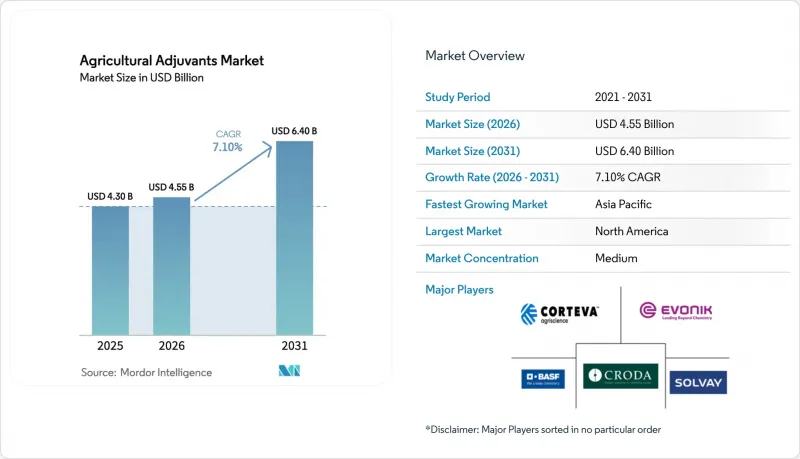
This report is Segmented by Type (Activator Adjuvants and Utility Adjuvants), by Application (Herbicide Adjuvants, Insecticide Adjuvants, and More), by Crop Type (Cereals and Grains, Oilseeds and Pulses, Fruits and Vegetables, and Other Crops) and by Geography (North America, South America, Europe, Asia-Pacific, Middle East, and More). The Market Forecasts are Provided in Terms of Value (USD).
Global Agricultural Adjuvants Market Trends and Insights
Growing Food Demand Versus Declining Arable Land
According to United Nations projections, the world's population is projected to reach 9.7 billion by 2050, and demand for additional arable land is projected to reach 165 million hectares. As cultivable land per capita declines, governments are promoting yield intensification programs that encourage the use of adjuvant-enhanced sprays to reduce repeat applications and improve input efficiency. This widening gap between food demand and available farmland compels growers to maximize productivity on existing acreage, increasing dependence on crop protection products. Agricultural adjuvants support this shift by improving spray deposition, spreading, and uptake, enabling more effective pest and weed control while optimizing agrochemical use.
Precision-Farming Adoption Boosting Spray Accuracy
Precision agriculture technologies, such as GPS-guided sprayers, variable rate technology (VRT), and sensor-based application systems, are significantly influencing crop protection practices. Such systems cut spray volumes by 15% to 25%, but only if droplets remain uniform, drift-control polymers and low-foam surfactants are now required additives. Similar trends hold in Western Europe, where the Farm-to-Fork strategy's 50% reduction target forces growers to squeeze more efficacy from each liter. China's drone fleet delivers 5-15 liters per hectare compared with 100 liters from ground rigs, making organosilicone superspreaders indispensable to maintain leaf coverage. These dynamics accelerate demand across every subsegment of the agricultural adjuvants market.
Tightening Toxicology Thresholds for Co-Formulants
Regulatory agencies are intensifying their scrutiny of inert ingredients and co-formulants used in adjuvants. The European Union, through the Registration, Evaluation, Authorisation, and Restriction of Chemicals (REACH) framework, and the Environmental Protection Agency (EPA) have implemented stricter toxicity benchmarks for surfactants and alkylphenol ethoxylates. In 2022, the European Union's Farm to Fork strategy targets a 50% reduction in pesticide use by 2030. As a result, member states are enforcing stringent maximum residue limits that surpass Codex standards. These measures have increased compliance costs and necessitated reformulations, leading to higher R&D expenditures. Compliance costs can reach high per-chemistry level, a burden that sidelines small formulators and shifts share toward vertically integrated majors in the agricultural adjuvants market. Cold-weather performance gaps still plague vegetable-oil surfactants, forcing reformulation cycles that sap margins.
Other drivers and restraints analyzed in the detailed report include:
- Shift to Herbicide-Tolerant Seeds Elevating Adjuvant Need
- Surge in Bio-Based Surfactant Innovation Lowering Toxicity
- Compatibility Gaps with Microbial Biocontrol Agents
For complete list of drivers and restraints, kindly check the Table Of Contents.
Segment Analysis
Activator adjuvants were the largest segment, led with 70.5% of the agricultural adjuvants market share in 2025, because surfactants and oils remain mandatory on most post-emergence herbicide labels. The global demand for agricultural activator adjuvants is rising significantly, driven by agronomic, economic, and regulatory factors influencing modern crop protection practices. As agricultural systems work to meet the growing global demand for food, feed, and fiber, farmers are increasingly prioritizing the efficiency and effectiveness of crop protection products, including herbicides, fungicides, insecticides, and foliar nutrients.
Utility adjuvants are fastest fastest-growing segment, forecast to post an 8.4% CAGR through 2031, fueled by drift-control polymers and water conditioners that help growers satisfy ever-tighter nozzle and pH specifications. The agricultural adjuvants market size for utility products is forecast to expand steadily as drone protocols and hard-water fields multiply use cases. Precision rules are embedding utilities into core agronomy. Drift-control agents meet ISO 22866 droplet standards, water conditioners neutralize mineral antagonism that can cut glyphosate performance by 40%, and antifoams protect high-pressure pumps from overflow. Each added tank-mix input increases the risk of incompatibility, which drives demand for buffers and polymers that stabilize emulsions.
Complete Report Scope:
- By Type
- Activator Adjuvants
- Surfactants
- Oil Adjuvants
- Utility Adjuvants
- Drift Control Agents
- Water Conditioners
- Antifoaming Agents
- Acidifiers and Buffers
- Activator Adjuvants
- By Application
- Herbicide Adjuvants
- Insecticide Adjuvants
- Fungicide Adjuvants
- Other Applications
- By Crop Type
- Cereals and Grains
- Oilseeds and Pulses
- Fruits and Vegetables
- Other Crops
- By Geography
- North America
- United States
- Canada
- Mexico
- Rest of North America
- South America
- Brazil
- Argentina
- Rest of South America
- Europe
- Germany
- France
- United Kingdom
- Italy
- Russia
- Rest of Europe
- Asia-Pacific
- China
- India
- Japan
- Australia
- Rest of Asia-Pacific
- Middle East
- Saudi Arabia
- United Arab Emirates
- Rest of Middle East
- Africa
- South Africa
- Nigeria
- Rest of Africa
- North America
Geography Analysis
North America was the largest region, holding 35.4% of the agricultural adjuvants market share in 2025, as its highly mechanized farms and extensive dealer networks already integrate adjuvant packages into routine crop-protection programs. Growth is projected to increase slightly behind the worldwide pace, because saturation in the United States caps incremental acreage. Canada adds resilience with canola and wheat programs that still depend on surfactant-optimized glyphosate passes, while Mexico, expanding drip-irrigated vegetables, brings faster growth to the continental mix.
Asia-Pacific is the fastest-growing region, on track to expand at an 8.1% CAGR to 2031, as China and India modernize their spraying equipment and push yield targets higher. China's policy backing for Unmanned Aerial Vehicles (UAVs) and smart machinery funnels adjuvant demand into superspreaders and drift-reducers. India's Digital Agriculture Mission funds half of the qualifying costs for precision-spray equipment, stoking sales of activators for cotton, mustard, and pulses. Japan and Australia round out regional growth with drone deployments in aging rural districts and cotton insecticide programs that rely heavily on drift control.
Europe and South America demonstrate moderate performance, balancing steady policy support with market limitations. In Europe, growth is primarily driven by stringent environmental regulations, which are shifting purchasing preferences toward bio-based blends rather than increasing overall volumes. In South America, a notable CAGR is observed as Brazilian and Argentine farmers expand soybean and corn cultivation. However, fluctuating currency values and input costs hinder the adoption of premium adjuvants. Africa lags behind other regions but maintains consistent single-digit growth, supported by the development of commercial farming and donor-funded training programs emphasizing drift control and water conditioning.
- BASF SE
- Corteva Agriscience
- Evonik Industries
- Solvay SA
- Croda International
- Nufarm Ltd
- Helena Agri-Enterprises
- AkzoNobel NV
- Brandt Consolidated
- Wilbur-Ellis Company
- Adjuvant Plus Inc.
- Huntsman Corporation
- Clariant AG
- Momentive Performance Materials
- Interagro Ltd
Additional Benefits:
- The market estimate (ME) sheet in Excel format
- 3 months of analyst support
TABLE OF CONTENTS
1 Introduction
- 1.1 Study Assumptions and Market Definition
- 1.2 Scope of the Study
2 Research Methodology
3 Executive Summary
4 Market Landscape
- 4.1 Market Overview
- 4.2 Market Drivers
- 4.2.1 Growing food demand versus declining arable land
- 4.2.2 Precision-farming adoption boosting spray accuracy
- 4.2.3 Shift to herbicide-tolerant seeds elevates adjuvant need
- 4.2.4 Surge in bio-based surfactant innovation, lowering toxicity
- 4.2.5 Drone-enabled ultra-low-volume spraying necessitating ultra-spreaders
- 4.2.6 Carbon-credit-linked dose-reduction incentives
- 4.3 Market Restraints
- 4.3.1 Tightening toxicology thresholds for co-formulants
- 4.3.2 Volatility in petrochemical feedstock pricing
- 4.3.3 Compatibility gaps with microbial biocontrol agents
- 4.3.4 AI-guided spray systems reducing broad-spectrum adjuvant use
- 4.4 Regulatory Landscape
- 4.5 Technological Outlook
- 4.6 Porter's Five Forces Analysis
- 4.6.1 Bargaining Power of Suppliers
- 4.6.2 Bargaining Power of Buyers
- 4.6.3 Threat of New Entrants
- 4.6.4 Threat of Substitutes
- 4.6.5 Intensity of Competitive Rivalry
5 Market Size and Growth Forecasts (Value)
- 5.1 By Type
- 5.1.1 Activator Adjuvants
- 5.1.1.1 Surfactants
- 5.1.1.2 Oil Adjuvants
- 5.1.2 Utility Adjuvants
- 5.1.2.1 Drift Control Agents
- 5.1.2.2 Water Conditioners
- 5.1.2.3 Antifoaming Agents
- 5.1.2.4 Acidifiers and Buffers
- 5.1.1 Activator Adjuvants
- 5.2 By Application
- 5.2.1 Herbicide Adjuvants
- 5.2.2 Insecticide Adjuvants
- 5.2.3 Fungicide Adjuvants
- 5.2.4 Other Applications
- 5.3 By Crop Type
- 5.3.1 Cereals and Grains
- 5.3.2 Oilseeds and Pulses
- 5.3.3 Fruits and Vegetables
- 5.3.4 Other Crops
- 5.4 By Geography
- 5.4.1 North America
- 5.4.1.1 United States
- 5.4.1.2 Canada
- 5.4.1.3 Mexico
- 5.4.1.4 Rest of North America
- 5.4.2 South America
- 5.4.2.1 Brazil
- 5.4.2.2 Argentina
- 5.4.2.3 Rest of South America
- 5.4.3 Europe
- 5.4.3.1 Germany
- 5.4.3.2 France
- 5.4.3.3 United Kingdom
- 5.4.3.4 Italy
- 5.4.3.5 Russia
- 5.4.3.6 Rest of Europe
- 5.4.4 Asia-Pacific
- 5.4.4.1 China
- 5.4.4.2 India
- 5.4.4.3 Japan
- 5.4.4.4 Australia
- 5.4.4.5 Rest of Asia-Pacific
- 5.4.5 Middle East
- 5.4.5.1 Saudi Arabia
- 5.4.5.2 United Arab Emirates
- 5.4.5.3 Rest of Middle East
- 5.4.6 Africa
- 5.4.6.1 South Africa
- 5.4.6.2 Nigeria
- 5.4.6.3 Rest of Africa
- 5.4.1 North America
6 Competitive Landscape
- 6.1 Market Concentration
- 6.2 Strategic Moves
- 6.3 Market Share Analysis
- 6.4 Company Profiles (Includes Global level Overview, Market level Overview, Core Segments, Financials as available, Strategic Information, Market Rank/Share, Products and Services, and Recent Developments)
- 6.4.1 BASF SE
- 6.4.2 Corteva Agriscience
- 6.4.3 Evonik Industries
- 6.4.4 Solvay SA
- 6.4.5 Croda International
- 6.4.6 Nufarm Ltd
- 6.4.7 Helena Agri-Enterprises
- 6.4.8 AkzoNobel NV
- 6.4.9 Brandt Consolidated
- 6.4.10 Wilbur-Ellis Company
- 6.4.11 Adjuvant Plus Inc.
- 6.4.12 Huntsman Corporation
- 6.4.13 Clariant AG
- 6.4.14 Momentive Performance Materials
- 6.4.15 Interagro Ltd
7 Market Opportunities and Future Outlook

