PUBLISHER: Mordor Intelligence | PRODUCT CODE: 2121398

PUBLISHER: Mordor Intelligence | PRODUCT CODE: 2121398
X-by-wire System - Market Share Analysis, Industry Trends & Statistics, Growth Forecasts (2026 - 2031)
According to Mordor Intelligence, the x-by-wire system market size is projected to be USD 25.81 billion in 2025, USD 29.69 billion in 2026, and reach USD 59.91 billion by 2031, growing at a CAGR of 15.07% from 2026 to 2031.
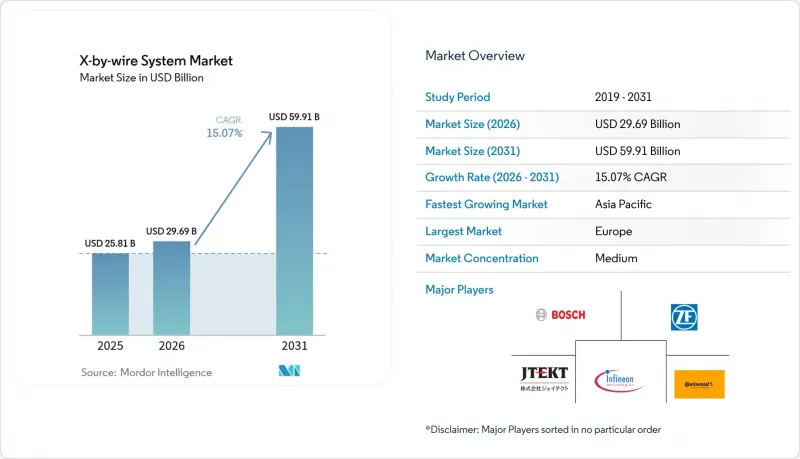
This report is Segmented by Type (Throttle-By-Wire, Brake-By-Wire, and More), Vehicle Type (Passenger Cars and More), Component (Sensors and Pedal Modules and More), Propulsion Type (ICE, Hybrid, and BEV), and Geography. The Market Forecasts are Provided in Value (USD).
Global X-by-wire System Market Trends and Insights
Advanced-driver-assistance and Autonomy Push
Steer-by-wire and brake-by-wire cut control-loop latency below 50 milliseconds, a threshold that Level 2+ autonomy requires for safe lane-keep and emergency maneuvers . Mercedes-Benz will ship the first mass-market steer-by-wire system in its EQS sedan during 2026, using ZF dual-pinion actuators that reduce driver effort by 40% in tight parking. Brake-by-wire supports one-pedal driving by merging friction pads with regenerative torque so smoothly that Bosch iBooster 3 recovers up to 0.3 kWh per mile in city cycles . Autonomous-vehicle developers favor by-wire because direct CAN commands avoid the energy drain of mechanical override motors, trimming redundant power budgets by 25%. Demand also extends to suppliers that embed torque, angle, and temperature telemetry in a single housing, streamlining the bill of materials and accelerating ISO 26262 assessments.
Global Safety and CO2 Rules Favor Electronics
The EU General Safety Regulation from 2024 mandates intelligent speed assistance, emergency lane keeping, and automatic braking, all of which are easier with precise electronic brake-force and steering actuation . China's GB 7258 rule extends emergency braking to trucks weighing more than 3.5 tonnes, spurring the fitment of brake-by-wire systems that eliminate 200-millisecond air-brake lag. CO2 fleet targets dropping to 49.5 g/km by 2030 drive OEMs toward BEVs that benefit from the 8-12 kg mass cut when hydraulics and columns disappear. ISO 26262 and ISO/SAE 21434 set a high bar for certification that favors early movers who already own ASIL D-approved platforms. Net effect is a regulatory ratchet that locks a rising electronics floor into every new vehicle, pushing the X-by-wire systems market deeper into the mainstream.
Functional-safety Certification Hurdles
Achieving ASIL D requires the hazardous failure probability to remain below 10 per billion operating hours, which necessitates dual actuators, isolated power, and millions of test kilometers. ZF needed 18 months of hardware-in-the-loop work for the Mercedes EQS steer-by-wire and spent USD 45 million beyond plan, delaying launch. Smaller suppliers pay USD 500-800 per laboratory hour for accelerated tests, a budget many cannot sustain. Brake-by-wire faces even closer scrutiny because loss of pressure poses a higher injury risk, and Bosch cycled its iBooster 3 through 2.4 million duty cycles to gain approval. U.S. homologation lags; NHTSA still grants temporary exemptions capped at 2,500 units, restricting early volume.
Other drivers and restraints analyzed in the detailed report include:
- EV Packaging and Weight-saving Benefits
- Digital Chassis Cost-saving Platforms
- High Integration Cost for Legacy Platforms
For complete list of drivers and restraints, kindly check the Table Of Contents.
Segment Analysis
Brake-by-wire generated 38.17% of 2025 revenue, the most significant slice of the X-by-wire systems market share, while steer-by-wire is projected to grow at a 15.09% CAGR to 2031. Demand stems from seamless regen-to-friction blending, which adds 0.3 kWh per urban mile in range and lets OEMs downsize packs. Bosch iBooster 3 began series production in late 2025 without a vacuum pump, illustrating how suppliers strip components and weight. ZF clinched a multi-year order for 5 million brake-by-wire units, signaling a migration from premium to volume segments.
Steer-by-wire is currently lagging but will accelerate as the Mercedes EQS, Lexus RZ, and Tesla Cybertruck popularize column-less designs. Unified chassis controllers mesh throttle, shift, and park functions, further lifting by-wire revenue even though those subsystems already appear in 90% of vehicles. Corner-module suppliers combine steering, braking, and drive motors into a single 68 kg assembly, collapsing historical distinctions among system types. The X-by-wire systems market size for integrated corner units is projected to expand at more than 16% annually once certification bottlenecks ease.
Passenger cars commanded 77.16% volume in 2025, reflecting premium BEV launches that require advanced regen and yoke steering. Yet medium- and heavy-duty commercial vehicles will grow fastest at a 15.21% CAGR to 2031, as fleets pursue predictive maintenance and fuel savings through tighter platooning. Geotab's 500-van pilot predicts 20% less downtime by tracking current draw anomalies in REE corner modules.
Light commercial vans benefit from brake-by-wire but wrestle with thin margins that make the USD 800-1,200 premium for steer-by-wire hard to absorb. For heavy trucks, China's GB 7258 braking mandate pushes adoption, while platooning enabled by 40 millisecond electric brake response shrinks inter-vehicle gaps to under 10 m, trimming drag 10%. The X-by-wire systems industry sees strong order pipelines from logistics firms that view autonomous yard parking and remote diagnostics as key to lowering labor costs.
Complete Report Scope:
- By Type
- Throttle-by-wire System
- Brake-by-wire System
- Steer-by-wire System
- Park-by-wire System
- Shift-by-wire System
- By Vehicle Type
- Passenger Cars
- Light Commercial Vehicles
- Medium and Heavy Commercial Vehicles
- By Component
- Sensors and Pedal Modules
- Actuators
- Electronic Control Units (ECUs)
- By Propulsion Type
- Internal-Combustion Engine Vehicles
- Hybrid Vehicles
- Battery-Electric Vehicles
- By Geography
- North America
- United States
- Canada
- Rest of North America
- South America
- Brazil
- Argentina
- Rest of South America
- Europe
- Germany
- United Kingdom
- France
- Italy
- Spain
- Russia
- Rest of Europe
- Asia Pacific
- China
- Japan
- India
- South Korea
- Rest of Asia Pacific
- Middle East and Africa
- Saudi Arabia
- United Arab Emirates
- Turkey
- South Africa
- Rest of Middle East and Africa
- North America
Geography Analysis
Europe led the X-by-wire systems market with 36.83% revenue in 2025 because EU safety rules require electronic lane-keeping and braking, and CO2 goals reward every kilogram saved. Germany, the United Kingdom, France, and Italy now host multiple steer-by-wire launches from Mercedes, Jaguar Land Rover, and Audi. Suppliers rely on local test tracks and TUV certification labs that expedite ASIL D validation, reinforcing Europe's early-adopter status.
Asia Pacific will register the fastest regional expansion at 15.17% CAGR to 2031, buoyed by China's Level 3 subsidy roadmap and Japan's luxury steer-by-wire rollouts. China's GB 7258 emergency-brake rule accelerates medium and heavy truck adoption because electro-mechanical calipers beat a 200-millisecond air-brake delay. South Korea's Hyundai and Kia have public programs to release steer-by-wire crossovers in 2027, while India restricts fitment to premium SUVs due to price sensitivity.
North America trails slightly; Tesla's Cybertruck steer-by-wire and REE's FMVSS-cleared corner modules spur momentum, but NHTSA has yet to issue permanent steer-by-wire rules, capping early volumes at 2,500 units per model. South America, the Middle East, and Africa remain niche markets because BEV penetration is low and hydromechanical platforms persist. Turkey and Saudi Arabia emerge as knock-down kit assembly hubs that may transition to by-wire once regional battery gigafactories scale.
- Continental AG
- ZF Friedrichshafen AG
- Robert Bosch GmbH
- JTEKT Corporation
- Nexteer Automotive
- Infineon Technologies AG
- Nissan Motor Corporation
- Tesla Inc.
- Audi AG
- Toyota Motor Corporation
- Hitachi Astemo Ltd.
- Denso Corporation
- Curtiss-Wright Corporation
- CTS Corporation
- Valeo SA
- Orscheln Products LLC
- Torc Robotics
- Jaguar Land Rover
- REE Automotive
Additional Benefits:
- The market estimate (ME) sheet in Excel format
- 3 months of analyst support
TABLE OF CONTENTS
1 Introduction
- 1.1 Study Assumptions & Market Definition
- 1.2 Scope of the Study
2 Research Methodology
3 Executive Summary
4 Market Landscape
- 4.1 Market Overview
- 4.2 Market Drivers
- 4.2.1 Advanced-driver-assistance and Autonomy Push
- 4.2.2 Global Safety and CO2 Rules Favour Electronics
- 4.2.3 EV Packaging and Weight-saving Benefits
- 4.2.4 Digital Chassis Cost-saving Platforms
- 4.2.5 OTA-tunable Software-defined Chassis
- 4.2.6 Corner-module EV Skateboards for Fleets
- 4.3 Market Restraints
- 4.3.1 Functional-safety Certification Hurdles
- 4.3.2 High Integration Cost for Legacy Platforms
- 4.3.3 In-vehicle-network Cyber-security Gaps
- 4.3.4 Supply Crunch of Redundancy-grade Sensors
- 4.4 Value / Supply-Chain Analysis
- 4.5 Regulatory Landscape
- 4.6 Technological Outlook
- 4.7 Porter's Five Forces
- 4.7.1 Threat of New Entrants
- 4.7.2 Bargaining Power of Suppliers
- 4.7.3 Bargaining Power of Buyers
- 4.7.4 Threat of Substitutes
- 4.7.5 Competitive Rivalry
5 Market Size & Growth Forecasts (Value (USD))
- 5.1 By Type
- 5.1.1 Throttle-by-wire System
- 5.1.2 Brake-by-wire System
- 5.1.3 Steer-by-wire System
- 5.1.4 Park-by-wire System
- 5.1.5 Shift-by-wire System
- 5.2 By Vehicle Type
- 5.2.1 Passenger Cars
- 5.2.2 Light Commercial Vehicles
- 5.2.3 Medium and Heavy Commercial Vehicles
- 5.3 By Component
- 5.3.1 Sensors and Pedal Modules
- 5.3.2 Actuators
- 5.3.3 Electronic Control Units (ECUs)
- 5.4 By Propulsion Type
- 5.4.1 Internal-Combustion Engine Vehicles
- 5.4.2 Hybrid Vehicles
- 5.4.3 Battery-Electric Vehicles
- 5.5 By Geography
- 5.5.1 North America
- 5.5.1.1 United States
- 5.5.1.2 Canada
- 5.5.1.3 Rest of North America
- 5.5.2 South America
- 5.5.2.1 Brazil
- 5.5.2.2 Argentina
- 5.5.2.3 Rest of South America
- 5.5.3 Europe
- 5.5.3.1 Germany
- 5.5.3.2 United Kingdom
- 5.5.3.3 France
- 5.5.3.4 Italy
- 5.5.3.5 Spain
- 5.5.3.6 Russia
- 5.5.3.7 Rest of Europe
- 5.5.4 Asia Pacific
- 5.5.4.1 China
- 5.5.4.2 Japan
- 5.5.4.3 India
- 5.5.4.4 South Korea
- 5.5.4.5 Rest of Asia Pacific
- 5.5.5 Middle East and Africa
- 5.5.5.1 Saudi Arabia
- 5.5.5.2 United Arab Emirates
- 5.5.5.3 Turkey
- 5.5.5.4 South Africa
- 5.5.5.5 Rest of Middle East and Africa
- 5.5.1 North America
6 Competitive Landscape
- 6.1 Market Concentration
- 6.2 Strategic Moves
- 6.3 Market Share Analysis
- 6.4 Company Profiles (includes Global Level Overview, Market Level Overview, Core Segments, Financials as Available, Strategic Information, Market Rank/Share for Key Companies, Products and Services, SWOT Analysis, and Recent Developments)
- 6.4.1 Continental AG
- 6.4.2 ZF Friedrichshafen AG
- 6.4.3 Robert Bosch GmbH
- 6.4.4 JTEKT Corporation
- 6.4.5 Nexteer Automotive
- 6.4.6 Infineon Technologies AG
- 6.4.7 Nissan Motor Corporation
- 6.4.8 Tesla Inc.
- 6.4.9 Audi AG
- 6.4.10 Toyota Motor Corporation
- 6.4.11 Hitachi Astemo Ltd.
- 6.4.12 Denso Corporation
- 6.4.13 Curtiss-Wright Corporation
- 6.4.14 CTS Corporation
- 6.4.15 Valeo SA
- 6.4.16 Orscheln Products LLC
- 6.4.17 Torc Robotics
- 6.4.18 Jaguar Land Rover
- 6.4.19 REE Automotive
7 Market Opportunities & Future Outlook
- 7.1 White-space & unmet-need assessment

