PUBLISHER: Mordor Intelligence | PRODUCT CODE: 2121423

PUBLISHER: Mordor Intelligence | PRODUCT CODE: 2121423
Middle East And Africa Thermal Imaging Systems - Market Share Analysis, Industry Trends & Statistics, Growth Forecasts (2026 - 2031)
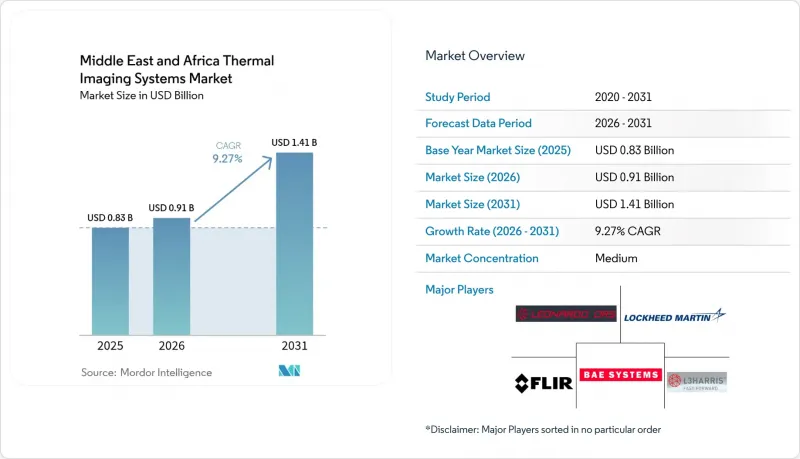
According to Mordor Intelligence, the Middle East and Africa thermal imaging systems market size is projected to expand from USD 0.83 billion in 2025 and USD 0.91 billion in 2026 to USD 1.41 billion by 2031, registering a CAGR of 9.27% between 2026 to 2031.
This report is Segmented by Solutions (Hardware, Software, and Services), Product Type (Fixed Thermal Cameras, and Handheld Thermal Cameras), Application (Security and Surveillance, Monitoring and Inspection, and Detection and Measurement), End-User (Aerospace and Defense, Automotive, and More), and Country. The Market Forecasts are Provided in Terms of Value (USD).
Middle East And Africa Thermal Imaging Systems Market Trends and Insights
Defense Modernization Programs Across GCC States
Regional militaries are refreshing legacy electro-optical suites with third-generation thermal imagers that extend detection ranges and enable multispectral fusion. Saudi Arabia's State Authority for Military Industries signed a 2024 memorandum with Hensoldt to localize production, underscoring the push for indigenous capability. Parallel U.S. Army awards to Teledyne FLIR for vehicle sensor systems cascade into foreign military sales channels and guide GCC specifications toward cooled mid-wave infrared arrays. Export-license bottlenecks persist, yet bilateral agreements are trimming approval cycles for trusted Gulf partners. As a result, hardware revenue rises while automatic target-recognition algorithms open recurring software opportunities.
Expanding Oil and Gas Predictive Maintenance Requirements
National oil companies now fuse thermal data with vibration and historian feeds to predict failures weeks ahead. Abu Dhabi National Oil Company rolled out AIQ's Neuron 5 platform across upstream assets in 2024. Saudi Aramco's 2024 contract with Gecko Robotics highlights robotic ultrasonic and thermal inspections that displace scaffold-based surveys and avert costly shutdowns. Drone-mounted cameras scan flare stacks and subsea lines for hotspots that signal corrosion or leaks, embedding thermal vision into digital-twin workflows. Cost avoidance from averted outages, often exceeding USD 20 million per incident, validates multiyear inspection budgets.
High Acquisition and Maintenance Costs for Cooled Platforms
Cooled mid-wave detectors exceed USD 50,000 per unit and rely on cryogenic coolers that demand six-month service intervals in sandy environments. Budget-constrained agencies in Africa and minor Gulf states therefore default to uncooled alternatives or defer projects, slowing top-line growth. Leasing models that shift maintenance risk to vendors are emerging but hinge on creditworthy buyers and predictable regulatory frameworks.
Other drivers and restraints analyzed in the detailed report include:
- Rapid Urban Security Investments Through Smart-City Initiatives
- Lower-Cost Uncooled Sensors Boosting Commercial Adoption
- Stringent Export-Control Regimes Limiting Sensor Availability
For complete list of drivers and restraints, kindly check the Table Of Contents.
Segment Analysis
Hardware generated 71.68% of revenue in 2025, reflecting sustained procurement of cameras, lenses, and detector modules for defense borders, oil terminals, and smart-city grids. The thermal imaging systems market size for hardware is projected to expand steadily as governments fund perimeter upgrades. Services, however, will outpace all other categories at a 10.39% CAGR as operators lock in calibration, analytics, and training contracts that convert capital layouts into predictable operating expenses. Early adopters such as Advanced Energy Industries bundle annual service plans, fostering sticky client relationships.
The services trajectory also addresses the regional shortage of certified thermographers. Training providers in the UAE and South Africa charge up to USD 1,900 for Level II certification, and the 2024 launch of the Certified Thermographers Network - Africa aims to harmonize standards across 20-plus countries. Software revenue follows hardware penetration, as cloud-hosted dashboards and edge-AI engines monetize data streams over multiyear cycles.
Fixed installations commanded 58.05% revenue in 2025 owing to large-area surveillance of borders, airports, and petro-chemical hubs. These systems integrate with visible-light cameras and radars, enabling layered situational awareness. Handheld units will post a 9.64% CAGR through 2031 as price points fall below USD 5,000 and smartphone add-ons popularize point-and-shoot diagnostics for electricians and building inspectors.
Teledyne FLIR's Hadron 640 and Gremsy's Vio F1 illustrate how miniaturized modules blur delineations between fixed and mobile platforms. Demand also comes from utilities that now issue handheld cameras to line crews for real-time fault detection. Consequently, the thermal imaging systems market share for handhelds is set to widen as field diagnostics embed infrared checks into daily workflows.
Complete Report Scope:
- By Solutions
- Hardware
- Software
- Services
- By Product Type
- Fixed Thermal Cameras
- Handheld Thermal Cameras
- By Application
- Security and Surveillance
- Monitoring and Inspection
- Detection and Measurement
- By End-user
- Aerospace and Defense
- Automotive
- Healthcare and Life Sciences
- Oil and Gas
- Food and Beverages
- Other End-users
- By Geography
- Middle East
- Saudi Arabia
- United Arab Emirates
- Turkey
- Rest of Middle East
- Africa
- South Africa
- Kenya
- Rest of Africa
- Middle East
List of Companies Covered in this Report:
- Teledyne FLIR LLC
- L3Harris Technologies Inc.
- Lockheed Martin Corporation
- BAE Systems plc
- Leonardo DRS Inc.
- Elbit Systems Ltd.
- RTX Corporation (Raytheon Business Unit)
- Thermoteknix Systems Ltd.
- Hangzhou Hikvision Digital Technology Co. Ltd.
- Guide Infrared Co. Ltd.
- Zhejiang Dali Technology Co. Ltd.
- Silent Sentinel Holdings Ltd.
- Testo SE and Co. KGaA
- Seek Thermal Inc.
- Optris GmbH
- Ametek Land (Land Instruments International Ltd.)
- Wuhan Guide Infrared Co. Ltd.
- Infrared Cameras Inc.
- SATIR (Shenzhen SAT Infrared Technology Co. Ltd.)
- Ulirvision Technologies Co. Ltd.
- Seek Thermal Inc.
Additional Benefits:
- The market estimate (ME) sheet in Excel format
- 3 months of analyst support
TABLE OF CONTENTS
1 INTRODUCTION
- 1.1 Study Assumptions and Market Definition
- 1.2 Scope of the Study
2 RESEARCH METHODOLOGY
3 EXECUTIVE SUMMARY
4 MARKET LANDSCAPE
- 4.1 Market Overview
- 4.2 Industry Value Chain Analysis
- 4.3 Impact of Macroeconomic Factors on the Market
- 4.4 Regulatory Landscape
- 4.5 Technological Outlook
- 4.6 Porter's Five Forces Analysis
- 4.6.1 Threat of New Entrants
- 4.6.2 Bargaining Power of Buyers
- 4.6.3 Bargaining Power of Suppliers
- 4.6.4 Threat of Substitute Products
- 4.6.5 Intensity of Competitive Rivalry
5 MARKET DYNAMICS
- 5.1 Market Drivers
- 5.1.1 Defense Modernization Programs Across GCC States
- 5.1.2 Expanding Oil and Gas Predictive Maintenance Requirements
- 5.1.3 Rapid Urban Security Investments Through Smart-City Initiatives
- 5.1.4 Lower-Cost Uncooled Sensors Boosting Commercial Adoption
- 5.1.5 AI-enabled Thermal-Vision Analytics Improving ROI
- 5.1.6 Advent of Rugged, Drone-Mounted Thermal Payloads for Desert Operations
- 5.2 Market Restraints
- 5.2.1 High Acquisition and Maintenance Costs for Cooled Platforms
- 5.2.2 Shortage of Certified Thermography Professionals
- 5.2.3 Stringent Export-Control Regimes Limiting Sensor Availability
- 5.2.4 Performance Degradation Due to Dust, Humidity and Extreme Heat
6 MARKET SIZE AND GROWTH FORECASTS (VALUE)
- 6.1 By Solutions
- 6.1.1 Hardware
- 6.1.2 Software
- 6.1.3 Services
- 6.2 By Product Type
- 6.2.1 Fixed Thermal Cameras
- 6.2.2 Handheld Thermal Cameras
- 6.3 By Application
- 6.3.1 Security and Surveillance
- 6.3.2 Monitoring and Inspection
- 6.3.3 Detection and Measurement
- 6.4 By End-user
- 6.4.1 Aerospace and Defense
- 6.4.2 Automotive
- 6.4.3 Healthcare and Life Sciences
- 6.4.4 Oil and Gas
- 6.4.5 Food and Beverages
- 6.4.6 Other End-users
- 6.5 By Geography
- 6.5.1 Middle East
- 6.5.1.1 Saudi Arabia
- 6.5.1.2 United Arab Emirates
- 6.5.1.3 Turkey
- 6.5.1.4 Rest of Middle East
- 6.5.2 Africa
- 6.5.2.1 South Africa
- 6.5.2.2 Kenya
- 6.5.2.3 Rest of Africa
- 6.5.1 Middle East
7 COMPETITIVE LANDSCAPE
- 7.1 Market Concentration
- 7.2 Strategic Moves
- 7.3 Market Share Analysis
- 7.4 Company Profiles (includes Global level Overview, Market level overview, Core Segments, Financials as available, Strategic Information, Market Rank/Share for key companies, Products and Services, and Recent Developments)
- 7.4.1 Teledyne FLIR LLC
- 7.4.2 L3Harris Technologies Inc.
- 7.4.3 Lockheed Martin Corporation
- 7.4.4 BAE Systems plc
- 7.4.5 Leonardo DRS Inc.
- 7.4.6 Elbit Systems Ltd.
- 7.4.7 RTX Corporation (Raytheon Business Unit)
- 7.4.8 Thermoteknix Systems Ltd.
- 7.4.9 Hangzhou Hikvision Digital Technology Co. Ltd.
- 7.4.10 Guide Infrared Co. Ltd.
- 7.4.11 Zhejiang Dali Technology Co. Ltd.
- 7.4.12 Silent Sentinel Holdings Ltd.
- 7.4.13 Testo SE and Co. KGaA
- 7.4.14 Seek Thermal Inc.
- 7.4.15 Optris GmbH
- 7.4.16 Ametek Land (Land Instruments International Ltd.)
- 7.4.17 Wuhan Guide Infrared Co. Ltd.
- 7.4.18 Infrared Cameras Inc.
- 7.4.19 SATIR (Shenzhen SAT Infrared Technology Co. Ltd.)
- 7.4.20 Ulirvision Technologies Co. Ltd.
- 7.4.21 Seek Thermal Inc.
8 MARKET OPPORTUNITIES AND FUTURE OUTLOOK
- 8.1 White-space and Unmet-need Assessment

