PUBLISHER: Mordor Intelligence | PRODUCT CODE: 2121429

PUBLISHER: Mordor Intelligence | PRODUCT CODE: 2121429
Automotive Coatings - Market Share Analysis, Industry Trends & Statistics, Growth Forecasts (2026 - 2031)
According to Mordor Intelligence, the automotive coatings market size is expected to grow from USD 30.97 billion in 2025 to USD 32.40 billion in 2026 and is forecast to reach USD 40.63 billion by 2031 at 4.63% CAGR over 2026-2031.
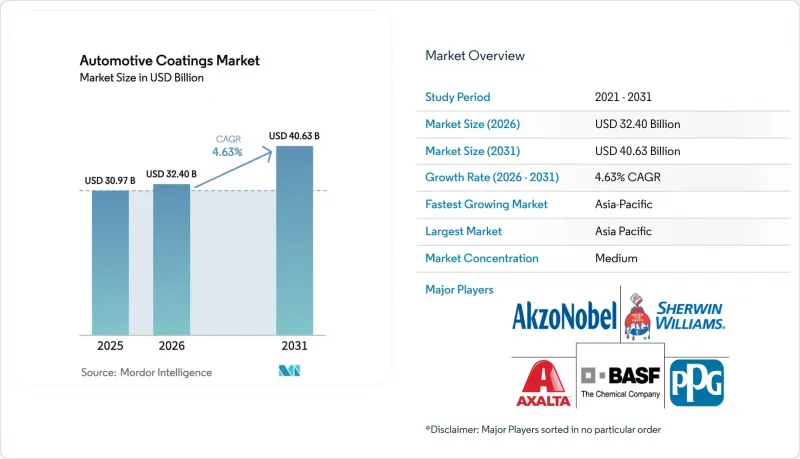
This report is Segmented by Resin Type (Acrylic, Polyurethane, Epoxy, and Other Resin Types), Technology (Solvent-Borne, Water-Borne, and Powder), Coating Layer (Clear Coat, E-Coat, Primer, and Base Coat), Application (OEM and Refinish), and Geography (Asia-Pacific, North America, Europe, South America, and Middle-East and Africa). The Market Forecasts are Provided in Terms of Value (USD).
Global Automotive Coatings Market Trends and Insights
Growing Global Vehicle-Production Rebound
Global light-vehicle output recovered to 92.5 million units in 2024 and is projected to surpass 95 million by 2026 as semiconductor shortages ease and new capacity comes online. China delivered 31.28 million units, while India and Japan collectively added more than 14 million units, anchoring Asia-Pacific's dominance. Each vehicle consumes 3-5 kilograms of coatings across electro-coat, primer, basecoat, and clear-coat layers, translating the production surge directly into higher coating volumes. India's USD 3.5 billion Production-Linked Incentive scheme accelerates investment by Maruti Suzuki, Hyundai, and Tata Motors, which will add roughly 180,000 metric tons of incremental demand by 2027. Southeast Asian assembly is expanding as firms hedge supply-chain risk, prompting suppliers to establish localized blending plants to trim tariffs and lead times.
Shift Toward Water-Borne and Powder Systems to Meet Volatile Organic Content Caps
The United States National Emission Standards for Hazardous Air Pollutants Phase II caps emissions at 420 grams per liter for primer-surfacers and 250 grams per liter for topcoats from January 2025, while the European Union's Directive 2004/42/EC enforces even stricter limits for two-pack systems. Water-borne substitutes emit 60-80% fewer volatile organic compounds per square meter, and powder coatings remove solvents completely, which helps paint shops stay below corporate carbon-budget ceilings. PPG Industries recorded 8% revenue growth in its water-borne automotive lines during 2024, fully offsetting declines in solvent-borne demand. China's GB 24409-2020 standard compels domestic formulators to re-engineer resin systems or risk losing OEM approvals, and investment is shifting toward large-scale water-borne lines in Jiangsu and Guangdong. Powder clearcoat technology still lacks Class A finish on exterior panels, but recent thin-film breakthroughs from Axalta close the gap, making niche adoption viable for door jambs and trunk interiors.
Stringent Solvent and Isocyanate Exposure Limits
The United States Occupational Safety and Health Administration caps toluene diisocyanate exposure at 0.02 ppm and methylene diphenyl diisocyanate at 0.005 ppm, obliging paint booths to upgrade local exhaust ventilation and supply respiratory protection. The EU's Classification, Labelling and Packaging Regulation further mandates hazard statements on isocyanate-bearing products, pushing suppliers toward low-free-monomer polyurethane resins that cost 10-15% more and deliver lower solids. A 2024 National Institute for Occupational Safety and Health study found 5-10% of automotive painters develop sensitization within five years even when personal protective equipment is used, accelerating substitution to water-borne crosslinker systems.
Other drivers and restraints analyzed in the detailed report include:
- Rising EV-Specific Coating Demand for Battery Thermal Management
- Recovery of Collision-Repair Volumes in Mature Markets
- Volatile Petrochemical-Based Raw-Material Pricing
For complete list of drivers and restraints, kindly check the Table Of Contents.
Segment Analysis
Acrylic resins commanded 48.12% revenue in 2025, yet polyurethane systems are forecast for a 5.04% CAGR through 2031 because OEMs want scratch-resistant clear layers without mass penalties on battery-electric structures. Polyurethane clearcoats offer 2H-3H pencil hardness, about 30% higher than acrylic equivalents, and keep gloss above 85% after 2,000 hours of accelerated weathering. Epoxy resins remain the go-to for electro-coat primers thanks to uniform deposition on complex geometries including battery enclosures.
Polyurethane uptake accelerates in China as BYD and NIO chase premium positioning, while Eastman Chemical's 140 °C low-bake epoxy widens adoption in aluminum-heavy platforms. This diversified resin slate preserves supply flexibility and shields the automotive coatings market from raw-material shocks.
Solvent-borne held 70.21% of 2025 volume, but regulatory limits already steer global paint lines toward water-borne and powder alternatives, positioning powder for a 4.97% CAGR through 2031. Water-borne basecoats now cover nearly all new lines in North America and Europe, achieving 60-80% lower volatile organic compound output and offering color parity with metallic-flake orientation that rivals solvent systems.
India, Southeast Asia, and South America still rely on solvent-borne because high humidity and limited climate control make water-borne curing unpredictable. Powder uptake climbs in Europe for commercial-vehicle chassis where chip resistance outranks Class A finish, while Axalta's thin-film powder clearcoat achieving 40-50 µm thickness at more than 90 gloss expands addressable substrates. Suppliers able to flex between chemistries and invest in humidity-controlled booths will capture future gains in the automotive coatings market.
Complete Report Scope:
- By Resin Type
- Acrylic
- Polyurethane
- Epoxy
- Other Resin Types
- By Technology
- Solvent-borne
- Water-borne
- Powder
- By Coating Layer
- Clear Coat
- E-coat
- Primer
- Base Coat
- By Application
- OEM
- Refinish
- By Geography
- Asia-Pacific
- China
- India
- Japan
- South Korea
- ASEAN Countries
- Rest of Asia-Pacific
- North America
- United States
- Canada
- Mexico
- Europe
- Germany
- United Kingdom
- France
- Italy
- NORDIC Countries
- Rest of Europe
- South America
- Brazil
- Argentina
- Rest of South America
- Middle-East and Africa
- Saudi Arabia
- South Africa
- Egypt
- Rest of Middle-East and Africa
- Asia-Pacific
Geography Analysis
Asia-Pacific contributed 58.89% of 2025 revenue and is set for a 6.12% CAGR thanks to China's 31.28 million-unit output, India's USD 3.5 billion incentive fund, and Southeast Asian diversification that attracts OEM assembly. China's volatile organic compound cap of 670 g/L pushes reformulation toward water-borne, and BYD's vertical integration gives it bargaining muscle on pricing and specification. South Korea's battery majors request aluminum nitride films, carving high-margin niches within the automotive coatings market.
In North America, Ultrium platform expansion and Tesla's Texas ramp sustain OEM growth, yet refinish remains under pressure from elevated total-loss frequency. Mexico's production drives localized capacity, and PPG runs three plants to dodge tariffs and service Ford, General Motors, and Stellantis lines in real time. Canada pushes water-borne adoption under provincial volatile organic compound rules, nudging smaller suppliers toward capital upgrades.
In Europe, Directive 2004/42/EC enforces stringent emission ceilings, and Volkswagen's sustainability bond makes low-volatile organic compound metrics a must-have for supplier contracts. Nordic plans to shift to 100% zero-emission sales by 2030 lift thermal-management coating demand. South America and Middle-East and Africa contributed smaller share, yet grow faster than the global average as Brazil pursues flex-fuel hybrids and Saudi Arabia funds a domestic electric-vehicle brand that needs premium coatings for desert corrosion risk.
- Akzo Nobel N.V.
- Asian Paints PPG Pvt., Ltd.
- Axalta Coating Systems, LLC
- BASF
- Beckers Group
- Cabot Corporation
- Eastman Chemical Company
- Hempel A/S
- HMG Paints Limited
- Jotun
- Kansai Nerolac Paints Limited
- KCC Corporation
- Nippon Paint Holdings Co., Ltd.
- Parker Hannifin Corp
- PPG Industries Inc.
- RPM International Inc.
- Shanghai Kinlita Chemical Co., Ltd.
- The Sherwin-Williams Company
Additional Benefits:
- The market estimate (ME) sheet in Excel format
- 3 months of analyst support
TABLE OF CONTENTS
1 Introduction
- 1.1 Study Assumptions and Market Definition
- 1.2 Scope of the Study
2 Research Methodology
3 Executive Summary
4 Market Landscape
- 4.1 Market Overview
- 4.2 Market Drivers
- 4.2.1 Growing Global Vehicle-Production Rebound
- 4.2.2 Shift Toward Water-Borne And Powder Systems To Meet Volatile Organic Content Caps
- 4.2.3 Rising EV-Specific Coating Demand for Battery Thermal Management
- 4.2.4 Recovery Of Collision-Repair Volumes in Mature Markets
- 4.2.5 Sustainability-Linked Financing Tying Interest Rates to Paint-Shop Volatile Organic Content Intensity
- 4.3 Market Restraints
- 4.3.1 Stringent Solvent and Isocyanate Exposure Limits
- 4.3.2 Volatile Petrochemical-Based Raw-Material Pricing
- 4.3.3 EV Skateboard Platforms Reducing Painted Surface Area
- 4.4 Value Chain Analysis
- 4.5 Porter's Five Forces
- 4.5.1 Bargaining Power of Suppliers
- 4.5.2 Bargaining Power of Buyers
- 4.5.3 Threat of New Entrants
- 4.5.4 Threat of Substitute Products and Services
- 4.5.5 Degree of Competition
5 Market Size and Growth Forecasts (Value)
- 5.1 By Resin Type
- 5.1.1 Acrylic
- 5.1.2 Polyurethane
- 5.1.3 Epoxy
- 5.1.4 Other Resin Types
- 5.2 By Technology
- 5.2.1 Solvent-borne
- 5.2.2 Water-borne
- 5.2.3 Powder
- 5.3 By Coating Layer
- 5.3.1 Clear Coat
- 5.3.2 E-coat
- 5.3.3 Primer
- 5.3.4 Base Coat
- 5.4 By Application
- 5.4.1 OEM
- 5.4.2 Refinish
- 5.5 By Geography
- 5.5.1 Asia-Pacific
- 5.5.1.1 China
- 5.5.1.2 India
- 5.5.1.3 Japan
- 5.5.1.4 South Korea
- 5.5.1.5 ASEAN Countries
- 5.5.1.6 Rest of Asia-Pacific
- 5.5.2 North America
- 5.5.2.1 United States
- 5.5.2.2 Canada
- 5.5.2.3 Mexico
- 5.5.3 Europe
- 5.5.3.1 Germany
- 5.5.3.2 United Kingdom
- 5.5.3.3 France
- 5.5.3.4 Italy
- 5.5.3.5 NORDIC Countries
- 5.5.3.6 Rest of Europe
- 5.5.4 South America
- 5.5.4.1 Brazil
- 5.5.4.2 Argentina
- 5.5.4.3 Rest of South America
- 5.5.5 Middle-East and Africa
- 5.5.5.1 Saudi Arabia
- 5.5.5.2 South Africa
- 5.5.5.3 Egypt
- 5.5.5.4 Rest of Middle-East and Africa
- 5.5.1 Asia-Pacific
6 Competitive Landscape
- 6.1 Market Concentration
- 6.2 Strategic Moves
- 6.3 Market Share(%)/Ranking Analysis
- 6.4 Company Profiles (includes Global level Overview, Market level overview, Core Segments, Financials as available, Strategic Information, Products and Services, and Recent Developments)
- 6.4.1 Akzo Nobel N.V.
- 6.4.2 Asian Paints PPG Pvt., Ltd.
- 6.4.3 Axalta Coating Systems, LLC
- 6.4.4 BASF
- 6.4.5 Beckers Group
- 6.4.6 Cabot Corporation
- 6.4.7 Eastman Chemical Company
- 6.4.8 Hempel A/S
- 6.4.9 HMG Paints Limited
- 6.4.10 Jotun
- 6.4.11 Kansai Nerolac Paints Limited
- 6.4.12 KCC Corporation
- 6.4.13 Nippon Paint Holdings Co., Ltd.
- 6.4.14 Parker Hannifin Corp
- 6.4.15 PPG Industries Inc.
- 6.4.16 RPM International Inc.
- 6.4.17 Shanghai Kinlita Chemical Co., Ltd.
- 6.4.18 The Sherwin-Williams Company
7 Market Opportunities and Future Outlook
- 7.1 White-space and Unmet-need Assessment
- 7.2 Self-Cleaning Coating Technology

