PUBLISHER: Mordor Intelligence | PRODUCT CODE: 2121436

PUBLISHER: Mordor Intelligence | PRODUCT CODE: 2121436
Automotive Air Filter - Market Share Analysis, Industry Trends & Statistics, Growth Forecasts (2026 - 2031)
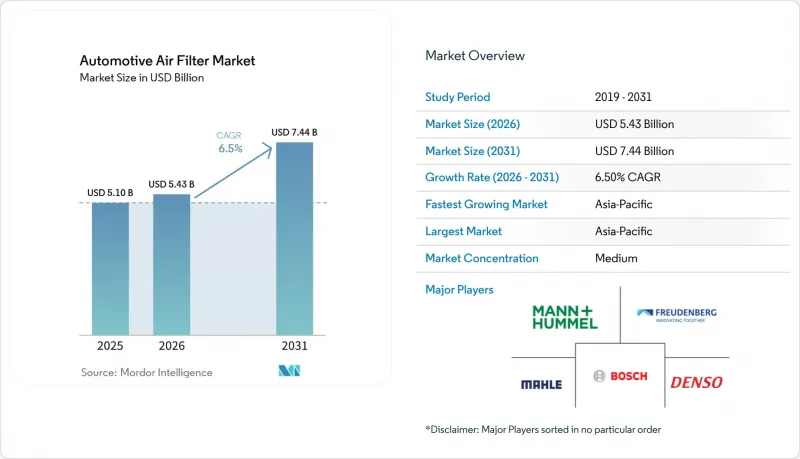
According to Mordor Intelligence, the automotive air filter market size was valued at USD 5.10 billion in 2025 and estimated to grow from USD 5.43 billion in 2026 to reach USD 7.44 billion by 2031, at a CAGR of 6.50% during the forecast period (2026-2031).
This report is Segmented by Product Type (Air-Intake Filters, Cabin Air Filters, and More), Filter Media (Cellulose, Synthetic/Melt-blown, and More), Vehicle Type (Passenger Cars, Light Commercial Vehicles, and More), Sales Channel (OEM Fitment, Aftermarket), and Geography (North America, South America, and More). Market Forecasts are Provided in Terms of Value (USD) and Volume (Units).
Global Automotive Air Filter Market Trends and Insights
Growing Global Vehicle Parc and Service-Interval Mileage
By 2025, the global light-vehicle parc reached a significant milestone. In OECD markets, average annual mileage stabilized, while in China, it showed higher levels. Turbo-diesel oil-change intervals extended further. However, air-filter replacements remained consistent due to engine-management alerts triggered by clogged elements. To address this, service providers began offering bundled "health kits" that combine air and cabin filters. This approach encourages motorists to replace both simultaneously, maintaining the replacement frequency even with the extended lubricant life.
Strict Emission and In-Cabin Air Quality Mandates
Euro 7, effective late 2026, caps particulate emissions at 4.5 mg/km for light-duty vehicles, pushing OEMs toward higher-efficiency air-intake elements to maintain catalyst temperatures. China's draft CN7 standard tightens NOx limits and mandates onboard diagnostics for filter clogging, pushing a quicker shift to low-pressure-drop synthetic media. In India, Bharat Stage VI Phase 2 now includes three-wheelers and tractors, expanding the compliance base. Meanwhile, in Germany, cabin-filter sales surged in 2025, despite a drop in measured PM2.5 levels, underscoring a perception gap driving the demand for premium filter upgrades.
Long-Life Synthetic Media Extending Replacement Intervals
Electro-charged melt-blown and nano-fiber layers now last significantly longer. Due to this innovation, vehicles now require fewer filter purchases over a standard lifespan . Although each premium filter element carries a heftier price, the surge in overall revenue has been muted. Traditionally, it's been the purchase frequency, not the price, that has fueled filter demand. Moreover, performance-centric washable products are dampening unit volumes, particularly among enthusiasts.
Other drivers and restraints analyzed in the detailed report include:
- Consumer Health Awareness in High-Pollution Megacities
- HEPA-Grade Filters Adopted by EV and Premium OEM Platforms
- Volatile Non-Woven and Activated-Carbon Prices
For complete list of drivers and restraints, kindly check the Table Of Contents.
Segment Analysis
Air-Intake Filters represented 55.12% of 2025 revenue, while cabin filters are projected to rise at 9.02% CAGR. The premiumization wave centers on nano-fiber media with an electrostatic charge that traps ultrafine particles without excessive pressure drop. In congested cities, ride-hailing fleets specify high-grade cabin filters as a service differentiator, making replacement sales less dependent on vehicle production cycles and more on health-oriented consumer behavior.
Turbocharged gasoline and diesel engines rely heavily on air-intake filters. Even a slight clog can reduce boost pressure and activate limp-home modes. However, as commoditization sets in, profit margins shrink. Conventional cellulose filters offer minimal profitability. While hybrid cellulose-carbon filters address odor issues in high-mileage fleets, the electrically enhanced ePM1 media remains priced above what the mainstream market will accept. Consequently, the automotive air filter market is turning to cabin components for revenue growth, a trend expected to continue through 2031.
Cellulose retained 44.25% of overall revenue in 2025 thanks to low cost and legacy OEM approvals, yet rising humidity-related degradation and stricter efficiency targets weigh on the outlook. Synthetic melt-blown media, currently a significant share of demand, offer extended life and better durability, making them the default for commercial diesel platforms operating in tropical climates. Activated-carbon composites held a notable share, driven by rising VOC concerns in India and China.
Nano-fiber and HEPA-grade layers will post the fastest growth at 10.86% CAGR through 2031. OEMs favor these materials for premium EVs because they achieve H13 performance without the airflow penalty of thicker cellulose mats. Suppliers respond by scaling electro-spinning lines and experimenting with bio-based polymers to hedge against polypropylene volatility. Hybrid constructions that blend 30% nano-fiber into cellulose show promise for mid-tier vehicles, offering near-HEPA efficiency at moderate cost. This pivot supports steady penetration into the automotive air filter market size, especially where regulators spotlight interior air quality.
Complete Report Scope:
- By Product Type
- Air-Intake Filters
- Cabin Air Filters
- Hybrid / Electrostatic Nano-fiber Filters
- Electrically-enhanced (ePM1) Filters
- By Filter Media
- Cellulose
- Synthetic/Melt-blown
- Activated-Carbon Composite
- Nano-fiber/HEPA Grade
- By Vehicle Type
- Passenger Cars
- Light Commercial Vehicles
- Medium and Heavy Commercial Vehicles
- By Sales Channel
- OEM Fitment
- Aftermarket
- By Geography
- North America
- United States
- Canada
- Rest of North America
- South America
- Brazil
- Argentina
- Rest of South America
- Europe
- Germany
- United Kingdom
- France
- Italy
- Spain
- Russia
- Rest of Europe
- Asia-Pacific
- China
- Japan
- India
- South Korea
- Australia and New Zealand
- Rest of Asia-Pacific
- Middle East and Africa
- United Arab Emirates
- Saudi Arabia
- Turkey
- South Africa
- Rest of Middle East and Africa
- North America
Geography Analysis
Asia-Pacific led with 39.12% of global revenue in 2025 and will expand at 7.55% CAGR to 2031. China's 469-million-unit parc and India's mass vehicle adoption underpin baseline demand, while Japan and South Korea elevate unit value through sensor-equipped cabin filters. Australia logged a bushfire-linked surge in HEPA retrofits during 2025, though volumes are expected to normalize.
In 2025, Europe was a significant contributor to the total revenue. While Euro 7 has set new performance benchmarks for intake filters, the adoption of HEPA filters in cabins remains predominantly with premium brands. In the United Kingdom and France, as new vehicle registrations plateau, the aging vehicle fleet continues to bolster aftermarket sales. Following sanctions, Russia has shifted its sourcing focus towards Chinese suppliers. North America also played a key role in the overall revenue. The United States, with its extensive vehicle fleet, drives significant aftermarket activity. However, this growth is moderated by extended OEM service intervals and an increasing preference for washable media. In Canada, similar trends are observed, but the country's harsher winters lead to more frequent changes of intake filters.
South America saw Brazil's Proconve L8 diesel regulation, which mandates two-stage intake filtration for heavy vehicles, play a pivotal role. While Argentina's economic challenges have dampened new vehicle sales, the country's aging fleet ensures consistent replacement cycles. The Middle East and Africa face unique challenges and opportunities. In the Gulf, dust conditions necessitate more frequent filter changes, while Turkey's adoption of the Euro 6d standard expands the market landscape. Despite a dip in vehicle sales, South Africa's established vehicle parc presents robust aftermarket prospects. Collectively, these regional dynamics highlight the diverse and resilient nature of the automotive air filter market.
- MANN+HUMMEL GmbH
- MAHLE GmbH
- Donaldson Company Inc.
- Robert Bosch GmbH
- Sogefi SpA
- Cummins Inc.
- DENSO Corporation
- Parker-Hannifin Corp.
- Ahlstrom-Munksjo (Ahlstrom)
- Freudenberg & Co. KG
- Hengst SE
- K&N Engineering Inc.
- Champion Laboratories Inc.
- Fram Group LLC
- Hollingsworth & Vose Co.
Additional Benefits:
- The market estimate (ME) sheet in Excel format
- 3 months of analyst support
TABLE OF CONTENTS
1 Introduction
- 1.1 Study Assumptions & Market Definition
- 1.2 Scope of the Study
2 Research Methodology
3 Executive Summary
4 Market Landscape
- 4.1 Market Overview
- 4.2 Market Drivers
- 4.2.1 Growing Global Vehicle Parc and Service-Interval Mileage
- 4.2.2 Strict Emission and In-Cabin Air Quality Mandates
- 4.2.3 Consumer Health Awareness in High-Pollution Megacities
- 4.2.4 HEPA-Grade Filters Adopted by EV and Premium OEM Platforms
- 4.2.5 Sensor-Activated Smart HVAC Filtration Modules
- 4.2.6 Predictive Fleet-Maintenance Algorithms Driving Filter Turnover
- 4.3 Market Restraints
- 4.3.1 Long-Life Synthetic Media Extending Replacement Intervals
- 4.3.2 Volatile Non-Woven and Activated-Carbon Prices
- 4.3.3 Sealed "Lifetime" Cabin-Filter Modules in Luxury EVs Reduce Aftermarket
- 4.3.4 Energy/Weight Penalty of Ultra-High-Efficiency Media in BEVs
- 4.4 Value/Supply-Chain Analysis
- 4.5 Porter's Five Forces
- 4.5.1 Threat of New Entrants
- 4.5.2 Bargaining Power of Buyers
- 4.5.3 Bargaining Power of Suppliers
- 4.5.4 Threat of Substitutes
- 4.5.5 Intensity of Rivalry
5 Market Size and Growth Forecasts (Value (USD) and Volume (Units))
- 5.1 By Product Type
- 5.1.1 Air-Intake Filters
- 5.1.2 Cabin Air Filters
- 5.1.3 Hybrid / Electrostatic Nano-fiber Filters
- 5.1.4 Electrically-enhanced (ePM1) Filters
- 5.2 By Filter Media
- 5.2.1 Cellulose
- 5.2.2 Synthetic/Melt-blown
- 5.2.3 Activated-Carbon Composite
- 5.2.4 Nano-fiber/HEPA Grade
- 5.3 By Vehicle Type
- 5.3.1 Passenger Cars
- 5.3.2 Light Commercial Vehicles
- 5.3.3 Medium and Heavy Commercial Vehicles
- 5.4 By Sales Channel
- 5.4.1 OEM Fitment
- 5.4.2 Aftermarket
- 5.5 By Geography
- 5.5.1 North America
- 5.5.1.1 United States
- 5.5.1.2 Canada
- 5.5.1.3 Rest of North America
- 5.5.2 South America
- 5.5.2.1 Brazil
- 5.5.2.2 Argentina
- 5.5.2.3 Rest of South America
- 5.5.3 Europe
- 5.5.3.1 Germany
- 5.5.3.2 United Kingdom
- 5.5.3.3 France
- 5.5.3.4 Italy
- 5.5.3.5 Spain
- 5.5.3.6 Russia
- 5.5.3.7 Rest of Europe
- 5.5.4 Asia-Pacific
- 5.5.4.1 China
- 5.5.4.2 Japan
- 5.5.4.3 India
- 5.5.4.4 South Korea
- 5.5.4.5 Australia and New Zealand
- 5.5.4.6 Rest of Asia-Pacific
- 5.5.5 Middle East and Africa
- 5.5.5.1 United Arab Emirates
- 5.5.5.2 Saudi Arabia
- 5.5.5.3 Turkey
- 5.5.5.4 South Africa
- 5.5.5.5 Rest of Middle East and Africa
- 5.5.1 North America
6 Competitive Landscape
- 6.1 Market Concentration
- 6.2 Strategic Moves (M&A, JV, and Capacity)
- 6.3 Market Share Analysis
- 6.4 Company Profiles (includes Global Level Overview, Market Level Overview, Core Segments, Financials as Available, Strategic Information, Market Rank/Share for Key Companies, Products and Services, SWOT Analysis, and Recent Developments)
- 6.4.1 MANN+HUMMEL GmbH
- 6.4.2 MAHLE GmbH
- 6.4.3 Donaldson Company Inc.
- 6.4.4 Robert Bosch GmbH
- 6.4.5 Sogefi SpA
- 6.4.6 Cummins Inc.
- 6.4.7 DENSO Corporation
- 6.4.8 Parker-Hannifin Corp.
- 6.4.9 Ahlstrom-Munksjo (Ahlstrom)
- 6.4.10 Freudenberg & Co. KG
- 6.4.11 Hengst SE
- 6.4.12 K&N Engineering Inc.
- 6.4.13 Champion Laboratories Inc.
- 6.4.14 Fram Group LLC
- 6.4.15 Hollingsworth & Vose Co.
7 Market Opportunities & Future Outlook
- 7.1 White-space & Unmet-need Assessment

