PUBLISHER: Mordor Intelligence | PRODUCT CODE: 2121437

PUBLISHER: Mordor Intelligence | PRODUCT CODE: 2121437
North America Canned Food Packaging - Market Share Analysis, Industry Trends & Statistics, Growth Forecasts (2026 - 2031)
According to Mordor Intelligence, the North America canned food packaging market size in 2026 is estimated at USD 9.38 billion, growing from 2025 value of USD 9.02 billion with 2031 projections showing USD 11.41 billion, growing at 3.99% CAGR over 2026-2031.
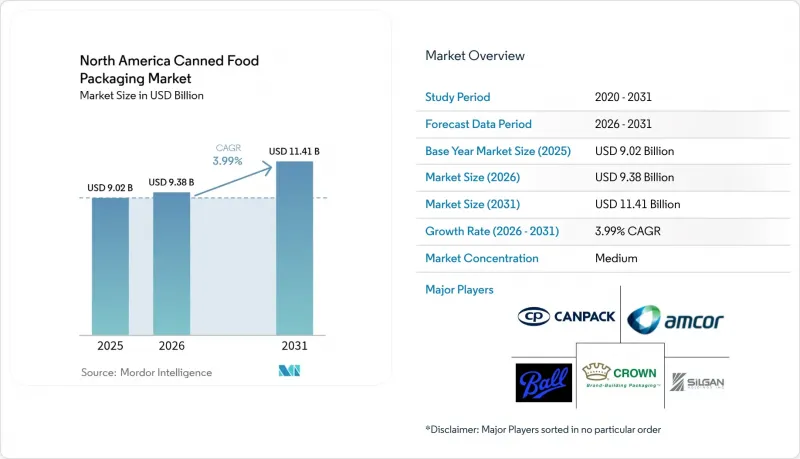
This report is Segmented by Material (Tinplate/Steel, Aluminium), Application (Ready-Made Meals, Meat, and More), Can Structure (2-Piece D&I Cans, 2-Piece DRD Cans, 3-Piece Welded Cans), Can Capacity (Up To 200 G, 201-500 G, 501-1000 G, Above 1000 G), and Geography (United States, Canada, Mexico). The Market Forecasts are Provided in Terms of Value (USD).
North America Canned Food Packaging Market Trends and Insights
Rising Consumption of Convenience and Ready-Made Meals
Ready-made meals already represent 28.95% of the North America canned food packaging market and continue to climb as workers balance hybrid schedules with limited cooking time. Mars is spending USD 2 billion on U.S. production through 2026, a figure that illustrates brand confidence in shelf-stable formats that allow streamlined distribution and year-long inventory cycles. Two-piece DRD lines added by Crown in Iowa and Minnesota shorten seaming steps, yielding sleeker cans that fit cup-holder-style niches popular in single-serve soups. FDA traceability rules are further motivating adop-tion of lot-coded ends that simplify recalls and reinforce consumer trust. Taken together, these dynamics keep the North America canned food packaging market firmly aligned with the convenience trend.
Sustainability Push for Infinitely-Recyclable Metal Cans
Aluminum's infinite recyclability resonates with state mandates in California, Ontario, and British Columbia that require high post-consumer content by 2028. Crown reports that roughly 80% of new beverage product launches now rely on aluminum, a signal that food portfolios will follow the same path as brand owners sync packaging choices with ESG metrics. Electrolit's USD 400 million Waco plant is designed for non-virgin substrates, illustrating how incoming capacity is future-proofed for circular-economy targets. Because metal can be remelted endlessly with no barrier loss, retailers use its credentials as an on-pack storytelling theme to justify premium shelf pricing. As regulations tighten, the sustainability moat strengthens, locking in long-run growth for the North America canned food packaging market.
Plastic Retort Pouches Displacing Mid-Size Food Cans
Lightweight flexible retort packs cut logistics costs by up to 30% compared with three-piece cans, attracting ready-meal brands that target urban millennials prioritizing portability. Retailers favor stand-up pouches, too, because each linear foot of shelf holds roughly 15% more SKUs than equivalent can facings, boosting category revenue density. Yet cans still prevail in 121 °C retort cycles where pouch delamination risk rises, and in value-pack formats where dent resistance matters during e-commerce fulfillment. Converters defend share by offering peel-off foil membranes and microwavable coatings that replicate pouch convenience. The contest limits, but does not reverse, volume growth for the North America canned food packaging market.
Other drivers and restraints analyzed in the detailed report include:
- Surge in Pet-Food Canning Capacity Across U.S. and Canada
- Retailer Private-Label Expansion in Canned Categories
- Tinplate and Aluminum Price Volatility Squeezing Converters
For complete list of drivers and restraints, kindly check the Table Of Contents.
Segment Analysis
Aluminum garnered 54.12% of North America canned food packaging market share in 2025 and is expanding at a 5.18% CAGR as brands highlight closed-loop recovery rates exceeding 70%. The substrate's light weight slashes freight emissions and its bright surface supports high-definition printing that elevates shelf appeal. Steel remains indispensable for bulk tomato paste and institutional soup packs, especially Sizes #10 and #300, yet Section 232 tariffs have tilted cost curves, nudging mainstream processors toward aluminum ends even on steel bodies.
Innovation furthers aluminum uptake: alloy refinements let mills roll gauges down to 0.205 mm without pinhole risk, yielding an immediate 6% metal saving per can. Nestle's La Choy line adopted this thin wall in 2025, cutting annual metal needs by 1,200 tons. As state deposit programs add multipliers for containers with>70% recycled content, can makers that leverage used-beverage-can (UBC) feedstock can gain cost insurance. These fundamentals secure aluminum's top slot in the North America canned food packaging market.
Ready-made meals commanded a 28.61% share of the North America canned food packaging market in 2025 as time-starved households embraced heat-and-eat kits that eliminate perishability concerns. Brand owners cooperated with converters to roll out integrated easy-open ends and microwave-safe lacquers that shorten prep to under two minutes.
Soups and broths, while smaller, are growing quickest at 5.51% CAGR on the strength of premium bone broths that retail above USD 4.25 per 14 oz can. Large pull tabs and matte varnishes reinforce artisan cues even in mass grocery, widening price bandwidth. The North America canned food packaging market size for soup alone is projected to reach USD 1.82 billion by 2031, reflecting steady cold-weather consumption patterns and category reinvention around global flavors.
Complete Report Scope:
- By Material
- Tinplate/Steel
- Aluminium
- By Application
- Ready-made Meals
- Meat
- Sea Food
- Pet Food
- Fruits and Vegetables
- Soups and Broths
- Dairy and Infant Nutrition
- Other Applications
- By Can Structure
- 2-Piece D&I Cans
- 2-Piece DRD Cans
- 3-Piece Welded Cans
- By Can Capacity
- Up to 200 g
- 201 - 500 g
- 501 - 1000 g
- Above 1 000 g
- By Country
- United States
- Canada
- Mexico
List of Companies Covered in this Report:
- Amcor plc
- Crown Holdings, Inc.
- Ball Corporation
- CANPACK S.A.
- Silgan Holdings Inc.
- Sonoco Products Company
- Trivium Packaging B.V.
- Ardagh Group S.A.
- CCL Industries Inc.
- Wells Can Company Ltd.
- Independent Can Company
- Container Supply Company, Inc.
- Allstate Can Corporation
- Ideal Can Inc.
- Toyo Seikan Group Holdings, Ltd.
- Mauser Packaging Solutions Holding Company
- ArcelorMittal S.A. - Packaging Steel
- Tata Steel Ltd. - Packaging Steel
- United States Steel Corporation - Packaging
- Novelis Inc.
Additional Benefits:
- The market estimate (ME) sheet in Excel format
- 3 months of analyst support
TABLE OF CONTENTS
1 INTRODUCTION
- 1.1 Study Assumptions and Market Definition
- 1.2 Scope of the Study
2 RESEARCH METHODOLOGY
3 EXECUTIVE SUMMARY
4 MARKET LANDSCAPE
- 4.1 Market Overview
- 4.2 Market Drivers
- 4.2.1 Rising consumption of convenience and ready-made meals
- 4.2.2 Sustainability push for infinitely-recyclable metal cans
- 4.2.3 Surge in pet-food canning capacity across U.S. and Canada
- 4.2.4 Retailer private-label expansion in canned categories
- 4.2.5 On-shoring of metal-can production to avoid Section-232 tariffs
- 4.2.6 OEM demand for QR-coded smart cans enabling traceability
- 4.3 Market Restraints
- 4.3.1 Plastic retort pouches displacing mid-size food cans
- 4.3.2 Tinplate and aluminium price volatility squeezing converters
- 4.3.3 Regulatory uncertainty around BPA-replacement chemistries
- 4.3.4 Labour shortages at North-American can-making plants
- 4.4 Industry Value Chain Analysis
- 4.5 Porter's Five Forces Analysis
- 4.5.1 Threat of New Entrants
- 4.5.2 Bargaining Power of Consumers
- 4.5.3 Bargaining Power of Suppliers
- 4.5.4 Threat of Substitute Products
- 4.5.5 Intensity of Competitive Rivalry
- 4.6 Impact of Macroeconomic Factors on the Market
- 4.7 Regulatory Landscape
- 4.8 Technological Outlook
- 4.9 Investment Analysis
5 MARKET SIZE AND GROWTH FORECASTS (VALUE)
- 5.1 By Material
- 5.1.1 Tinplate/Steel
- 5.1.2 Aluminium
- 5.2 By Application
- 5.2.1 Ready-made Meals
- 5.2.2 Meat
- 5.2.3 Sea Food
- 5.2.4 Pet Food
- 5.2.5 Fruits and Vegetables
- 5.2.6 Soups and Broths
- 5.2.7 Dairy and Infant Nutrition
- 5.2.8 Other Applications
- 5.3 By Can Structure
- 5.3.1 2-Piece D&I Cans
- 5.3.2 2-Piece DRD Cans
- 5.3.3 3-Piece Welded Cans
- 5.4 By Can Capacity
- 5.4.1 Up to 200 g
- 5.4.2 201 - 500 g
- 5.4.3 501 - 1000 g
- 5.4.4 Above 1 000 g
- 5.5 By Country
- 5.5.1 United States
- 5.5.2 Canada
- 5.5.3 Mexico
6 COMPETITIVE LANDSCAPE
- 6.1 Market Concentration
- 6.2 Strategic Moves
- 6.3 Market Share Analysis
- 6.4 Company Profiles (includes Global level Overview, Market level overview, Core Segments, Financials as available, Strategic Information, Market Rank/Share for key companies, Products and Services, and Recent Developments)
- 6.4.1 Amcor plc
- 6.4.2 Crown Holdings, Inc.
- 6.4.3 Ball Corporation
- 6.4.4 CANPACK S.A.
- 6.4.5 Silgan Holdings Inc.
- 6.4.6 Sonoco Products Company
- 6.4.7 Trivium Packaging B.V.
- 6.4.8 Ardagh Group S.A.
- 6.4.9 CCL Industries Inc.
- 6.4.10 Wells Can Company Ltd.
- 6.4.11 Independent Can Company
- 6.4.12 Container Supply Company, Inc.
- 6.4.13 Allstate Can Corporation
- 6.4.14 Ideal Can Inc.
- 6.4.15 Toyo Seikan Group Holdings, Ltd.
- 6.4.16 Mauser Packaging Solutions Holding Company
- 6.4.17 ArcelorMittal S.A. - Packaging Steel
- 6.4.18 Tata Steel Ltd. - Packaging Steel
- 6.4.19 United States Steel Corporation - Packaging
- 6.4.20 Novelis Inc.
7 MARKET OPPORTUNITIES AND FUTURE OUTLOOK
- 7.1 White-space and Unmet-Need Assessment

