PUBLISHER: Mordor Intelligence | PRODUCT CODE: 2121461

PUBLISHER: Mordor Intelligence | PRODUCT CODE: 2121461
United States Frozen Food Packaging - Market Share Analysis, Industry Trends & Statistics, Growth Forecasts (2026 - 2031)
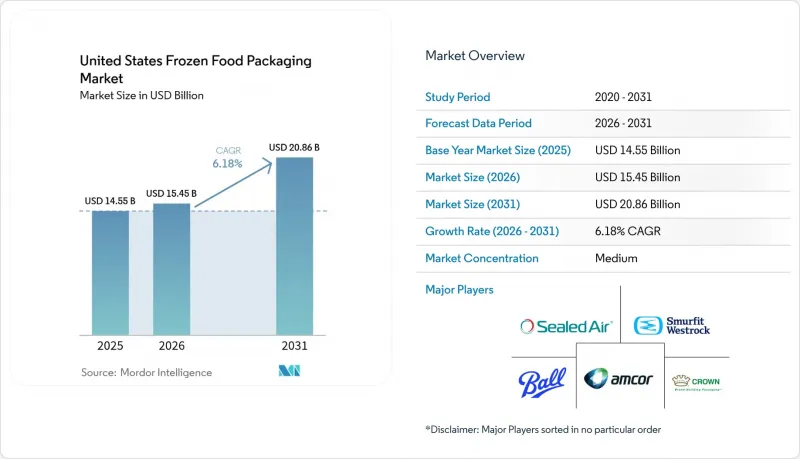
According to Mordor Intelligence, the United States frozen food packaging market size is expected to grow from USD 14.55 billion in 2025 to USD 15.45 billion in 2026 and is forecast to reach USD 20.86 billion by 2031 at 6.18% CAGR over 2026-2031.
This report is Segmented by Material (Plastic, Metal, and More), Packaging Format (Flexible, and Rigid), Packaging Product (Bags and Pouches, Trays, and More), Food Product Type (Ready Meals, Fruits and Vegetables, Meat, Seafood, and More), and Packaging Technology (Modified Atmosphere Packaging, Vacuum Packaging, and More). The Market Forecasts are Provided in Terms of Value (USD).
United States Frozen Food Packaging Market Trends and Insights
Rising Consumer Demand for Convenient Heat-and-Eat Formats
Microwaveable and oven-ready meals accounted for 62% of new frozen product launches in 2024, up from 48% two years prior. Dual-ovenable CPET trays endure 425 °F for 40 minutes, supporting premium positioning and faster shelf turns. Single-serve packs under 12 ounces grew 19% in unit volume in 2024, three times faster than family-size alternatives, reinforcing the need for packaging formats that stack vertically and minimize freezer cube waste. Retailers report that heat-and-eat SKUs cycle 1.7 times faster than conventional entrees, incentivizing shelf re-allocation to tray-based lines. Converters able to supply CPET and coated-paperboard hybrids enjoy pricing power despite the substrate's 35% cost premium.
Growth of Direct-to-Consumer Frozen Meal Subscriptions
D2C frozen meal sales climbed to USD 2.8 billion in 2024, a 23% jump from 2023. These services bypass store freezers, requiring insulated shippers that maintain temperatures between -10 °F and 10 °F for 48 hours. Korrvu suspension pouches from Sealed Air reduce breakage rates to below 2%, enhancing brand reputation and minimizing returns. Right-sizing initiatives shave USD 1.20-1.80 off excess freight per order, which is critical when D2C gross margins hover near 12-15%. USDA regulations further require tamper-evident seals and freeze-by dating, adding complexity that only converters with digital printing and quality control systems can manage efficiently.
PFAS and Single-Use Plastics Regulatory Crackdowns
California's AB 1200 bans PFAS in food packaging by 2028, while Maine's LD 1541 imposes a similar prohibition by 2030. Converters relying on fluorinated grease barriers must reformulate or exit a USD 680 million microwaveable-tray niche. FDA's voluntary phase-out of long-chain PFAS, announced in 2024, accelerates compliance deadlines. Bio-based alternatives derived from algae and chitosan currently lag CPET-grade grease resistance by 15-20%, adding USD 0.08-0.12 per tray. Smaller regional converters have begun to exit the category, citing USD 2-4 million in reformulation costs per product line.
Other drivers and restraints analyzed in the detailed report include:
- Surge in Plant-Based Frozen Entrees Requiring Specialized Films
- Retailer Private-Label Expansion Driving High-Volume Flexible Packaging
- Volatile Resin Prices Compressing Converter Margins
For complete list of drivers and restraints, kindly check the Table Of Contents.
Segment Analysis
Paper and paperboard are projected to advance at a 7.35% CAGR to 2031, outpacing all other substrates, as Walmart and Target incorporate curbside-recyclable requirements into their 2025 supplier contracts. Graphic Packaging logged a 16% year-over-year rise in frozen-food paperboard shipments during 2024, underscoring volume momentum. Amcor's AmFiber paper tray, launched in late 2024, withstands freezer conditions and microwave reheating without a polyethylene laminate, helping brands secure retailer sustainability credits. Plastic maintained a 46.15% share of the United States frozen food packaging market in 2025, yet its growth has moderated. The United States frozen food packaging market size for plastic is expected to inch forward at a mid-single-digit rate as PFAS bans and mono-material demands accelerate capital spending. Metal cans remain relegated to frozen juice concentrates and institutional vegetables, while glass is nearly absent due to weight and breakage risks.
Plastic's dominance persists because mono-PE pouches achieve sub-1 cc/m2-day oxygen transmission rates at half the weight of coated board, favoring applications such as frozen fruits and single-serve entrees. Nevertheless, fiber trays now qualify for municipality curbside programs in 72% of U.S. ZIP codes, improving end-of-life economics for retailers. Converters must juggle a wider substrate slate, often stocking six platforms versus three a decade ago, which raises working-capital burdens but also permits tailored solutions that match product viscosity, headspace, and reheat method.
Flexible structures held a 54.10% share in 2025, driven by high-speed horizontal FFS lines that reduce labor costs by 22%. These lines fill 180 pouches per minute for vegetables and 100 for chunky entree fillings, driving a 6.9% CAGR for flexibles through 2031. Sealed Air's recyclable PE pouch won Association of Plastic Recyclers recognition in 2024 and unlocked distribution at Walmart by enabling How2Recycle labeling. Rigid packaging format retained a 45.90% share, supported by the oven-ready performance required in premium entrees.
While rigid formats expand at a slower rate, innovations such as Sabert's pulp-based post-consumer recycled (PCR) polypropylene tray reduce carbon footprint by 28%, softening sustainability concerns. Flexible pouches improve pallet cube efficiency by 18% and shrink blast-freezer energy use by 11%. Yet they require outer corrugated cases for pallet stability, adding USD 0.06-0.09 per unit. Trays self-stack, cutting secondary-packaging costs but sacrificing shipping density. The divergence means that high-velocity value lines lean toward pouches, whereas premium SKUs priced above USD 6.50 per unit continue to favor ridged CPET or PCR-PP trays, which communicate quality through their heft.
Complete Report Scope:
- By Material
- Plastic
- Paper and Paperboard
- Metal
- Glass
- By Packaging Format
- Flexible
- Rigid
- By Packaging Product
- Bags and Pouches
- Trays
- Cans
- Other Packaging Products
- By Food Product Type
- Ready Meals
- Fruits and Vegetables
- Meat
- Sea Food
- Other Food Product Types
- By Packaging Technology
- Modified Atmosphere Packaging (MAP)
- Vacuum Packaging
- Intelligent / Active Packaging
- Other Packaging Technologies
List of Companies Covered in this Report:
- Amcor Plc
- Pactiv Evergreen Inc.
- Sealed Air Corporation
- Smurfit WestRock
- Crown Holdings Inc.
- Ball Corporation
- Graphic Packaging Holding Company
- Genpak LLC
- Printpack Inc.
- Novolex Holdings LLC
- Tetra Pak International SA
- Cascades Inc.
- Sonoco Products Company
- Sabert Corporation
- Mondi plc
- Coveris Holdings SA
- Huhtamaki Oyj
- Silgan Holdings Inc.
Additional Benefits:
- The market estimate (ME) sheet in Excel format
- 3 months of analyst support
TABLE OF CONTENTS
1 INTRODUCTION
- 1.1 Study Assumptions and Market Definition
- 1.2 Scope of the Study
2 RESEARCH METHODOLOGY
3 EXECUTIVE SUMMARY
4 MARKET LANDSCAPE
- 4.1 Market Overview
- 4.2 Market Drivers
- 4.2.1 Rising Consumer Demand for Convenient Heat-and-Eat Formats
- 4.2.2 Growth of Direct-to-Consumer Frozen Meal Subscriptions
- 4.2.3 Surge in Plant-Based Frozen Entrees Requiring Specialized Films
- 4.2.4 Retailer Private-Label Expansion Driving High-Volume Flexible Packaging
- 4.2.5 Intelligent Time-Temperature Indicator Labels for Cold-Chain Integrity
- 4.2.6 Automation of Pouch and Bag Form/Fill/Seal Lines Reducing Cost per Unit
- 4.3 Market Restraints
- 4.3.1 PFAS and Single-Use Plastics Regulatory Crackdowns
- 4.3.2 Volatile Resin Prices Compressing Converter Margins
- 4.3.3 Limited Curbside Recyclability of Multi-Layer Films
- 4.3.4 Capital-Intensive Shift Toward Recyclable Mono-Material Structures
- 4.4 Industry Value Chain Analysis
- 4.5 Regulatory Landscape
- 4.6 Technological Outlook
- 4.7 Impact of Macroeconomic Factors on the Market
- 4.8 Porter's Five Forces Analysis
- 4.8.1 Threat of New Entrants
- 4.8.2 Bargaining Power of Buyers
- 4.8.3 Bargaining Power of Suppliers
- 4.8.4 Threat of Substitute Products
- 4.8.5 Intensity of Competitive Rivalry
5 MARKET SIZE AND GROWTH FORECASTS (VALUE)
- 5.1 By Material
- 5.1.1 Plastic
- 5.1.2 Paper and Paperboard
- 5.1.3 Metal
- 5.1.4 Glass
- 5.2 By Packaging Format
- 5.2.1 Flexible
- 5.2.2 Rigid
- 5.3 By Packaging Product
- 5.3.1 Bags and Pouches
- 5.3.2 Trays
- 5.3.3 Cans
- 5.3.4 Other Packaging Products
- 5.4 By Food Product Type
- 5.4.1 Ready Meals
- 5.4.2 Fruits and Vegetables
- 5.4.3 Meat
- 5.4.4 Sea Food
- 5.4.5 Other Food Product Types
- 5.5 By Packaging Technology
- 5.5.1 Modified Atmosphere Packaging (MAP)
- 5.5.2 Vacuum Packaging
- 5.5.3 Intelligent / Active Packaging
- 5.5.4 Other Packaging Technologies
6 COMPETITIVE LANDSCAPE
- 6.1 Market Concentration
- 6.2 Strategic Moves
- 6.3 Market Share Analysis
- 6.4 Company Profiles (includes Global Level Overview, Market Level Overview, Core Segments, Financials as available, Strategic Information, Market Rank/Share for Key Companies, Products and Services, and Recent Developments)
- 6.4.1 Amcor Plc
- 6.4.2 Pactiv Evergreen Inc.
- 6.4.3 Sealed Air Corporation
- 6.4.4 Smurfit WestRock
- 6.4.5 Crown Holdings Inc.
- 6.4.6 Ball Corporation
- 6.4.7 Graphic Packaging Holding Company
- 6.4.8 Genpak LLC
- 6.4.9 Printpack Inc.
- 6.4.10 Novolex Holdings LLC
- 6.4.11 Tetra Pak International SA
- 6.4.12 Cascades Inc.
- 6.4.13 Sonoco Products Company
- 6.4.14 Sabert Corporation
- 6.4.15 Mondi plc
- 6.4.16 Coveris Holdings SA
- 6.4.17 Huhtamaki Oyj
- 6.4.18 Silgan Holdings Inc.
7 MARKET OPPORTUNITIES AND FUTURE OUTLOOK
- 7.1 White-Space and Unmet-Need Assessment

