PUBLISHER: Mordor Intelligence | PRODUCT CODE: 2121464

PUBLISHER: Mordor Intelligence | PRODUCT CODE: 2121464
Chemical Sensors - Market Share Analysis, Industry Trends & Statistics, Growth Forecasts (2026 - 2031)
According to Mordor Intelligence, the chemical sensors market size in 2026 is estimated at USD 28.86 billion, growing from 2025 value of USD 27.26 billion with 2031 projections showing USD 38.36 billion, growing at 5.86% CAGR over 2026-2031.
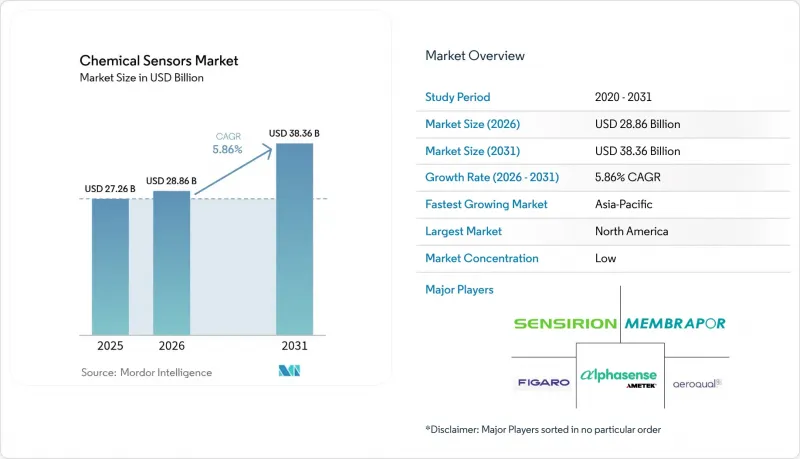
This report is Segmented by Product Type (Electrochemical Sensors, Optical Sensors, and More), Technology (CMOS-Integrated Sensors, MEMS-Based Sensors, and More), Application (Environmental Monitoring, Medical Diagnostics, Automotive Emissions and Cabin Air, and More), Analyte Phase (Gas Phase, Liquid Phase, and Solid Phase), and Geography. The Market Forecasts are Provided in Terms of Value (USD).
Global Chemical Sensors Market Trends and Insights
Stringent Environmental Regulations Driving Demand For Industrial Gas Detection
Revisions to the U.S. National Ambient Air Quality Standards in 2024 lowered the annual PM2.5 limit, obliging facilities to install multi-gas monitors that stream electrochemical sulfur-dioxide and nitrogen-dioxide data in real time. The European Union amended its Industrial Emissions Directive the same year, forcing chemical plants over 100 tonnes throughput to publish near-continuous volatile-organic-compound readouts. China expanded its ambient network to 1,800 stations by mid-2025 and each site runs ozone, carbon-monoxide, and nitrogen-oxides cells that collectively created a USD 400 million procurement pool. India's Central Pollution Control Board mandated Source Emission Monitoring Systems for thermal plants, which spurred a 31% YoY spike in sensor shipments during early 2025. Refineries swapping catalytic-bead elements for infrared heads have cut false alarms by 40% and doubled calibration intervals, reinforcing this regulatory tailwind.
Growing Adoption Of Miniaturized Electrochemical Sensors In Medical Diagnostics
The U.S. FDA cleared seven new point-of-care electrochemical platforms in 2024 that shrink form factors under 15 mm, opening hospital and at-home use cases. Abbott's FreeStyle Libre posted USD 5.3 billion revenue in 2024, up 21% YoY, underscoring reimbursement-led diffusion of amperometric glucose oxidase stacks. Sensirion introduced a 10 mm-square carbon-dioxide cell in March 2025 that fits ventilator circuits at one-third the cost of infrared alternatives. Europe's In Vitro Diagnostic Regulation tightened detection-limit rules in May 2024, prompting nanostructured electrodes that drop lactate thresholds below 1 µM. Screen-printed sweat-lactate patches launched for endurance athletes in 2024 and already measure 2-25 mM ranges on the fly.
Calibration And Maintenance Costs Limit Adoption In Cost-Sensitive Industries
Field calibration every 90-180 days costs USD 150-300 per instrument and quickly eclipses hardware outlays over a five-year run. A 2024 survey of 340 food processors pegged annual upkeep at USD 18,000 per site, 2.8 times capex, discouraging broader coverage. Warehousing operators running net margins below 5% favor handheld spot checks over continuous monitors because service contracts strain budgets. NFPA eased residential carbon-monoxide detector intervals to seven-year cycles in 2025, but industrial units remain on quarterly schedules, cementing this cost divide.
Other drivers and restraints analyzed in the detailed report include:
- Expansion Of Industrial Automation And Process Safety Systems
- Emergence Of Flexible Printed Chemical Sensors For Disposable IoT Devices
- Sensor Drift And Limited Lifespan Affect Long-Term Reliability
For complete list of drivers and restraints, kindly check the Table Of Contents.
Segment Analysis
Electrochemical cells captured 32.31% of 2025 revenue and remain the preferred route for hydrogen-sulfide, carbon-monoxide, and nitrogen-dioxide alarms in refineries and wastewater plants. Optical devices are expanding at a 6.98% CAGR through 2031 as operators migrate toward non-dispersive infrared heads that extend maintenance intervals beyond 24 months.
Catalytic-bead sensors, once a staple for combustible gas, are slipping below 17.60% share because intrinsic-safety rules encourage ignition-free optics. Semiconductor metal-oxide devices, now 21.70% of demand, dominate budget indoor-air applications where sub-USD 5 price points matter. Infrared spectroscopy upgrades in natural-gas pipeline inspection push parts-per-billion methane detection and are a key reason optical traction is accelerating. U.S. methane-reduction incentives add a USD 280 million annual pull for these modules. Electrochemical single-gas badges still rule personal protective gear because electrolyte depletion drives repeat sales and predictable replacement cycles, keeping the chemical sensors market robust in consumables revenue.
MEMS variants delivered 27.02% of 2025 revenue by slipping sensing elements and mixed-signal ASICs onto 5 mm silicon dies. Wafer-level packaging slashes assembly overhead and has pulled retail air-quality monitors under USD 50. Printed and flexible formats are logging a 6.86% CAGR as roll-to-roll gravure drops unit cost to USD 0.10 for single-use biosensing strips, opening new frontiers in athletics and decentralized medicine.
CMOS-integrated units, currently 18.70% share, add on-chip calibration that pares bill-of-materials by 30%. Infrared blocks represent about 20.80% of demand, serving HVAC, incubators, and greenhouses where optical lifetime exceeds a decade. Surface-acoustic-wave lines, roughly 12.80% share, stay in niche defense roles for chemical warfare agent alerts, but standardization work on shock and vibration tests is making them more attractive in transport safety. ISO 27891 now requires MEMS gas chips to survive 1,500 g shock with no drift, a hurdle most mainline suppliers have cleared, shoring up confidence in automotive and industrial buyers.
Complete Report Scope:
- By Product Type
- Electrochemical Sensors
- Optical Sensors
- Pellistor/Catalytic Bead Sensors
- Semiconductor Sensors
- Other Product Type
- By Technology
- CMOS-Integrated Sensors
- MEMS-Based Sensors
- NDIR and Infrared Sensors
- SAW and Acoustic Sensors
- Printed/Flexible Sensors
- By Application
- Industrial Safety and Process Control
- Environmental Monitoring
- Medical Diagnostics
- Automotive Emissions and Cabin Air
- Oil and Gas Exploration and Refining
- Homeland Security and Defense
- Other Application
- By Analyte Phase
- Gas Phase
- Liquid Phase
- Solid Phase
- By Geography
- North America
- United States
- Canada
- Mexico
- Europe
- Germany
- United Kingdom
- France
- Italy
- Rest of Europe
- Asia-Pacific
- China
- Japan
- India
- South Korea
- Australia
- Rest of Asia-Pacific
- Middle East and Africa
- Middle East
- Saudi Arabia
- United Arab Emirates
- Rest of Middle East
- Africa
- South Africa
- Egypt
- Rest of Africa
- Middle East
- South America
- Brazil
- Argentina
- Rest of South America
- North America
Geography Analysis
North America generated 46.55% of 2025 revenue, a lead built on strict OSHA confined-space laws and Medicare expansion that added 3.2 million glucose-monitoring beneficiaries. The 2024 PM2.5 standard drove a USD 340 million sensor retrofit wave, and Canada earmarked CAD 180 million (USD 133 million) to extend ozone and particulate networks into remote communities.
Europe contributed 27.98% of sales; its shift to Euro 7 exhaust norms mandates +-10% accuracy across -40-85 °C, generating steady orders for electrochemical and solid-state stacks. Germany carved EUR 500 million (USD 565 million) for hydrogen stations that each need redundant sub-second detectors, while the United Kingdom cut the formaldehyde limit to 0.3 ppm, spurring upgrades across laboratories.
Asia-Pacific is projected to outpace all regions at a 6.88% CAGR through 2031. China's 1,800-node air network and factory VOC rules, India's Source Emission Monitoring rollout, and Japan's hydrogen-fuel road map combine to unlock multi-billion-dollar tenders. South Korea's semiconductor VOC law adds another USD 85 million annual pull. Middle East and Africa and South America remain smaller slices but are moving toward national gas-pipeline safety laws that hinge on infrared methane trackers, creating long-tail opportunities for local integrators.
- Alphasense Limited
- Figaro Engineering Inc.
- Membrapor AG
- Sensirion AG
- Aeroqual Limited
- SGX Sensortech Limited
- Nemoto & Co., Ltd.
- SPEC Sensors, LLC
- Sensitron S.r.l.
- NTM Sensors
- Dynament Limited
- City Technology Limited
- Gas Sensing Solutions Ltd.
- Zhengzhou Winsen Electronics Technology Co., Ltd.
- Sensorix GmbH
- DD-Scientific Ltd.
- SST Sensing Ltd.
- Crowcon Detection Instruments Limited
- PureAire Monitoring Systems, Inc.
- Aeroqual Limited (repeat for completeness)
Additional Benefits:
- The market estimate (ME) sheet in Excel format
- 3 months of analyst support
TABLE OF CONTENTS
1 INTRODUCTION
- 1.1 Study Assumptions and Market Definition
- 1.2 Scope of the Study
2 RESEARCH METHODOLOGY
3 EXECUTIVE SUMMARY
4 MARKET LANDSCAPE
- 4.1 Market Overview
- 4.2 Impact of Macroeconomic Factors
- 4.3 Industry Value Chain Analysis
- 4.4 Regulatory Landscape
- 4.5 Technological Outlook
- 4.6 Market Drivers
- 4.6.1 Stringent Environmental Regulations Driving Demand For Industrial Gas Detection
- 4.6.2 Growing Adoption Of Miniaturized Electrochemical Sensors In Medical Diagnostics
- 4.6.3 Expansion Of Industrial Automation And Process Safety Systems
- 4.6.4 Emergence Of Flexible Printed Chemical Sensors for Disposable IoT Devices
- 4.6.5 Integration Of Chemical Sensors into Hydrogen Infrastructure Safety Systems
- 4.6.6 Rapid Proliferation Of Indoor Air Quality Mandates In Commercial Real Estate
- 4.7 Market Restraints
- 4.7.1 Calibration And Maintenance Costs Limit Adoption In Cost-Sensitive Industries
- 4.7.2 Sensor Drift And Limited Lifespan Affect Long-Term Reliability
- 4.7.3 Supply Chain Bottlenecks For Specialty Electrochemical Catalysts
- 4.7.4 Data Governance Concerns Slowing Deployment Of Cloud-Connected Sensors
- 4.8 Porter's Five Forces Analysis
- 4.8.1 Threat of New Entrants
- 4.8.2 Bargaining Power of Buyers
- 4.8.3 Bargaining Power of Suppliers
- 4.8.4 Threat of Substitutes
- 4.8.5 Competitive Rivalry
5 MARKET SIZE AND GROWTH FORECASTS (VALUE)
- 5.1 By Product Type
- 5.1.1 Electrochemical Sensors
- 5.1.2 Optical Sensors
- 5.1.3 Pellistor/Catalytic Bead Sensors
- 5.1.4 Semiconductor Sensors
- 5.1.5 Other Product Type
- 5.2 By Technology
- 5.2.1 CMOS-Integrated Sensors
- 5.2.2 MEMS-Based Sensors
- 5.2.3 NDIR and Infrared Sensors
- 5.2.4 SAW and Acoustic Sensors
- 5.2.5 Printed/Flexible Sensors
- 5.3 By Application
- 5.3.1 Industrial Safety and Process Control
- 5.3.2 Environmental Monitoring
- 5.3.3 Medical Diagnostics
- 5.3.4 Automotive Emissions and Cabin Air
- 5.3.5 Oil and Gas Exploration and Refining
- 5.3.6 Homeland Security and Defense
- 5.3.7 Other Application
- 5.4 By Analyte Phase
- 5.4.1 Gas Phase
- 5.4.2 Liquid Phase
- 5.4.3 Solid Phase
- 5.5 By Geography
- 5.5.1 North America
- 5.5.1.1 United States
- 5.5.1.2 Canada
- 5.5.1.3 Mexico
- 5.5.2 Europe
- 5.5.2.1 Germany
- 5.5.2.2 United Kingdom
- 5.5.2.3 France
- 5.5.2.4 Italy
- 5.5.2.5 Rest of Europe
- 5.5.3 Asia-Pacific
- 5.5.3.1 China
- 5.5.3.2 Japan
- 5.5.3.3 India
- 5.5.3.4 South Korea
- 5.5.3.5 Australia
- 5.5.3.6 Rest of Asia-Pacific
- 5.5.4 Middle East and Africa
- 5.5.4.1 Middle East
- 5.5.4.1.1 Saudi Arabia
- 5.5.4.1.2 United Arab Emirates
- 5.5.4.1.3 Rest of Middle East
- 5.5.4.2 Africa
- 5.5.4.2.1 South Africa
- 5.5.4.2.2 Egypt
- 5.5.4.2.3 Rest of Africa
- 5.5.4.1 Middle East
- 5.5.5 South America
- 5.5.5.1 Brazil
- 5.5.5.2 Argentina
- 5.5.5.3 Rest of South America
- 5.5.1 North America
6 COMPETITIVE LANDSCAPE
- 6.1 Market Concentration
- 6.2 Strategic Moves
- 6.3 Market Share Analysis
- 6.4 Company Profiles (includes Global Level Overview, Market Level Overview, Core Segments, Financials as Available, Strategic Information, Market Rank/Share for Key Companies, Products and Services, and Recent Developments)
- 6.4.1 Alphasense Limited
- 6.4.2 Figaro Engineering Inc.
- 6.4.3 Membrapor AG
- 6.4.4 Sensirion AG
- 6.4.5 Aeroqual Limited
- 6.4.6 SGX Sensortech Limited
- 6.4.7 Nemoto & Co., Ltd.
- 6.4.8 SPEC Sensors, LLC
- 6.4.9 Sensitron S.r.l.
- 6.4.10 NTM Sensors
- 6.4.11 Dynament Limited
- 6.4.12 City Technology Limited
- 6.4.13 Gas Sensing Solutions Ltd.
- 6.4.14 Zhengzhou Winsen Electronics Technology Co., Ltd.
- 6.4.15 Sensorix GmbH
- 6.4.16 DD-Scientific Ltd.
- 6.4.17 SST Sensing Ltd.
- 6.4.18 Crowcon Detection Instruments Limited
- 6.4.19 PureAire Monitoring Systems, Inc.
- 6.4.20 Aeroqual Limited (repeat for completeness)
7 MARKET OPPORTUNITIES AND FUTURE OUTLOOK
- 7.1 White-Space and Unmet-Need Assessment

