PUBLISHER: Mordor Intelligence | PRODUCT CODE: 2121466

PUBLISHER: Mordor Intelligence | PRODUCT CODE: 2121466
Document Management Systems - Market Share Analysis, Industry Trends & Statistics, Growth Forecasts (2026 - 2031)
According to Mordor Intelligence, the document management systems market size is projected to expand from USD 10.48 billion in 2025 and USD 11.81 billion in 2026 to USD 21.39 billion by 2031, registering a CAGR of 12.61% between 2026 to 2031.
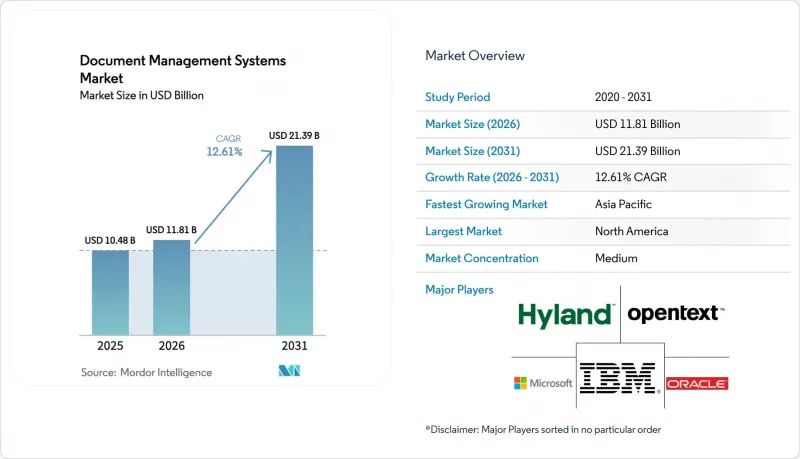
This report is Segmented by Component (Software, and Services), Deployment Mode (Cloud, and On-Premise), End-User Industry (Banking and Financial Services, Manufacturing and Construction, and More), and Geography (North America, South America, Europe, Asia Pacific, Middle East, Africa). The Market Forecasts are Provided in Terms of Value (USD).
Global Document Management Systems Market Trends and Insights
Rapid Shift Toward Paper-Free Processes
Government mandates are accelerating digital conversion far faster than voluntary sustainability initiatives. The U.S. National Archives requires every federal agency to digitize permanent records by December 2026. Japan's Digital Agency ordered all prefectures to adopt paperless workflows by April 2025, triggering a 35% jump in procurements. Canon processed 18 billion pages through its cloud-scanning service in 2025, up 22% from 2024, illustrating the flood of analog content entering repositories. Rising capture volumes trim storage costs but inflate metadata-tagging labor, a trade-off that favors AI-driven auto-classification over manual indexing. Enterprises therefore prioritize platforms with built-in machine-learning enrichers that satisfy compliance while slashing operating expense.
Cloud-Native DMS Platforms Bundled Inside Collaboration Suites
Hyperscalers now embed repositories directly in collaboration tools, bypassing lengthy procurement. Microsoft launched SharePoint Embedded in March 2024; by January 2025, more than 200 ISVs had adopted the service. Box deepened integration with Google Workspace in June 2025, and pilot clients recorded 40% fewer version-control errors. Bundled offerings command 15-20% price premiums because they deliver seamless interoperability, forcing pure-play vendors to compete on vertical depth rather than horizontal features.
Persistent User-Change Resistance in Regulated Back-Office Functions
Deloitte found that 38% of financial-services compliance staff still print filings for manual review, doubting the evidentiary strength of digital signatures. Civil-law jurisdictions that require notarized deeds maintain hybrid processes, prolonging change-management programs to two years and inflating training budgets to USD 0.5-2 million per enterprise. Resistance delays ROI and moderates cloud-migration momentum.
Other drivers and restraints analyzed in the detailed report include:
- Surge in AI-Enhanced Search and Auto-Classification Accuracy
- Strict Data-Sovereignty Rules Driving Compliant Roll-Outs
- High E-Discovery Costs From Poor Metadata Hygiene
For complete list of drivers and restraints, kindly check the Table Of Contents.
Segment Analysis
Services are growing at a 17.21% CAGR because migration complexity, AI tuning, and compliance mapping outstrip in-house skills. KnowledgeLake migrated 450 million federal documents to SharePoint Online in six weeks, remapping retention policies on the fly. EY and Adobe deliver Basel III audit trails in only 12 weeks through a bundled advisory and e-signature package. Software licenses held a 66.12% market share in 2025. Software remains indispensable, yet license fees fall 10-15% annually under hyperscaler price pressure.
As buyers seek turnkey outcomes, vendors with strong consulting arms, such as IBM, Hyland, and OpenText, capture stickier revenue. Managed services likewise appeal to mid-market firms lacking 24-hour IT coverage; DocuWare's cloud service bundles backup and patching to cut the total cost of ownership by 30%. Consequently, the document management systems market size for services is expanding faster than license revenue and reshaping vendor business models.
Complete Report Scope:
- By Component
- Software
- Services
- By Deployment Mode
- Cloud
- On-Premise
- By End-User Industry
- Banking and Financial Services
- Manufacturing and Construction
- Education
- Healthcare
- Retail
- Legal
- Other End-User Industries
- By Geography
- North America
- United States
- Canada
- Mexico
- South America
- Brazil
- Argentina
- Rest of South America
- Europe
- Germany
- United Kingdom
- France
- Italy
- Spain
- Russia
- Rest of Europe
- Asia Pacific
- China
- Japan
- South Korea
- India
- Australia
- New Zealand
- Rest of Asia Pacific
- Middle East
- United Arab Emirates
- Saudi Arabia
- Turkey
- Rest of Middle East
- Africa
- South Africa
- Nigeria
- Kenya
- Rest of Africa
- North America
Geography Analysis
North America delivered 37.53% of 2025 revenue, helped by U.S. federal digitization deadlines and a Canadian directive that all federal departments move to cloud repositories by March 2027. High Microsoft 365 penetration speeds deployment, yet growth moderates as enterprises stretch platform life cycles and focus on AI add-ons rather than replacements.
Asia Pacific will grow at 18.43% through 2031. India's Digital India program earmarked INR 14,903 crore (USD 1.8 billion) for e-governance in its 2025-2026 budget. China's Digital Silk Road funds state-enterprise deployments to standardize cross-border trade documents. Japan mandated paperless prefectures by April 2025, spurring a 35% order increase. Australia's amended Privacy Act requires breach notification within 72 hours, pushing organizations toward real-time audit trails.
Europe, the Middle East, and Africa form a patchwork shaped by GDPR and localization rules. The EU Data Governance Act obliges vendors to run regional data centers. Germany's cybersecurity agency advises on-premise or hybrid deployments for critical infrastructure. Gulf smart-city programs such as Dubai Smart 2030 embed repositories into e-government services. South Africa's POPIA drives banks and telecoms toward consent-managed archives.
- Microsoft Corporation
- OpenText Corporation
- IBM Corporation
- Hyland Software Inc.
- Oracle Corporation
- Box Inc.
- Adobe Inc.
- Laserfiche
- M-Files Corp.
- Alfresco (Hyland)
- Dropbox Business
- Zoho Corporation
- DocStar (Epicor)
- AODocs
- LogicalDOC Srl
- Agiloft Inc.
- Synergis Technologies
- Everteam
- FileHold Systems
- PaperSave
- DocuWare GmbH
- Newgen Software Technologies
- Canon Inc.
- Xerox Holdings Corporation
Additional Benefits:
- The market estimate (ME) sheet in Excel format
- 3 months of analyst support
TABLE OF CONTENTS
1 INTRODUCTION
- 1.1 Study Assumptions and Market Definition
- 1.2 Scope of the Study
2 RESEARCH METHODOLOGY
3 EXECUTIVE SUMMARY
4 MARKET LANDSCAPE
- 4.1 Market Overview
- 4.2 Market Drivers
- 4.2.1 Rapid Shift Toward Paper-Free Processes
- 4.2.2 Cloud-Native DMS Platforms Bundled Inside Collaboration Suites
- 4.2.3 Surge in AI-Enhanced Search and Auto-Classification Accuracy
- 4.2.4 Strict Data-Sovereignty Rules Driving Compliant Roll-Outs
- 4.2.5 Rise of Industry-Specific Templates Shortening Deployment Cycles
- 4.2.6 Generative-AI Copilots Unlocking Content-in-Context Workflows
- 4.3 Market Restraints
- 4.3.1 Persistent User-Change Resistance in Regulated Back-Office Functions
- 4.3.2 High E-Discovery Costs From Poor Metadata Hygiene
- 4.3.3 Cyber-Insurance Premiums Rising After DMS-Centred Ransomware Events
- 4.3.4 Vendor Lock-In Concerns Slowing Migration From Legacy ECMs
- 4.4 Industry Value / Supply-Chain Analysis
- 4.5 Regulatory Landscape
- 4.6 Technological Outlook
- 4.7 Porter's Five Forces Analysis
- 4.7.1 Bargaining Power of Suppliers
- 4.7.2 Bargaining Power of Buyers
- 4.7.3 Threat of New Entrants
- 4.7.4 Threat of Substitutes
- 4.7.5 Intensity of Competitive Rivalry
- 4.8 Pricing Analysis
- 4.9 Industry Ecosystem Analysis
- 4.10 Impact of Macroeconomic Factors on the Market
5 MARKET SIZE AND GROWTH FORECASTS (VALUE)
- 5.1 By Component
- 5.1.1 Software
- 5.1.2 Services
- 5.2 By Deployment Mode
- 5.2.1 Cloud
- 5.2.2 On-Premise
- 5.3 By End-User Industry
- 5.3.1 Banking and Financial Services
- 5.3.2 Manufacturing and Construction
- 5.3.3 Education
- 5.3.4 Healthcare
- 5.3.5 Retail
- 5.3.6 Legal
- 5.3.7 Other End-User Industries
- 5.4 By Geography
- 5.4.1 North America
- 5.4.1.1 United States
- 5.4.1.2 Canada
- 5.4.1.3 Mexico
- 5.4.2 South America
- 5.4.2.1 Brazil
- 5.4.2.2 Argentina
- 5.4.2.3 Rest of South America
- 5.4.3 Europe
- 5.4.3.1 Germany
- 5.4.3.2 United Kingdom
- 5.4.3.3 France
- 5.4.3.4 Italy
- 5.4.3.5 Spain
- 5.4.3.6 Russia
- 5.4.3.7 Rest of Europe
- 5.4.4 Asia Pacific
- 5.4.4.1 China
- 5.4.4.2 Japan
- 5.4.4.3 South Korea
- 5.4.4.4 India
- 5.4.4.5 Australia
- 5.4.4.6 New Zealand
- 5.4.4.7 Rest of Asia Pacific
- 5.4.5 Middle East
- 5.4.5.1 United Arab Emirates
- 5.4.5.2 Saudi Arabia
- 5.4.5.3 Turkey
- 5.4.5.4 Rest of Middle East
- 5.4.6 Africa
- 5.4.6.1 South Africa
- 5.4.6.2 Nigeria
- 5.4.6.3 Kenya
- 5.4.6.4 Rest of Africa
- 5.4.1 North America
6 COMPETITIVE LANDSCAPE
- 6.1 Market Concentration
- 6.2 Strategic Moves
- 6.3 Market Share Analysis
- 6.4 Company Profiles (includes Global-level Overview, Market-level Overview, Core Segments, Financials as available, Strategic Information, Market Rank/Share, Products and Services, Recent Developments)
- 6.4.1 Microsoft Corporation
- 6.4.2 OpenText Corporation
- 6.4.3 IBM Corporation
- 6.4.4 Hyland Software Inc.
- 6.4.5 Oracle Corporation
- 6.4.6 Box Inc.
- 6.4.7 Adobe Inc.
- 6.4.8 Laserfiche
- 6.4.9 M-Files Corp.
- 6.4.10 Alfresco (Hyland)
- 6.4.11 Dropbox Business
- 6.4.12 Zoho Corporation
- 6.4.13 DocStar (Epicor)
- 6.4.14 AODocs
- 6.4.15 LogicalDOC Srl
- 6.4.16 Agiloft Inc.
- 6.4.17 Synergis Technologies
- 6.4.18 Everteam
- 6.4.19 FileHold Systems
- 6.4.20 PaperSave
- 6.4.21 DocuWare GmbH
- 6.4.22 Newgen Software Technologies
- 6.4.23 Canon Inc.
- 6.4.24 Xerox Holdings Corporation
7 MARKET OPPORTUNITIES AND FUTURE OUTLOOK
- 7.1 White-Space and Unmet-Need Assessment

