PUBLISHER: Mordor Intelligence | PRODUCT CODE: 2121478

PUBLISHER: Mordor Intelligence | PRODUCT CODE: 2121478
Terahertz Technologies - Market Share Analysis, Industry Trends & Statistics, Growth Forecasts (2026 - 2031)
According to Mordor Intelligence, the terahertz technologies market size was valued at USD 0.78 billion in 2025 and estimated to grow from USD 0.89 billion in 2026 to reach USD 1.77 billion by 2031, at a CAGR of 14.74% during the forecast period (2026-2031).
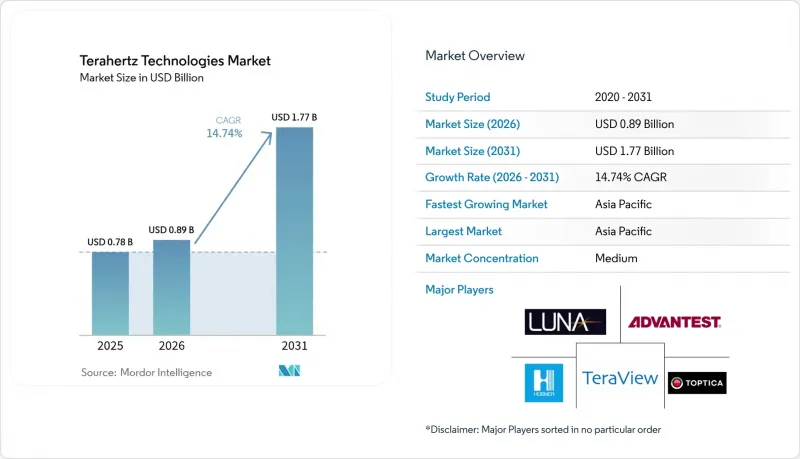
This report is Segmented by Application Category (Terahertz Imaging Systems, Communication Systems, and More), Frequency Range (Low-Frequency Terahertz, Mid-Frequency Terahertz, and More), End User (Healthcare, Industrial, and More), Component Type (Terahertz Sources, Terahertz Detectors, Optics and Passive Components, and More), and Geography. The Market Forecasts are Provided in Terms of Value (USD).
Global Terahertz Technologies Market Trends and Insights
Advances in Compact Photonic-Integrated THz Sources
Photonic integration is shrinking terahertz emitters from bench-top optical assemblies to millimeter-scale chips that drop directly into handheld instruments. Thin-film lithium niobate modulators now achieve difference-frequency mixing efficiencies approaching 1%, providing continuous-wave output above 1 THz without cryogenic mirrors or bulky alignment hardware. Commercial foundries have licensed more than 40 university patents since 2024, bringing the technology to 200 mm silicon photonics lines that cut part counts and lead times by more than half. Unit cost is falling below USD 10,000 for mid-power sources, opening up price-sensitive segments such as food inspection and cultural heritage conservation. The combination of a lower price and a field-ready form factor underpins the projected 15.32% growth in imaging systems through 2031.
Surge in 6G-Backhaul Proof-of-Concept Installations
Telecom operators completed over 25 terahertz backhaul pilots in dense urban corridors during 2025, targeting multi-gigabit links where trenching fiber exceeds USD 1 million per kilometer. Japan's NICT validated a 100 Gbps, 300 GHz connection over 500 m in downtown Tokyo, meeting 6G latency and packet-error requirements under real traffic conditions. South Korea's ETRI achieved 50 Gbps at 220 GHz with adaptive beam steering that compensated for building sway and pedestrian blockage, demonstrating robustness for small-cell aggregation. Capital budgets for 2026 now include terahertz radios alongside microwave and optical backhaul gear, confirming the segment's transition from research to deployment. These pilots explain why communication systems retained 42.36% market share in 2025.
Limited Atmospheric Transmission Windows for Outdoor Links
Water vapor creates attenuation peaks above 100 dB km-1 at many terahertz frequencies, restricting reliable outdoor service to narrow windows near 300 GHz and 350 GHz. Humid tropical climates experience two-to-three times higher losses, forcing operators to oversize link budgets or confine deployments to dry seasons. Rainfall above 10 mm h-1 can drop link availability below carrier standards, pushing networks to retain microwave or fiber overlays for resiliency. These environmental limits cap the long-term share of terahertz in backhaul architectures despite technical successes in pilot trials. Investment, therefore, shifts toward indoor, short-range, or point-to-point campus links where atmospheric effects are minimal.
Other drivers and restraints analyzed in the detailed report include:
- Rising Adoption in Inline Pharmaceutical QA/QC
- Defense Demand for mm-Resolution Passive Standoff Scanners
- Cryogenic Cooling Cost for High-Power QCL Sources
For complete list of drivers and restraints, kindly check the Table Of Contents.
Segment Analysis
Terahertz imaging systems are projected to grow at a 15.32% CAGR between 2026-2031, closing in on communication platforms that commanded 42.36% of the terahertz technologies market share in 2025. The terahertz technologies market for imaging will benefit from falling hardware prices as photonic-integrated sources reach sub-USD 10,000 unit costs and enable routine non-destructive testing on pharmaceutical lines and composite-material parts. Active imagers that couple quantum-cascade lasers with fast detectors dominate tablet-coating inspection and aerospace defect mapping, while passive arrays lead airport screening by avoiding export-control limits on high-power emitters.
The expanding use cases in dermatology clinics, dental practices, and cultural-heritage conservation are driving demand beyond research labs. Hybrid instruments that overlay spectral fingerprints on high-contrast images allow a single platform to shift between quality control, security, and medical diagnostics through software updates rather than hardware swaps. As these multipurpose systems mature, integrators bundle AI analytics that reduce operator training time and standardize results across sites. Together, these factors underpin sustained double-digit growth for imaging despite communication remaining the largest revenue generator through mid-decade.
Mid-frequency solutions spanning roughly 0.5-1.5 THz held 47.93% of 2025 revenue, the largest slice of the terahertz technologies market share, and are expected to expand at a 15.37% CAGR to 2031. In this band of the terahertz technologies market, 1 THz spectroscopy can effectively resolve 5 µm coating layers, providing high precision in material analysis. At the same time, atmospheric attenuation and component costs remain manageable for field systems, making it an optimal range for practical applications in various industries, including healthcare, security, and telecommunications.
Low-frequency gear below 0.5 THz propagates farther and operates at room temperature, making it well-suited for point-to-point links and through-wall sensing, but millimeter-scale resolution limits its appeal for precision QA. Above 1.5 THz, sub-millimeter imaging is used for EUV mask metrology, although stronger water-vapor absorption and higher detector noise keep such units largely laboratory-bound. Mid-band designs, therefore, remain the default for pharmaceutical, telecom, and security users that need balanced performance without cryogenic overhead or severe weather constraints.
Complete Report Scope:
- By Application Category
- Terahertz Imaging Systems
- Active Systems
- Passive Systems
- Terahertz Spectroscopy Systems
- Time-Domain
- Frequency-Domain
- Communication Systems
- Terahertz Imaging Systems
- By Frequency Range
- Low-Frequency Terahertz
- Mid-Frequency Terahertz
- High-Frequency Terahertz
- By End User
- Healthcare
- Defense and Security
- Telecommunications
- Industrial
- Food and Agriculture
- Laboratories
- Other End Users
- By Component Type
- Terahertz Sources
- Terahertz Detectors
- Optics and Passive Components
- Systems and Softwares
- By Geography
- North America
- United States
- Canada
- Mexico
- South America
- Brazil
- Argentina
- Rest of South America
- Europe
- United Kingdom
- Germany
- France
- Italy
- Rest of Europe
- Asia Pacific
- China
- Japan
- India
- South Korea
- Rest of Asia Pacific
- Middle East and Africa
- Middle East
- United Arab Emirates
- Saudi Arabia
- Rest of Middle East
- Africa
- South Africa
- Egypt
- Rest of Africa
- Middle East
- North America
Geography Analysis
Asia-Pacific captured 38.23% of global revenue in 2025, the highest regional share, and is projected to expand at a 15.79% CAGR through 2031. China's Ministry of Science and Technology allocated CNY 2.1 billion (USD 290 million) in 2025 to 6G terahertz consortia that develop indigenous sources and detectors. Japan's National Institute of Information and Communications Technology demonstrated a 100 Gbps, 300 GHz link across 500 m of central Tokyo in late 2025, validating sub-terahertz reliability under dense urban conditions. South Korea's ETRI field-tested a portable 220 GHz transceiver that delivered 50 Gbps on Seoul streets in mid-2025, further cementing regional leadership in pilot deployments. Together, these initiatives position the region to dictate future component cost curves and performance benchmarks.
North America ranked second in revenue, buoyed by DARPA grants for passive standoff scanners and widespread pharmaceutical rollout of inline spectroscopy. The terahertz technologies market in North America is forecast to grow steadily, though the region's CAGR trails Asia-Pacific as telecom operators pursue measured 6G backhaul expansion. Europe's contribution remains significant thanks to research hubs such as Fraunhofer IAF, which advanced thin-film lithium-niobate photomixers that enable room-temperature sources. Fragmented spectrum policy and more conservative capital expenditure, however, slow cross-border deployments. As a result, Europe is expected to yield incremental share to faster-moving Asian markets through the forecast window.
South America stands at an evaluation stage, with Brazil's agricultural agencies testing terahertz moisture sensors for coffee and soybean quality control. Mexico's automotive sector pilots non-destructive testing of composite panels, yet import duties and limited local manufacturing constrain volume adoption. In the Middle East and Africa, airport security screening and border-control orders generate periodic but high-value sales, while the absence of an indigenous component supply curbs scale. Collectively, these emerging regions hold less than 10% of the terahertz technologies market share today and are expected to remain single-digit contributors until falling Asia-Pacific price points broaden accessibility.
- ADVANTEST Corporation
- Luna Innovations Incorporated
- TeraView Limited
- TOPTICA Photonics AG
- HUBNER GmbH and Co. KG
- BATOP GmbH
- Microtech Instruments Inc.
- Menlo Systems GmbH
- Gentec-EO Inc.
- Bakman Technologies LLC
- QMC Instruments Ltd
- Bruker Corporation
- Lytid SAS
- Attocube Systems AG
- Helmut Fischer GmbH
- Baugh and Weedon Ltd
- Das-nano S.L.
- Teravil Ltd
- Terasense Group Inc.
- Virginia Diodes Inc.
Additional Benefits:
- The market estimate (ME) sheet in Excel format
- 3 months of analyst support
TABLE OF CONTENTS
1 INTRODUCTION
- 1.1 Study Assumptions and Market Definition
- 1.2 Scope of the Study
2 RESEARCH METHODOLOGY
3 EXECUTIVE SUMMARY
4 MARKET LANDSCAPE
- 4.1 Market Overview
- 4.2 Market Drivers
- 4.2.1 Advances in Compact Photonic-Integrated THz Sources
- 4.2.2 Surge in 6G-Backhaul Proof-of-Concept Installations
- 4.2.3 Rising Adoption in Inline Pharmaceutical QA/QC
- 4.2.4 Defense Demand for mm-Resolution Passive Standoff Scanners
- 4.2.5 Standardization of THz EUV Lithography Mask Metrology
- 4.2.6 Funding for THz Cultural Heritage Preservation Analysis
- 4.3 Market Restraints
- 4.3.1 Limited Atmospheric Transmission Windows for Outdoor Links
- 4.3.2 Cryogenic Cooling Cost for High-Power QCL Sources
- 4.3.3 Scarcity of Volume-Manufacturable Low-Loss THz Packaging
- 4.3.4 Absence of Harmonised Global EMC and Health Exposure Limits Above 275 GHz
- 4.4 Industry Value Chain Analysis
- 4.5 Impact of Macroeconomic Factors
- 4.6 Regulatory Landscape
- 4.7 Technological Outlook
- 4.8 Porter's Five Forces Analysis
- 4.8.1 Bargaining Power of Suppliers
- 4.8.2 Bargaining Power of Buyers
- 4.8.3 Threat of New Entrants
- 4.8.4 Threat of Substitutes
- 4.8.5 Degree of Competition
- 4.9 Pricing Analysis
- 4.10 Analysis of Non-Destructive Testing Applications of Terahertz Technology
- 4.11 Legal and Regulatory Space for Terahertz Technologies
5 MARKET SIZE AND GROWTH FORECASTS (VALUE)
- 5.1 By Application Category
- 5.1.1 Terahertz Imaging Systems
- 5.1.1.1 Active Systems
- 5.1.1.2 Passive Systems
- 5.1.2 Terahertz Spectroscopy Systems
- 5.1.2.1 Time-Domain
- 5.1.2.2 Frequency-Domain
- 5.1.3 Communication Systems
- 5.1.1 Terahertz Imaging Systems
- 5.2 By Frequency Range
- 5.2.1 Low-Frequency Terahertz
- 5.2.2 Mid-Frequency Terahertz
- 5.2.3 High-Frequency Terahertz
- 5.3 By End User
- 5.3.1 Healthcare
- 5.3.2 Defense and Security
- 5.3.3 Telecommunications
- 5.3.4 Industrial
- 5.3.5 Food and Agriculture
- 5.3.6 Laboratories
- 5.3.7 Other End Users
- 5.4 By Component Type
- 5.4.1 Terahertz Sources
- 5.4.2 Terahertz Detectors
- 5.4.3 Optics and Passive Components
- 5.4.4 Systems and Softwares
- 5.5 By Geography
- 5.5.1 North America
- 5.5.1.1 United States
- 5.5.1.2 Canada
- 5.5.1.3 Mexico
- 5.5.2 South America
- 5.5.2.1 Brazil
- 5.5.2.2 Argentina
- 5.5.2.3 Rest of South America
- 5.5.3 Europe
- 5.5.3.1 United Kingdom
- 5.5.3.2 Germany
- 5.5.3.3 France
- 5.5.3.4 Italy
- 5.5.3.5 Rest of Europe
- 5.5.4 Asia Pacific
- 5.5.4.1 China
- 5.5.4.2 Japan
- 5.5.4.3 India
- 5.5.4.4 South Korea
- 5.5.4.5 Rest of Asia Pacific
- 5.5.5 Middle East and Africa
- 5.5.5.1 Middle East
- 5.5.5.1.1 United Arab Emirates
- 5.5.5.1.2 Saudi Arabia
- 5.5.5.1.3 Rest of Middle East
- 5.5.5.2 Africa
- 5.5.5.2.1 South Africa
- 5.5.5.2.2 Egypt
- 5.5.5.2.3 Rest of Africa
- 5.5.5.1 Middle East
- 5.5.1 North America
6 COMPETITIVE LANDSCAPE
- 6.1 Market Concentration
- 6.2 Strategic Moves
- 6.3 Market Share Analysis
- 6.4 Company Profiles (includes Global Level Overview, Market Level Overview, Core Segments, Financials as available, Strategic Information, Market Rank/Share, Products and Services, Recent Developments)
- 6.4.1 ADVANTEST Corporation
- 6.4.2 Luna Innovations Incorporated
- 6.4.3 TeraView Limited
- 6.4.4 TOPTICA Photonics AG
- 6.4.5 HUBNER GmbH and Co. KG
- 6.4.6 BATOP GmbH
- 6.4.7 Microtech Instruments Inc.
- 6.4.8 Menlo Systems GmbH
- 6.4.9 Gentec-EO Inc.
- 6.4.10 Bakman Technologies LLC
- 6.4.11 QMC Instruments Ltd
- 6.4.12 Bruker Corporation
- 6.4.13 Lytid SAS
- 6.4.14 Attocube Systems AG
- 6.4.15 Helmut Fischer GmbH
- 6.4.16 Baugh and Weedon Ltd
- 6.4.17 Das-nano S.L.
- 6.4.18 Teravil Ltd
- 6.4.19 Terasense Group Inc.
- 6.4.20 Virginia Diodes Inc.
7 MARKET OPPORTUNITIES AND FUTURE OUTLOOK
- 7.1 White-Space and Unmet-Need Assessment

