PUBLISHER: Mordor Intelligence | PRODUCT CODE: 2121486

PUBLISHER: Mordor Intelligence | PRODUCT CODE: 2121486
Cloud MFT Services - Market Share Analysis, Industry Trends & Statistics, Growth Forecasts (2026 - 2031)
According to Mordor Intelligence, the cloud MFT services market size is expected to grow from USD 2.24 billion in 2025 to USD 2.45 billion in 2026 and is forecast to reach USD 3.84 billion by 2031 at 9.40% CAGR over 2026-2031.
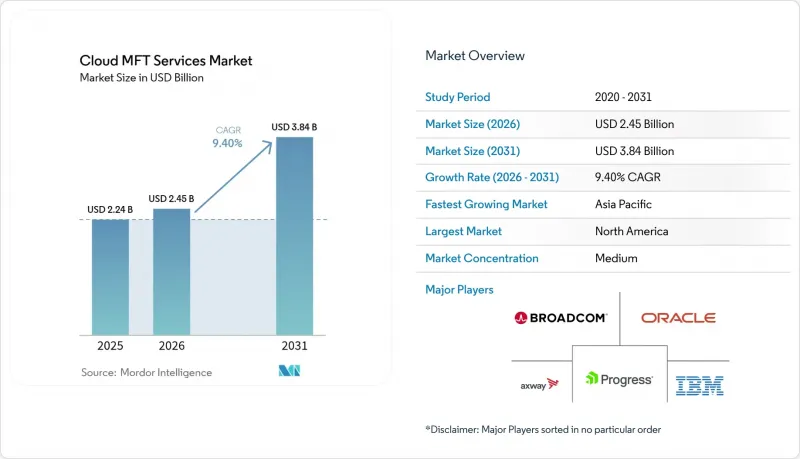
This report is Segmented by Cloud Type (Public, Private, and Hybrid), End-User Industry (Government, Retail, and More), Organization Size (Large Enterprises, and More), Transfer Type (Ad-Hoc Transfer, System-To-System Transfer, and Mobile-To-Mobile Transfer), and Geography (North America, South America, Europe, Asia Pacific, and More). The Market Forecasts are Provided in Terms of Value (USD).
Global Cloud MFT Services Market Trends and Insights
Increasing Need for Secure File Transfer
Ransomware incidents targeting insecure file-transfer endpoints climbed 38% year-over-year in 2024, according to the FBI's Internet Crime Complaint Center.Enterprises are therefore hardening exchange workflows with end-to-end encryption, multi-factor authentication, and policy-based quarantines. The Cybersecurity and Infrastructure Security Agency's directive 23-01 compels U.S. federal agencies to embed zero-trust principles in every file movement. Parallel momentum is evident in payment ecosystems following the tightening of PCI DSS v4.0 requirements for encrypted data-in-motion, which has catalyzed the procurement of certified MFT services by processors and merchant acquirers. Healthcare adoption accelerated when the Department of Health and Human Services imposed USD 4.75 million in HIPAA fines for unencrypted transmissions during 2024.
Proliferation of Hybrid Cloud Architectures
A 2024 Cloud Security Alliance survey found that 67% of enterprises already operate workloads across at least three cloud environments. Hybrid MFT deployments enable firms to retain sensitive files on-premises for residency compliance while leveraging public cloud scalability for burst workloads. European banks are adopting hybrid models to comply with the European Banking Authority's outsourcing rules, which mandate that critical payment files be hosted on EU-domiciled infrastructure. Manufacturers synchronize large CAD files between private PLM systems and supplier portals, reducing iteration cycles. Telecom operators are injecting MFT micro-services into 5G edge nodes to serve latency-sensitive use cases such as autonomous vehicles.
Dependence on Legacy FTPS Infrastructure
International Data Corporation research indicates 54% of large enterprises still rely on FTPS for at least half of their external exchanges.Hard-coded IPs, custom scripts, and proprietary authentication loom as migration hurdles. Mainframe-centric financial institutions bear the heaviest burden, as FTPS gateways are intricately integrated with core banking systems. Re-engineering workflows to support REST APIs and OAuth can exceed USD 5 million for global firms, delaying projects. The absence of native S3 or Azure Blob connectors in legacy stacks forces middleware deployments that add latency and risk.
Other drivers and restraints analyzed in the detailed report include:
- Regulatory Compliance Requirements for Data Protection
- AI-Powered Adaptive Routing Optimizing Bandwidth Utilization
- High Switching Costs for Large Enterprises
For complete list of drivers and restraints, kindly check the Table Of Contents.
Segment Analysis
Hybrid deployments contributed the fastest 13.92% CAGR from 2026 to 2031, as organizations blended regulatory assurance with elastic capacity. Public cloud retained 45.72% of the Cloud MFT Services market share in 2025, as banks and telecom operators prized pay-as-you-go scaling during seasonal transaction peaks. Private cloud remained essential for agencies bound by FedRAMP High and similar sovereignty requirements.
Hybrid adoption intensifies as enterprises adopt multicloud playbooks to avoid single-vendor dependence. The Cloud MFT Services market size tied to hybrid models will expand steadily as low-latency edge nodes connect factory floors and branch offices to centralized compliance engines. Vendors now bundle containerized gateways and software-defined connectors that expose uniform policies across AWS, Azure, Google Cloud, and on-premises clusters. This capability is vital for manufacturers distributing CAD updates through supplier networks and logistics platforms, while safeguarding intellectual property in accordance with export control rules.
BFSI captured a 23.74% share in 2025, driven by early regulatory triggers, including PCI DSS and SWIFT CSP audits. The Cloud MFT Services market size linked to BFSI will continue to grow, yet healthcare's 12.95% forecast CAGR positions the sector as the prime accelerator. Electronic health record interoperability mandates and the growth of telehealth raise the volume of protected health information (PHI) circulating among providers, payers, and patients.
The 21st Century Cures Act compels U.S. providers to expose standardized APIs by 2025, driving investment in connectors that translate HL7 streams to FHIR while preserving encryption. Pharmacies and clinical research organizations similarly need validated transfer logs for regulatory audits. Other verticals are maturing at varying speeds: the government is embracing MFT for tax filings and license renewals, manufacturing relies on the secure exchange of design and inspection files, and the media sector secures high-resolution content transfers for streaming distribution.
Complete Report Scope:
- By Cloud Type
- Public
- Private
- Hybrid
- By End-User Industry
- Government
- Retail
- Manufacturing
- Energy and Utilities
- Telecommunications
- BFSI
- Healthcare
- Other Industries
- By Organization Size
- Large Enterprises
- Small and Medium Enterprises
- By Transfer Type
- Ad-Hoc Transfer
- System-to-System Transfer
- Mobile-to-Mobile Transfer
- By Geography
- North America
- United States
- Canada
- Mexico
- South America
- Brazil
- Argentina
- Rest of South America
- Europe
- United Kingdom
- Germany
- France
- Italy
- Spain
- Russia
- Rest of Europe
- Asia Pacific
- China
- Japan
- India
- South Korea
- Australia
- Rest of Asia Pacific
- Middle East
- Saudi Arabia
- United Arab Emirates
- Turkey
- Rest of Middle East
- Africa
- South Africa
- Nigeria
- Egypt
- Rest of Africa
- North America
Geography Analysis
North America controlled 36.68% of the Cloud MFT Services market in 2025, driven by the Health Insurance Portability and Accountability Act (HIPAA), Sarbanes-Oxley rules, and stringent state breach-notification laws that mandate the encryption of data in motion. Enterprises lead global zero-trust adoption, extending verification policies to every file exchange endpoint. The U.S. Securities and Exchange Commission amended Regulation S-P in 2024, obliging financial institutions to integrate secure transfer protocols into incident response plans. Canadian organizations face similar imperatives under PIPEDA, boosting demand for certified platforms with blockchain audit trails.
Asia Pacific is forecast to deliver a 13.55% CAGR through 2031, the highest regional pace. India's Digital Personal Data Protection Act mandates the local processing of sensitive personal information, whereas China's Cybersecurity Law and supporting measures stipulate in-country storage and regulatory approval for outbound transfers. Japan and South Korea both tightened personal data statutes in 2024, prompting enterprises to adopt MFT services with granular permission controls. The region's vast manufacturing base relies on secure exchange for just-in-time supply chains, intensifying adoption among automotive and electronics clusters.
Europe's trajectory is shaped by the GDPR, with supervisory authorities imposing significant penalties for lapses in data transfer security. The European Banking Authority's 2024 update insists that banks retain oversight of outsourced file-transfer operations. Germany's BSI cloud guidelines and the United Kingdom's Data Protection Act add sector nuances. Middle Eastern regulators mandate sovereign cloud architectures, exemplified by Saudi Arabia's National Cybersecurity Authority, which requires locally hosted MFT. In Africa, South Africa and Nigeria spearhead uptake through financial inclusion programs that hinge on secure mobile transfers, while Brazil's LGPD drives similar modernization in South America.
- International Business Machines Corporation
- Axway Software SA
- Progress Software Corporation (Ipswitch)
- Broadcom Inc.
- Oracle Corporation
- Citrix Systems Inc. (ShareFile)
- Accellion Inc.
- OPEN TEXT CORPORATION
- Software AG
- Saison Information Systems Co. Ltd.
- TIBCO Software Inc.
- Cleo Communications Inc.
- GlobalSCAPE Inc.
- Coviant Software LLC
- South River Technologies Inc.
- JSC Stonebranch
- Seeburger AG
- HelpSystems LLC (GoAnywhere)
- Primeur Group
- Maytech Communications Ltd.
- Hightail Inc.
- Box Inc.
- Dropbox Inc. (Secure MFT offerings)
- Thru Inc.
- Biscom Inc.
Additional Benefits:
- The market estimate (ME) sheet in Excel format
- 3 months of analyst support
TABLE OF CONTENTS
1 INTRODUCTION
- 1.1 Market Definition and Scope
- 1.2 Study Assumptions
2 RESEARCH METHODOLOGY
3 EXECUTIVE SUMMARY
4 MARKET LANDSCAPE
- 4.1 Market Overview
- 4.2 Market Drivers
- 4.2.1 Increasing Need for Secure File Transfer
- 4.2.2 Proliferation of Hybrid Cloud Architectures
- 4.2.3 Regulatory Compliance Requirements for Data Protection
- 4.2.4 AI-Powered Adaptive Routing Optimizing Bandwidth Utilization
- 4.2.5 Expansion of Edge Computing Creating Micro-Transfer Hubs
- 4.2.6 Rising Adoption of Event-Driven Architectures Requiring Real-Time File Streaming
- 4.3 Market Restraints
- 4.3.1 Dependence on Legacy FTPS Infrastructure
- 4.3.2 High Switching Costs for Large Enterprises
- 4.3.3 Limited IPv6 Support in MFT Protocol Implementations
- 4.3.4 ESG Scrutiny Elevating Data Center Energy Audit Costs
- 4.4 Industry Value Chain Analysis
- 4.5 Impact of Macroeconomic Factors on the Market
- 4.6 Regulatory Landscape
- 4.7 Technological Outlook
- 4.8 Porter's Five Forces Analysis
- 4.8.1 Bargaining Power of Suppliers
- 4.8.2 Bargaining Power of Buyers
- 4.8.3 Threat of New Entrants
- 4.8.4 Threat of Substitutes
- 4.8.5 Intensity of Competitive Rivalry
5 MARKET SIZE AND GROWTH FORECASTS (VALUE)
- 5.1 By Cloud Type
- 5.1.1 Public
- 5.1.2 Private
- 5.1.3 Hybrid
- 5.2 By End-User Industry
- 5.2.1 Government
- 5.2.2 Retail
- 5.2.3 Manufacturing
- 5.2.4 Energy and Utilities
- 5.2.5 Telecommunications
- 5.2.6 BFSI
- 5.2.7 Healthcare
- 5.2.8 Other Industries
- 5.3 By Organization Size
- 5.3.1 Large Enterprises
- 5.3.2 Small and Medium Enterprises
- 5.4 By Transfer Type
- 5.4.1 Ad-Hoc Transfer
- 5.4.2 System-to-System Transfer
- 5.4.3 Mobile-to-Mobile Transfer
- 5.5 By Geography
- 5.5.1 North America
- 5.5.1.1 United States
- 5.5.1.2 Canada
- 5.5.1.3 Mexico
- 5.5.2 South America
- 5.5.2.1 Brazil
- 5.5.2.2 Argentina
- 5.5.2.3 Rest of South America
- 5.5.3 Europe
- 5.5.3.1 United Kingdom
- 5.5.3.2 Germany
- 5.5.3.3 France
- 5.5.3.4 Italy
- 5.5.3.5 Spain
- 5.5.3.6 Russia
- 5.5.3.7 Rest of Europe
- 5.5.4 Asia Pacific
- 5.5.4.1 China
- 5.5.4.2 Japan
- 5.5.4.3 India
- 5.5.4.4 South Korea
- 5.5.4.5 Australia
- 5.5.4.6 Rest of Asia Pacific
- 5.5.5 Middle East
- 5.5.5.1 Saudi Arabia
- 5.5.5.2 United Arab Emirates
- 5.5.5.3 Turkey
- 5.5.5.4 Rest of Middle East
- 5.5.6 Africa
- 5.5.6.1 South Africa
- 5.5.6.2 Nigeria
- 5.5.6.3 Egypt
- 5.5.6.4 Rest of Africa
- 5.5.1 North America
6 COMPETITIVE LANDSCAPE
- 6.1 Market Concentration
- 6.2 Strategic Moves
- 6.3 Market Share Analysis
- 6.4 Company Profiles (includes Global Level Overview, Market Level Overview, Core Segments, Financials as available, Strategic Information, Market Rank/Share for Key Companies, Products and Services, and Recent Developments)
- 6.4.1 International Business Machines Corporation
- 6.4.2 Axway Software SA
- 6.4.3 Progress Software Corporation (Ipswitch)
- 6.4.4 Broadcom Inc.
- 6.4.5 Oracle Corporation
- 6.4.6 Citrix Systems Inc. (ShareFile)
- 6.4.7 Accellion Inc.
- 6.4.8 OPEN TEXT CORPORATION
- 6.4.9 Software AG
- 6.4.10 Saison Information Systems Co. Ltd.
- 6.4.11 TIBCO Software Inc.
- 6.4.12 Cleo Communications Inc.
- 6.4.13 GlobalSCAPE Inc.
- 6.4.14 Coviant Software LLC
- 6.4.15 South River Technologies Inc.
- 6.4.16 JSC Stonebranch
- 6.4.17 Seeburger AG
- 6.4.18 HelpSystems LLC (GoAnywhere)
- 6.4.19 Primeur Group
- 6.4.20 Maytech Communications Ltd.
- 6.4.21 Hightail Inc.
- 6.4.22 Box Inc.
- 6.4.23 Dropbox Inc. (Secure MFT offerings)
- 6.4.24 Thru Inc.
- 6.4.25 Biscom Inc.
7 MARKET OPPORTUNITIES AND FUTURE OUTLOOK
- 7.1 White-Space and Unmet-Need Assessment

