PUBLISHER: Mordor Intelligence | PRODUCT CODE: 2121494

PUBLISHER: Mordor Intelligence | PRODUCT CODE: 2121494
Ultrafast Lasers - Market Share Analysis, Industry Trends & Statistics, Growth Forecasts (2026 - 2031)
According to Mordor Intelligence, ultrafast lasers market size in 2026 is estimated at USD 3.29 billion, growing from 2025 value of USD 2.86 billion with 2031 projections showing USD 6.64 billion, growing at 15.07% CAGR over 2026-2031.
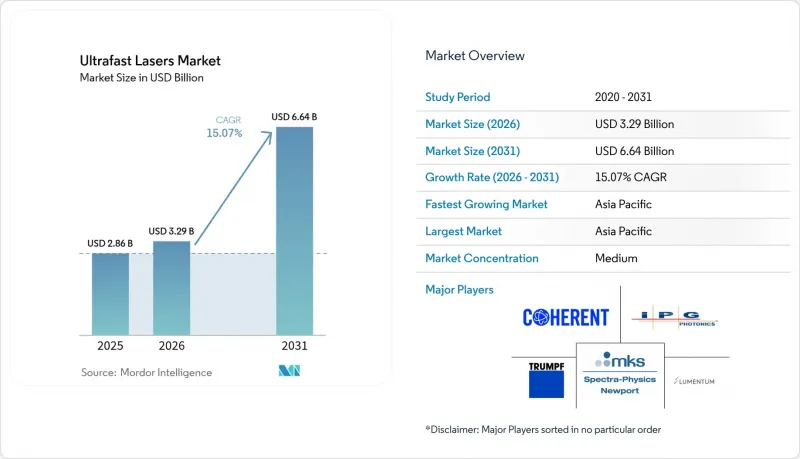
This report is Segmented by Laser Type (Fiber Laser, Solid-State Laser, and More), Pulse Duration (Femtosecond, and Picosecond), Wavelength (Infra-Red, and More), Application (Material Processing and Micromachining, and More), End User (Consumer Electronics, Medical Devices, and More), and Geography. The Market Forecasts are Provided in Terms of Value (USD).
Global Ultrafast Lasers Market Trends and Insights
Semiconductor Mini-Miniaturization Wave Fuels <20 µm Feature Machining Demand
Chipmakers migrating to 3D packaging architectures depend on femtosecond pulses that drill through-silicon vias with aspect ratios beyond 10:1 while eliminating heat-affected zones. Samsung and SK Hynix already deploy such systems for high-bandwidth memory stacking. Tool vendors report that ultrafast platforms represented 35% of new wafer-processing orders in 2024, up from 18% in 2022. Continuous node shrinkage below 20 nm widens the addressable ultrafast lasers market by forcing abandonment of mechanical or CW-laser options. Volume ramps in Asia-Pacific amplify equipment demand across allied photomask and substrate houses.
EV Battery Foil Cutting Shift to Ultrafast "Burst-Mode" Lasers
Gigafactory data show femtosecond burst-mode cutting improves 6 µm foil throughput by 40% while eliminating edge burrs that trigger short circuits. CATL and BYD invested USD 150 million in laser cutting lines during 2024, illustrating commercialization momentum. Precision demand rises as battery energy density climbs, pushing manufacturers to thinner foils that favor ablation over mechanical shearing. Multiplexed beam splitting allows simultaneous processing of stacked sheets, lifting utilization, and justifying higher capital expenditure. These factors enlarge the ultrafast lasers market share devoted to automotive manufacturing lines.
Supply-Chain Choke Points in Ytterbium-Doped Fiber
Lead times for high-power ytterbium fibers lengthened to six months in 2024 as only a handful of firms master the rare-earth uniformity needed for femtosecond stability. Chinese newcomers struggle with impurities that trigger mode instabilities, limiting penetration to sub-100 W systems. Restricted supply threatens production ramps for all-fiber femtosecond lasers, the fastest expanding slice of the ultrafast lasers market. Vendors respond by qualifying dual sources, yet process complexity slows capacity additions until at least 2026. Any prolonged shortage risks capping revenue even as downstream demand spikes.
Other drivers and restraints analyzed in the detailed report include:
- High-Aspect-Ratio Glass Drilling for Foldable Displays
- On-Wafer Quantum Photonics Prototyping Needs Sub-200 fs Pulses
- Productivity Gap vs. CW Fiber Lasers in Thick-Metal Cutting
For complete list of drivers and restraints, kindly check the Table Of Contents.
Segment Analysis
Fiber architectures captured 45.68% of the ultrafast lasers market in 2025, underpinned by a mean time between failures above 50,000 hours that satisfy factory uptime targets. Solid-state and diode-pumped bulk platforms retain utility for peak energies above 1 mJ, yet they see slower sales into production lines. The ultrafast lasers market size for all-fiber femtosecond units is projected to climb at a 16.28% CAGR as alignment-free layouts cut maintenance visits. Vendors like Coherent compress sources, power supplies, and chiller units into footprint-saving racks, allowing direct integration inside wafer or battery tools.
System simplification lets OEMs embed lasers within motion stages, removing external beam paths that previously invited contamination. Integration also strengthens service stickiness, because swapping brands would mean requalifying the entire machine. Fiber leaders thus extend firmware, scanner, and AI optics suites that raise switching costs, deepening control of the ultrafast lasers market. Bulk-laser specialists pivot toward research or exotic-wavelength niches where fibers lag in pulse energy or tunability.
Femtosecond devices owned 62.35% revenue in 2025 because non-thermal ablation prevents substrate damage in silicon, glass, and polymer films. Advancing burst-mode architectures now achieve fivefold material-removal rate jumps while restraining heat below 100 nm penetration. The ultrafast lasers market segment is forecast at 16.42% CAGR to 2031 as tooling costs converge with picosecond options. Picosecond sources persist where slight heat zones are acceptable, and higher average power is required for large-area texturing.
Convergence blurs the boundary as femtosecond prices fall and speed rises. Equipment buyers increasingly specify pulse duration by application physics rather than budget constraints, tightening competition. Suppliers augment controllers that switch between single-pulse and burst sequences, enabling one head to serve dicing, marking, and trimming within the same line, broadening the ultrafast lasers market addressable reach.
Complete Report Scope:
- By Laser Type
- Fiber Laser
- Solid-State Laser
- Diode-Pumped Bulk Laser
- All-Fiber Femtosecond Laser
- By Pulse Duration
- Femtosecond
- Picosecond
- By Wavelength
- Infra-red (Approx. 1030 nm)
- Green (Approx. 515 nm)
- UV (Approx. 355 nm)
- Deep-UV (Less than or Equal to 266 nm)
- By Application
- Material Processing and Micromachining
- Biomedical and Bio-imaging
- Spectroscopy and Metrology
- Scientific Research
- By End User
- Consumer Electronics
- Medical Devices
- Automotive
- Aerospace and Defense
- Research Institutes
- Other End Users
- By Geography
- North America
- United States
- Canada
- Mexico
- South America
- Brazil
- Argentina
- Colombia
- Rest of South America
- Europe
- United Kingdom
- Germany
- France
- Italy
- Spain
- Rest of Europe
- Asia-Pacific
- China
- Japan
- South Korea
- India
- Rest of Asia-Pacific
- Middle East and Africa
- Middle East
- Saudi Arabia
- United Arab Emirates
- Rest of Middle East
- Africa
- South Africa
- Egypt
- Rest of Africa
- Middle East
- North America
Geography Analysis
Asia-Pacific commanded 38.14% of the ultrafast lasers market in 2025 and is forecast at 18.21% CAGR to 2031 because wafer fabs, battery gigafactories, and display lines cluster across China, Japan, and South Korea. China's policy incentives nurture domestic laser suppliers, but Western brands still dominate high-precision tiers that demand sub-300 fs stability. Japan retains innovation leadership; Hamamatsu's USD 800 million NKT Photonics buy enlarges its quantum and biomedical portfolio, increasing local system integration density. South Korean chip and display leaders anchor steady tool demand, ensuring the region remains the primary engine for ultrafast lasers market revenue.
North America benefits from research funding and reshoring grants. Programs like Massachusetts' Manufacturing Accelerate deliver USD 200,000 subsidies that offset IEC 60825 certification costs, prompting SMEs to adopt femtosecond tools. U.S. labs pilot quantum-photonics prototypes, while automotive suppliers in Michigan and Texas turn to burst-mode lasers for EV modules. Canadian universities bolster fiber-laser research, providing a pipeline of photonics graduates who sustain regional service ecosystems.
Europe maintains strongholds in automotive and medical devices. German tier-ones specify ultrafast systems for battery enclosure welding and stent machining, preserving premium margins. French and Lithuanian vendors contribute specialty wavelength modules, enhancing intra-EU supply security. Meanwhile, Middle East and Africa emerge slowly as governments fund research hubs in the United Arab Emirates. Though volume remains small, pilot lines in aerospace composites and photonic sensors foreshadow future contributions to the ultrafast lasers market once technical workforces mature.
- TRUMPF SE + Co. KG
- Coherent Corp.
- IPG Photonics Corporation
- MKS Instruments Inc. (Spectra-Physics and Newport)
- Lumentum Holdings Inc.
- Amplitude Laser Group SA
- Novanta Inc. (Laser Quantum Ltd.)
- NKT Photonics A/S
- Light Conversion UAB
- Ekspla UAB (EKSMA Group)
- Clark-MXR Inc.
- IMRA America Inc. (Aisin Corp.)
- Jenoptik AG
- Hamamatsu Photonics K.K.
- Menlo Systems GmbH
- Fluence Sp. z o.o.
- Wuhan Huaray Precision Laser Co., Ltd.
- YSL Photonics Co., Ltd.
- Raycus Fiber Laser Technologies Co., Ltd.
- nLIGHT, Inc.
Additional Benefits:
- The market estimate (ME) sheet in Excel format
- 3 months of analyst support
TABLE OF CONTENTS
1 INTRODUCTION
- 1.1 Study Assumptions and Market Definition
- 1.2 Scope of the Study
2 RESEARCH METHODOLOGY
3 EXECUTIVE SUMMARY
4 MARKET LANDSCAPE
- 4.1 Market Overview
- 4.2 Market Drivers
- 4.2.1 Semiconductor mini-maturization wave fuels Less than 20 µm feature machining demand
- 4.2.2 EV battery foil cutting shift to ultrafast "burst-mode" lasers
- 4.2.3 High-aspect-ratio glass drilling for foldable displays
- 4.2.4 On-wafer quantum photonics prototyping needs sub-200 fs pulses
- 4.2.5 Government incentives for reshoring advanced manufacturing
- 4.2.6 AI-assisted adaptive optics boosting multi-beam throughput
- 4.3 Market Restraints
- 4.3.1 Supply-chain choke points in ytterbium-doped fiber
- 4.3.2 Productivity gap vs. CW fiber lasers in thick-metal cutting
- 4.3.3 IEC 60825 laser-safety compliance costs for SMEs
- 4.3.4 Thermal-lens instability above 500 W average power
- 4.4 Industry Supply Chain Analysis
- 4.5 Regulatory Landscape
- 4.6 Technological Outlook
- 4.7 Porter's Five Forces Analysis
- 4.7.1 Bargaining Power of Suppliers
- 4.7.2 Bargaining Power of Buyers
- 4.7.3 Threat of New Entrants
- 4.7.4 Threat of Substitutes
- 4.7.5 Intensity of Competitive Rivalry
5 MARKET SIZE AND GROWTH FORECASTS (VALUE)
- 5.1 By Laser Type
- 5.1.1 Fiber Laser
- 5.1.2 Solid-State Laser
- 5.1.3 Diode-Pumped Bulk Laser
- 5.1.4 All-Fiber Femtosecond Laser
- 5.2 By Pulse Duration
- 5.2.1 Femtosecond
- 5.2.2 Picosecond
- 5.3 By Wavelength
- 5.3.1 Infra-red (Approx. 1030 nm)
- 5.3.2 Green (Approx. 515 nm)
- 5.3.3 UV (Approx. 355 nm)
- 5.3.4 Deep-UV (Less than or Equal to 266 nm)
- 5.4 By Application
- 5.4.1 Material Processing and Micromachining
- 5.4.2 Biomedical and Bio-imaging
- 5.4.3 Spectroscopy and Metrology
- 5.4.4 Scientific Research
- 5.5 By End User
- 5.5.1 Consumer Electronics
- 5.5.2 Medical Devices
- 5.5.3 Automotive
- 5.5.4 Aerospace and Defense
- 5.5.5 Research Institutes
- 5.5.6 Other End Users
- 5.6 By Geography
- 5.6.1 North America
- 5.6.1.1 United States
- 5.6.1.2 Canada
- 5.6.1.3 Mexico
- 5.6.2 South America
- 5.6.2.1 Brazil
- 5.6.2.2 Argentina
- 5.6.2.3 Colombia
- 5.6.2.4 Rest of South America
- 5.6.3 Europe
- 5.6.3.1 United Kingdom
- 5.6.3.2 Germany
- 5.6.3.3 France
- 5.6.3.4 Italy
- 5.6.3.5 Spain
- 5.6.3.6 Rest of Europe
- 5.6.4 Asia-Pacific
- 5.6.4.1 China
- 5.6.4.2 Japan
- 5.6.4.3 South Korea
- 5.6.4.4 India
- 5.6.4.5 Rest of Asia-Pacific
- 5.6.5 Middle East and Africa
- 5.6.5.1 Middle East
- 5.6.5.1.1 Saudi Arabia
- 5.6.5.1.2 United Arab Emirates
- 5.6.5.1.3 Rest of Middle East
- 5.6.5.2 Africa
- 5.6.5.2.1 South Africa
- 5.6.5.2.2 Egypt
- 5.6.5.2.3 Rest of Africa
- 5.6.5.1 Middle East
- 5.6.1 North America
6 COMPETITIVE LANDSCAPE
- 6.1 Market Concentration
- 6.2 Strategic Moves
- 6.3 Market Share Analysis
- 6.4 Company Profiles (includes Global-level Overview, Market-level Overview, Core Segments, Financials as available, Strategic Information, Market Rank/Share, Products and Services, Recent Developments)
- 6.4.1 TRUMPF SE + Co. KG
- 6.4.2 Coherent Corp.
- 6.4.3 IPG Photonics Corporation
- 6.4.4 MKS Instruments Inc. (Spectra-Physics and Newport)
- 6.4.5 Lumentum Holdings Inc.
- 6.4.6 Amplitude Laser Group SA
- 6.4.7 Novanta Inc. (Laser Quantum Ltd.)
- 6.4.8 NKT Photonics A/S
- 6.4.9 Light Conversion UAB
- 6.4.10 Ekspla UAB (EKSMA Group)
- 6.4.11 Clark-MXR Inc.
- 6.4.12 IMRA America Inc. (Aisin Corp.)
- 6.4.13 Jenoptik AG
- 6.4.14 Hamamatsu Photonics K.K.
- 6.4.15 Menlo Systems GmbH
- 6.4.16 Fluence Sp. z o.o.
- 6.4.17 Wuhan Huaray Precision Laser Co., Ltd.
- 6.4.18 YSL Photonics Co., Ltd.
- 6.4.19 Raycus Fiber Laser Technologies Co., Ltd.
- 6.4.20 nLIGHT, Inc.
7 MARKET OPPORTUNITIES AND FUTURE OUTLOOK
- 7.1 White-space and Unmet-need Assessment

