PUBLISHER: Mordor Intelligence | PRODUCT CODE: 2121512

PUBLISHER: Mordor Intelligence | PRODUCT CODE: 2121512
Pico Projector - Market Share Analysis, Industry Trends & Statistics, Growth Forecasts (2026 - 2031)
According to Mordor Intelligence, the pico projector market size is estimated at USD 3.45 billion in 2026, and is expected to reach USD 5.23 billion by 2031, at a CAGR of 8.68% during the forecast period (2026-2031).
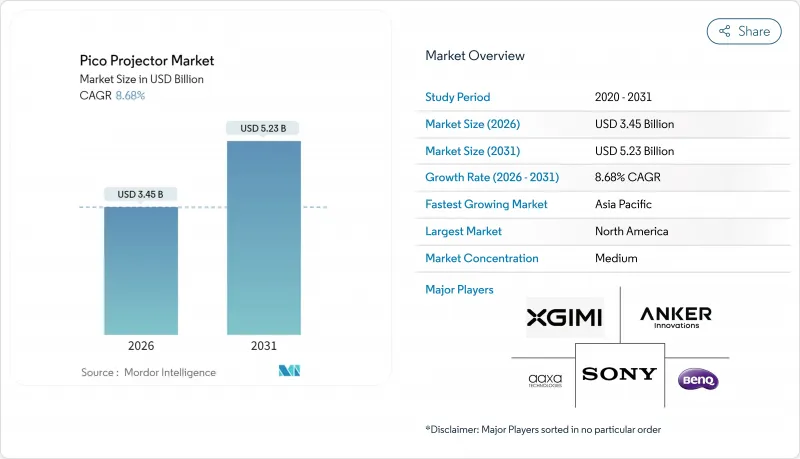
This report is Segmented by Technology (Digital Light Processing, Liquid Crystal On Silicon, and More), Product Type (USB, Embedded, Media-Player, Stand-Alone), Application (Consumer Electronics, Business and Enterprise, Education and Training, and More), Brightness (Below 100 Lumens, 100-500 Lumens, 500-1000 Lumens, Above 1000 Lumens), and Geography. The Market Forecasts are Provided in Terms of Value (USD).
Global Pico Projector Market Trends and Insights
Integration Into Smartphones and Wearables
Smartphone brands integrate compact DLP or LBS modules to escape feature parity in mature handset lines. Samsung prototypes and Xiaomi's Smart Projector L1 convert a foldable phone into a 100-inch viewing surface without external hardware. Meta's photonic-integrated-circuit display, published in January 2025, achieved 10,000 nits in a wafer-scale form factor, outlining a path for true eyewear projection. XREAL and Qualcomm combine beam steering with 5G to overlay repair manuals onto machinery, trimming downtime for field engineers. Falling component costs and rising battery energy density should make always-on projection a default flagship feature before 2028.
Rise of Hybrid Work and Mobile Presentations
Portable, USB-C-powered projectors replace fixed conference-room rigs as companies embrace flexible office footprints. Anker's Nebula Capsule 3 Laser, launched in September 2024, supplies 300 ANSI lumens for two-hour cafe meetings, while ViewSonic's M2e delivers 1,000 ANSI lumens with instant keystone correction, eliminating IT setup friction. Departmental budgets now favor self-service devices that workers can carry between home and headquarters, driving double-digit unit growth in the sub-USD 700 bracket.
Other drivers and restraints analyzed in the detailed report include:
- Advances in Solid-State Light Sources (LED/Laser)
- Automotive HUD and AR Windscreen Adoption
For complete list of drivers and restraints, kindly check the Table Of Contents.
Segment Analysis
Digital Light Processing held 35.81% of 2025 revenue, sustained by Texas Instruments' patent shield and single-chip reliability. Laser Beam Steering is projected to outpace at 9.78% CAGR as MicroVision's PicoP modules eliminate color wheels and shrink optics to sub-3 cm3 footprints. The pico projector market size for Laser Beam Steering is expected to widen meaningfully as augmented-reality headsets enter mass production for enterprise maintenance crews. Liquid Crystal on Silicon remains a niche for high-contrast home theater, but the share is sliding as DLP achieves native 4K at a lower cost. Research prototypes from Meta hint that flat-panel silicon photonics could disrupt all incumbent approaches after 2028, a wildcard that vendors monitor closely.
Holographic techniques remain confined to concept cars and laboratories because they require coherent light and computationally intensive wavefront control. LED/laser hybrids blend long life with moderate brightness and dominate mid-priced consumer models. STMicroelectronics' MEMS mirrors enable sub-milli-radian accuracy essential for AR overlays in military helmet visors, proving that precision scanning can coexist with rugged design. Overall, cross-licensing between chipset makers and projector brands drives a virtuous upgrade cycle that anchors the pico projector market even if one architecture ultimately prevails.
Stand-alone devices commanded 40.66% of 2025 revenue as users valued plug-and-play simplicity. Yet embedded modules are forecast to post a 10.11% CAGR as phone and wearable vendors add projection to counter stagnating camera innovation. The pico projector market size attributed to embedded designs is therefore likely to climb faster than any other product class. Samsung prototypes demonstrate seamless casting of social-media feeds onto walls, while BMW plans rear-seat entertainment modules built directly into headrests. Meanwhile, rugged outdoor units like BenQ's GS50 show that the stand-alone category can still expand if designs withstand dust and light rain.
Media-player variants and USB sticks now serve niche cases, such as field sales reps who rely on thumb-drive slide decks. Widespread USB-C display support, however, reduces their strategic relevance. Price compression favors embedded modules because they omit enclosures, batteries, and speakers, collapsing bill of materials below USD 30 at million-unit scale. That cost delta makes it hard for low-brightness plug-ins to remain attractive at retail.
Complete Report Scope:
- By Technology
- Digital Light Processing (DLP)
- Liquid Crystal on Silicon (LCoS)
- Laser Beam Steering (LBS)
- Holographic Laser Projection
- LED / Laser Hybrid Engines
- By Product Type
- USB Pico Projector
- Embedded Pico Projector
- Media-Player Pico Projector
- Stand-alone Pico Projector
- By Application
- Consumer Electronics
- Business and Enterprise
- Education and Training
- Automotive Head-Up Displays
- Healthcare Visualization
- Aerospace and Defense
- Industrial and Other Uses
- By Brightness
- Below 100 Lumens
- 100- 500 Lumens
- 500- 1000 Lumens
- Above 1000 Lumens
- By Geography
- North America
- United States
- Canada
- Mexico
- South America
- Brazil
- Argentina
- Rest of South America
- Europe
- Germany
- United Kingdom
- France
- Italy
- Spain
- Rest of Europe
- Asia-Pacific
- China
- Japan
- India
- South Korea
- ASEAN
- Rest of Asia-Pacific
- Middle East
- Saudi Arabia
- United Arab Emirates
- Rest of Middle East
- Africa
- South Africa
- Nigeria
- Rest of Africa
- North America
Geography Analysis
North America accounted for 36.92% of global revenue in 2025, driven by early enterprise adoption of USB-C portables and steady defense procurement of ruggedized displays for training ranges. Defense solicitations such as SBIR A244-011 guarantee baseline demand for U.S. suppliers over the forecast window. Corporate return-to-office policies emphasize small huddle spaces rather than large auditoriums, aligning perfectly with pico form factors. Consumer interest centers on outdoor movie nights and gaming, driven by affordable 4K streaming sticks that pair seamlessly via HDMI-ARC.
Asia Pacific is forecast to log an 11.27% CAGR, the fastest worldwide. India's ICT Samagra Shiksha outlay of INR 6.40 lakh per school (USD 7,680) includes explicit projector line items and anchors predictable tenders through 2031. China's middle-class buyers now view triple-laser 4K models under USD 2,000 as attainable luxuries. XGIMI's July 2024 Hong Kong IPO, raising HKD 1.2 billion (USD 154 million), injects capital for regional channel expansion. Japan and South Korea upgrade to ultra-short-throw designs that suit compact apartments, with Epson and Sony defending share against aggressive Chinese entrants.
Europe trails in volume but enjoys premium ASPs because automotive head-up displays carry higher margins than consumer units. Continental's and Visteon's systems, validated on electric platforms, accelerate a localized supply chain for MEMS mirrors and laser diodes. Stricter enforcement of IEC 62471 pushes non-compliant imports out of mainstream retail, protecting domestic OEMs. Middle East governments channel petro-revenues into smart-city classrooms, while South America and Africa remain volume-starved yet strategically important for vendors offering solar-compatible batteries. Acer's C250i, able to play five hours on a single charge, targets these off-grid deployments.
- LG Electronics Inc.
- XGIMI Technology Co., Ltd.
- Anker Innovations Ltd.
- BenQ Corporation
- AAXA Technologies Inc.
- ViewSonic Corporation
- Optoma Corporation
- Sony Group Corporation
- Samsung Electronics Co., Ltd.
- Koninklijke Philips N.V.
- Acer Inc.
- ASUS Tek Computer Inc.
- Hangzhou Dangbei Network Technology Co., Ltd.
- Shenzhen Holatek Co., Ltd. (JMGO)
- MicroVision Inc.
- Texas Instruments Incorporated
- NEC Corporation
- Seiko Epson Corporation
- Hisense Visual Technology Co., Ltd.
- Dell Technologies Inc.
- Xiaomi Communications Co., Ltd.
- Miroir USA, LLC
Additional Benefits:
- The market estimate (ME) sheet in Excel format
- 3 months of analyst support
TABLE OF CONTENTS
1 INTRODUCTION
- 1.1 Study Assumptions and Market Definition
- 1.2 Scope of the Study
2 RESEARCH METHODOLOGY
3 EXECUTIVE SUMMARY
4 MARKET LANDSCAPE
- 4.1 Market Overview
- 4.2 Market Drivers
- 4.2.1 Integration Into Smartphones and Wearables
- 4.2.2 Rise of Hybrid Work and Mobile Presentations
- 4.2.3 Advances in Solid-state Light Sources (LED/laser)
- 4.2.4 Growth of Outdoor/Home Entertainment Culture
- 4.2.5 Automotive HUD and AR Windscreen Adoption
- 4.2.6 Subsidies for Digital Classrooms in Emerging Markets
- 4.3 Market Restraints
- 4.3.1 Limited Brightness in Ultra-compact Form Factors
- 4.3.2 Photobiological Safety Compliance Costs (IEC 62471)
- 4.3.3 Competition from Large OLED/mini-LED TVs
- 4.3.4 Supply-chain Volatility for DLP and MEMS Chips
- 4.4 Industry Value Chain Analysis
- 4.5 Regulatory Landscape
- 4.6 Technological Outlook
- 4.7 Porter's Five Forces Analysis
- 4.7.1 Bargaining Power of Suppliers
- 4.7.2 Bargaining Power of Buyers
- 4.7.3 Threat of New Entrants
- 4.7.4 Threat of Substitutes
- 4.7.5 Intensity of Competitive Rivalry
5 MARKET SIZE AND GROWTH FORECASTS (VALUE)
- 5.1 By Technology
- 5.1.1 Digital Light Processing (DLP)
- 5.1.2 Liquid Crystal on Silicon (LCoS)
- 5.1.3 Laser Beam Steering (LBS)
- 5.1.4 Holographic Laser Projection
- 5.1.5 LED / Laser Hybrid Engines
- 5.2 By Product Type
- 5.2.1 USB Pico Projector
- 5.2.2 Embedded Pico Projector
- 5.2.3 Media-Player Pico Projector
- 5.2.4 Stand-alone Pico Projector
- 5.3 By Application
- 5.3.1 Consumer Electronics
- 5.3.2 Business and Enterprise
- 5.3.3 Education and Training
- 5.3.4 Automotive Head-Up Displays
- 5.3.5 Healthcare Visualization
- 5.3.6 Aerospace and Defense
- 5.3.7 Industrial and Other Uses
- 5.4 By Brightness
- 5.4.1 Below 100 Lumens
- 5.4.2 100- 500 Lumens
- 5.4.3 500- 1000 Lumens
- 5.4.4 Above 1000 Lumens
- 5.5 By Geography
- 5.5.1 North America
- 5.5.1.1 United States
- 5.5.1.2 Canada
- 5.5.1.3 Mexico
- 5.5.2 South America
- 5.5.2.1 Brazil
- 5.5.2.2 Argentina
- 5.5.2.3 Rest of South America
- 5.5.3 Europe
- 5.5.3.1 Germany
- 5.5.3.2 United Kingdom
- 5.5.3.3 France
- 5.5.3.4 Italy
- 5.5.3.5 Spain
- 5.5.3.6 Rest of Europe
- 5.5.4 Asia-Pacific
- 5.5.4.1 China
- 5.5.4.2 Japan
- 5.5.4.3 India
- 5.5.4.4 South Korea
- 5.5.4.5 ASEAN
- 5.5.4.6 Rest of Asia-Pacific
- 5.5.5 Middle East
- 5.5.5.1 Saudi Arabia
- 5.5.5.2 United Arab Emirates
- 5.5.5.3 Rest of Middle East
- 5.5.6 Africa
- 5.5.6.1 South Africa
- 5.5.6.2 Nigeria
- 5.5.6.3 Rest of Africa
- 5.5.1 North America
6 COMPETITIVE LANDSCAPE
- 6.1 Market Concentration
- 6.2 Strategic Moves
- 6.3 Market Share Analysis
- 6.4 Company Profiles (includes Global level Overview, Market Level Overview, Core Segments, Financials as Available, Strategic Information, Market Rank/Share for Key Companies, Products and Services, and Recent Developments)
- 6.4.1 LG Electronics Inc.
- 6.4.2 XGIMI Technology Co., Ltd.
- 6.4.3 Anker Innovations Ltd.
- 6.4.4 BenQ Corporation
- 6.4.5 AAXA Technologies Inc.
- 6.4.6 ViewSonic Corporation
- 6.4.7 Optoma Corporation
- 6.4.8 Sony Group Corporation
- 6.4.9 Samsung Electronics Co., Ltd.
- 6.4.10 Koninklijke Philips N.V.
- 6.4.11 Acer Inc.
- 6.4.12 ASUS Tek Computer Inc.
- 6.4.13 Hangzhou Dangbei Network Technology Co., Ltd.
- 6.4.14 Shenzhen Holatek Co., Ltd. (JMGO)
- 6.4.15 MicroVision Inc.
- 6.4.16 Texas Instruments Incorporated
- 6.4.17 NEC Corporation
- 6.4.18 Seiko Epson Corporation
- 6.4.19 Hisense Visual Technology Co., Ltd.
- 6.4.20 Dell Technologies Inc.
- 6.4.21 Xiaomi Communications Co., Ltd.
- 6.4.22 Miroir USA, LLC
7 MARKET OPPORTUNITIES AND FUTURE OUTLOOK
- 7.1 White-space and Unmet-Need Assessment

