PUBLISHER: Mordor Intelligence | PRODUCT CODE: 2121527

PUBLISHER: Mordor Intelligence | PRODUCT CODE: 2121527
Cell Based Assay - Market Share Analysis, Industry Trends & Statistics, Growth Forecasts (2026 - 2031)
According to Mordor Intelligence, the cell based assay market size was valued at USD 19.45 billion in 2025 and estimated to grow from USD 21.13 billion in 2026 to reach USD 32.02 billion by 2031, at a CAGR of 8.67% during the forecast period (2026-2031).
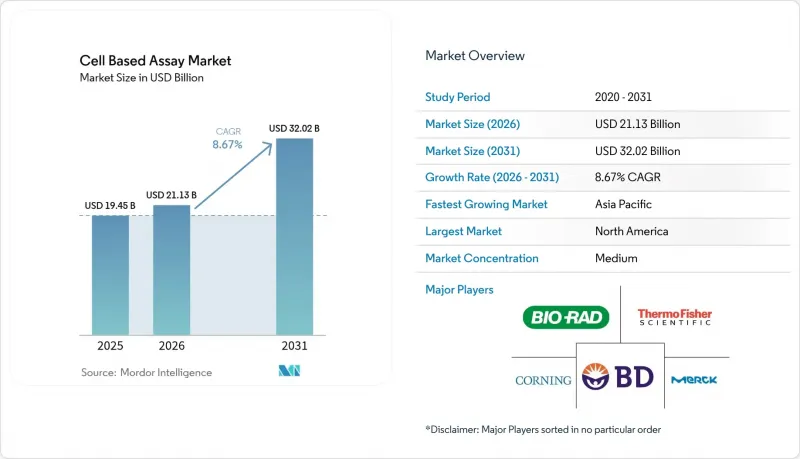
This report is Segmented by Product (Cell Lines, Reagents and Kits, and More), Technology (High-Throughput Screening, and More), Application (Drug Discovery and Development, and More), End User (Pharmaceutical and Biotechnology Companies, and More), and Geography (North America, Europe, Asia-Pacific, Middle East and Africa, South America). The Market Forecasts are Provided in Terms of Value (USD).
Global Cell Based Assay Market Trends and Insights
Rising Prevalence of Chronic & Lifestyle Diseases
Escalating cancer and metabolic-disease incidence is intensifying demand for sophisticated phenotypic screens that shorten discovery cycles. The National Cancer Institute budget rose by USD 407.6 million in 2024, earmarking funds for high-content platforms aimed at oncology pipelines. Vertex Pharmaceuticals committed USD 240 million to scale stem-cell therapeutics for type 1 diabetes, illustrating how disease-driven investment accelerates the cell-based assay market. As aging demographics widen clinical need, pharmaceutical groups integrate organoid panels and multiplex flow cytometry to improve translational relevance, reinforcing long-term growth.
Escalating Pharma-Biotech R&D Spending on Drug Discovery
Thermo Fisher Scientific has budgeted USD 2 billion (2025-2028) for U.S. manufacturing and R&D sites that include cell-analysis capabilities. AstraZeneca's USD 300 million cell-therapy facility in Maryland and Novo Nordisk's USD 4.1 billion injectable-therapeutic plant reveal broad capital reallocation toward in vitro testing workflows. Contract manufacturers such as Fujifilm Diosynth follow with USD 1.6 billion expansions focused on mammalian-cell processes, indicating multistakeholder confidence in the cell based assay industry
High Capital & Maintenance Costs of Advanced Platforms
Spectral flow systems can exceed USD 500,000, while annual service contracts add 20% of that figure, limiting uptake in price-sensitive academic and emerging-market settings. Financing schemes, including Beckman Coulter's modular upgrades, seek to lower entry barriers, but capital outlays remain a gating factor for broader cell-based assay market penetration.
Other drivers and restraints analyzed in the detailed report include:
- Continuous Advances in High-Throughput & Label-Free Assays
- Growing Adoption of 3-D Organoid Models for Precision Oncology
- Shortage of Multi-Disciplinary, Assay-Development Talent
For complete list of drivers and restraints, kindly check the Table Of Contents.
Segment Analysis
Reagents and kits, benefiting from repeat-purchase economics, contributed 51.02% of the cell-based assay market in 2025, anchoring the consumables revenue base. Cell lines, however, represent the pivotal innovation engine, expanding at 10.02% CAGR on the back of induced pluripotent stem cell advances and CRISPR-engineered disease models. TreeFrog Therapeutics' USD 240 million C-Stem licensing deal with Vertex underscores rising valuations for scalable, high-quality cellular material.
The microplates subsegment enjoys steady gains from laboratory-automation compatibility, while specialty media and buffers mirror overall market expansion. Stem-cell-derived lines increasingly replace primary cultures due to improved consistency, a critical requirement for high-content screens.
High-throughput screening (HTS) platforms, long the backbone of pharmaceutical discovery, delivered 41.66% revenue in 2025. Yet, demand is shifting toward physiologically relevant 3-D models that more accurately recapitulate in-vivo biology. The 3-D culture segment's 8.14% CAGR is propelled by organoid standardization and regulatory endorsement. BD's spectral flow integration with robotic arms illustrates how established vendors are future-proofing HTS through automation and multi-modal detection.
Label-free detection and spectral cytometry broaden assay readouts, while automated liquid handlers compress sample-prep times, enhancing throughput. Together, these advances are expanding the cell based assay market size for integrated platforms expected to post double-digit growth within oncology workflows.
Complete Report Scope:
- By Product
- Cell Lines
- Primary Cell Lines
- Stem Cell Lines
- Induced Pluripotent Cell Lines
- Engineered / Recombinant Lines
- Others
- Reagents & Kits
- Assay Reagents
- Reporter Gene & Substrate Kits
- Buffers & Media
- Other Reagents
- Microplates
- Other Consumables
- Cell Lines
- By Technology
- High-Throughput Screening
- Flow Cytometry
- Automated Liquid Handling
- Label-free Detection
- 3-D Cell-Culture Assays
- Others
- By Application
- Drug Discovery & Development
- ADME & Toxicology Studies
- Basic Research
- Precision & Regenerative Medicine
- Other Applications
- By End User
- Pharmaceutical & Biotechnology Companies
- Contract Research Organizations
- Academic & Government Institutes
- Others
- By Geography
- North America
- United States
- Canada
- Mexico
- Europe
- Germany
- United Kingdom
- France
- Italy
- Spain
- Rest of Europe
- Asia-Pacific
- China
- Japan
- India
- Australia
- South Korea
- Rest of Asia-Pacific
- Middle East & Africa
- GCC
- South Africa
- Rest of Middle East & Africa
- South America
- Brazil
- Argentina
- Rest of South America
- North America
Geography Analysis
North America generated 40.85% of 2025 revenue, underpinned by deep biopharma pipelines, NIH funding, and FDA guidance favoring human-relevant models. Government incentives and domestic manufacturing investments, for example, Thermo Fisher Scientific's USD 2 billion plan, fortify regional supply chains and enlarge the cell based assay market.
Asia-Pacific posts the fastest expansion at 9.02% CAGR. China's talent pool and infrastructure are scaling rapidly, highlighted by Cytek Biosciences' 50,000 sq ft manufacturing hub in Wuxi targeting high-dimensional cytometry systems. Japan's fast-track approval path for cell and gene therapies accelerates commercialization of assay-dependent products, reinforcing demand for 3-D cultures and AI-enhanced analytics.
Europe retains a substantial share through entrenched pharma clusters in Germany, Switzerland, and the UK. Harmonization of alternative-testing regulations with U.S. standards is catalyzing upgrades to label-free detection and organ-on-chip platforms. Meanwhile, Latin America, the Middle East, and Africa offer emerging opportunities where technology transfer and collaborative programs mitigate high-capital entry barriers. Collectively these regions add incremental volume to the global cell based assay market while progressing toward regulatory convergence.
- Beckton Dickinson
- Thermo Fisher Scientific
- Danaher
- Merck
- PerkinElmer
- Bio-Rad Laboratories
- Corning
- Lonza Group
- Promega
- Cell Signaling Technology
- Agilent Technologies
- Charles River
- Eurofins
- DiscoverX Corporation
- Revvity Life Sciences
- Abcam
- GE HealthCare Technologies Inc.
- Miltenyi Biotec
- Sartorius
- ATCC
Additional Benefits:
- The market estimate (ME) sheet in Excel format
- 3 months of analyst support
TABLE OF CONTENTS
1 Introduction
- 1.1 Study Assumptions & Market Definition
- 1.2 Scope of the Study
2 Research Methodology
3 Executive Summary
4 Market Landscape
- 4.1 Market Overview
- 4.2 Market Drivers
- 4.2.1 Rising Prevalence of Chronic & Lifestyle Diseases
- 4.2.2 Escalating Pharma-Biotech R&D Spending on Drug Discovery
- 4.2.3 Continuous Advances in High-Throughput & Label-Free Assays
- 4.2.4 Growing Adoption of 3-D Organoid Models for Precision Oncology
- 4.2.5 AI-Powered High-Content Analytics Accelerating Screening Cycles
- 4.2.6 Global Regulatory Shift Toward In Vitro Alternatives to Animal Tests
- 4.3 Market Restraints
- 4.3.1 High Capital & Maintenance Costs of Advanced Platforms
- 4.3.2 Shortage of Multi-Disciplinary, Assay-Development Talent
- 4.3.3 Steep Learning Curve for Data Integration & Assay Interoperability
- 4.3.4 Fragile, Specialty-Reagent Supply Chains Post-Pandemic
- 4.4 Porter's Five Forces Analysis
- 4.4.1 Threat of New Entrants
- 4.4.2 Bargaining Power of Buyers
- 4.4.3 Bargaining Power of Suppliers
- 4.4.4 Threat of Substitutes
- 4.4.5 Intensity of Competitive Rivalry
5 Market Size & Growth Forecasts (Value in USD)
- 5.1 By Product
- 5.1.1 Cell Lines
- 5.1.1.1 Primary Cell Lines
- 5.1.1.2 Stem Cell Lines
- 5.1.1.3 Induced Pluripotent Cell Lines
- 5.1.1.4 Engineered / Recombinant Lines
- 5.1.1.5 Others
- 5.1.2 Reagents & Kits
- 5.1.2.1 Assay Reagents
- 5.1.2.2 Reporter Gene & Substrate Kits
- 5.1.2.3 Buffers & Media
- 5.1.2.4 Other Reagents
- 5.1.3 Microplates
- 5.1.4 Other Consumables
- 5.1.1 Cell Lines
- 5.2 By Technology
- 5.2.1 High-Throughput Screening
- 5.2.2 Flow Cytometry
- 5.2.3 Automated Liquid Handling
- 5.2.4 Label-free Detection
- 5.2.5 3-D Cell-Culture Assays
- 5.2.6 Others
- 5.3 By Application
- 5.3.1 Drug Discovery & Development
- 5.3.2 ADME & Toxicology Studies
- 5.3.3 Basic Research
- 5.3.4 Precision & Regenerative Medicine
- 5.3.5 Other Applications
- 5.4 By End User
- 5.4.1 Pharmaceutical & Biotechnology Companies
- 5.4.2 Contract Research Organizations
- 5.4.3 Academic & Government Institutes
- 5.4.4 Others
- 5.5 By Geography
- 5.5.1 North America
- 5.5.1.1 United States
- 5.5.1.2 Canada
- 5.5.1.3 Mexico
- 5.5.2 Europe
- 5.5.2.1 Germany
- 5.5.2.2 United Kingdom
- 5.5.2.3 France
- 5.5.2.4 Italy
- 5.5.2.5 Spain
- 5.5.2.6 Rest of Europe
- 5.5.3 Asia-Pacific
- 5.5.3.1 China
- 5.5.3.2 Japan
- 5.5.3.3 India
- 5.5.3.4 Australia
- 5.5.3.5 South Korea
- 5.5.3.6 Rest of Asia-Pacific
- 5.5.4 Middle East & Africa
- 5.5.4.1 GCC
- 5.5.4.2 South Africa
- 5.5.4.3 Rest of Middle East & Africa
- 5.5.5 South America
- 5.5.5.1 Brazil
- 5.5.5.2 Argentina
- 5.5.5.3 Rest of South America
- 5.5.1 North America
6 Competitive Landscape
- 6.1 Market Concentration
- 6.2 Market Share Analysis
- 6.3 Company Profiles (includes Global level Overview, Market level overview, Core Segments, Financials as available, Strategic Information, Market Rank/Share for key companies, Products & Services, and Recent Developments)
- 6.3.1 Becton, Dickinson and Company
- 6.3.2 Thermo Fisher Scientific Inc.
- 6.3.3 Danaher Corporation
- 6.3.4 Merck KGaA
- 6.3.5 PerkinElmer Inc.
- 6.3.6 Bio-Rad Laboratories Inc.
- 6.3.7 Corning Incorporated
- 6.3.8 Lonza Group AG
- 6.3.9 Promega Corporation
- 6.3.10 Cell Signaling Technology Inc.
- 6.3.11 Agilent Technologies Inc.
- 6.3.12 Charles River Laboratories
- 6.3.13 Eurofins Scientific SE
- 6.3.14 DiscoverX Corporation
- 6.3.15 Revvity Life Sciences
- 6.3.16 Abcam plc
- 6.3.17 GE HealthCare Technologies Inc.
- 6.3.18 Miltenyi Biotec
- 6.3.19 Sartorius AG
- 6.3.20 ATCC
7 Market Opportunities & Future Outlook
- 7.1 White-space & Unmet-Need Assessment

