PUBLISHER: Mordor Intelligence | PRODUCT CODE: 2121528

PUBLISHER: Mordor Intelligence | PRODUCT CODE: 2121528
Automotive Suspension System - Market Share Analysis, Industry Trends & Statistics, Growth Forecasts (2026 - 2031)
According to Mordor Intelligence, the automotive suspension system market size is expected to grow from USD 142.38 billion in 2025 to USD 151.71 billion in 2026 and is forecast to reach USD 204.46 billion by 2031, advancing at a 6.15% CAGR during the forecast period (2026-2031), as electrification and software-defined vehicle architectures reshape chassis design priorities.
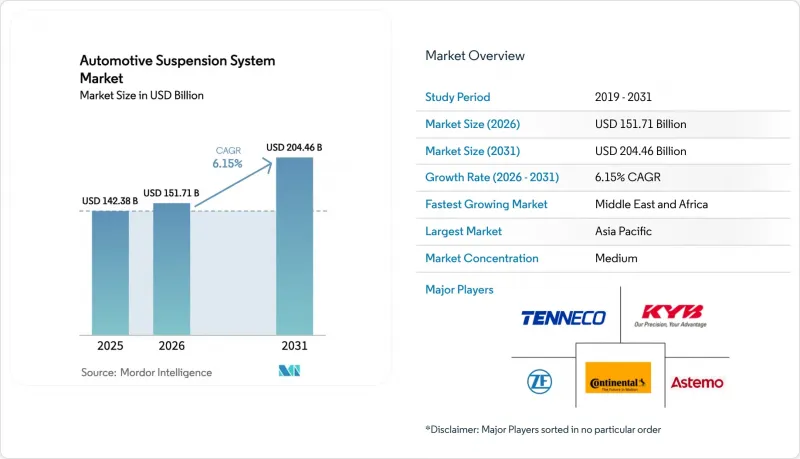
This report is Segmented by Component Type (Coil Spring, Leaf Spring, and More), Suspension System Type (Passive Suspension and More), Geometry (MacPherson Strut, Double Wishbone, and More), Vehicle Type (Passenger Cars, LCV, and More), Sales Channel (OEM and Aftermarket), Propulsion (ICE and More), and Geography. The Market Forecasts are Provided in Terms of Value (USD) and Volume (Units).
Global Automotive Suspension System Market Trends and Insights
Electrification-Driven Lightweight Adaptive Suspensions
Mahindra's BE 6e SUV, equipped with die-cast aluminum lower arms, enhances isolation indices on India's rugged roads. ZF's sMOTION, integrating air springs with active anti-roll bars, reduces mass compared to traditional steel coil counterparts, allowing electric vehicles to regain lost driving range. The European Commission's LEVA program has endorsed a 3D-printed thermoplastic composite arm, which is lighter than its forged steel counterpart and meets ECE crash standards. Toyota's bZ4X, using finite element analysis, has achieved weight reduction through a hollow stabilizer bar. Following this trend, Hendrickson's PRIMAAX EX has successfully reduced axle weight in electric delivery vans, a move that commercial fleets have echoed.
Regulatory Push for ADAS-Linked Chassis Safety
In Europe, UN R171 mandates lane-keeping and subtly advocates semi-active damping, as passive systems struggle to stabilize lateral loads within a crucial time window . Continental observed a significant reduction in lane-departure incidents with the installation of electronically controlled dampers. The EU regulation 2019/2144 emphasizes the importance of stable tire contact during emergency braking. In response, ZF's sMOTION technology pre-compresses the dampers before autonomous braking is activated. Meanwhile, NHTSA's 2025 initiative aims to certify automatic emergency braking systems for higher speeds, thereby amplifying the U.S. market's appetite for active safety features. Additionally, ISO 26262 has designated suspension ECUs as safety-critical, a move that extends development cycles but also underscores the importance of certified suppliers.
High Upfront and Lifecycle Cost of Smart Suspension Architectures
Volkswagen, facing higher vehicle build costs due to semi-active hardware, has limited adaptive damping to higher-priced Tiguan trims. This strategic move safeguards the company's margins. While air-spring compressors require replacement after a certain distance, overshadowing the lifetime costs of coil springs, India sees a higher failure rate in semi-active dampers within a specific distance. The issue arises from solenoid valves clogging with ferrous dust. In contrast, passive units report a significantly lower failure rate. Although subscription pricing eases entry costs, only a small percentage of price-sensitive buyers continue paying after the free trial period.
Other drivers and restraints analyzed in the detailed report include:
- Increasing Demand for Enhanced Ride Comfort and Handling
- Rapid SUV and Premium-Vehicle Sales in Emerging Economies
- Reliability and Maintenance Challenges in Harsh Conditions
For complete list of drivers and restraints, kindly check the Table Of Contents.
Segment Analysis
The automotive suspension system market for electronic control units and sensors is expanding at a 9.22% CAGR through 2031, driven by the 8-12 accelerometers and multiple ride-height sensors required per vehicle. Shock absorbers still accounted for 40.21% of 2025 revenue, but monotube upgrades, priced at USD 55-75, are holding their value even as volumes shift toward adaptive variants. Changes in the mix now prioritize monotube heat-dissipation efficiency, a key requirement for regenerative-braking duty cycles in electric vehicles (EVs). While shipments of coil and leaf springs remained stable, air-spring modules for Class 8 trucks have increased their share of North American axles.
Innovations on the horizon include thermoplastic-elastomer bushings, which maintain consistent stiffness across a wide temperature range, leading to a significant reduction in NVH complaints. Magnetorheological engine mounts, which utilize the same MR fluid as dampers, are isolating powertrain shocks in hybrids. This development is set to increase the content per vehicle for suppliers like Parker. Chinese monotube suppliers have captured a notable share of Asia-Pacific absorber revenue by pricing themselves lower than their Japanese counterparts, while adhering to GB/T 21510 quality standards.
Passive designs accounted for 64.32% of the automotive suspension system market share in 2025, but are ceding share as semi-active content rises due to volume-driven cost reductions; Ford's decision to standardize continuously controlled damping across all F-150 Lightning models underscores a significant trend. The growing adoption of semi-active systems, with a CAGR of 8.74%, is elevating the role of electronic components in the automotive suspension market, while proprietary control algorithms further solidify supplier dominance. While active hydraulically driven systems hold a smaller share of the market, they're finding a niche in luxury EVs. For instance, in the Mercedes-Benz EQS, cabin tilt control effectively reduces perceived lateral forces.
Price sensitivity keeps passive systems in the sub-USD 25,000 market segment, especially given the steep ISO 26262 validation costs for electronics. Torsion beams, which constitute a significant portion of the global compact-car output, are facing a shift. This is mainly due to EU lane-keeping mandates that are pushing for the replacement of these setups with independent systems. There's a notable regional disparity: Europe shows higher adoption rates for semi-active systems than Asia-Pacific, highlighting differing consumer valuations of automotive refinement.
Complete Report Scope:
- By Component Type
- Coil Springs
- Leaf Springs
- Air Springs
- Shock Absorbers
- Stabilizer / Anti-roll Bars
- Suspension Arms & Links
- Electronic Control Units and Sensors
- Other Components
- By Suspension System Type
- Passive Suspension
- Semi-Active Suspension
- Active Suspension
- By Geometry /Architecture
- MacPherson Strut
- Double Wishbone
- Multi-Link
- Torsion Beam / Twist Beam
- Other Geometries
- By Vehicle Type
- Passenger Cars
- Light Commercial Vehicles
- Heavy Commercial Vehicles
- By Sales Channel
- Original Equipment Manufacturer (OEM)
- Aftermarket
- By Propulsion
- Internal-Combustion-Engine Vehicles
- Electric & Hybrid Vehicles
- By Geography
- North America
- United States
- Canada
- Rest of North America
- South America
- Brazil
- Argentina
- Rest of South America
- Europe
- Germany
- United Kingdom
- France
- Italy
- Spain
- Russia
- Rest of Europe
- Asia-Pacific
- China
- India
- Japan
- South Korea
- Rest of Asia-Pacific
- Middle East and Africa
- Saudi Arabia
- United Arab Emirates
- South Africa
- Egypt
- Turkey
- Rest of Middle East and Africa
- North America
Geography Analysis
The Asia-Pacific region accounted for 48.96% of the automotive suspension system market share in 2025, as China's light-vehicle production saw local OEMs, such as BYD, equipping their Seal sedans with adaptive dampers. In India, a booming SUV market led Tata to implement multi-link rear axles, which reduced body roll and aligned with benchmarks set by the Hyundai Tucson. To reduce unit labor costs, Japanese suppliers relocated absorber production to Thailand and Vietnam, resulting in a drop in Japan's regional share. Highlighting the push for localization, Hyundai Mobis inaugurated a plant in Indonesia, aiming to produce suspension modules annually.
North America and Europe accounted for a significant portion of the turnover, with a noticeable tilt towards semi-active content. Ford's F-150 Lightning set a precedent by making adaptive damping standard, achieving full penetration across its sales. ZF's production line in Germany successfully delivered sMOTION units for BMW and Mercedes-Benz. Europe's lane-keeping regulations have driven the adoption of semi-active installations. Meanwhile, North America's aftermarket experienced a revenue boost, driven by the surge in e-commerce demand for adjustable coilovers. In Canada, frigid winters are prompting pickup buyers to opt for air-springs, ensuring optimal ground clearance.
The Middle East and Africa, although they held a smaller share of the 2025 volume, are pacing the global growth chart at a 7.65% CAGR through 2031. Saudi Arabia's Lucid joint venture plans to produce air-suspended cars annually, establishing new regional supply chains for Continental and ZF. In the UAE, luxury car demand skews heavily towards adaptive damping systems, a move aimed at combating the sweltering desert heat. While South Africa's power supply challenges led to a dip in car production, a weaker rand bolstered exports to Europe, seeing an uptick. In response to Egypt's high import tariffs, Tenneco is setting up a damper plant in the Suez zone. South America accounted for a small market share, with Argentina witnessing a surge after lifting caps on component imports.
- Continental AG
- ZF Friedrichshafen AG
- Tenneco Inc.
- KYB Corporation
- Hitachi Astemo Ltd.
- Thyssenkrupp AG
- Mando Corporation
- Marelli Corporation
- Hyundai Mobis Co. Ltd.
- BWI Group
- Sogefi SpA
- Parker LORD Corporation
- Benteler International AG
- Fox Factory Holding Corp.
- Hendrickson International
- Showa Corporation
Additional Benefits:
- The market estimate (ME) sheet in Excel format
- 3 months of analyst support
TABLE OF CONTENTS
1 Introduction
- 1.1 Study Assumptions and Market Definition
- 1.2 Scope of the Study
2 Research Methodology
3 Executive Summary
4 Market Landscape
- 4.1 Market Overview
- 4.2 Market Drivers
- 4.2.1 Increasing Demand for Enhanced Ride Comfort and Handling
- 4.2.2 Electrification-Driven Chassis Redesign (Lightweight Adaptive Suspensions)
- 4.2.3 Regulatory Push for ADAS-Linked Chassis Safety
- 4.2.4 Rapid SUV and Premium-Vehicle Sales in Emerging Economies
- 4.2.5 Subscription-Based OTA Upgrades Unlocking Active-Suspension Features
- 4.2.6 3-D Printed Composite Suspension Parts Reducing Tooling Cost
- 4.3 Market Restraints
- 4.3.1 High Upfront and Lifecycle Cost of Smart Suspension Architectures
- 4.3.2 Reliability and Maintenance Challenges in Harsh Conditions
- 4.3.3 Cyber-Security and Functional-Safety Compliance Burden
- 4.3.4 Rare-Earth MR-Fluid and Semiconductor Sensor Supply Bottlenecks
- 4.4 Value / Supply-Chain Analysis
- 4.5 Regulatory Landscape
- 4.6 Technological Outlook
- 4.7 Porter's Five Forces
- 4.7.1 Bargaining Power of Suppliers
- 4.7.2 Bargaining Power of Buyers/Consumers
- 4.7.3 Threat of New Entrants
- 4.7.4 Threat of Substitute Products
- 4.7.5 Intensity of Competitive Rivalry
5 Market Size and Growth Forecasts (Value (USD) and Volume (Units))
- 5.1 By Component Type
- 5.1.1 Coil Springs
- 5.1.2 Leaf Springs
- 5.1.3 Air Springs
- 5.1.4 Shock Absorbers
- 5.1.5 Stabilizer / Anti-roll Bars
- 5.1.6 Suspension Arms & Links
- 5.1.7 Electronic Control Units and Sensors
- 5.1.8 Other Components
- 5.2 By Suspension System Type
- 5.2.1 Passive Suspension
- 5.2.2 Semi-Active Suspension
- 5.2.3 Active Suspension
- 5.3 By Geometry /Architecture
- 5.3.1 MacPherson Strut
- 5.3.2 Double Wishbone
- 5.3.3 Multi-Link
- 5.3.4 Torsion Beam / Twist Beam
- 5.3.5 Other Geometries
- 5.4 By Vehicle Type
- 5.4.1 Passenger Cars
- 5.4.2 Light Commercial Vehicles
- 5.4.3 Heavy Commercial Vehicles
- 5.5 By Sales Channel
- 5.5.1 Original Equipment Manufacturer (OEM)
- 5.5.2 Aftermarket
- 5.6 By Propulsion
- 5.6.1 Internal-Combustion-Engine Vehicles
- 5.6.2 Electric & Hybrid Vehicles
- 5.7 By Geography
- 5.7.1 North America
- 5.7.1.1 United States
- 5.7.1.2 Canada
- 5.7.1.3 Rest of North America
- 5.7.2 South America
- 5.7.2.1 Brazil
- 5.7.2.2 Argentina
- 5.7.2.3 Rest of South America
- 5.7.3 Europe
- 5.7.3.1 Germany
- 5.7.3.2 United Kingdom
- 5.7.3.3 France
- 5.7.3.4 Italy
- 5.7.3.5 Spain
- 5.7.3.6 Russia
- 5.7.3.7 Rest of Europe
- 5.7.4 Asia-Pacific
- 5.7.4.1 China
- 5.7.4.2 India
- 5.7.4.3 Japan
- 5.7.4.4 South Korea
- 5.7.4.5 Rest of Asia-Pacific
- 5.7.5 Middle East and Africa
- 5.7.5.1 Saudi Arabia
- 5.7.5.2 United Arab Emirates
- 5.7.5.3 South Africa
- 5.7.5.4 Egypt
- 5.7.5.5 Turkey
- 5.7.5.6 Rest of Middle East and Africa
- 5.7.1 North America
6 Competitive Landscape
- 6.1 Market Concentration
- 6.2 Strategic Moves
- 6.3 Market Share Analysis
- 6.4 Company Profiles (Includes Global Level Overview, Market Level Overview, Core Segments, Financials as Available, Strategic Information, Market Rank/Share for Key Companies, Products & Services, and Recent Developments)
- 6.4.1 Continental AG
- 6.4.2 ZF Friedrichshafen AG
- 6.4.3 Tenneco Inc.
- 6.4.4 KYB Corporation
- 6.4.5 Hitachi Astemo Ltd.
- 6.4.6 Thyssenkrupp AG
- 6.4.7 Mando Corporation
- 6.4.8 Marelli Corporation
- 6.4.9 Hyundai Mobis Co. Ltd.
- 6.4.10 BWI Group
- 6.4.11 Sogefi SpA
- 6.4.12 Parker LORD Corporation
- 6.4.13 Benteler International AG
- 6.4.14 Fox Factory Holding Corp.
- 6.4.15 Hendrickson International
- 6.4.16 Showa Corporation
7 Market Opportunities and Future Outlook
- 7.1 White-space & Unmet-Need Assessment

