PUBLISHER: Mordor Intelligence | PRODUCT CODE: 2121541

PUBLISHER: Mordor Intelligence | PRODUCT CODE: 2121541
China Pressure Sensors - Market Share Analysis, Industry Trends & Statistics, Growth Forecasts (2026 - 2031)
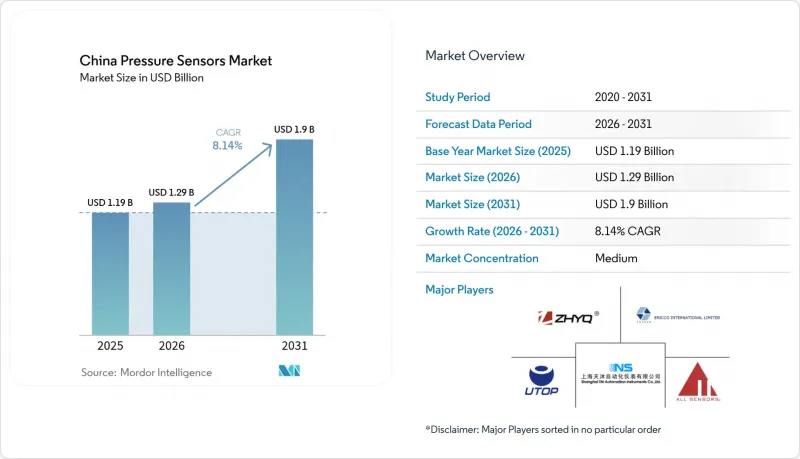
According to Mordor Intelligence, the China pressure sensors market size was valued at USD 1.19 billion in 2025 and estimated to grow from USD 1.29 billion in 2026 to reach USD 1.9 billion by 2031, at a CAGR of 8.14% during the forecast period (2026-2031).
This report is Segmented by Product Type (MEMS, Capacitive, Piezoelectric, and More), Pressure Measurement (Gauge, Absolute, Differential, Vacuum, and Sealed Reference), End-User Industry (Automotive, Aerospace and Defense, Chemical and Petrochemical, Medical Devices, and More), Technology Platform (Piezoresistive, Capacitive MEMS, and More). The Market Forecasts are Provided in Terms of Value (USD).
China Pressure Sensors Market Trends and Insights
Accelerating Adoption of MEMS-Based Miniaturized Sensors in Electric Vehicles
China's electric-vehicle leadership pushes unprecedented volumes for compact, automotive-qualified pressure sensors. Domestic fabs now deliver millions of MEMS units annually, lowering import dependence and ensuring supply resilience. Each EV integrates 15-20 sensing points for thermal management, braking, and ADAS functions, and the convergence of autonomy with electrification multiplies sensor content per car. Robust designs withstand -40 °C to 150 °C temperature swings and high vibration, meeting AEC-Q103 reliability demands. Rapid battery-pack innovation further fuels demand for high-accuracy differential sensors that monitor cell pressure for safety. As automakers localize component sourcing, price-performance dynamics favor homegrown MEMS that match global specifications at lower landed cost.
Government Incentives for Domestic Semiconductor Self-Sufficiency and Sensor Localization
National and provincial programs earmark substantial grants, tax incentives, and low-interest loans for sensor fabs and R&D centers. Wuxi High-tech Zone alone raised several hundred million RMB for four pressure-sensor start-ups in 2024, funding cleanroom expansion and backend packaging lines. Sensor pilot lines now benefit from shared metrology labs, lowering entry barriers for small firms. The 14th Five-Year Plan prioritizes core process equipment, aiming to lift domestic content above 70% by 2030. Strategic clusters in Xiong'an and Shenzhen offer expedited permitting, discounted land, and workforce subsidies, accelerating time-to-market for qualified devices.
Volatility in Silicon-Wafer and Rare-Earth Material Prices
Global wafer-fab cycles create sharp price swings; 2024 spot silicon rose 38% before softening in late Q4. China's dominance in rare-earth processing introduces additional uncertainty, as export-quota adjustments and geopolitical tensions influence Nd- and Pr-based compound pricing. Manufacturers hedge by multi-sourcing and holding higher safety stocks, tying up working capital and pressuring gross margins. Larger fabs leverage forward contracts, but smaller houses face squeezed book-to-bill ratios, delaying capacity upgrades. Accelerated recycling programs may partly ease supply-chain risk after 2026.
Other drivers and restraints analyzed in the detailed report include:
- Expansion of Industry 4.0 Smart Manufacturing Across Chinese Industrial Parks
- Rising Demand for High-Precision Medical Devices and Wearable Health Monitoring
- High Reliability-Certification Barriers for Automotive-Grade Sensors
For complete list of drivers and restraints, kindly check the Table Of Contents.
Segment Analysis
MEMS devices accounted for 42.35% of the China pressure sensors market share in 2025, and this category is projected to grow at a 9.34% CAGR to 2031. MEMS dies fabricated on 8-inch CMOS lines leverage mature tooling, delivering high yield and low unit cost. Simultaneous integration of ADCs and temperature compensation logic enables plug-and-play modules, supporting drop-in replacement across industries. Capacitive sensors maintain a loyal base in industrial pneumatics thanks to superior overload tolerance, whereas piezoelectric variants meet aerospace vibration needs. Strain-gauge sensors serve heavy machinery requiring rugged mechanical bonding. Optical pressure sensors occupy small niches in high-EMI zones such as power-generation switchyards. Hybrid smart modules that pair MEMS cores with BLE or Wi-Fi microcontrollers illustrate an evolution from single-parameter measurement toward holistic condition monitoring.
The China pressure sensors market size for MEMS designs benefits from automotive and medical synergies, where miniaturization, low power, and fast response converge. Domestic IDMs invest in wafer-level chip-scale packaging to shrink Z-height for smartwatches and hearables. Strategic partnerships with ASIC design houses reduce BOM cost, quickening competitive cycles. As fabs qualify 12-inch MEMS tooling after 2027, die output per wafer will rise, further lowering cost curves and widening adoption into price-sensitive appliances.
Gauge variants led the China pressure sensors market with 48.25% revenue in 2025, serving air-brake, HVAC, and hydraulic circuits. However, differential devices will record the highest 9.68% CAGR, propelled by flow metering, filter monitoring, and smart-building VAV control. Vacuum and sealed-reference devices supply semiconductor tools and laboratory instrumentation where absolute accuracy below 10 mTorr is mandatory. Wireless differential modules achieve sub-Pascal resolution at 1 µA sleep currents, aligning with battery-powered retrofit projects.
China pressure sensors market size gains in differential configurations mirror expanding digital oilfield programs and high-rise energy audits. As construction codes tighten envelope-leakage limits, air-flow balancing becomes mandatory, lifting sensor attach rates per floor. Manufacturers improve long-term stability via silicon-on-insulator diaphragms and proprietary micro-porous reference cavities, curbing drift below 0.1% per year. Emerging micro-fluidic dosing lines in biotech plants adopt millibar-range differential sensing to assure dosing accuracy.
Complete Report Scope:
- By Product Type
- MEMS Pressure Sensors
- Capacitive Pressure Sensors
- Piezoelectric Pressure Sensors
- Strain Gauge Pressure Sensors
- Optical Pressure Sensors
- Other Product Types
- By Pressure Measurement
- Gauge Pressure Sensors
- Absolute Pressure Sensors
- Differential Pressure Sensors
- Vacuum Pressure Sensors
- Sealed Reference Pressure Sensors
- By End-user Industry
- Automotive
- Aerospace and Defense
- Chemical and Petrochemical
- Medical Devices
- HVAC and Building Automation
- Power Generation
- Industrial Manufacturing
- Oil and Gas
- Consumer Electronics
- Other Industries
- By Technology Platform
- Piezoresistive
- Capacitive MEMS
- Optical Fiber
- Resonant Solid State
- Electromagnetic
- Nano and Flexible
List of Companies Covered in this Report:
- Honeywell International Inc.
- Robert Bosch GmbH
- Infineon Technologies AG
- TE Connectivity Ltd.
- Siemens Aktiengesellschaft
- Emerson Electric Co.
- ABB Ltd.
- Sensata Technologies Holding plc
- Panasonic Holdings Corporation
- STMicroelectronics N.V.
- NXP Semiconductors N.V.
- First Sensor AG
- All Sensors Corporation
- Shanghai Zhaohui Pressure Apparatus Co., Ltd.
- Ericco International Limited
- Xi'an UTOP Measurement Instrument Co., Ltd.
- TM Automation Instruments Co., Ltd.
- Ninghai Sendo Sensor Co., Ltd.
- Suzhou Memsensor Technology Co., Ltd.
- Hunan Firstrate Sensor Co., Ltd.
- Jiangsu Hanwei Electronics Co., Ltd.
- WIKA Alexander Wiegand SE and Co. KG
- Keller Druckmesstechnik AG
Additional Benefits:
- The market estimate (ME) sheet in Excel format
- 3 months of analyst support
TABLE OF CONTENTS
1 INTRODUCTION
- 1.1 Study Assumptions and Market Definition
- 1.2 Scope of the Study
2 RESEARCH METHODOLOGY
3 EXECUTIVE SUMMARY
4 MARKET LANDSCAPE
- 4.1 Market Overview
- 4.2 Market Drivers
- 4.2.1 Accelerating adoption of MEMS-based miniaturized sensors in electric vehicles
- 4.2.2 Government incentives for domestic semiconductor self-sufficiency and sensor localization
- 4.2.3 Expansion of Industry 4.0 smart manufacturing across Chinese industrial parks
- 4.2.4 Rising demand for high-precision medical devices and wearable health monitoring
- 4.2.5 HVAC and smart-building retrofits boosting demand for wireless pressure sensors
- 4.2.6 Digital oil and gas field development requiring harsh-environment pressure sensing
- 4.3 Market Restraints
- 4.3.1 Volatility in silicon-wafer and rare-earth material prices
- 4.3.2 High reliability-certification barriers for automotive-grade sensors
- 4.3.3 Intellectual-property disputes limiting export opportunities
- 4.3.4 Short product lifecycles causing rapid obsolescence for consumer-grade sensors
- 4.4 Industry Value Chain Analysis
- 4.5 Regulatory Landscape
- 4.6 Technological Outlook
- 4.7 Porter's Five Forces Analysis
- 4.7.1 Threat of New Entrants
- 4.7.2 Bargaining Power of Buyers
- 4.7.3 Bargaining Power of Suppliers
- 4.7.4 Threat of Substitutes
- 4.7.5 Intensity of Competitive Rivalry
5 MARKET SIZE AND GROWTH FORECASTS (VALUE)
- 5.1 By Product Type
- 5.1.1 MEMS Pressure Sensors
- 5.1.2 Capacitive Pressure Sensors
- 5.1.3 Piezoelectric Pressure Sensors
- 5.1.4 Strain Gauge Pressure Sensors
- 5.1.5 Optical Pressure Sensors
- 5.1.6 Other Product Types
- 5.2 By Pressure Measurement
- 5.2.1 Gauge Pressure Sensors
- 5.2.2 Absolute Pressure Sensors
- 5.2.3 Differential Pressure Sensors
- 5.2.4 Vacuum Pressure Sensors
- 5.2.5 Sealed Reference Pressure Sensors
- 5.3 By End-user Industry
- 5.3.1 Automotive
- 5.3.2 Aerospace and Defense
- 5.3.3 Chemical and Petrochemical
- 5.3.4 Medical Devices
- 5.3.5 HVAC and Building Automation
- 5.3.6 Power Generation
- 5.3.7 Industrial Manufacturing
- 5.3.8 Oil and Gas
- 5.3.9 Consumer Electronics
- 5.3.10 Other Industries
- 5.4 By Technology Platform
- 5.4.1 Piezoresistive
- 5.4.2 Capacitive MEMS
- 5.4.3 Optical Fiber
- 5.4.4 Resonant Solid State
- 5.4.5 Electromagnetic
- 5.4.6 Nano and Flexible
6 COMPETITIVE LANDSCAPE
- 6.1 Market Concentration
- 6.2 Strategic Moves
- 6.3 Market Share Analysis
- 6.4 Company Profiles (includes Global-level Overview, Market-level Overview, Core Segments, Financials as available, Strategic Information, Market Rank/Share, Products and Services, Recent Developments)
- 6.4.1 Honeywell International Inc.
- 6.4.2 Robert Bosch GmbH
- 6.4.3 Infineon Technologies AG
- 6.4.4 TE Connectivity Ltd.
- 6.4.5 Siemens Aktiengesellschaft
- 6.4.6 Emerson Electric Co.
- 6.4.7 ABB Ltd.
- 6.4.8 Sensata Technologies Holding plc
- 6.4.9 Panasonic Holdings Corporation
- 6.4.10 STMicroelectronics N.V.
- 6.4.11 NXP Semiconductors N.V.
- 6.4.12 First Sensor AG
- 6.4.13 All Sensors Corporation
- 6.4.14 Shanghai Zhaohui Pressure Apparatus Co., Ltd.
- 6.4.15 Ericco International Limited
- 6.4.16 Xi'an UTOP Measurement Instrument Co., Ltd.
- 6.4.17 TM Automation Instruments Co., Ltd.
- 6.4.18 Ninghai Sendo Sensor Co., Ltd.
- 6.4.19 Suzhou Memsensor Technology Co., Ltd.
- 6.4.20 Hunan Firstrate Sensor Co., Ltd.
- 6.4.21 Jiangsu Hanwei Electronics Co., Ltd.
- 6.4.22 WIKA Alexander Wiegand SE and Co. KG
- 6.4.23 Keller Druckmesstechnik AG
7 MARKET OPPORTUNITIES AND FUTURE OUTLOOK
- 7.1 White-space and Unmet-need Assessment

