PUBLISHER: Mordor Intelligence | PRODUCT CODE: 2121589

PUBLISHER: Mordor Intelligence | PRODUCT CODE: 2121589
Annatto - Market Share Analysis, Industry Trends & Statistics, Growth Forecasts (2026 - 2031)
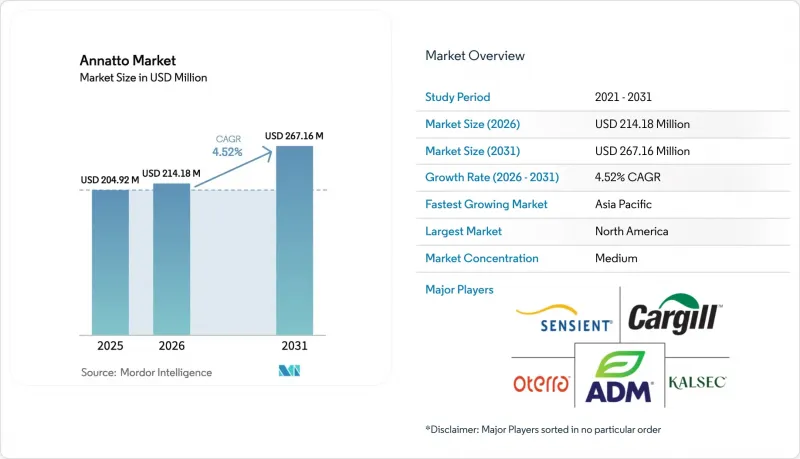
According to Mordor Intelligence, the annatto market size is expected to grow from USD 204.92 million in 2025 to USD 214.18 million in 2026 and is forecast to reach USD 267.16 million by 2031 at 4.52% CAGR over 2026-2031.
This report is Segmented by Product Type (Oil-Soluble, Water-Soluble, Emulsified), Nature (Organic, Conventional), Application (Food and Beverage, Cosmetic and Personal Care, Animal Feed, Other Applications), and Geography (North America, Europe, Asia-Pacific, South America, Middle East and Africa). The Market Forecasts are Provided in Terms of Value (USD).
Global Annatto Market Trends and Insights
Strong shift toward clean-label and naturally sourced food additives
Consumer demand for clean-label and naturally sourced food additives is driving significant changes in the annatto market. Food manufacturers are increasingly replacing artificial colors with natural pigments like annatto extract to align with evolving consumer preferences. In the United Kingdom, over 76% of adults read food labels before purchasing, with 82% of individuals aged 18-34 doing so. Additionally, nearly 45% of consumers report paying more attention to label information compared to five years ago, and 70% focus on processing and ingredient details, as per the National Science Foundation . This shift has prompted food brands to prioritize ingredient transparency and secure clean-label certifications to maintain consumer trust and strengthen their market positioning. Annatto ingredient manufacturers, such as DDW The Color House, are responding to these trends by investing in sustainable extraction technologies and expanding their clean-label product portfolios. As a globally recognized supplier of high-purity natural annatto extracts, DDW supports multinational food and beverage producers across applications like cheese, snacks, beverages, and other processed foods. These developments highlight how consumer preferences for natural and transparent ingredients are shaping innovation and competitive strategies within the annatto market.
Growing adoption of plant-forward and vegan dietary lifestyles
The increasing adoption of plant-forward and vegan dietary lifestyles is driven by consumer preferences for sustainable, ethical, and health-focused alternatives to animal-based products. This shift has created a growing demand for clean, recognizable ingredients, with annatto emerging as a key natural colorant in plant-based formulations. According to data from The Good Food Institute and the Plant Based Food Association, 6 in 10 or 59% of United States households purchased plant-based foods in 2024, reflecting mainstream acceptance and the need for natural additives to enhance the visual appeal of vegan dairy alternatives and meat substitutes . This trend has intensified reformulation efforts, as brands prioritize transparency and clean-label solutions to meet consumer expectations. Annatto ingredient manufacturers, such as Kalsec, are addressing these demands by offering verified vegan-compliant oleoresins, supporting scalability in beverages, snacks, and other applications. Additionally, regulatory initiatives promoting sustainability have further positioned annatto as a critical component in aligning plant-based products with wellness and ethical sourcing goals. The minimal processing of annatto aligns with consumer scrutiny of product labels, reinforcing its role in delivering authenticity without compromising vibrancy or stability. As plant-based portfolios diversify, annatto manufacturers are leveraging these dynamics to expand their applications, solidifying naturally sourced additives as essential to the evolving vegan market.
Fluctuating prices of annatto seeds due to supply-side uncertainties
Fluctuating prices of annatto seeds, driven by supply-side uncertainties, present a significant challenge for the market. Annatto seeds, primarily sourced from tropical regions like Latin America, are subject to unpredictable weather conditions, seasonal harvest cycles, and agricultural volatility, leading to inconsistent yields and supply. This dependency results in frequent price fluctuations, with agricultural data showing substantial year-to-year variations in seed availability and market prices. These fluctuations directly impact extract producers' raw material costs and profit margins, complicating planning and pricing for food, cosmetic, and pharmaceutical formulators relying on annatto-derived colorants and ingredients. Furthermore, limited mechanization and smallholder farming practices in key producing countries exacerbate issues of inconsistent quality and availability, increasing lead times and procurement costs. Manufacturers are often forced to absorb higher input expenses or seek alternative colorants, which dampens market growth. Companies like Novonesis, a global supplier of natural annatto extracts for food and beverage applications, have implemented diversified sourcing strategies and optimized supply chains to address price instability and ensure supply continuity. However, these measures underscore the broader challenges posed by raw material price volatility, which continues to affect the market's stability and competitive dynamics.
Other drivers and restraints analyzed in the detailed report include:
- Expansion of the global processed and packaged food industry
- Broader utilization across cosmetics and pharmaceutical formulations
- Stability limitations in aqueous and light-sensitive formulations
For complete list of drivers and restraints, kindly check the Table Of Contents.
Segment Analysis
Oil-soluble annatto held the largest market share of 43.48% in 2025, primarily driven by its use in fat-based applications such as cheese and margarine. However, the growing demand for emulsified annatto is reshaping the market landscape. Emulsified formats are projected to expand at a CAGR of 7.41% from 2026 to 2031, surpassing oil-soluble and water-soluble formats. These formats address the need for versatile dispersions that perform effectively in both aqueous and lipid phases without phase separation or color migration. By combining bixin or norbixin with emulsifiers like lecithin, polysorbates, or modified starches, emulsified annatto creates stable systems that withstand pH changes, ionic variations, and thermal processing. Regulatory approvals under FDA 21 CFR 73.30, 73.1030, and EU E160b(i)/(ii) further support its adoption by enabling flexible "annatto color" labeling, which aligns with consumer scrutiny of ingredient lists.
The processed food industry's focus on simplified formulations and clean-label trends is a key driver of emulsified annatto's growth. These formats reduce inventory complexity and accelerate product launches, particularly as vegan food adoption rises, with 59% of United States households purchasing plant-based foods in 2024. Additionally, encapsulation techniques such as spray-drying with maltodextrin or gum arabic enhance shelf life for dry mixes, consolidating the position of established suppliers. Emulsified annatto's technical advantages, including phase stability and compatibility across diverse applications, position it as a critical solution for evolving market demands.
Complete Report Scope:
- By Product Type
- Oil-Soluble
- Water-Soluble
- Emulsified
- By Nature
- Organic
- Conventional
- By Application
- Food and Beverage
- Dairy Products
- Bakery and Confectionery
- Beverages
- Meat and Plant-based Analogues
- Other Food and Beverages
- Cosmetic and Personal Care
- Animal Feed
- Other Applications
- Food and Beverage
- By Geography
- North America
- United States
- Canada
- Mexico
- Rest of North America
- Europe
- Germany
- United Kingdom
- Italy
- France
- Spain
- Netherlands
- Poland
- Belgium
- Sweden
- Rest of Europe
- Asia-Pacific
- China
- India
- Japan
- Australia
- Indonesia
- South Korea
- Thailand
- Singapore
- Rest of Asia-Pacific
- South America
- Brazil
- Argentina
- Colombia
- Chile
- Peru
- Rest of South America
- Middle East and Africa
- South Africa
- Saudi Arabia
- United Arab Emirates
- Nigeria
- Egypt
- Morocco
- Turkey
- Rest of Middle East and Africa
- North America
Geography Analysis
North America held the largest share of the annatto market in 2025, accounting for 31.44%. The region reflects a mature market where annatto usage in dairy, bakery, and processed food applications is well established. With clean-label reformulation cycles largely completed, growth is primarily driven by population expansion and per-capita consumption rather than new substitution opportunities. In contrast, Europe's demand is shaped by stringent regulatory oversight and high consumer preference for natural ingredients. EU Regulation 2020/771, which divides E160b into E160b(i) for bixin and E160b(ii) for norbixin, enhances technical transparency but increases compliance complexity for suppliers. While regulatory clarity supports stable demand, Europe's mature food sector and slower population growth limit volume expansion compared to other regions.
The Asia-Pacific region is projected to grow at the fastest CAGR of 7.47% through 2031, driven by rising processed food consumption in China, India, and Southeast Asia. Strengthened regulatory enforcement and alignment with Codex Alimentarius standards create a harmonized operating environment for multinational food producers. For example, China's National Health Commission includes annatto under GB 2760 standards, and India's Food Safety and Standards Authority permits its use under INS 160b. These developments enable standardized formulations across markets, reducing reformulation costs and accelerating adoption in dairy, confectionery, and snack categories. South America, meanwhile, plays a dual role as a major production hub and an emerging consumption market. Brazil, Peru, and Colombia account for over 85% of global annatto seed production, while rising middle-class incomes drive domestic demand for processed foods and cosmetics, strengthening vertical integration opportunities.
The Middle East and Africa represent developing markets where expanding modern retail formats and growing awareness of natural ingredients support early-stage demand. However, infrastructure gaps, import tariffs, and evolving regulatory frameworks constrain faster adoption compared to more established regions. Suppliers focusing on Asia-Pacific distribution networks, regulatory compliance, and local partnerships are well-positioned for growth, while incumbents in North America and Europe must prioritize formulation innovation and premium organic offerings to maintain competitiveness. Companies like Oterra A/S exemplify this approach by aligning geographic strategies with evolving consumption and regulatory trends.
- Aarkay Food Products Ltd.
- AICA Kogyo Co., Ltd. (AICA Color)
- Amerilure Inc.
- Biocon Colors
- Cargill, Incorporated
- FMC Corporation
- Novozymes A/S
- International Flavors & Fragrances (Frutarom)
- Kalsec Inc.
- DIC Corporation (Sun Chemical)
- Sensient Technologies Corporation
- Oterra A/S
- Archer Daniels Midland Company
- Givaudan S.A.
- Fiorio Colori S.p.A.
- IFC Solutions, Inc.
- D.B. Dyechem
- Roquette Freres S.A. (Sethness Roquette)
- FoodRGB Inc.
- Vinayak Ingredients Pvt. Ltd.
- DDW The Color House (GNT Group)
- Synthite Industries Pvt. Ltd.
Additional Benefits:
- The market estimate (ME) sheet in Excel format
- 3 months of analyst support
TABLE OF CONTENTS
1 INTRODUCTION
- 1.1 Study Assumptions and Market Definition
- 1.2 Scope of the Study
2 RESEARCH METHODOLOGY
3 EXECUTIVE SUMMARY
4 MARKET DYNAMICS
- 4.1 Market Overview
- 4.2 Market Drivers
- 4.2.1 Strong shift toward clean-label and naturally sourced food additives
- 4.2.2 Rising demand for certified organic and non-GMO ingredient solutions
- 4.2.3 Growing adoption of plant-forward and vegan dietary lifestyles
- 4.2.4 Expansion of the global processed and packaged food industry
- 4.2.5 Broader utilization across cosmetics and pharmaceutical formulations
- 4.2.6 Ongoing innovation in extraction and formulation technology
- 4.3 Market Restraints
- 4.3.1 Fluctuating prices of annatto seeds due to supply-side uncertainties
- 4.3.2 Stability limitations in aqueous and light-sensitive formulations
- 4.3.3 Restricted cultivation zones and dependence on specific sourcing regions
- 4.3.4 Intensifying competition from other natural coloring agents
- 4.4 Supply Chain Analysis
- 4.5 Regulatory Landscape
- 4.6 Porter's Five Forces Analysis
- 4.6.1 Threat of New Entrants
- 4.6.2 Bargaining Power of Suppliers
- 4.6.3 Bargaining Power of Buyers
- 4.6.4 Threat of Substitutes
- 4.6.5 Intensity of Competitive Rivalry
5 MARKET SIZE AND GROWTH FORECASTS (VALUE)
- 5.1 By Product Type
- 5.1.1 Oil-Soluble
- 5.1.2 Water-Soluble
- 5.1.3 Emulsified
- 5.2 By Nature
- 5.2.1 Organic
- 5.2.2 Conventional
- 5.3 By Application
- 5.3.1 Food and Beverage
- 5.3.1.1 Dairy Products
- 5.3.1.2 Bakery and Confectionery
- 5.3.1.3 Beverages
- 5.3.1.4 Meat and Plant-based Analogues
- 5.3.1.5 Other Food and Beverages
- 5.3.2 Cosmetic and Personal Care
- 5.3.3 Animal Feed
- 5.3.4 Other Applications
- 5.3.1 Food and Beverage
- 5.4 By Geography
- 5.4.1 North America
- 5.4.1.1 United States
- 5.4.1.2 Canada
- 5.4.1.3 Mexico
- 5.4.1.4 Rest of North America
- 5.4.2 Europe
- 5.4.2.1 Germany
- 5.4.2.2 United Kingdom
- 5.4.2.3 Italy
- 5.4.2.4 France
- 5.4.2.5 Spain
- 5.4.2.6 Netherlands
- 5.4.2.7 Poland
- 5.4.2.8 Belgium
- 5.4.2.9 Sweden
- 5.4.2.10 Rest of Europe
- 5.4.3 Asia-Pacific
- 5.4.3.1 China
- 5.4.3.2 India
- 5.4.3.3 Japan
- 5.4.3.4 Australia
- 5.4.3.5 Indonesia
- 5.4.3.6 South Korea
- 5.4.3.7 Thailand
- 5.4.3.8 Singapore
- 5.4.3.9 Rest of Asia-Pacific
- 5.4.4 South America
- 5.4.4.1 Brazil
- 5.4.4.2 Argentina
- 5.4.4.3 Colombia
- 5.4.4.4 Chile
- 5.4.4.5 Peru
- 5.4.4.6 Rest of South America
- 5.4.5 Middle East and Africa
- 5.4.5.1 South Africa
- 5.4.5.2 Saudi Arabia
- 5.4.5.3 United Arab Emirates
- 5.4.5.4 Nigeria
- 5.4.5.5 Egypt
- 5.4.5.6 Morocco
- 5.4.5.7 Turkey
- 5.4.5.8 Rest of Middle East and Africa
- 5.4.1 North America
6 COMPETITIVE LANDSCAPE
- 6.1 Market Concentration
- 6.2 Strategic Moves
- 6.3 Market Share Analysis
- 6.4 Company Profiles (includes Global level Overview, Market level overview, Core Segments, Financials as available, Strategic Information, Market Rank/Share for key companies, Products and Services, and Recent Developments)
- 6.4.1 Aarkay Food Products Ltd.
- 6.4.2 AICA Kogyo Co., Ltd. (AICA Color)
- 6.4.3 Amerilure Inc.
- 6.4.4 Biocon Colors
- 6.4.5 Cargill, Incorporated
- 6.4.6 FMC Corporation
- 6.4.7 Novozymes A/S
- 6.4.8 International Flavors & Fragrances (Frutarom)
- 6.4.9 Kalsec Inc.
- 6.4.10 DIC Corporation (Sun Chemical)
- 6.4.11 Sensient Technologies Corporation
- 6.4.12 Oterra A/S
- 6.4.13 Archer Daniels Midland Company
- 6.4.14 Givaudan S.A.
- 6.4.15 Fiorio Colori S.p.A.
- 6.4.16 IFC Solutions, Inc.
- 6.4.17 D.B. Dyechem
- 6.4.18 Roquette Freres S.A. (Sethness Roquette)
- 6.4.19 FoodRGB Inc.
- 6.4.20 Vinayak Ingredients Pvt. Ltd.
- 6.4.21 DDW The Color House (GNT Group)
- 6.4.22 Synthite Industries Pvt. Ltd.
7 MARKET OPPORTUNITIES AND FUTURE OUTLOOK

