PUBLISHER: Mordor Intelligence | PRODUCT CODE: 2121630

PUBLISHER: Mordor Intelligence | PRODUCT CODE: 2121630
Isopropyl Alcohol (IPA) - Market Share Analysis, Industry Trends & Statistics, Growth Forecasts (2026 - 2031)
According to Mordor Intelligence, the isopropyl alcohol market size was valued at USD 3.32 billion in 2025 and estimated to grow from USD 3.46 billion in 2026 to reach USD 4.27 billion by 2031, at a CAGR of 4.28% during the forecast period (2026-2031).
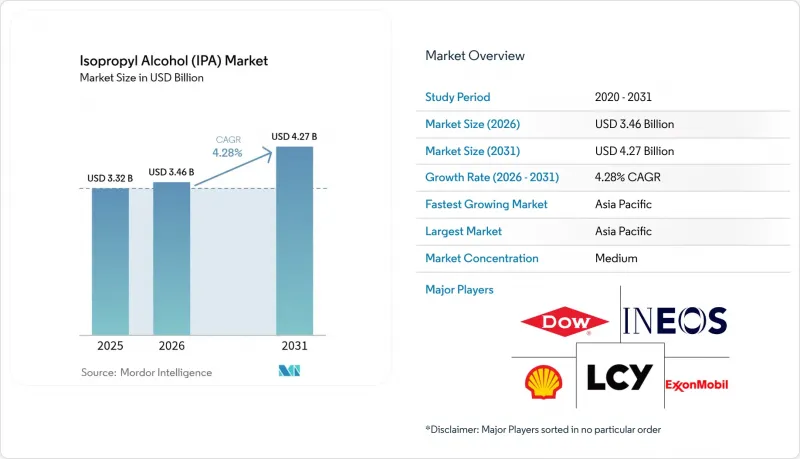
This report is Segmented by Application (Process and Preparation Solvent, Cleaning and Drying Agent, Coating and Dye Solvent, and Other Applications), End-User Industry (Healthcare, Cosmetics and Personal Care, Chemicals, and Other Industries), and Geography (Asia-Pacific, North America, Europe, South America, and Middle East and Africa). The Market Forecasts are Provided in Terms of Value (USD).
Global Isopropyl Alcohol (IPA) Market Trends and Insights
Surging Demand from Pharmaceutical API Production
Pharmaceutical manufacturers rely on IPA for synthesis, purification, and crystallization steps because the solvent mixes readily with water and evaporates rapidly, minimizing contamination risks. Food and Drug Administration (FDA) cGMP (Good Manufacturing Practices) frameworks specify minimum purity and microbial standards that raise switching barriers and lock in long-term offtake contracts. Post-pandemic on-shoring of generic drug manufacturing in India and the United States elevates baseline consumption, while continuous manufacturing lines intensify solvent throughput requirements. Low price elasticity within the pharmaceutical segment shields volumes from short-term price hikes, reinforcing a stable core for the Isopropyl Alcohol market. Forward-looking operators certifying low-carbon or renewable IPA grades position themselves with ESG-focused pharma buyers for preferred-supplier status.
Rising Usage in Healthcare Disinfection Products
IPA-based disinfectants deliver broad-spectrum microbial efficacy at 70% aqueous concentration, achieving rapid kill times against enveloped viruses and bacteria without residue. Hospitals increasingly integrate automated dilution and dispensing systems that require bulk IPA deliveries with tight batch-to-batch consistency. Infection-control guidelines from the Centers for Disease Control and Prevention (CDC) and the World Health Organization continue to reference IPA, anchoring demand in routine cleaning workflows. Demand spikes observed in 2020-2022 have normalized but remain well above pre-pandemic baselines, creating a structurally larger slice of the Isopropyl Alcohol market. Suppliers who document pharmaceutical-grade manufacturing practices enjoy preferred status in tenders covering hand rubs, surface wipes, and instrument reprocessing fluids.
Substitution by Less-flammable Solvents in Consumer Products
New safety protocols in consumer electronics and aerospace maintenance call for non-flammable alternatives to IPA, such as Honeywell's Solstice and 3M's Novec fluids. EU regulations on storage volumes for Class IB flammables restrict inventory at manufacturing sites, nudging formulators toward substitutes. Nonetheless, many low-GWP solvents carry higher costs and lower evaporation rates, preserving IPA's foothold in cost-sensitive segments. Where substitution occurs, it concentrates in enclosed-equipment cleaning systems that recover and recycle solvent vapors, limiting net volume displacement. Still, the perceived hazard profile caps IPA penetration in certain consumer product categories, modestly curbing growth potential in the Isopropyl Alcohol market.
Other drivers and restraints analyzed in the detailed report include:
- Growing Consumption in Personal-care Formulations
- Demand for Electronic-grade IPA in Advanced Lithography
- Volatile Propylene Feedstock Prices
For complete list of drivers and restraints, kindly check the Table Of Contents.
Segment Analysis
Process and Preparation Solvents represented 42.98% of the Isopropyl Alcohol market share in 2025, generating the largest absolute revenue and registering a 4.88% CAGR through 2031. The segment benefits from the solvent's dual polarity, which supports broad solubility profiles during pharmaceutical synthesis and specialty chemical reactions. Chemical engineers value rapid vaporization that eases downstream drying and limits thermal degradation. Cleaning and Drying Agents form the second-largest slice of the Isopropyl Alcohol market. Demand here converges with semiconductor roadmap milestones, where each node shrink tightens contamination thresholds and locks in higher solvent purity tiers. As fabs commercialize gate-all-around architectures, 99.999% IPA volumes scale rapidly, commanding margins triple those of commodity-grade solvent.
Coating and Dye Solvent applications hold smaller but stable demand, anchored in automotive refinish, industrial primers, and architectural emulsions. IPA's compatibility with acrylic and nitrocellulose resins ensures adhesion and consistent film formation. Meanwhile, Chemical Intermediate usage tracks acetone production dynamics, providing a balancing outlet for by-product streams. Novel 3D printing post-processing and extraction technologies expand Other Applications, adding high-growth micro-niches that together lift demand elasticity. Across every use case, suppliers advertising renewable energy inputs differentiate themselves, capturing Environmental, Social, and Governance (ESG)-linked premiums that enhance revenue diversity in the Isopropyl Alcohol market.
Complete Report Scope:
- By Application
- Process and Preparation Solvent
- Cleaning and Drying Agent
- Coating and Dye Solvent
- Chemical Intermediate
- Other Applications
- By End-user Industry
- Healthcare
- Cosmetics and Personal Care
- Electronics
- Paints and Coatings
- Chemicals
- Other Industries
- By Geography
- Asia-Pacific
- China
- India
- Japan
- South Korea
- Malaysia
- Thailand
- Indonesia
- Vietnam
- Rest of Asia-Pacific
- North America
- United States
- Canada
- Mexico
- Europe
- Germany
- United Kingdom
- France
- Italy
- Spain
- Nordic Countries
- Turkey
- Russia
- Rest of Europe
- South America
- Brazil
- Argentina
- Colombia
- Rest of South America
- Middle East and Africa
- Saudi Arabia
- United Arab Emirates
- Qatar
- South Africa
- Nigeria
- Egypt
- Rest of Middle East and Africa
- Asia-Pacific
Geography Analysis
Asia-Pacific dominated the Isopropyl Alcohol market with a 42.10% share in 2025 and is forecast to grow at a 5.22% CAGR through 2031. China's 22.87 million t propylene capacity pipeline underpins feedstock security, while India's USD 142 billion petrochemical program accelerates backward integration into solvents. Regional electronics clusters in South Korea, Taiwan, and mainland China anchor demand for electronic-grade IPA, and local pharmaceutical producers tap domestic supply for API synthesis. Southeast Asian countries, notably Vietnam and Thailand, liberalize healthcare spending and expand personal-care manufacturing, further widening regional demand.
North America ranks as the second-largest region in the Isopropyl Alcohol market, benefiting from robust pharmaceutical output and a resurgent semiconductor build cycle driven by the United States CHIPS Act. ExxonMobil's Baton Rouge debottlenecking project adds badly needed electronic-grade capacity, reducing dependency on Japanese imports. However, propylene price swings, influenced by refinery closures and PDH unit maintenance, inject cost volatility that can ripple into contract renegotiations. Canada's clean-energy incentives stimulate interest in renewable hydrogen projects, potentially leading to the first North American green-route IPA plant before the decade ends.
Europe trails in volume but leads sustainability initiatives. CEPSA's Andalusian plant, powered by solar-sourced green hydrogen, exemplifies the region's push toward carbon-neutral solvents. Stringent REACH regulations and proposed PFAS restrictions encourage ongoing solvent reformulations, but IPA retains favored status in critical healthcare and pharma uses. Emerging adoption of low-carbon procurement clauses in public tenders aligns with renewable IPA offerings, protecting market share despite higher production costs.
South America and the Middle East & Africa collectively account for under 10% of global consumption today but register above-average growth. Brazil's universal healthcare expansion lifts disinfectant demand, while Saudi Arabia's integrated refinery-to-chemicals projects could create the first regional surplus of competitively priced IPA. Sub-Saharan Africa's pharmaceutical localization policies, particularly in Nigeria and Kenya, gradually unlock solvent demand and stimulate smaller scale local production. The global trade matrix therefore becomes more complex as new production hubs emerge, but Asia maintains its primacy in both supply and demand within the Isopropyl Alcohol market.
- Avantor
- Cepsa (Moeve)
- CNPC Jinzhou Petrochemical Company
- Deepak Fertilisers and Petrochemicals Corporation Ltd.
- Dow
- Eneos Corporation
- Exxon Mobil Corporation
- INEOS
- Kailing Chemical (Zhangjiagang) Co., Ltd.
- LCY
- LG Chem
- LyondellBasell Industries Holdings B.V.
- Mitsui Chemicals, Inc.
- Shell plc
- Tokuyama Corporation
Additional Benefits:
- The market estimate (ME) sheet in Excel format
- 3 months of analyst support
TABLE OF CONTENTS
1 Introduction
- 1.1 Study Assumptions and Market Definition
- 1.2 Scope of the Study
2 Research Methodology
3 Executive Summary
4 Market Landscape
- 4.1 Market Overview
- 4.2 Market Drivers
- 4.2.1 Surging Demand from Pharmaceutical API Production
- 4.2.2 Rising Usage in Healthcare Disinfection Products
- 4.2.3 Growing Consumption in Personal-care Formulations
- 4.2.4 Demand for Electronic-grade IPA in Advanced Lithography
- 4.2.5 Cost Advantages from Green-hydrogen Direct Hydration Routes
- 4.3 Market Restraints
- 4.3.1 Volatile Propylene Feedstock Prices
- 4.3.2 Substitution by Less-flammable Solvents in Consumer Products
- 4.3.3 Capital Risk from Electro-chemical IPA Synthesis Technologies
- 4.4 Value Chain Analysis
- 4.5 Porter's Five Forces
- 4.5.1 Bargaining Power of Suppliers
- 4.5.2 Bargaining Power of Buyers
- 4.5.3 Threat of New Entrants
- 4.5.4 Threat of Substitutes
- 4.5.5 Degree of Competition
5 Market Size and Growth Forecasts (Value and Volume)
- 5.1 By Application
- 5.1.1 Process and Preparation Solvent
- 5.1.2 Cleaning and Drying Agent
- 5.1.3 Coating and Dye Solvent
- 5.1.4 Chemical Intermediate
- 5.1.5 Other Applications
- 5.2 By End-user Industry
- 5.2.1 Healthcare
- 5.2.2 Cosmetics and Personal Care
- 5.2.3 Electronics
- 5.2.4 Paints and Coatings
- 5.2.5 Chemicals
- 5.2.6 Other Industries
- 5.3 By Geography
- 5.3.1 Asia-Pacific
- 5.3.1.1 China
- 5.3.1.2 India
- 5.3.1.3 Japan
- 5.3.1.4 South Korea
- 5.3.1.5 Malaysia
- 5.3.1.6 Thailand
- 5.3.1.7 Indonesia
- 5.3.1.8 Vietnam
- 5.3.1.9 Rest of Asia-Pacific
- 5.3.2 North America
- 5.3.2.1 United States
- 5.3.2.2 Canada
- 5.3.2.3 Mexico
- 5.3.3 Europe
- 5.3.3.1 Germany
- 5.3.3.2 United Kingdom
- 5.3.3.3 France
- 5.3.3.4 Italy
- 5.3.3.5 Spain
- 5.3.3.6 Nordic Countries
- 5.3.3.7 Turkey
- 5.3.3.8 Russia
- 5.3.3.9 Rest of Europe
- 5.3.4 South America
- 5.3.4.1 Brazil
- 5.3.4.2 Argentina
- 5.3.4.3 Colombia
- 5.3.4.4 Rest of South America
- 5.3.5 Middle East and Africa
- 5.3.5.1 Saudi Arabia
- 5.3.5.2 United Arab Emirates
- 5.3.5.3 Qatar
- 5.3.5.4 South Africa
- 5.3.5.5 Nigeria
- 5.3.5.6 Egypt
- 5.3.5.7 Rest of Middle East and Africa
- 5.3.1 Asia-Pacific
6 Competitive Landscape
- 6.1 Market Concentration
- 6.2 Strategic Moves
- 6.3 Market Share (%)/Ranking Analysis
- 6.4 Company Profiles (includes Global level Overview, Market level overview, Core Segments, Financials as available, Strategic Information, Market Rank/Share for key companies, Products and Services, and Recent Developments)
- 6.4.1 Avantor
- 6.4.2 Cepsa (Moeve)
- 6.4.3 CNPC Jinzhou Petrochemical Company
- 6.4.4 Deepak Fertilisers and Petrochemicals Corporation Ltd.
- 6.4.5 Dow
- 6.4.6 Eneos Corporation
- 6.4.7 Exxon Mobil Corporation
- 6.4.8 INEOS
- 6.4.9 Kailing Chemical (Zhangjiagang) Co., Ltd.
- 6.4.10 LCY
- 6.4.11 LG Chem
- 6.4.12 LyondellBasell Industries Holdings B.V.
- 6.4.13 Mitsui Chemicals, Inc.
- 6.4.14 Shell plc
- 6.4.15 Tokuyama Corporation
7 Market Opportunities and Future Outlook
- 7.1 White-space and Unmet-need Assessment

